
Executive Summary
Finance AI is moving into the oldest corner of finance: the controls behind reconciliations, approvals, and audit trails. Procedures that once ran on habit and signatures now run on pattern recognition, with anomalies flagged in real time.
This article examines where AI strengthens controls, how auditability survives, which new risks emerge, and how finance teams must adapt. The central argument is simple: finance AI does not remove vigilance, it redefines who exercises it.
Why Finance AI Changes the Nature of Financial Controls
Financial controls have never been glamorous, yet they mark the boundary between transparency and temptation. For decades, they were procedural, designed through logic and enforced through routine. Manual reviews and approval chains produced defensible results, though rarely fast ones. Finance AI moves that model from procedure to prediction, and from periodic checks to continuous monitoring.
The shift raises leadership questions more than technical ones. If a model spots expense anomalies faster than an auditor, does oversight grow stronger or weaker? A classifier may reach 99.9% accuracy, and teams may still hesitate to trust it. That hesitation is healthy, because AI changes the relationship between the controller and the controlled. Mastery means blending algorithmic precision with human judgment about which anomalies matter.
Where AI-Powered Financial Controls Deliver Value Today
Transaction Monitoring and Expense Oversight
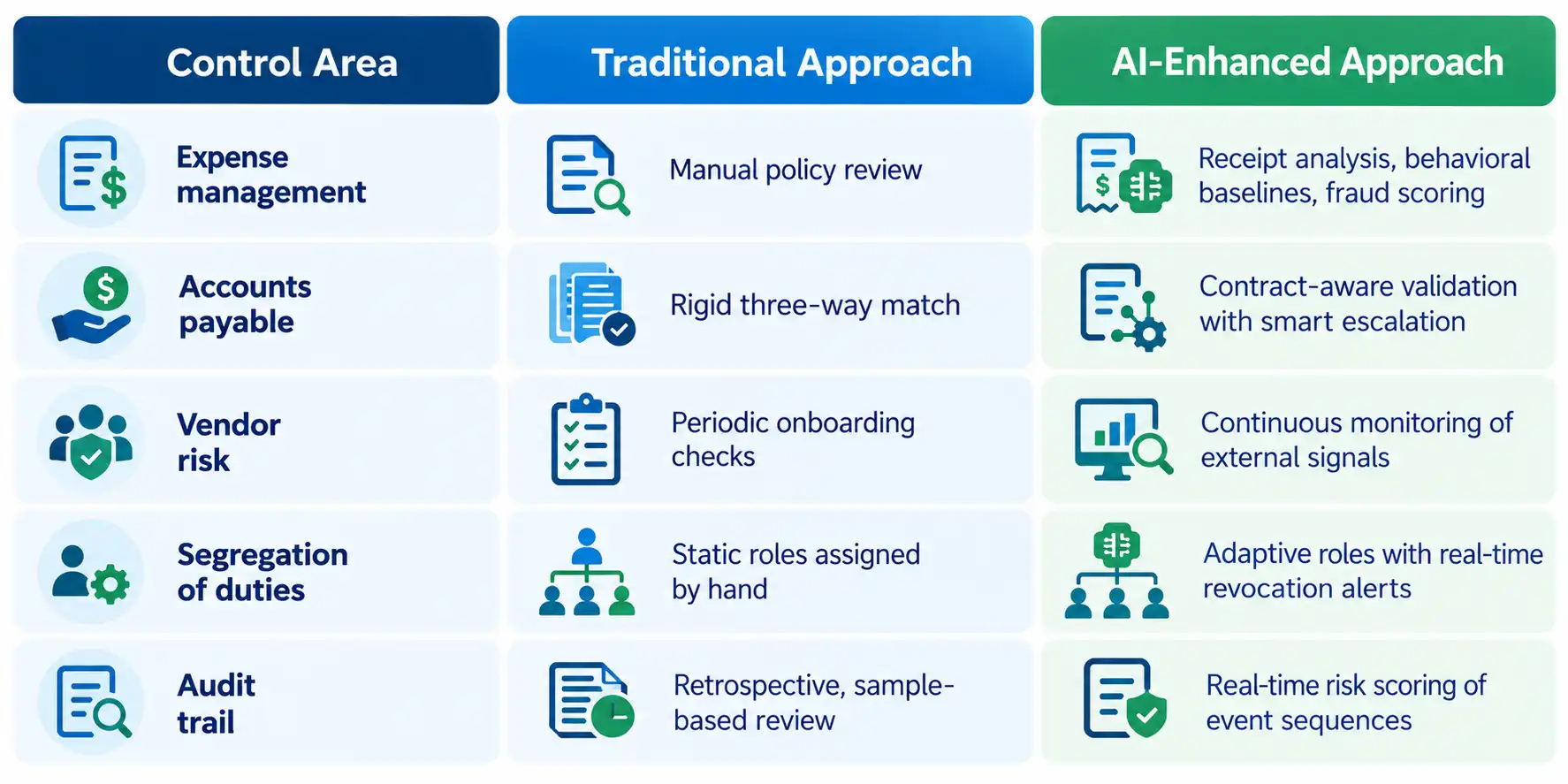
In expense management, language models read receipts, check policy, and estimate fraud probability. A 2 a.m. dinner in a city the employee never visited gets flagged for review. The deeper value lies in behavioral baselines built for each user, cost center, and vendor. Deviations from those baselines become signals, not just rule exceptions.
Procurement, Payables, and Vendor Risk
Intelligent AP systems check each invoice against contract terms, payment history, and delivery schedules. Replacing a manual three-way match can cut false positives by as much as 90%. Yet that efficiency can also remove useful friction that once surfaced operational nuance. In vendor management, AI for financial analysis reads outside signals such as lawsuits, adverse news, and supply chain stress.
Dynamic Segregation of Duties and the Living Audit Trail
The real frontier is dynamic control logic, where AI suggests the rule instead of only enforcing it. An AI-enhanced system watches access behavior and recommends revoking permissions that drift from a user’s role. Audit trails are evolving too, as models score event sequences and point SOX testing toward areas a sample would miss.
Traditional Versus AI-Enhanced Controls
Explainable AI and the Auditability Dilemma in Finance AI
Trust in finance has always rested on explanation. A CFO must be able to explain why the system denied an expense and under which policy. When a model flags a payment without stating its reasoning, the CFO ends up defending a black box. Regulators will not accept “the model said so” for a missed disclosure. Auditors will not attest to controls that evolve but cannot explain themselves.
That standard does not relax because a machine produced the number. Every figure sent to an audit committee needs a traceable lineage, whatever its source.
Choosing Intelligible Models Over Inscrutable Ones
Deep neural networks often trade clarity for predictive power, which fails where every control needs an audit trail. The real choice lies between intelligible and inscrutable finance AI, not between AI and no AI. An auditor can follow a supervised model that ranks transactions by risk, but not a generative model inventing journal patterns. Even the top AI financial software deserves evaluation on accountability, not only on accuracy. Sound model governance for finance AI should include these elements:
- Model validation before deployment and after major business changes
- Bias testing across training data and live outputs
- Drift detection tied to clear, documented retraining triggers
- Reproducibility, so a flagged payment behaves the same way under the same conditions
A quieter danger is the erosion of human intuition. When a system becomes fast and opaque, people stop questioning it, and the advisor turns into an oracle. Finance leaders must engineer trust in finance AI rather than assume it, and the CFO serves as its chief engineer.
Designing an AI Financial Controls Architecture That Learns
Where traditional design relied on walls and gates, an AI-enabled environment behaves like a nervous system that senses, learns, and reacts. Five design principles keep that system coherent as it adapts.
Five Design Principles for AI-Enabled Controls
| Principle | What It Means | Practical Example |
| Contextual intelligence | Learns business nuance within policy limits | A payment unusual in one region but routine in another |
| Modularity | AI built as discrete, testable services | An invoice classifier retrained without touching the ERP |
| Feedback loops | Human resolutions train the model | A controller override recorded with its rationale |
| Observability | Models monitored as closely as the ledger | Dashboards tracking accuracy and drift |
| Human override | Visible, documented authority to overrule | A CFO override logged with reason and trail |
Each of these principles depends on clean, consistent data. One ERP and a single definition of revenue across every entity give models a reliable starting point. A common foundation of that kind is what any finance AI model needs before it can learn.
The Human-in-the-Loop Control Cycle
| Step | Actor | Action |
| 1 | AI model | Flags a transaction and states its reasons |
| 2 | Controller | Reviews the flag, then approves, explains, or overrides |
| 3 | System | Records the decision and the rationale |
| 4 | AI model | Retrains on the resolution |
| 5 | CFO | Reviews override patterns to find blind spots |
The New Risks Inside AI-Powered Financial Controls
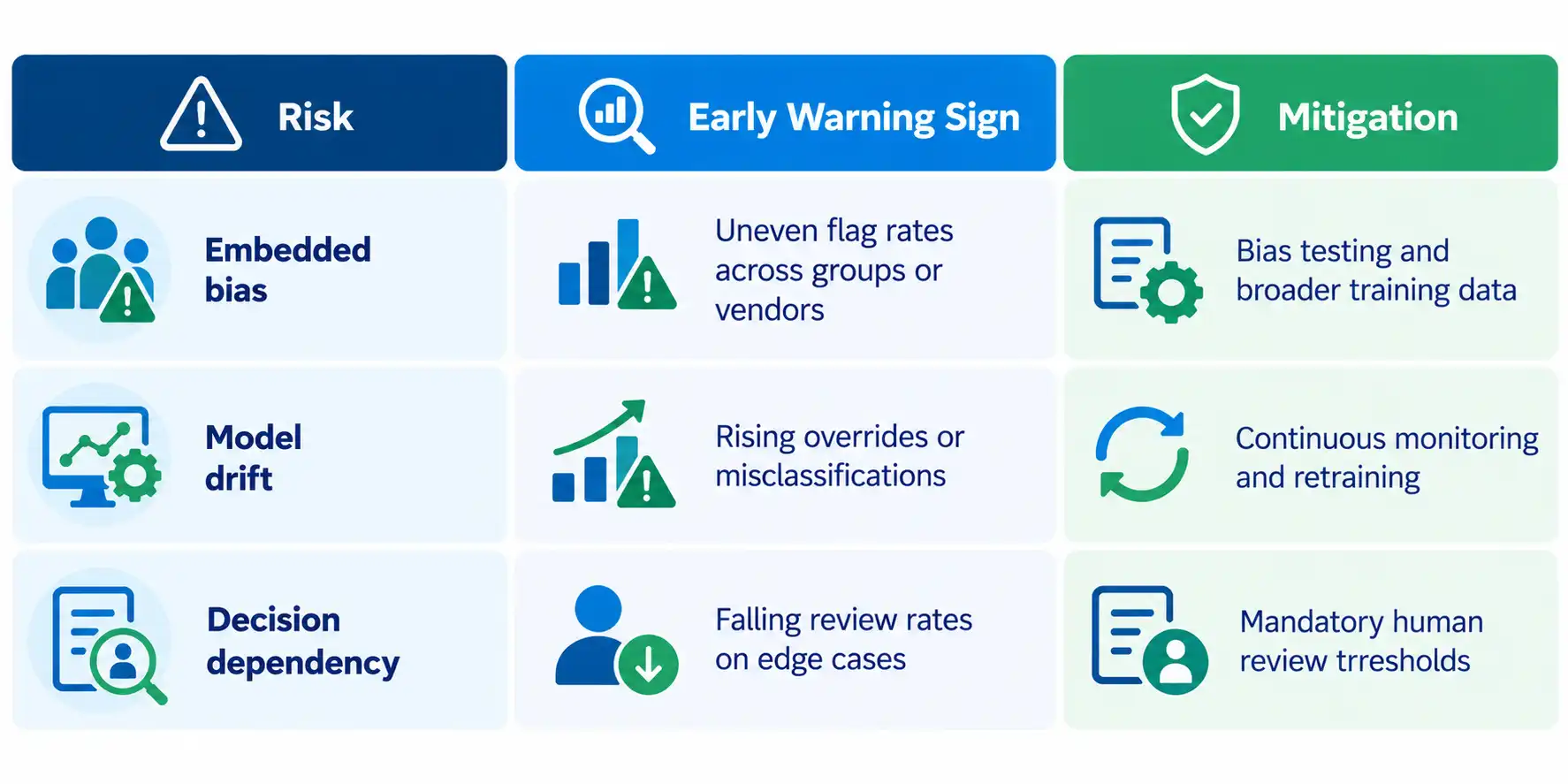
AI does not eliminate risk in financial controls; it moves risk from the spreadsheet into the model. The most dangerous risks speak the language of intelligence while eroding the foundations they protect. Three of them deserve close attention from finance leaders:
- Embedded bias: an expense model may learn that one group files fewer claims and then scrutinize it less.
- Model drift: as products and markets change, an accurate model can misclassify with full confidence.
- Decision dependency: controllers stop reviewing edge cases because the model “usually gets it right.”
More capable systems demand more vigilance, not less. In regulated industries such as medical devices, cost and inventory controls must withstand line-by-line audit scrutiny. Any model touching those numbers needs documented training data, assumptions, and test results.
Model Governance, Control Layering, and Exception Management
Mitigation starts with model governance: a record of each control’s training and a protocol for continuous retraining. Control layering must let machines and humans cross-validate each other. Exceptions deserve study, because each override shows where the model’s map no longer fits the territory.
Leading Finance Teams in the Age of Finance AI
Finance work was built on certainty, yet AI speaks in probabilities and suggestions. The strongest finance leaders in this setting are not the most technical but the most curious. A controller now has to think like a forensic analyst and a data translator at once. A shift in vendor payment cadence could signal risk, a negotiation tactic, or supplier distress, and only a person can judge which.
Building Fluency Across the Finance Team
AI-first workflows across modeling, reporting, and diligence can compress the time from question to decision. Judgment about which answers matter still belongs with people. That balance offers a template for teams adopting finance AI:
- Train staff to interpret model outputs, not just process them
- Shift the culture from “follow the process” to “understand the system”
- Treat junior accountants as insight miners and stewards of edge cases
Control in this era becomes less about prevention and more about collaboration between pattern and meaning. The most powerful control remains the human who chooses to care about the outcome.
Three Key Takeaways
- Finance AI redefines vigilance instead of replacing it, so pair algorithmic detection with human judgment about which anomalies matter.
- Require explainability, reproducibility, and documented governance from every AI-driven control. Auditors, regulators, and boards will hold the CFO accountable for decisions a model makes.
- Build feedback loops, observability, and visible human override into the control architecture. Then train the finance team to interpret and question models, not simply obey them.
Disclaimer: This article is intended for informational purposes only and does not constitute legal, tax, or accounting advice. You should consult your own tax advisor or counsel for advice tailored to your specific situation.
Hindol Datta is a four-time CFO and senior finance executive with over 25 years of leadership experience across cybersecurity, SaaS, gaming, logistics, digital marketing, medical devices, consumer products, and nonprofit organizations. He has led more than $120M in fundraising and over $150M in M&A transactions while building the financial and operational systems that let complex businesses scale with confidence. He is the author of seven books in the Systems CFO Series and holds active CPA, CMA, and CIA credentials.
AI-assisted insights, supplemented by 25 years of finance leadership experience.



