Executive Summary
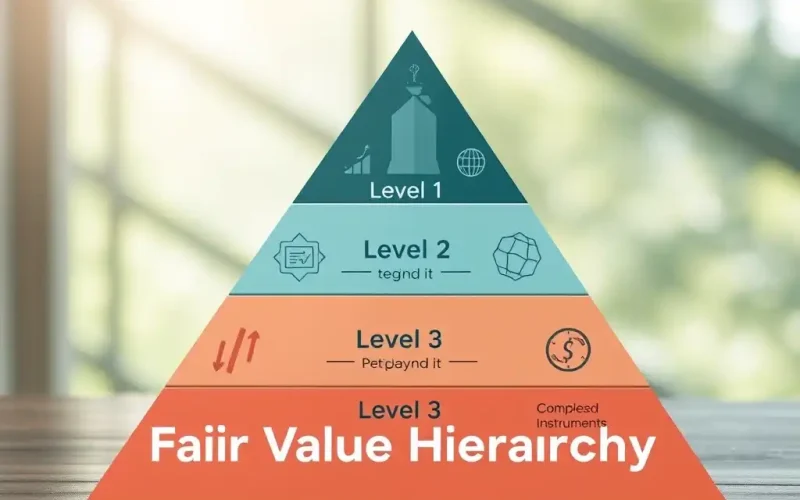
The fair value hierarchy levels defined under ASC 820 sound like an accounting technicality. Then a Level 3 instrument swings the income statement by several million dollars in a single quarter. The board wants to know whether the business is actually losing money. I have sat through that conversation more than once. The companies have ranged from pre-Series A platforms to a publicly listed operator. Over time, I have come to think of the hierarchy differently. It is less a classification scheme. It is more a discipline for knowing how solid the ground is beneath every number a company reports. Level 1 is bedrock. Beneath it, Level 2 is dense, packed soil that still holds weight if you test it. Level 3 sits lowest of all. It is a structure that assumptions hold together. It stands only when someone inspects the foundation regularly.
This article walks through what each level of the fair value hierarchy means. It applies to a growth-stage or newly public company. Why does the classification carry operational consequences well beyond the audit file? The answer lies in governance. A finance organization needs the governance to defend a Level 3 valuation. That governance matters when an auditor, a board member, or an investor raises a question. The question is how anyone knows this number is right.
What the Fair Value Hierarchy Levels Actually Measure
ASC 820 defines fair value as an exit price. That is the amount a company would receive to sell an asset or pay to transfer a liability. The transaction is orderly, between market participants, at the measurement date. The standard does not care how the asset was acquired or how the liability came to exist. It asks a single, somewhat theoretical question: what would a hypothetical, willing counterparty pay today. The Financial Accounting Standards Board needed a consistent answer across thousands of reporting entities. So it built a three-level hierarchy. It ranks valuation inputs by how observable, and therefore how defensible, they are. The three-level architecture appears in PwC’s fair value hierarchy guidance, and it echoes in every Big Four accounting manual. It is the same architecture every CFO eventually has to translate into a boardroom explanation.
Level 1: Quoted Prices and the Luxury of Clarity
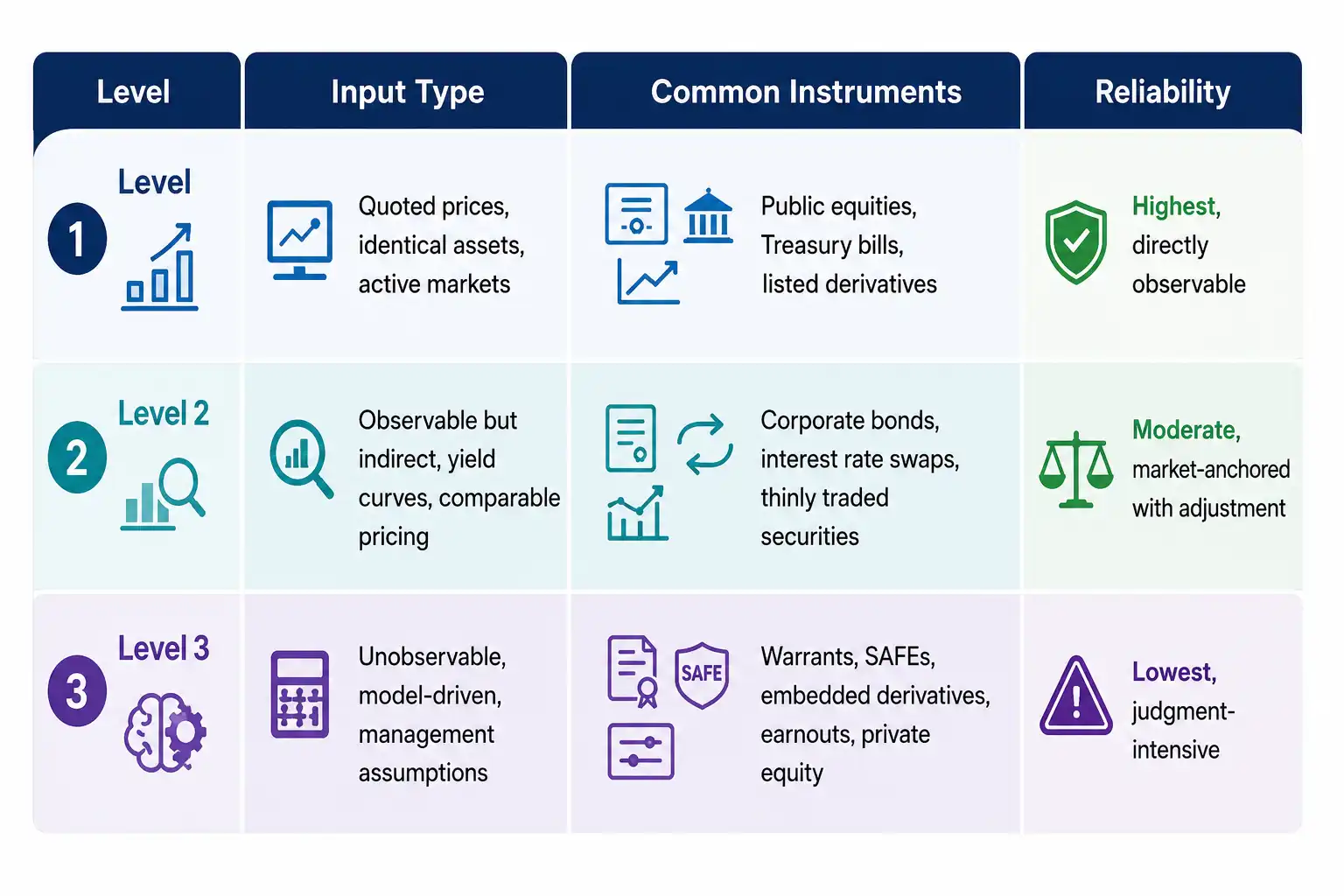
Level 1 inputs are quoted prices in active markets for identical assets or liabilities. Publicly traded equities, Treasury bills, and exchange-listed derivatives fall here. If a Bloomberg terminal or a brokerage app can show the price, the instrument sits at Level 1. The audit trail is about as clean as financial reporting gets. Early-stage and even mid-growth companies rarely hold much at this level. That is precisely why it deserves attention when it shows up. It is a gift, not a line item to rush past.
Level 2: Observable Inputs and the Realm of Judgment
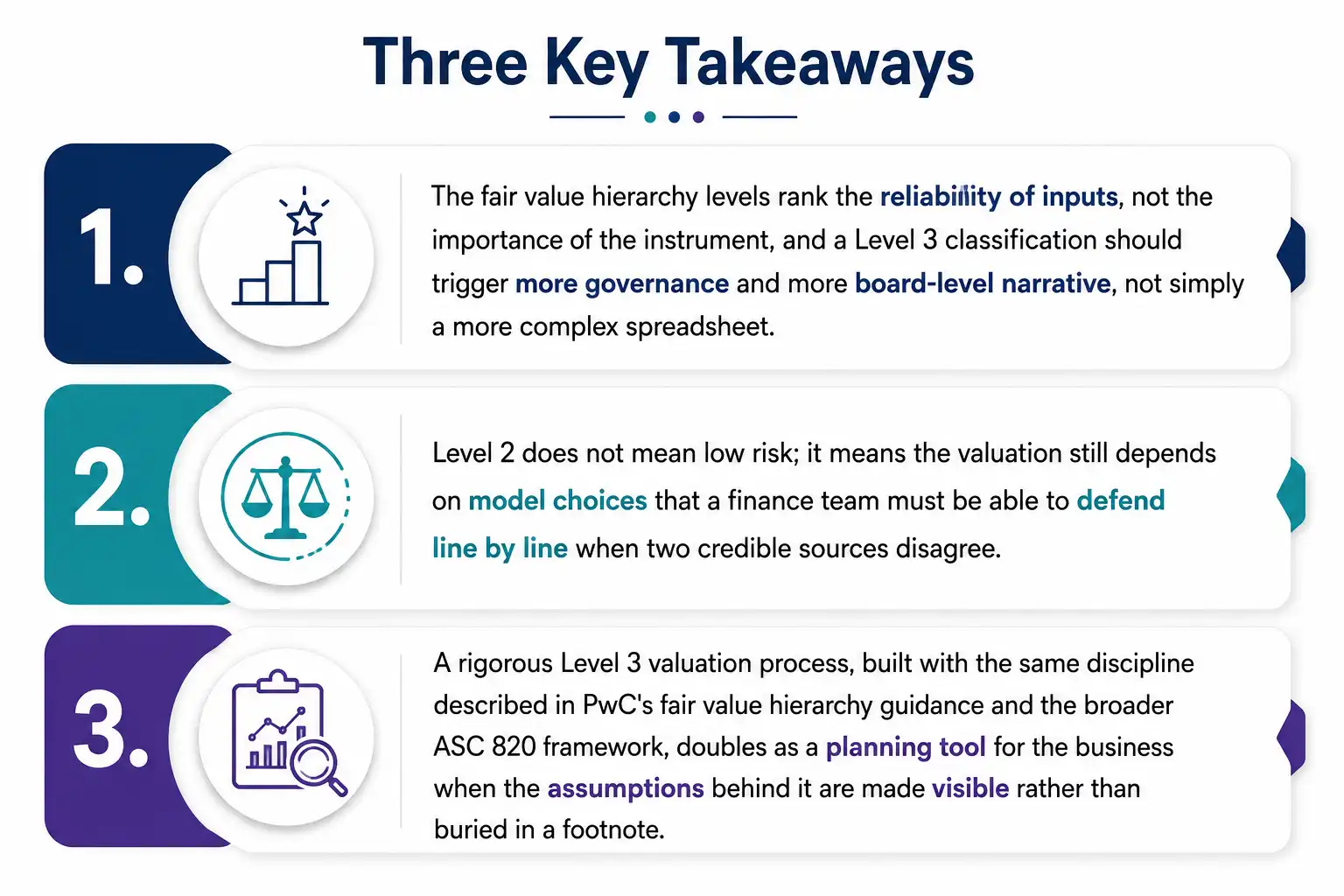
Level 2 inputs are still anchored in market activity, but indirectly. Corporate bonds, interest rate swaps, and thinly traded securities typically live here, valued using yield curves, implied volatilities, or prices for similar instruments rather than a direct quote. Third-party pricing services are common at this level, and in theory they deliver consistency. In practice, their underlying models require the same scrutiny a company would apply to any internal estimate, because Level 2 does not mean low risk. It means observable, but still dependent on modeling choices that someone has to be able to defend.
Level 3: Unobservable Inputs and the Weight of Discretion
Level 3 inputs are unobservable, built from internal models, management assumptions, and estimates rather than market data. Private equity stakes, illiquid warrants, complex embedded derivatives, and earnout or contingent consideration arrangements almost always land here. There is no clean market price to reference, so the company constructs one, using discounted cash flow models, Black-Scholes or Monte Carlo simulations, and probability-weighted scenarios. These are the fair value hierarchy levels where the classification itself becomes a source of financial reporting risk, and where the finance function earns its keep or exposes its gaps.
Why the Classification Changes How a CFO Runs the Business
The hierarchy might read as an academic exercise, but its consequences are operational. Instruments issued in the ordinary course of raising capital, including warrants, SAFEs, and convertible notes with embedded derivatives, often require remeasurement at fair value every reporting period. That remeasurement flows through the balance sheet and, frequently through non-cash gains or losses, through the income statement as well, in a way that can distort the picture a board or an investor is reading.
I have watched a performance-linked warrant issued to a strategic partner move through exactly this cycle at a high-growth cybersecurity and identity access management company. The warrant had no public analog, was contingent on operational milestones, and fell into Level 3 without much debate. The valuation required a Monte Carlo simulation built around volatility assumptions, exit timing, and milestone probability, and the resulting liability moved meaningfully across two quarters, not because the underlying business had changed, but because the volatility inputs shifted and the expected exit horizon compressed. The board’s question was not about the mechanics of the model. It was about whether the company was genuinely losing money or simply revaluing a future dilution event, and the honest answer was that both were true, in different senses, and the job of the finance team was to make that distinction legible rather than to hide behind the calculation.
Where the PwC Hierarchy Framework Meets Real Practitioner Judgment
Level 2 valuations occupy the space between confidence and interpretation, and the gap can widen faster than most finance teams expect. In an interim finance leadership role at a marketplace SaaS platform raising a Series B round, I relied on third-party pricing inputs for instruments that were technically Level 2 but that still demanded a documented rationale for every methodology choice, because auditors do not accept ease of integration as an answer when two pricing services produce materially different values for the same instrument. That episode reinforced a lesson worth repeating: the fair value hierarchy levels tell you how much market data exists, not how much diligence the number deserves.
Level 3 instruments carry three distinct risks worth naming plainly. Model inputs such as volatility, exit timing, or revenue growth projections can be highly sensitive, so a small assumption change can produce a disproportionate revaluation. External valuation firms, who frequently build these models, may not fully understand the operational nuance behind the assumptions they are given. The results can materially affect the financial statements, particularly when remeasurement recurs every reporting period rather than at a single point in time.
The opportunity sits alongside the risk. A rigorous, transparent Level 3 process builds trust with auditors and investors, and it can double as a planning tool for the business itself. In a mission-driven education and research institution where I served as chief financial officer, the same modeling discipline used to satisfy audit and board reporting requirements also shaped how leadership evaluated funding scenarios under variable philanthropic and earned-revenue conditions, which meant the valuation exercise stopped being a compliance obligation and became part of how the organization planned its future.
Disclosure, Governance, and Audit Readiness
ASC 820 requires disclosure of the hierarchy level assigned, the valuation technique applied, and any significant unobservable inputs used. For Level 3 instruments specifically, a reconciliation of opening and closing balances is required, along with a narrative explanation of what changed and why. None of that disclosure means much without governance behind it. Who approves the assumptions before they enter a model. How frequently are those models refreshed. Are changes to a discount rate or a volatility assumption documented at the time they are made, or reconstructed after the fact when an auditor asks.
At a $127M global consumer products company where I served as CFO, delivering four consecutive clean external audits depended less on any single valuation technique and more on a governance rhythm that made every assumption traceable back to a decision someone could stand behind. Growth-stage companies frequently underinvest in that governance layer, leaning on an external valuation firm without building the internal oversight to match. That is a structural risk, because the external valuation is an input to the company’s judgment, not a substitute for it. Management retains the responsibility for every assumption that enters the model, regardless of who built the spreadsheet.
Building a Defensible Fair Value Process
A CFO does not need to master every valuation technique personally, but the process around Level 3 instruments in particular benefits from a short, enforced discipline:
- Inventory every instrument subject to fair value measurement and confirm its hierarchy level at each reporting date, since classification can shift as markets or instrument terms change.
- Document the valuation methodology and the source of every significant input before the reporting deadline arrives, not during the audit.
- Require a documented rationale whenever two pricing services or two models diverge, rather than defaulting to the more convenient source.
- Refresh Level 3 assumptions on a fixed cadence and record who approved each change and why.
- Translate the valuation narrative for the board in plain terms, distinguishing operational performance from non-cash remeasurement so the two are never mistaken for one another.
Disclaimer: This article is intended for informational purposes only and does not constitute legal, tax, or accounting advice. You should consult your own tax advisor or counsel for advice tailored to your specific situation.
Hindol Datta is a four-time CFO and senior finance executive with over 25 years of leadership experience across cybersecurity, SaaS, gaming, logistics, digital marketing, medical devices, consumer products, and nonprofit organizations. He has led more than $120M in fundraising and over $150M in M&A transactions while building the financial and operational systems that let complex businesses scale with confidence. He is the author of seven books in the Systems CFO Series and holds active CPA, CMA, and CIA credentials.
AI-assisted insights, supplemented by 25 years of finance leadership experience.