
Executive Summary
ESG compliance has moved from a reporting exercise to a core test of capital expenditure. A factory, fleet, or data center locks in emissions, labor practices, and regulatory exposure for decades. Once built, these assets cannot pivot quarter to quarter. Every capital decision therefore becomes a bet on what regulators, investors, and communities will accept in the future.
The sections ahead explain how CFOs can build ESG capital allocation into the full life of a project. They cover ESG criteria in project selection, the data systems that support credible disclosure, and board governance of capital approvals. They also address green financing instruments and the way capital decisions shape culture. Together they show that ESG-aligned investment reflects sound risk management, not charity.
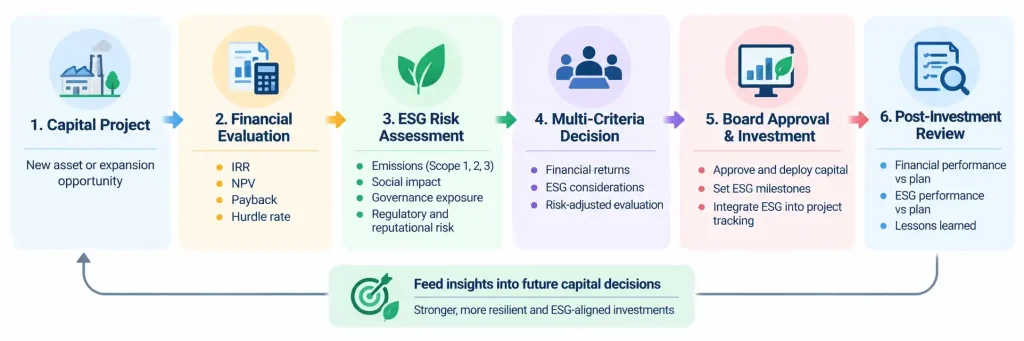
Building ESG Compliance Into Project Selection
Traditional capital approval relies on IRR, NPV, payback, and the hurdle rate. Those measures remain essential, yet they often leave out environmental, social, and governance risks that surface years later. Capital expenditure, with its long life and fixed form, is where mispricing those risks costs the most.
Pricing ESG Risk Into the Model
Every capital project carries an emissions profile that follows the balance sheet for decades. CFOs can apply an internal carbon price to Scope 1, Scope 2, and, where feasible, Scope 3 emissions. They can then discount those costs like any other future outflow. Projects that once cleared the hurdle rate with room to spare may fall short once these costs appear.
Social and governance factors are harder to quantify but no less real. A distribution center that strains local labor relations may face permit resistance or brand damage within a few years. Materials sourced through opaque supply chains can create legal and reputational exposure. Finance should treat these risks as contingent liabilities in the model.
Traditional Versus ESG-Adjusted Capital Evaluation
| Dimension | Traditional Evaluation | ESG-Adjusted Evaluation |
| Core metric | IRR and NPV against a hurdle rate | Risk-adjusted returns within ESG constraints |
| Emissions | Excluded or noted separately | Priced through internal carbon costs |
| Social impact | Rarely modeled | Treated as contingent liability and scored |
| Approval model | Pass or fail on financial metrics | Multi-criteria scoring weighted by sector and region |
| Post-investment review | Cost and schedule variance | Financial and ESG performance against plan |
Three shifts make ESG capital allocation practical for most companies. Finance moves from maximizing IRR alone to optimizing within real-world constraints. Approval moves from binary decisions to multi-criteria scoring. Feedback loops then compare the actual ESG performance of past projects with their original assumptions, improving future models.
Data and Disclosure for ESG Capital Allocation
Declaring a building sustainable is marketing; measuring its energy, water, and emissions every quarter is accountability. Once a company deploys capital, the environmental and social effects begin immediately. Credible ESG compliance therefore depends on instrumentation built in from the start.
Instrumentation, Traceability, and Taxonomy
The data foundation for ESG-linked capital spending usually includes several elements:
- Real-time or near-real-time metering of energy use, emissions, and resource consumption
- Traceability of key inputs, including where materials originate and under what labor conditions
- A consistent taxonomy, drawn from recognized frameworks such as the ISSB standards or internal definitions
- ESG fields inside ERP and project tracking systems, alongside cost codes and milestones
Data must flow inside finance systems, not beside them. When capital project tools track ESG milestones such as clean energy installations or emissions thresholds, leaders can act on that information in real time. Finance teams must learn sustainability metrics, and sustainability teams must learn discounted cash flow.
Transparency completes the picture for investors and regulators. ESG data will not always flatter the company, and some targets will slip. A disclosed shortfall paired with a credible remediation plan, however, builds more trust than silence. This matters financially, because many sustainability-linked financing structures tie interest rates directly to reported ESG performance.
A $127M global consumer products company illustrates how widely these choices reach. Finance there owned a logistics P&L spanning ocean freight, trucking, last-mile delivery, and warehousing. Each of those operations involves assets and contracts with distinct cost and resource profiles. Bringing them under one P&L gave leadership a single view of trade-offs across the network.
Board Governance of ESG Compliance in Capital Projects
Approving a capital project commits the company to infrastructure that will outlast current leadership. Integrating ESG into that approval is part of the fiduciary duty to assess long-term risk. Done well, it extends financial discipline instead of diluting it.
From Briefing to Fluency
Boards need active engagement with ESG materiality, not occasional briefings. Once directors understand the relevant risks for their sector, governance can set clear thresholds. A project that exceeds a defined emissions profile or relies on contentious sourcing can trigger escalation to a risk or sustainability committee.
Some companies apply ESG-adjusted hurdle rates to capital requests. These may require a higher return for carbon-intensive investments or model future carbon prices in cash flows. Others vary the cost of capital by expected regulatory exposure. Post-investment reviews then test whether a project delivered its promised emissions reductions or local hiring goals. They work much like the cost and schedule audits that test financial results.
Friction is likely during the early stages of adoption. Some sponsors will resist added oversight and argue that ESG review slows decisions. In a world of climate volatility and regulatory change, however, ignoring these risks is not speed; it is exposure. The CFO acts as translator between project sponsors, boards, and capital markets.
A mission-driven education and research institution in Silicon Valley offers a relevant governance example. Finance leadership there reported to a board and audit committee while overseeing Finance, HR, IT, Legal, and Facilities. Facility decisions in that setting had to balance cost, mission, and stakeholder expectations under formal oversight.
Financing ESG-Aligned Capital Expenditure
Capital markets increasingly attach ESG conditions to funding. Green and sustainability-linked instruments reward companies whose investments match stated ESG goals. For the CFO, these instruments can lower capital costs and broaden the investor base when used with discipline.
Green Bonds and Sustainability-Linked Loans
The two most common instruments work differently, and each suits different capital plans.
Green Bonds Versus Sustainability-Linked Loans
| Feature | Green Bond | Sustainability-Linked Loan |
| Use of proceeds | Limited to eligible environmental projects | General corporate purposes |
| Link to ESG | Tied to the funded assets | Tied to company-wide performance targets |
| Pricing effect | Market demand may support favorable pricing | Rate adjusts when targets are met or missed |
| Verification | External review against frameworks such as the Green Bond Principles | Independent verification of target performance |
| Best fit | Discrete projects such as renewable energy or efficient facilities | Broad transition plans across the business |
Both instruments demand reliable and auditable internal data. To participate credibly, a company must measure and forecast ESG outcomes with the same confidence it brings to cash flow. Markets are also growing less tolerant of greenwashing, so overstated claims now carry legal, reputational, and pricing costs.
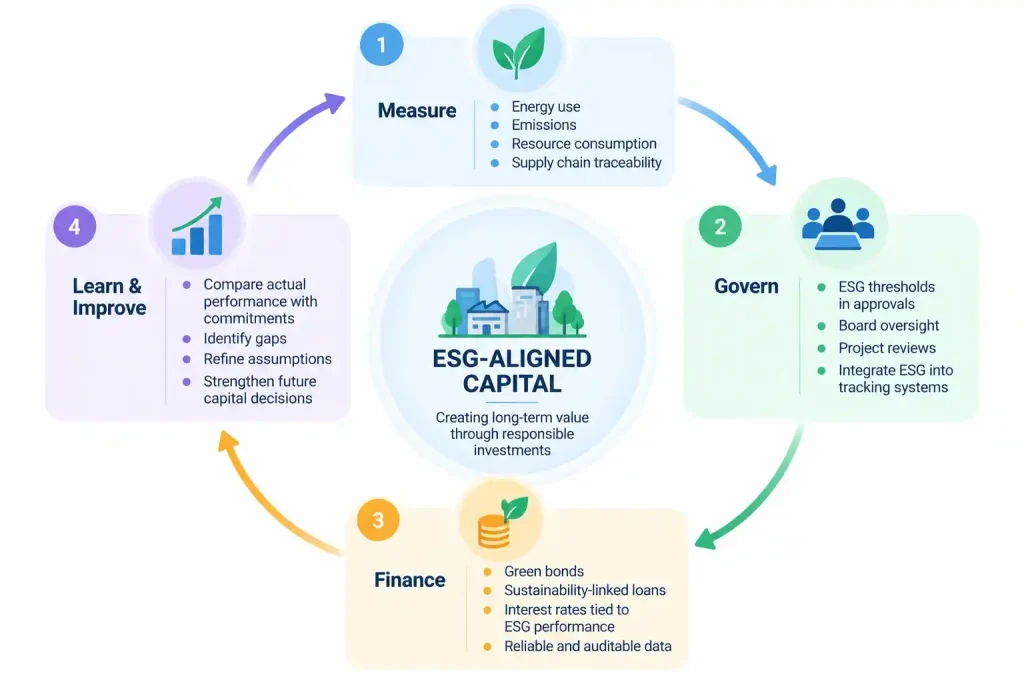
Lender trust builds on consistent reporting regardless of instrument type. The same $127M consumer products company secured $12M in growth financing while maintaining strong banking and lender relationships. Clear, credible financial reporting is the base on which any conditional financing rests.
How ESG Capital Allocation Shapes Culture
Capital decisions teach an organization what it truly values. A company can hold many sustainability workshops, yet one decision to retrofit a plant for water recycling sends a stronger message. Capital expenditure is slow and durable, which makes it a powerful cultural anchor.
From Rhetoric to Reflex
The capital request process is one of the few moments when engineering, operations, HR, procurement, and finance design something together. When ESG criteria sit inside that process, they become a shared language. Procurement screens vendors on labor practices, engineers weigh lifecycle emissions, and regional managers treat local hiring as part of the return.
Not every capital project will achieve perfect ESG results. Trade-offs will remain, and some targets will slip. Yet when leaders ask the right questions consistently, even imperfect projects become lessons that move the company forward. ESG compliance then stops being an overlay and becomes part of how the company decides what to build.
Three Key Takeaways
- ESG compliance in capital expenditure starts with pricing emissions and social risks into project models and moving to multi-criteria approval.
- Effective ESG capital allocation depends on integrated data, clear board thresholds, and post-investment reviews that test results against promises.
- Green bonds and sustainability-linked loans reward credible ESG performance, while consistent capital decisions turn ESG commitments into company culture.
Disclaimer: This article is intended for informational purposes only and does not constitute legal, tax, or accounting advice. You should consult your own tax advisor or counsel for advice tailored to your specific situation.
Hindol Datta is a four-time CFO and senior finance executive with over 25 years of leadership experience across cybersecurity, SaaS, gaming, logistics, digital marketing, medical devices, consumer products, and nonprofit organizations. He has led more than $120M in fundraising and over $150M in M&A transactions while building the financial and operational systems that let complex businesses scale with confidence. He is the author of seven books in the Systems CFO Series and holds active CPA, CMA, and CIA credentials.
AI-assisted insights, supplemented by 25 years of finance leadership experience.



