
Executive Summary
A company owning between 20 and 50 percent of another entity often can shape its direction without controlling it. Equity method accounting becomes the bridge between a passive investment and full consolidation in this case. Governed by ASC 323, this method records the investor’s pro rata share of an investee’s earnings. It gives a proportional view of economic participation, not a claim of operational control.
For finance leaders weighing joint ventures, supplier partnerships, or minority stakes, equity accounting is not a footnote in the financials. It shapes how EBITDA reads and how a board interprets ownership. It also determines how a growth story holds up once diligence or an audit begins asking harder questions.
What Equity Method Accounting Means Under ASC 323
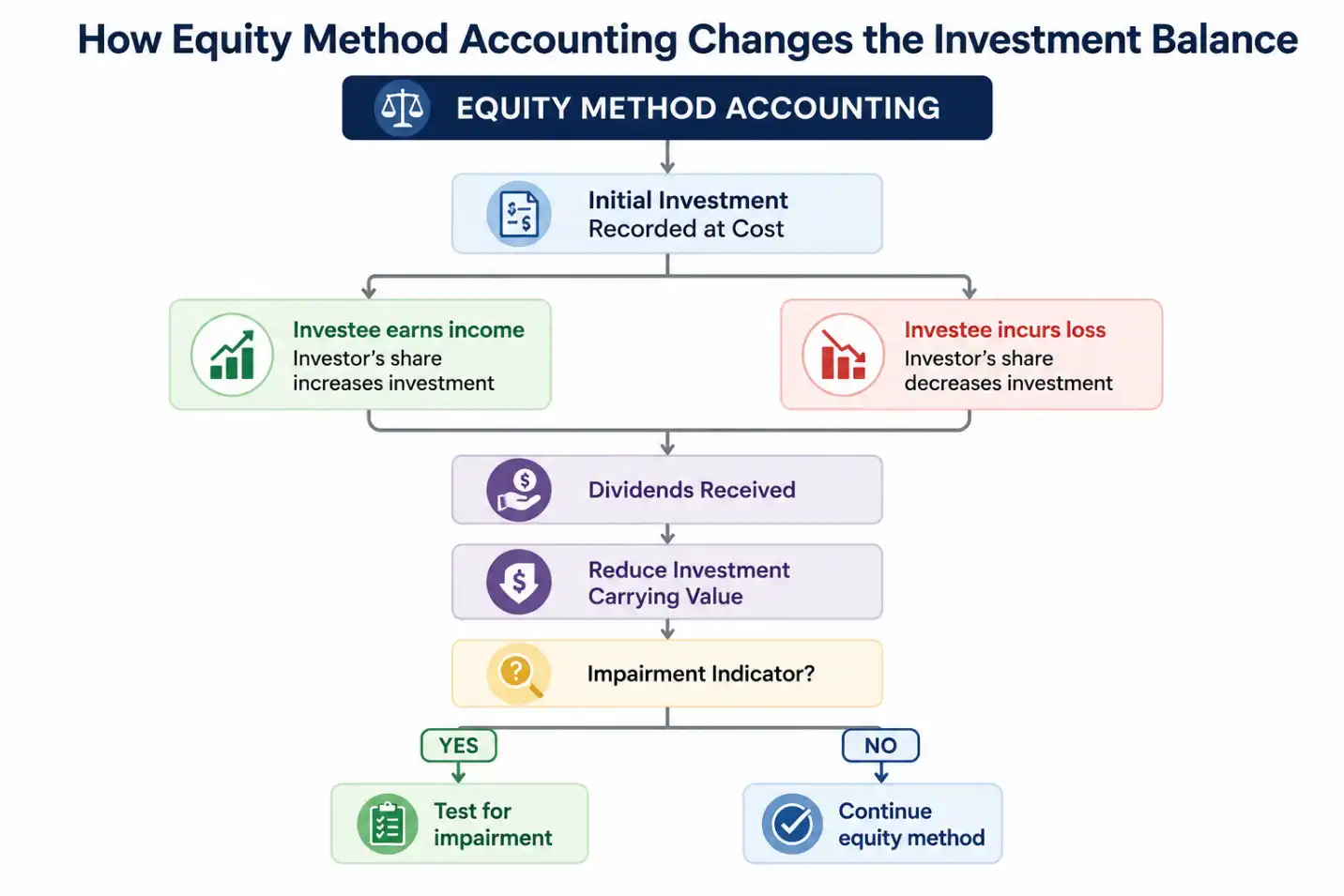
Consolidation assumes control. Cost accounting assumes distance. Equity method accounting sits between the two. It suits situations where an investor holds real influence over an investee without holding the majority of the vote. The equity method starts the investment at cost. It then adjusts the carrying value each period for the investor’s share of the investee’s net income or loss. Dividends reduce that carrying value rather than appearing as income, because they represent a return of capital already recognized. The result is one balance sheet line, Investment in Affiliate, and one income statement line, Equity in Earnings. Together, these carry the full weight of an ownership relationship. They do this without folding another company’s revenue and expenses into the parent’s operating results.
When Equity Method Accounting Applies
The 20 percent ownership threshold in ASC 323 is a starting point, not a finish line. Regulators and auditors look past the percentage to the substance of the relationship. An investor can cross into equity method territory with a smaller stake or stay out with a larger one. It all depends on whether influence is real. Indicators of significant influence include the following.
- Board representation or a seat with meaningful voting rights
- Participation in policy-making, budgeting, or strategic decisions
- Material transactions between the investor and the investee
- Interchange of managerial or technical personnel
- Provision of proprietary technology or operational support
An ownership stake above 20 percent can still fail the test if another shareholder controls the board or legal restrictions block participation. That’s why documentation has to support the analysis rather than assume it.
How Equity Accounted Investments Are Measured
The mechanics are straightforward once the influence question is settled. The investment is recorded at cost on day one. Each period, the investor books its share of the investee’s net income or loss, moving the carrying value up or down accordingly. Dividends received reduce the carrying value rather than flowing through as revenue, since they represent cash already reflected in prior earnings pickups. When an investee’s performance deteriorates in a way that appears other than temporary, the investment is tested for impairment. None of this requires line-by-line consolidation, and that restraint is the point, because it preserves a clean read on the parent’s own operating performance while still capturing the economics of the stake.
Why Equity Method Investment Decisions Matter for Strategic Reporting
Equity method investments often carry weight beyond their dollar size, especially when they touch adjacent capabilities or market entry. A software company investing in a workflow automation startup buys optionality for future integration. A biotech firm collaborating through a research joint venture captures early-stage upside without absorbing the full volatility of the underlying research. In a global consumer products organization sourcing components across manufacturing partners in China and Vietnam, a minority stake in a critical supplier would carry the same logic, stabilizing input costs and gaining design influence while leaving the supplier’s daily operations independent. In each case, equity method accounting lets the parent recognize the financial reality of the relationship without implying ownership or risk it does not actually hold.
Common Pitfalls in Equity Accounted Investments
A few mistakes show up again and again in practice.
- Treating a minority stake as a cost-method investment for simplicity, only to have an auditor later point to board rights or policy involvement that triggers equity treatment
- Failing to update carrying values for income, loss, and dividends, which leaves the balance sheet stale
- Ignoring impairment indicators when an investee underperforms or faces adverse change
- Letting a board or investor group treat equity income as controllable operating margin, which distorts KPI conversations
Buy-side due diligence work on an IT services acquisition surfaced this kind of gap, where quality-of-earnings analysis uncovered EBITDA adjustments tied to an equity accounted investment that the seller had not properly reassessed. In a separate case, a growth-stage fintech company held a 25 percent stake in a payment’s infrastructure joint venture, recorded it at cost, and left it unadjusted for four quarters, quietly missing $2M in earnings. The gap was not large enough to violate GAAP thresholds on its own, but it was large enough to create friction in a strategic review and force an avoidable restatement.
Cost Method vs Equity Method vs Consolidation
The right accounting model depends on both ownership percentage and the degree of influence.
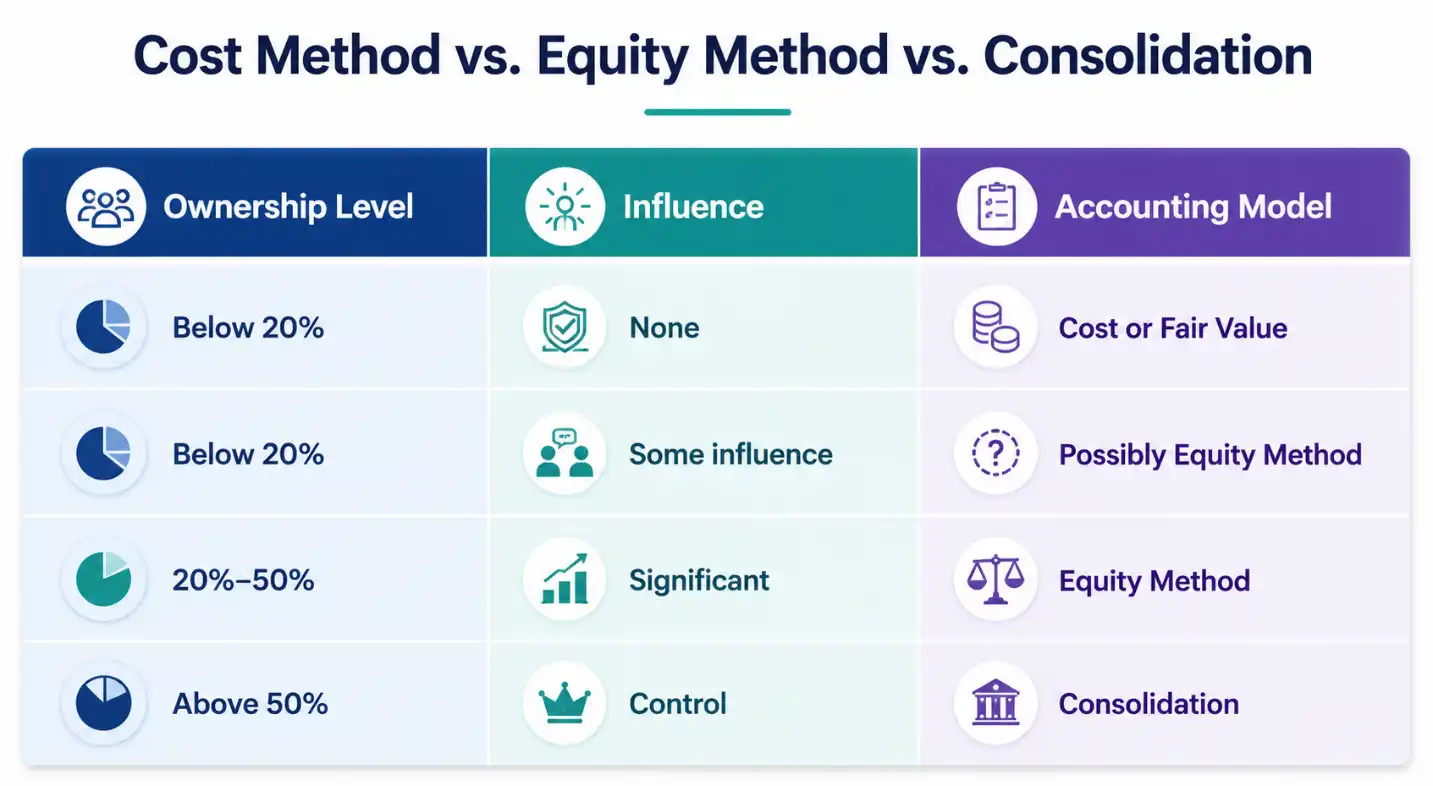
Leading a Euronext Paris-listed gaming and digital entertainment company through consolidated reporting across five countries under both IFRS and US GAAP made this table more than an academic reference. Rolling out a single financial system across every subsidiary meant defending, line by line, why some entities consolidated fully and others carried through a single equity earnings line, and that distinction had to survive scrutiny from underwriters and Big Four auditors during an IPO-readiness process.
Impact on Financial Metrics
Equity method investments touch key metrics in ways that are easy to overlook.
- EBITDA typically excludes equity method income, since it is non-operating
- Free cash flow benefits from dividends received, but those dividends need to be separated from cash flow generated by core operations
- ROIC and ROE can shift meaningfully depending on whether equity earnings are included or excluded
Finance leaders have to decide, deliberately, whether to highlight or strip out these effects in investor materials, board reporting, and covenant definitions, because the choice changes how capital efficiency looks to anyone reading the numbers from outside the company.
Steps for Finance Leaders Applying Equity Accounting
Getting this right is less about the standard and more about discipline. Identify every minority investment and test for significant influence based on what actually happens operationally, not just on what a cap table says. Document the indicators, board seats, veto rights, policy involvement, and revisit that documentation annually rather than treating it as a one-time judgment call. Update carrying values on a regular cadence tied to the investee’s reported income, loss, and dividends. Build impairment monitoring criteria suited to the volatility of the sector, particularly for early-stage or high-risk investees. Building a forecasting engine and board-grade reporting cadence for a multi-entity cybersecurity and identity access management company, spanning operations in the United States, Canada, Mexico, India, and Nepal, made clear how much of this work depends on process discipline rather than technical knowledge alone, since the hardest part was rarely the accounting judgment and almost always the operating cadence behind it. Finally, educate the people who will read the numbers, boards, investors, and internal stakeholders, on what equity method treatment actually implies for KPIs, so nobody mistakes participation for control.
Three Key Takeaways
- Equity method accounting exists to capture influence without control, and the 20 to 50 percent ownership range is a guideline for testing that influence rather than a rule that decides it automatically.
- The mechanics, cost basis, periodic income pickups, dividend reductions, and impairment testing, are simple, but they only work if carrying values are updated every period rather than revisited when an auditor asks.
- Because equity accounted investments sit outside core operating metrics, finance leaders carry the responsibility of explaining what those investments mean, and do not mean, to boards, investors, and anyone reading the growth story from outside the company.
Disclaimer: This article is intended for informational purposes only and does not constitute legal, tax, or accounting advice. Readers should consult their own tax advisor or counsel for advice tailored to their specific situation. Hindol Datta is a four-time CFO and senior finance executive with over 25 years of leadership experience across cybersecurity, SaaS, gaming, logistics, digital marketing, medical devices, consumer products, and nonprofit organizations. He has led more than $120M in fundraising and over $150M in M&A transactions while building the financial and operational systems that let complex businesses scale with confidence. He is the author of seven books in the Systems CFO Series and holds active CPA, CMA, and CIA credentials.
AI-assisted insights, supplemented by 25 years of finance leadership experience.