
Executive Summary
EBITDA multiples in a buy-and-build strategy carry two different meanings. A platform price reflects what the sponsor believes the business can become, while an add-on price reflects what integration can unlock. The spread between EBITDA multiples of 14x and 6x looks like free value. It holds only when integration is real and the thesis is proven.
This article examines why platforms earn premium EBITDA multiples, how add-on acquisitions create or destroy value, how to capture the spread between them, and why the CFO acts as steward of the multiple from entry through exit.
Why EBITDA Multiples Diverge Between Platforms and Add-Ons
The price paid for a business is never only a function of competition or negotiation. It is a wager on fit, timing, and optionality. A platform often commands premium EBITDA multiples because buyers believe its operating system, brand, and management can scale. The price pays for throughput potential as much as for earnings.
Add-on acquisitions follow a different valuation logic altogether. Sponsors acquire them at lower EBITDA multiples and expect synergy, rationalization, or revenue lift to unlock their value. That spread holds only if the platform absorbs the add-on without decay. A cheap asset poorly integrated becomes expensive quickly.
For the CFO, the platform becomes the anchor for every future valuation in the roll-up. Its systems define what is knowable, its dashboards frame what is measurable, and its norms shape what can scale. Overpaying here distorts the math of every later deal. Underinvesting in the platform leaves fragility at the core of the strategy.
The Platform Acquisition as Keystone
A platform is the keystone on which the whole arch of a roll-up rests. Premium EBITDA multiples signal confidence that management, systems, governance, and culture can serve as an engine for performance and as a template for future add-ons. The buyer is paying for the architecture behind earnings, not for earnings alone.
Four Qualities That Justify a Premium Multiple
- Systems and standards: Proven go-to-market, technology, finance, and customer success systems reduce integration risk and turn complexity into repeatable leverage.
- Cultural credibility: Strong norms of performance and accountability lower integration friction and let leadership set the tone at scale.
- Financial visibility: Diversified, contracted revenue, resilient margins, and normalized working capital needs turn earnings into a blueprint instead of a surprise.
- Optionality and growth regime: A strong platform opens paths to cross-sell, international reach, and vertical consolidation.
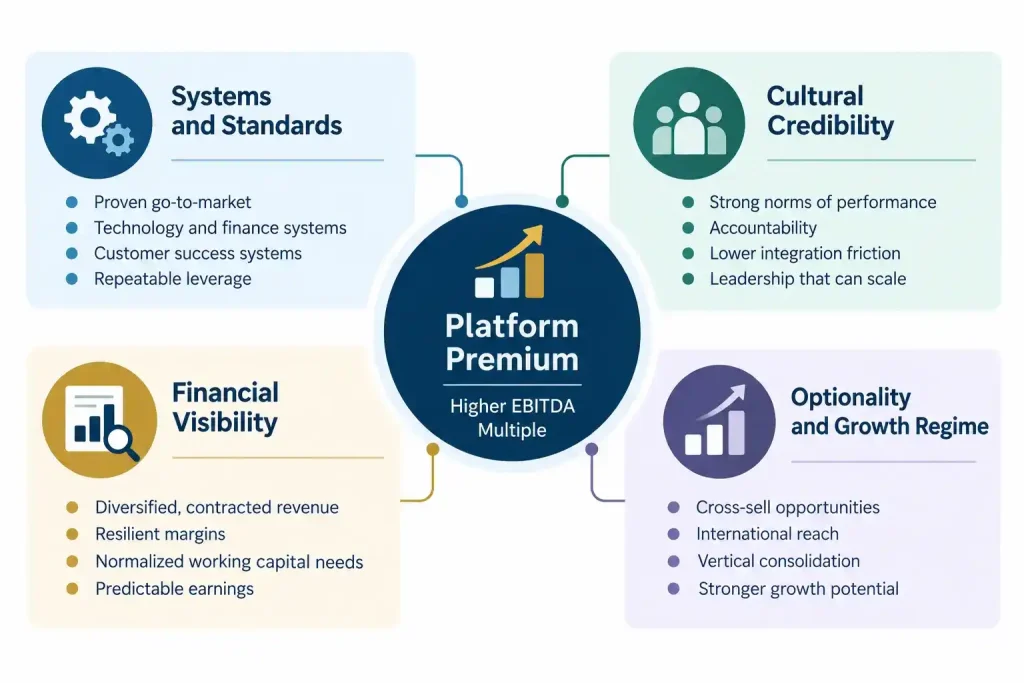
None of these qualities appear in EBITDA alone. They live in what the platform enables: the speed of integration, the scale of repeatability, and the quality of future earnings. If the platform is weak or fragmented, high EBITDA multiples become a markup on friction.
Is the Premium Strategic or Speculative?
In a competitive auction, high EBITDA multiples from the market do not prove the premium is deserved. The CFO must model the risk-adjusted economics of the platform with a few pointed questions:
- Does the platform have integration-ready systems, or will each add-on require custom reporting and parallel systems?
- Can the management team scale through replication, or will its artisanal approach break under stretch?
- Are earn-outs or performance-based structures needed to protect the sponsor if the assumptions fail?
When these answers align, a high multiple stops being a cost and becomes a signal that the platform will generate a base for future returns.
Add-On Acquisitions and the Fragile Art of Accretion
The most common misunderstanding in acquisition strategy holds that an add-on’s value lies in its price. The surface logic is tempting: buy at low EBITDA multiples, integrate well, and watch the blended multiple rise. In practice, the value of an add-on lies in its integrability. Integration that nobody manages tends to expand, confuse, and corrode.
A 6x acquisition rolled into a 10x platform does not create instant value. It creates potential, and potential becomes value only when the acquired EBITDA transfers into the platform’s operating rhythm, governance cadence, and culture. During buy-side diligence on an IT services acquisition, quality-of-earnings work surfaced material EBITDA adjustments and concentrated integration risks that a headline multiple would have hidden.
Building a Disciplined Integration Thesis
Each add-on is a system insertion, a new node embedded into an existing network. Integration of this kind amounts to finance process transformation in miniature, and the thesis behind it should include:
- A clear plan for merging finance, IT, sales, and HR, both technically and culturally
- Success metrics beyond cost savings, such as churn reduction, margin improvement, and CAC to LTV convergence
- Pre-modeled working capital impacts, since add-ons often bring different receivable and payable cycles
- Governance that lets platform norms lead while respecting local context
The sequencing of integration steps matters as much as their content. Integrate too fast and confusion erodes value; move too slowly and cultural divergence widens. Three acquisitions at a venture-backed digital marketing company, which grew from $9M to $180M in revenue, rested on CAC, LTV, and contribution margin discipline.
Talent and Narrative Risk
Add-ons often arrive with founders and key sales leaders whose loyalty sits with the legacy entity. An early exit costs the business operating depth. Staying unaligned forces the platform to absorb contradiction. Retention packages, equity alignment, and role clarity become valuation-critical levers.
A low-quality add-on can also weaken the platform’s story. Future buyers will ask whether the group is a coherent ecosystem or a loose collection of entities. The wrong add-on, even at 5x, can suppress the exit multiple of the entire platform.
Executed well, however, add-ons deliver leverage through coherence instead of debt. They widen revenue diversity, extend customer reach, and lower marginal acquisition costs. The true valuation lift comes from integration quality, not from the discount.
Managing the Spread Between Platform and Add-On EBITDA Multiples
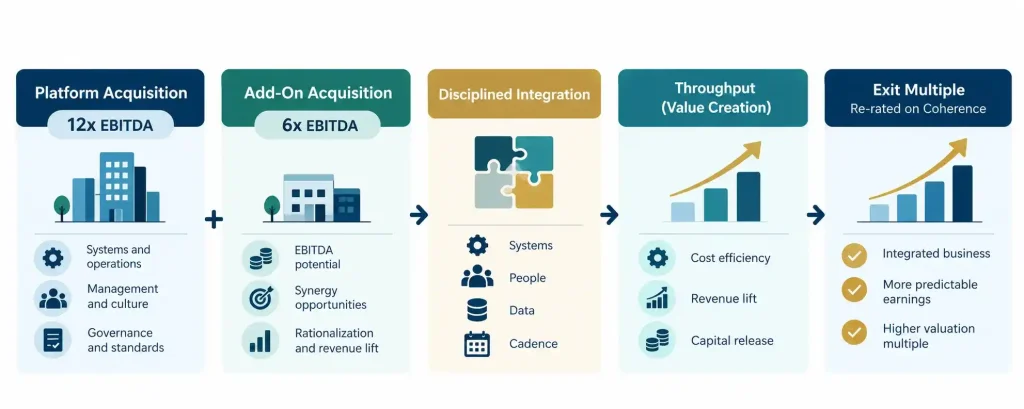
The gap between platform and add-on EBITDA multiples is often treated as free money. A platform bought at 12x and add-ons at 6x imply uplift on paper, yet the spread presumes smooth integration, behavioral alignment, and strategic fit. Without these conditions, the spread between EBITDA multiples disguises erosion.
Four Forms of the Spread
| Spread | What It Measures | Primary Risk |
| Financial | The gap between entry multiples | Leakage from integration costs, dis-synergy, and working capital drag |
| Operational | Differences in systems, processes, and capabilities | Add-on resists the platform playbook |
| Cultural | Differences in tempo, trust, and governance norms | Founder-led informal controls clash with board governance |
| Narrative | How coherent the combined system appears at exit | Loosely related add-ons trigger a downward re-rating |
A spread must convert into throughput, meaning cost efficiency, revenue lift, or capital release. A deal at 6x EBITDA that adds revenue but drags margin and consumes working capital is not accretive. At a $127M global consumer products company, lifting inventory turns from 3x to 7x through demand planning released trapped working capital, the kind of throughput a spread must produce.
Institutionalizing Integration Discipline
The narrative spread can erase every arithmetic gain. A platform rated at 10x can fall to 7x at exit when the story loses coherence, even if the financials hold. Four integration disciplines protect against that outcome and preserve exit EBITDA multiples:
- A common data architecture so every entity reports to the same dashboard
- GAAP or IFRS consistency so EBITDA stays comparable across entities
- A unifying operating cadence of weekly metrics, monthly reviews, and quarterly strategy checkpoints
- Incentive alignment so new teams pursue the platform’s strategic direction
The CFO must also avoid overfitting to the present. Decisions that lift short-term EBITDA but damage scalability, team health, or customer satisfaction collapse under future scrutiny.
The CFO’s Role in Shaping EBITDA Multiples That Last
An EBITDA multiple is a belief function, a compressed signal of what the market thinks the enterprise can produce, sustain, and evolve. Exit EBITDA multiples are earned through a long accumulation of choices that suggest repeatability and truthfulness. The CFO carries four core responsibilities in that work:
- Govern the system of truth: Keep definitions consistent, metrics traceable, and forecasts revisited, and set a standard of proof for synergy and cultural fit.
- Own the strategic narrative: Build the story of convergence in real time through board reporting, integration playbooks, and annual planning.
- Protect coherence: Test each add-on for definitional drift, new systems, or new leadership layers that hide a cost of attention behind low EBITDA multiples.
- Govern the time horizon: Revise assumptions as evidence arrives and tie short-term deliverables to long-term strategic optionality.
At a publicly listed gaming company that completed over $100M in cross-border M&A, one unified revenue definition across every subsidiary turned separate acquisitions into a single reporting system. Buyers discount whatever they cannot verify in diligence, yet they pay generously for systems they understand and leaders who can show the math behind their optimism.
Three Key Takeaways
- Platform EBITDA multiples pay for the architecture behind earnings, so a premium is justified only when systems, leadership, and governance are ready to absorb future add-ons.
- An add-on’s value lies in its integrability rather than its price, and a disciplined integration thesis decides whether a low multiple becomes accretion or erosion.
- The spread between platform and add-on multiples is captured at exit, when buyers re-rate the combined entity on the coherence of its data, cadence, and narrative.
Disclaimer: This article is intended for informational purposes only and does not constitute legal, tax, or accounting advice. You should consult your own tax advisor or counsel for advice tailored to your specific situation.
Hindol Datta is a four-time CFO and senior finance executive with over 25 years of leadership experience across cybersecurity, SaaS, gaming, logistics, digital marketing, medical devices, consumer products, and nonprofit organizations. He has led more than $120M in fundraising and over $150M in M&A transactions while building the financial and operational systems that let complex businesses scale with confidence. He is the author of seven books in the Systems CFO Series and holds active CPA, CMA, and CIA credentials.
AI-assisted insights, supplemented by 25 years of finance leadership experience.