
Executive Summary
Dynamic KPIs keep measurement anchored to the strategic priorities a company holds today, not those of years past. Most companies design their KPI framework once and revise it only at the edges, even as strategy moves from growth to efficiency, retention, or monetization. Dashboards still glow and teams still hit targets, yet execution drifts because the numbers answer outdated questions.
This article examines why static metrics outlive their usefulness and what makes a KPI system adaptive instead of volatile. It lays out how to operationalize dynamic KPIs through operating rhythm, dashboards, capital allocation, and incentives. Finally, it frames the CFO as the steward who decides when the company must change what it measures.
Why Static KPIs Drift Away from Strategic Priorities
Every company watches a set of numbers, and those numbers quietly teach people what progress looks like. To measure something declares it worth attention, and rewarding it declares it worth a change in behavior. KPIs, in that sense, are statements of intent. Revenue, CAC, LTV, churn, and EBITDA form the skeleton of most dashboards, and that skeleton endures long after strategy has moved.
The result is organizational friction that rarely announces itself. A board asks for capital efficiency while the dashboard still celebrates gross bookings. Teams optimize around metrics built for a previous chapter, and leadership debates priorities that the numbers cannot settle. Execution starts to feel well structured but hollow, because the company is measuring beautifully without measuring wisely.
The Organizational Gravity Behind Outdated Metrics
Static KPIs persist because established metrics become woven into bonus plans, investor updates, board decks, and annual planning cycles. Changing them feels like breaking comparability or moving the goalposts, so most teams preserve the metric and lose the moment. Rapid growth worsens this, as land-grab dashboards carry forward unrevised into a phase that demands proof of unit economics.
A venture-backed performance marketing company that scaled revenue from $9M to $180M in 24 months illustrates the stakes. Top-line growth carried the early dashboard, but sustaining it required a deliberate turn toward CAC, LTV, and contribution margin. Without that shift, dashboards would have kept rewarding volume the unit economics could not support.
Warning Signs That KPIs No Longer Reflect Strategy
Most leadership teams sense misalignment before they can name it, and several symptoms tend to surface first:
- Teams hit their targets while the company misses its gross margin or cash goals.
- Board conversations center on metrics that the dashboard does not track.
- Executives cite monthly CAC or ARR shifts after the business has pivoted toward retention or pricing.
The Anatomy of Dynamic KPIs
A metric on its own resembles a sentence fragment, describing a fact without supplying meaning until it sits in relation to strategy. For that reason, dynamic KPIs begin with a narrative question instead of a spreadsheet: what chapter of the business is the company living now?
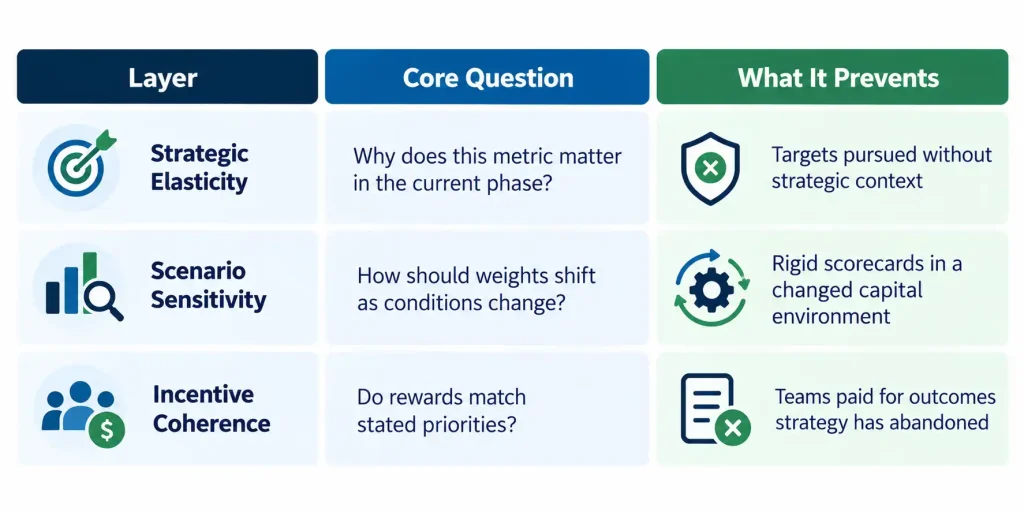
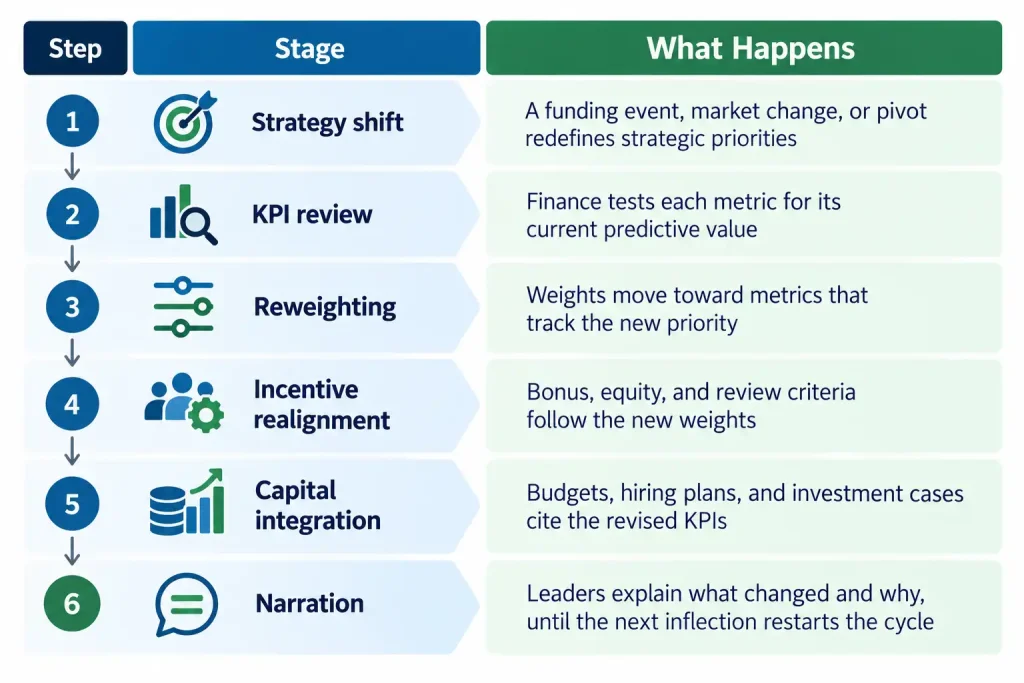
Dynamic does not mean volatile or revised every month, since a dynamic KPI stays anchored to a strategic north star while accepting that north stars move. Revisions follow material inflections such as a funding event, a go-to-market shift, or a turn in unit economics. Three layers make that adaptability work without creating confusion.
Strategic Elasticity
Strategic elasticity places each KPI inside a frame that explains why it matters now. Instead of declaring that NPS must exceed 60, leadership asks what customer sentiment reveals about positioning durability. Rather than demanding 200 bps of margin expansion, finance asks how it supports cash-flow neutrality within four quarters. The KPI becomes a test of strategic fidelity, not merely a target to hit.
Scenario Sensitivity
Scenario sensitivity gives the KPI framework the structural ability to reweight metrics as operating conditions change. In a capital-rich year, top-line growth per headcount might lead the dashboard. During a capital-scarce year, contribution margin per customer takes priority instead. The formulas stay constant while their weight and meaning flex.
An early-stage email marketing technology company offers a clear case of this reweighting. Reducing monthly burn from $800K to $200K required shifting the entire scorecard toward cash runway and cost per outcome. Growth metrics stayed visible but no longer drove the decisions that kept the company alive.
Incentive Coherence
Incentive coherence, the layer most companies neglect, decides whether the other two matter at all. A dynamic KPI system fails if bonus plans, equity vesting, and performance reviews stay tethered to outdated priorities. A company that names efficiency as its new frontier but pays bonuses on gross bookings will get bookings, along with inefficiency. The CFO’s job is to close the gap between what leadership claims matters and what the compensation plan rewards.
The Three Layers at a Glance
How KPI Weighting Shifts Across Strategic Phases
| Strategic Phase | Strategic Priority | KPIs to Elevate | KPIs to Cool |
| Land-grab growth | Market share and velocity | New ARR, bookings growth, logo acquisition | Payback period, margin per account |
| Efficiency | Unit economics | CAC payback, contribution margin, burn multiple | Raw bookings volume |
| Retention | Customer durability | Net revenue retention, gross churn, expansion revenue | New logo count |
| Monetization | Pricing leverage | ARPU, gross margin, price realization | Discount-driven volume |
Operationalizing Dynamic KPIs Across the Company
A metric holds power only to the extent that it shapes decisions, and the final mile, where numbers enter planning, meetings, and paychecks, is the most fragile. The CFO must act as a translator of intent, helping sales, product, and HR see new metrics as lenses instead of demands.
The Dynamic KPI Operating Cycle
Building Rhythm and Distribution
Most organizations engage with KPIs episodically, at QBRs, board meetings, or post-mortems. Dynamic KPIs need momentum instead, so weekly reviews, monthly operating meetings, and quarterly reforecasts must carry the same metric DNA. Weights may shift, but the frame holds, and that consistency builds trust.
A $30M ARR cybersecurity and identity company shows what rhythm can accomplish. A driver-based forecasting engine and a fixed reporting cadence held actuals within five percent of forecast for 8 consecutive quarters.
Distribution matters as much as rhythm, because a KPI system must serve operators and not only executives. Procurement leads, churn-experiment teams, and product managers all need dashboards that reflect their own domain. Flat, universal dashboards sever the causal chains that make metrics meaningful.
Integrating Capital Allocation and Narration
Dynamic KPIs gain teeth when they govern capital allocation. Budget reviews, investment cases, and hiring approvals should cite the revised metrics as genuine decision criteria. If the company now invests for LTV expansion over volume, every spending request must show how it serves that goal.
At a $127M global consumer products company, tying capital decisions to cash conversion helped lift inventory turns from 3x to 7x. Demand planning and SKU rationalization followed the metric, releasing working capital that volume-focused targets had trapped.
Leaders must also speak the KPIs, not just display them, and explain why a weight moved, which inflection the company is managing, and why a once-trusted metric no longer predicts outcomes. Narration of this kind turns numbers into signals of shared alignment.
Why the CFO Must Steward Dynamic KPIs
Numbers rarely lie, but they can grow stale in ways that mislead. The most dangerous untruth in a company is a frozen truth, accurate once and still treated as current. The CFO usually holds the vantage point, objectivity, and standing to notice that drift and declare that measurement must change.
That declaration requires the humility to admit that a KPI served the company well but now obscures more than it reveals. Courage matters too, since unhooking incentives from outdated targets disrupts comfortable habits.
Misalignment erodes trust quietly, as when a sales leader hits quota while the company misses its margin targets. The CFO’s task is to name that discomfort and convert it into design.
Control protects the dashboard, while leadership protects the direction. Stewardship means structured change: KPI reviews inside planning cycles, weighting shifts in the quarterly rhythm, and board updates that reflect evolution without apology. A company moves in the direction of what it continues to measure, and the CFO decides whether that direction still matches its ambition.
Three Key Takeaways
- Audit KPIs at every material inflection, such as a funding event or a go-to-market shift. A metric that once guided strategy can quietly reward behavior the company no longer wants.
- Build dynamic KPIs on strategic elasticity, scenario sensitivity, and incentive coherence. Reweighting metrics without realigning bonuses and capital allocation produces activity, not change.
- Treat KPI stewardship as a leadership responsibility, not a reporting task. A CFO who explains why measurement changed turns new metrics into shared alignment across every function.
Disclaimer: This article is intended for informational purposes only and does not constitute legal, tax, or accounting advice. You should consult your own tax advisor or counsel for advice tailored to your specific situation.
Hindol Datta is a four-time CFO and senior finance executive with over 25 years of leadership experience across cybersecurity, SaaS, gaming, logistics, digital marketing, medical devices, consumer products, and nonprofit organizations. He has led more than $120M in fundraising and over $150M in M&A transactions while building the financial and operational systems that let complex businesses scale with confidence. He is the author of seven books in the Systems CFO Series and holds active CPA, CMA, and CIA credentials.
AI-assisted insights, supplemented by 25 years of finance leadership experience.