
Executive Summary
Every transaction begins with an asymmetry, because the seller knows far more than the buyer about the business on offer. Due diligence best practices exist to close that gap, turning ambiguity into understanding and uncertainty into a deliberate plan for price, structure, and ownership. Treated as a checklist, due diligence tends to confirm what the buyer already hopes to believe.
This article reframes due diligence as a discipline of inquiry rather than a compliance phase. It covers cognitive bias, full-stack workstreams, commercial realities, and the ethics of acting on partial knowledge. The goal is a process that shapes good deals, not one that merely screens out bad ones.
Why Due Diligence Best Practices Go Beyond the Checklist
Data rooms arrive polished, with smooth trends, a coherent narrative, and risks tucked into footnotes and normalized EBITDA. A hurried review under deal momentum produces hygiene, not understanding. Diligence does not happen before the deal; it decides whether the deal should happen at all, and on what terms.
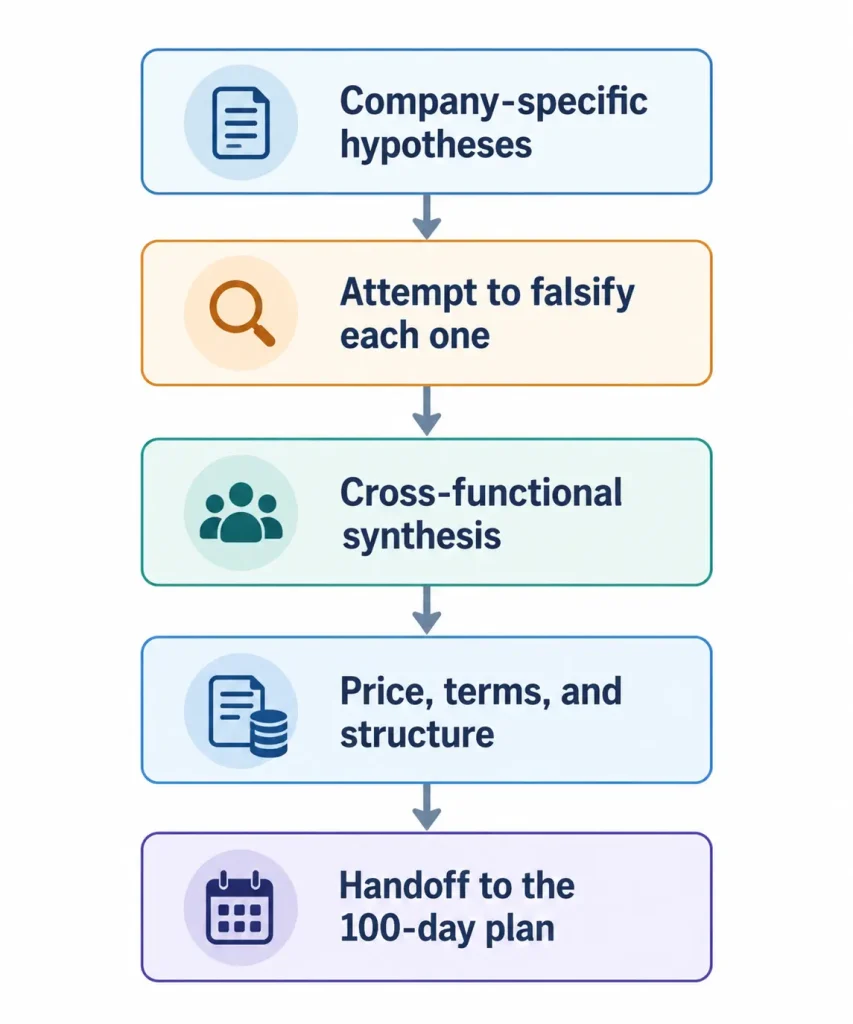
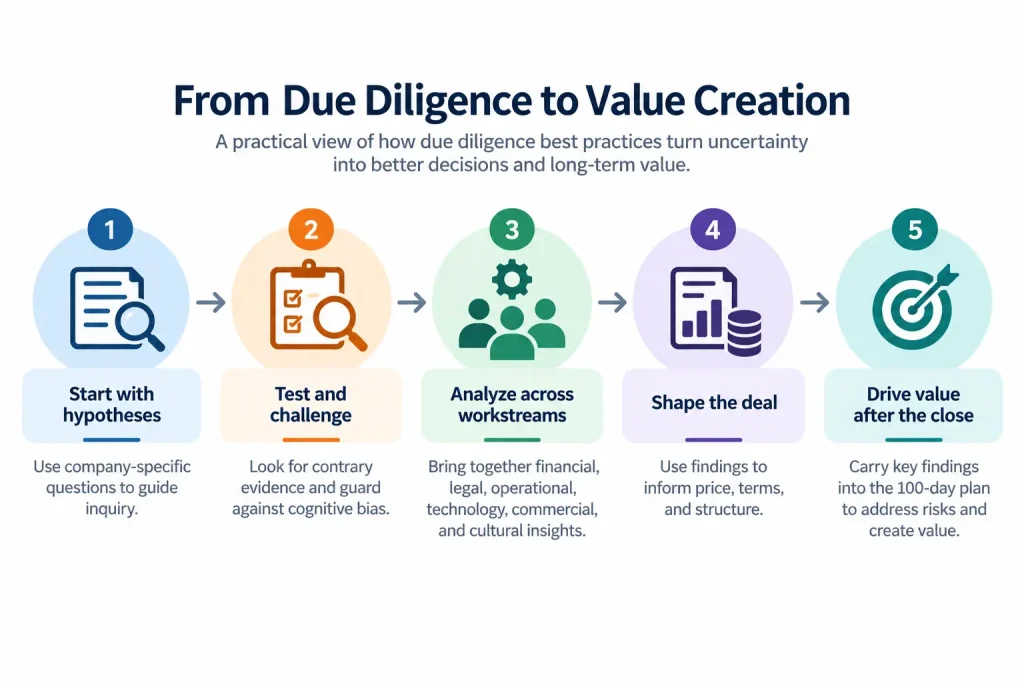
The strongest processes start with company-specific hypotheses rather than with documents. Each hypothesis becomes something the team tries to falsify or refine:
- What is the true source of differentiation and pricing power?
- Where does net revenue growth hide customer churn?
- What share of EBITDA is repeatable, and what share reflects macro cycles, founder energy, or one-off contracts?
- Is the target’s market growing, shrinking, or quietly being redrawn?
Every model carries its risk in its assumptions, which are beliefs about how customers, competitors, and employees will behave. Testing those beliefs means observing and listening, not running macros. Insights must also outlive the close, so the red flags raised in diligence should become the early agenda of the value-creation plan.
Cognitive Bias: The Hidden Threat in Due Diligence
The greatest danger in diligence is not learning too little but believing too much. Once a deal feels “compelling,” momentum gathers around the thesis before any real analysis begins. Three biases do most of the damage in a typical process:
- Confirmation bias: the team seeks data that affirms the thesis, so a 90% retention claim goes unexamined for cohort decay or regional variation.
- Availability bias: recent and vivid data wins, and one delighted customer call outweighs five calls that went unreturned.
- Anchoring bias: an early figure, such as “this closes at 8x EBITDA,” pulls every later analysis toward it.
Structural Defenses Against Bias
Bias cannot be removed, but a well-designed process can expose it and slow it down. Due diligence best practices favor institutionalized doubt over individual brilliance:
- Assign devil’s advocates structurally, with real authority to challenge the thesis.
- Require second-source verification for every load-bearing claim.
- Reward dissent, so a warning that the team lacks enough evidence carries weight.
- Ask what would make this business unattractive, and how the team would know.
- Revisit early assumptions after each deep-dive phase.
- Apply forecast penalties and widen confidence intervals over time, so the optimistic case never becomes the base case.
Cross-functional friction matters just as much as formal safeguards. Strong gross margins may rest on deferred maintenance, and a lean cost base may reflect an exhausted workforce. A useful test asks when a diligence call last changed the team’s view of a deal. If the answer is never, inquiry has collapsed into ritual.
Applying Due Diligence Best Practices Across Every Workstream
Comprehensive diligence runs concurrent workstreams, and each one exposes a different face of the company. None of them stands alone, since revenue trends depend on legal exposure, cash flow depends on IT debt, and cost structures rest on culture. The table below shows where each lens falls short on its own.
| Workstream | Core Question | What It Misses Alone |
| Financial | Is reported EBITDA real, recurring, and backed by cash? | Why results happened and whether they will repeat |
| Legal | Are IP, contracts, and liabilities clean and assignable? | Whether the assets create a durable moat |
| Operational | Can the business deliver what the model requires? | Market demand and pricing power |
| Technology | Is the infrastructure secure, scalable, and enabling? | The cultural posture toward data |
| Commercial | Can the firm grow profitably in this market? | Internal capacity to execute |
| Cultural | How does the firm behave under pressure? | Financial resilience and cash dynamics |
Financial and Legal Due Diligence
Financial due diligence tells buyers what happened, though not why it happened. Add-backs, normalization adjustments, and carve-out assumptions deserve a cynic’s heart and a surgeon’s hand. A pristine trailing EBITDA can hide seasonality, concentration, or margin compression wherever cash flow diverges from it. On one buy-side engagement for an IT services acquisition, quality-of-earnings work surfaced material EBITDA adjustments that reshaped the buyer’s view of value.
Legal diligence, done well, reveals operating constraints as well as liabilities. Change-of-control clauses can make customer revenue vanish at closing. Non-competes and exclusivity terms can block strategic pivots for years. At a $30M ARR cybersecurity company, a rigorous ASC 606 framework and controls environment carried the business cleanly through acquisition diligence.
Operational and Technology Due Diligence
Operational due diligence asks whether the plant, supply chain, and systems can support the plan’s growth and margin targets. Site visits, floor walks, and process mapping reveal what spreadsheets assume about labor, maintenance, quality, and inventory. Most firms bring operators in too late, after the assumptions have hardened. Technology diligence should ask whether the business uses data to drive decisions or merely to report history. Heavy reliance on spreadsheets for core workflows signals tech debt and a posture resistant to change.
Cultural Due Diligence
Culture in a leveraged buyout is durability, not decoration. Diligence must uncover how decisions get made, who holds real power, and whether dissent is voiced or suppressed. Anonymous interviews, turnover analysis, and behavioral observation all help, as does listening for silences. A conflict-averse or charisma-dependent leadership team will often break under leverage rather than gain discipline.
Commercial Due Diligence and Market Durability
Markets are harder to pin down than audited financials, which makes commercial due diligence the most prone to illusion. The work must start with the market itself, testing real growth rates, incumbents, and disruptors. A great firm in a declining sector still faces entropy, while a mediocre one may float on tailwinds.
Testing Customers, Cohorts, and Channels
Among due diligence best practices, independent customer interviews offer some of the richest signal. These conversations should probe how buyers evaluate alternatives and how they would react to a 5% or 10% price increase. Acquisition cost, payback period, and margin by channel matter just as much. Cohort analysis then separates real growth from acquisition layered on top of churn. During a $20M Series B raise at a marketplace SaaS company, cohort and unit economics models anchored investor diligence and withstood scrutiny. Channel concentration also deserves attention, because a firm selling 80% through one distributor leases its power rather than owning it.
Market Sizing, Competition, and Change
The remaining tests focus on what the market is becoming, not what it was:
- Addressable market: is the TAM real, reachable, and profitable, or does it blend adjacent categories?
- Reaction risk: how will scaled or venture-backed competitors respond once the target grows?
- Digital entropy: could AI-generated search summaries or digital-first buying erase existing discovery channels?
- Brand equity: is the brand trusted and premium, or has it become a commodity?
- Remaining levers: has growth relied on deepening discounts, leaving little room for further gains?
Sponsors should also temper their own optimism bias. A fragmented market may consolidate, or it may stay fragmented because of regulation, channel friction, or stubborn incumbents.
The Ethics of Due Diligence and the Burden of Knowing
Late in a process, a quiet inversion often occurs, and the team starts justifying a decision it has already made emotionally. Sunk costs in quality-of-earnings work, legal review, and customer surveys begin to feel like momentum. Diligence then shifts from discovery to justification, and the operating plan inherits a fragile consensus.
Acquiring a business means assuming authority over employees, vendors, and customers. Restructuring and longer supplier terms are not unethical, but they become suspect when they rest on untested assumptions. Culture is also easy to misread, since a CFO resisting weekly forecasts may simply be protecting her team. Rigor, in this light, is a form of fairness to everyone who bears the deal’s risk.
Transparency and Continuity After Close
Ethical diligence begins with intentional design, asking what the team has no incentive to ask. The final memo should read as a confession of uncertainty, naming unknowns, low-probability risks, and unprovable assumptions. The most overlooked of all due diligence best practices is continuity, the deliberate handoff of knowledge to operators. Across more than $100M in cross-border gaming acquisitions, carrying diligence findings straight into post-merger integration kept hard-won insight intact. Without that handoff, the operating team starts again with a blindfold on.
Three Key Takeaways
- Due diligence best practices start with hypotheses the team tries to disprove, backed by devil’s advocates and forecast penalties that keep bias in check.
- Every diligence workstream must inform the others, because no single lens shows how the business will behave under leverage.
- The diligence memo should state uncertainty openly, and its red flags should lead the 100-day plan so knowledge survives the close.
Disclaimer: This article is intended for informational purposes only and does not constitute legal, tax, or accounting advice. You should consult your own tax advisor or counsel for advice tailored to your specific situation.
Hindol Datta is a four-time CFO and senior finance executive with over 25 years of leadership experience across cybersecurity, SaaS, gaming, logistics, digital marketing, medical devices, consumer products, and nonprofit organizations. He has led more than $120M in fundraising and over $150M in M&A transactions while building the financial and operational systems that let complex businesses scale with confidence. He is the author of seven books in the Systems CFO Series and holds active CPA, CMA, and CIA credentials.
AI-assisted insights, supplemented by 25 years of finance leadership experience.