Executive Summary
Driver-based forecasting gives market expansion the structure it needs to move from ambition to disciplined action. Most expansion plans present one polished future, complete with market sizing and a breakeven month. They rarely show what breaks first when reality differs. Scenario models built on a few key drivers let leaders test assumptions, sequence capital, and adjust course without starting over.
The sections ahead explain why single-path expansion models fail and how scenario forecasting supports measured boldness. They also show how to build driver-based models that flex with real markets and how the CFO links them to strategic performance management.
Why Single-Path Expansion Models Fail
From the comfort of headquarters, market expansion often looks precise. Slide decks size the market in billions, sales efficiency rises on smooth curves, and breakeven arrives neatly in month 27. The model looks thorough, yet it cannot bend under pressure.
The Mirage of Confidence
A deterministic model works only if the world cooperates. It assumes buyers behave as they do in the core market, CAC holds, hiring proceeds on time, and churn stays stable. New markets rarely offer that kind of deference.
These models usually fail through isolation, not bad faith. Finance works from historical assumptions while the business supplies ambitious targets, and nobody simulates how the plan behaves under stress. The company then commits to a single narrative instead of a set of strategic options.
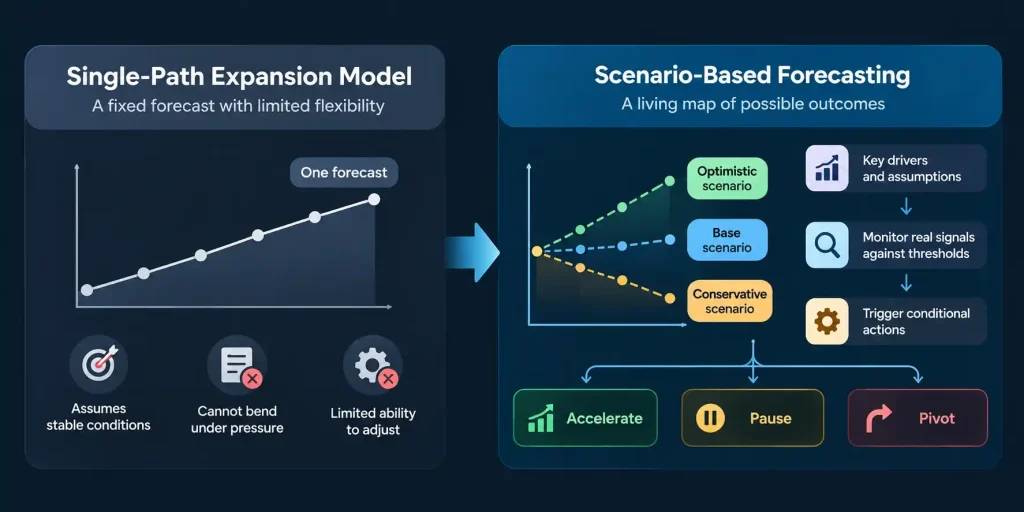
When the expansion begins to wobble, a rigid model offers no room to adjust. Costs creep, sales lag, and leadership tightens spending while still building against the original plan. The CFO can reshape this frame by insisting the forecast becomes a living map of possible outcomes instead of a verdict.
Driver-Based Forecasting as a Source of Strategic Courage
The real gift of forecasting is permission, not prediction. Scenario forecasting makes the future discussable through conditional reasoning instead of speculation. In a world that punishes both timidity and recklessness, it gives finance leaders a valuable asset in measured boldness.
From Go or No-Go to Conditional Playbooks
For driver-based forecasting, new markets behave like complex systems, not linear extensions of the core business. Each brings different regulations, buying habits, channel efficiency, and demand pacing. Those differences change the slope of CAC, the cadence of bookings, and the length of payback.
Scenarios show how different futures behave and what the company must believe to succeed in each. Instead of one ARR forecast, the CFO presents several, each tied to real assumptions about local hiring, brand translation, and delayed conversion. The leadership question shifts from whether the plan is good to which world the company is entering. Leaders also need to know how they will recognize it.
Expansion then becomes a set of conditional playbooks, each with its own capital pacing, talent curve, and performance thresholds. This is where driver-based forecasting connects with strategic performance management. Every scenario carries clear signals that tell leaders when to accelerate, pause, or change course.
Building Driver-Based Forecasting Models That Flex
A good scenario model shows genuinely different futures, not three versions of the same one. It flexes the logic as well as the output, revealing which assumptions are fragile and which can shift without collapse.
Entry Architecture, Constants, and Variables
The first step is to define the mode of entry instead of treating a new market as a smaller copy of the core. Leaders must decide whether to hire locally, sell directly or through partners, adapt the product, open a physical footprint, or adjust pricing. Each choice becomes a lever within the model.
Constants and Variables in a Driver-Based Forecasting Model
| Type | Examples | How to Model |
| Constants | Customer onboarding time, product cost structure, legal overhead | Fixed inputs that change rarely across markets |
| Variables | CAC trajectory, hiring velocity, LTV curve, compliance friction | Bounded ranges with clear triggers for revision |
| Decision triggers | CAC above target by month four, conversion 20% below plan | Predefined actions such as deferring hires or switching to partners |
Craft matters most at this stage of driver-based forecasting. Instead of building hundreds of sensitivities, the CFO identifies the six to eight drivers that matter most across likely paths. Logic trees then link each driver to a response, such as deferring a hiring wave if CAC exceeds its threshold. Another rule might shift spend back to headquarters if in-country costs climb.
A cybersecurity and identity SaaS company with roughly $30M in ARR shows what this approach can achieve. A driver-based forecasting engine and capacity model, built from scratch, held actuals within plus or minus five percent of forecast for 8 consecutive quarters. That company also operated across the United States, Canada, Mexico, India, and Nepal, which made reliable drivers essential for multi-country planning.
Capital Elasticity and Feedback Visibility
Every scenario must tie to capital timing, showing what the company needs, when it needs it, and which signals justify each commitment. Confidence-adjusted funding tiers turn this principle into a working plan. At one signal threshold the company commits a first tranche, and at a stronger outcome it doubles down. If neither signal appears, it pauses to reassess.
A model must also define how leaders will recognize each scenario as it unfolds. Leaders need to know which signals arrive first, how quickly leaders can trust them, and how often the team will review them. This feedback loop is where driver-based forecasting becomes the backbone of strategic performance management.
A marketplace SaaS company expanding across the United States and Poland offers a useful reference point. Its consolidated cross-border reporting, along with cohort and unit economics models, anchored investor diligence during a $20M Series B. Clear drivers made the cross-border story easier to defend.
The CFO’s Role in Strategic Performance Management
After the models are built, a quiet moment usually arrives in the boardroom. At this point the decision rests on conviction more than math. The CFO’s task is to interpret risk and show how the company can move and what waiting would cost. The CFO also shows how far the company could still reverse course.
Making Expansion Real and Reversible
Strategic expansion carries no guarantees, but it can include reversibility and signal-led decision points. A well-modeled plan lets leaders commit with elasticity, testing and adjusting instead of plunging into the unknown. Capital moves with conditions, accelerating when signals are strong and slowing when they weaken.
Honest planning avoids false certainty about how new markets will behave. Demand in Berlin will not mirror Boston, and sales timelines in Brazil will not match London. The CFO tells teams and investors what the company believes, what it needs to see, and what it will do if results differ.
A Euronext Paris-listed gaming company operating across the United States, France, the United Kingdom, Singapore, and South Korea illustrates this need for coherence. Consolidated reporting under both IFRS and US GAAP gave leadership one consistent view across markets with distinct rules. That consistency is the foundation of credible strategic performance management.
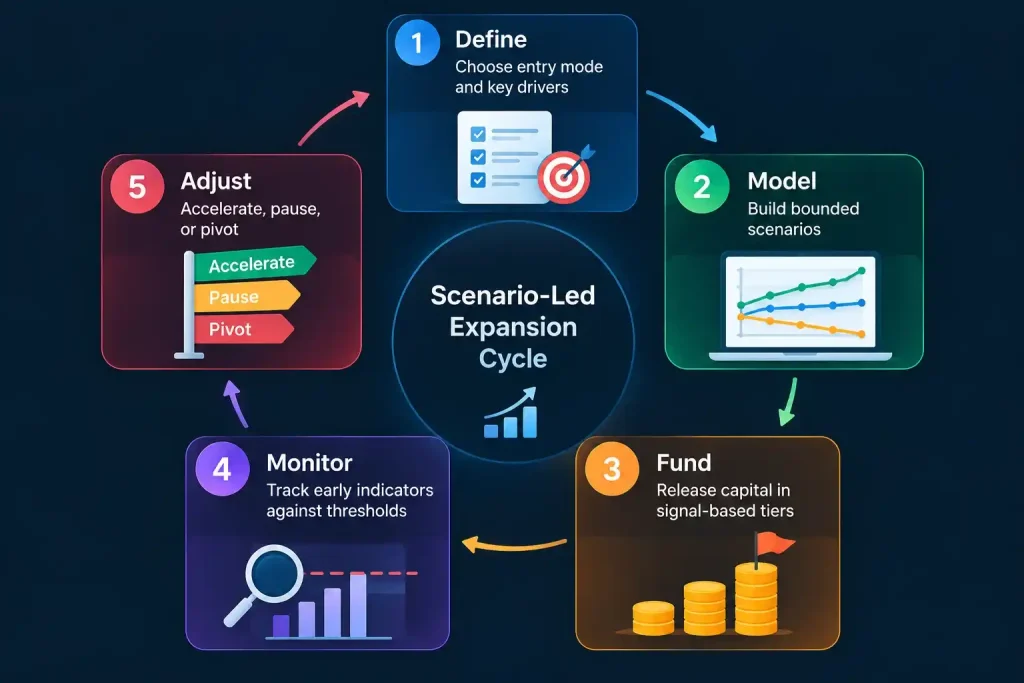
The Scenario-Led Expansion Cycle
| Define | Model | Fund | Monitor | Adjust |
| Choose entry mode and key drivers | Build bounded scenarios | Release capital in signal-based tiers | Track early indicators against thresholds | Accelerate, pause, or pivot |
Teams in new markets sense whether leadership acts from grounded clarity or abstract hope. When the CFO presents scenarios as intentions built with scaffolding, teams gain the confidence to act. The goal is not zero risk, but a company that knows where the edge begins before it takes the leap.
Three Key Takeaways
- Single-path expansion models create false confidence in leadership teams. Driver-based forecasting with multiple scenarios shows what breaks first and how the company should respond.
- Strong models focus on a handful of dominant drivers, predefined decision triggers, and capital released in tiers tied to real signals.
- Linking scenarios to strategic performance management keeps expansion reversible, so leaders can accelerate, pause, or pivot with discipline.
Disclaimer: This article is intended for informational purposes only and does not constitute legal, tax, or accounting advice. You should consult your own tax advisor or counsel for advice tailored to your specific situation.
Hindol Datta is a four-time CFO and senior finance executive with over 25 years of leadership experience across cybersecurity, SaaS, gaming, logistics, digital marketing, medical devices, consumer products, and nonprofit organizations. He has led more than $120M in fundraising and over $150M in M&A transactions while building the financial and operational systems that let complex businesses scale with confidence. He is the author of seven books in the Systems CFO Series and holds active CPA, CMA, and CIA credentials.
AI-assisted insights, supplemented by 25 years of finance leadership experience.