
Executive Summary
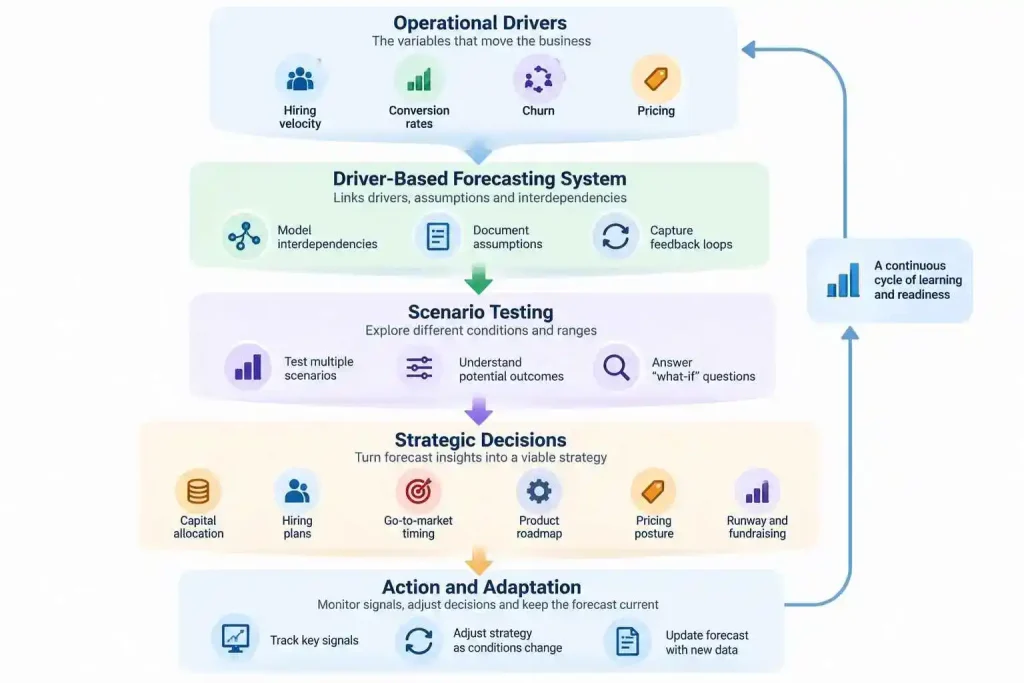
Driver-based forecasting links financial projections to the operational variables that actually move a business, such as hiring velocity, conversion rates, churn, and pricing. Its value lies less in predicting the future than in preparing the company to act when reality shifts. Every strategy is a theory about the future, and a strategy without a credible forecast is closer to a fable than a plan.
The sections ahead explain how CFOs use driver-based forecasting to shape strategy in five ways. They cover the mental models behind precision, the role of forecasts in forming strategy, and the design of scenario architecture. They also address the emotional politics of forecasting and how to embed it into daily decisions. Together they show precision as a discipline of readiness instead of a promise of accuracy.
The Foundations of Driver-Based Forecasting
Forecasting begins in the mind before it begins in a spreadsheet. The most serious forecasting error is not mathematical; it is the failure to admit what cannot be known. Precision, in this sense, means intentionality: finance interrogates every assumption and states the conditions behind every number.
From Components to Systems
Many corporate forecasts model each line item on its own, often in a straight line. A driver-based forecasting approach instead models how variables interact. Revenue growth stretches support capacity, which affects churn, which in turn changes upsell probability.
Component Forecasts Versus Driver-Based Systems
| Dimension | Component Forecast | Driver-Based Forecasting System |
| Structure | Each line projected independently | Lines linked through operational drivers |
| Logic | Linear extrapolation of history | Interdependencies and feedback loops |
| Assumptions | Hidden inside cell formulas | Documented with owners and rationale |
| Response to change | Surprise when one variable shifts | Visible cascade across the model |
| Typical result | Numbers that look precise | Insight into what moves the business |
An assumption ledger strengthens this structure in a practical way. It sits beside the model and records the beliefs behind each driver. Instead of stating that sales will grow 18%, it explains the three conditions behind that growth. It also notes that growth may fall to 12% if one condition fails. The forecast then becomes a conversation instead of a verdict.
Finance must also manage noise and bias in the data. Reported numbers arrive filtered through reporting delays and accounting conventions, so random swings can look like trends. People anchor on recent results and smooth out inflection points. One useful counter is a simple question: what would have to be true for the forecast to be wrong in both directions?
A cybersecurity and identity SaaS company with roughly $30M in ARR shows the payoff of this approach. A driver-based forecasting engine, capacity model, and steady reporting cadence kept actuals within plus or minus five percent of forecast for 8 consecutive quarters. That consistency came from modeling the drivers, not just the totals.
How Driver-Based Forecasting Shapes Strategy
A forecast becomes most valuable when it stops following strategy and starts shaping it. Visions tend to stay broad, and strategies often remain loose. The act of modeling, testing, and revising is where a viable strategy takes form.
Testing Ambition Against Reality
When a bold plan enters the model, it meets burn curves, ramp periods, retention lag, and dilution risk. The forecast does not reject the vision; it refines it by asking hard questions. What happens if ARR grows but cash flow weakens, or if sales hiring outpaces enablement?
Driver-based forecasting clarifies several strategic choices for leadership teams:
- Capital allocation: where the next dollar creates the most value across R&D, sales capacity, and geography
- Go-to-market timing: how ramp time and conversion variability delay revenue relative to hiring
- Product roadmap: which features justify their engineering, support, and testing costs
- Pricing posture: which price points win deals and which sustain margins over time
- Runway and fundraising: when cash burn peaks relative to the next capital raise
Consider a commercial plan to double coverage in three regions with a linear hiring ramp. A driver-based model may show that revenue lags hiring by nearly three quarters and that cash burn peaks just before the next fundraise. The ambition may be right while the tempo is wrong. Revealing that rhythm is how finance adds value without blocking strategy.
A pre-Series A AI governance and assurance platform illustrates this link between modeling and strategy. Finance built go-to-market financial models and partnership economics alongside multi-year scenario planning and capital strategy. Those models helped shape the order and pace of the company’s growth plans.
Building Scenario Architecture
The single forecast is one of the most persistent illusions in corporate life. It is tidy and easy to present, yet it ties the whole enterprise to one strand of hope. The future branches instead of following a line.
Scenarios That Provoke Action
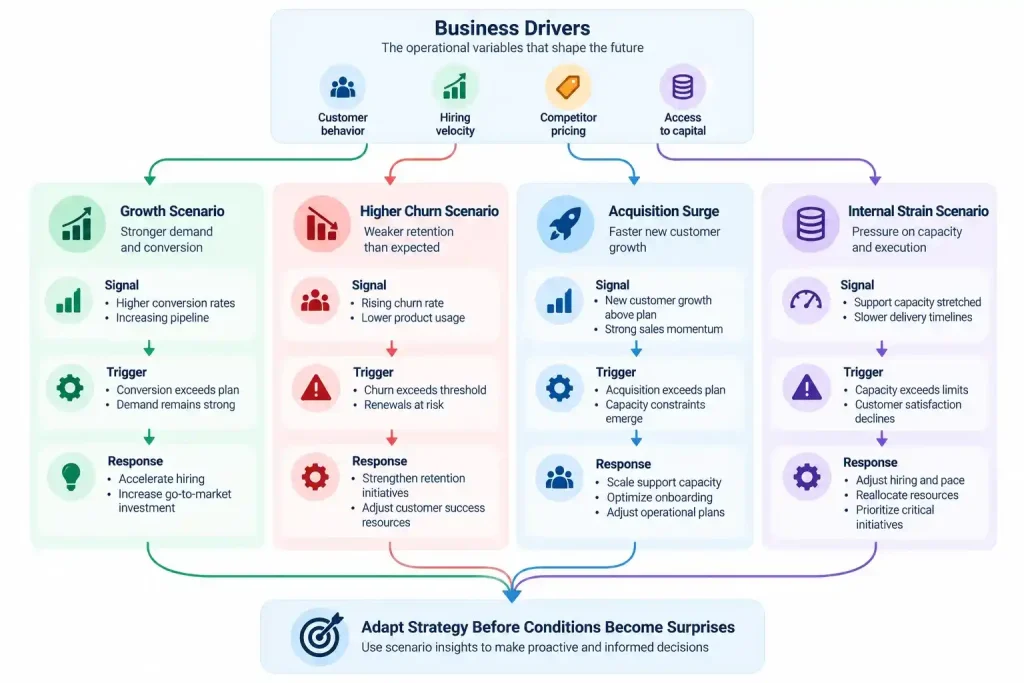
Best, base, and worst cases are calibration points, not true scenarios. A real scenario describes a coherent alternative world in which assumptions and interdependencies change together. Leaders choose each one for its strategic relevance, not only its likelihood.
Sample Scenario Architecture for a Shift to Subscription Revenue
| Scenario | What Changes | Strategic Posture |
| Smooth conversion | Low churn and fast cash flow inflection | Accelerate investment |
| Rising churn | Customers need re-engagement and heavier support | Stabilize the base |
| Acquisition surge | New customers grow faster than support capacity | Triage costs and service levels |
| Internal system strain | Billing and collections slow down | Redesign processes and systems |
Strong scenarios begin with drivers, not with desired outcomes. Finance identifies the variables that move the business, such as customer behavior, hiring velocity, competitor pricing, and access to capital. It then traces how a change in one driver cascades through payback, runway, working capital, and hiring plans.
The real power comes from linking each scenario to triggers. For every scenario, leaders define what they would do, what they would watch, and which signal would show they have entered that world. A global hardware business facing currency and supply chain shocks might review actuals every two weeks against component prices, shipping times, and regional demand. Such a firm can adjust sourcing, pricing, and investment before competitors update their forecasts.
The Emotional Politics of Forecasting
Even driver based forecasting cannot escape human emotion. Every forecast carries hope as well as arithmetic. Executives attach their credibility to forecasts, boards treat them as promises, and teams measure their worth against them. Lowering a forecast can trigger disappointment and blame.
Credibility Compounds
That pressure creates a temptation to round up, delay adjustments, or push pipeline assumptions higher. The CFO must resist, because a forecast should test hope, not signal it. Skepticism applied well is not pessimism; it is truth-telling.
Imagine a company whose sales target holds steady each quarter and misses by just enough to excuse the gap. Teams stop trusting the plan, and capital follows the wrong priorities. Rebuilding the forecast from the bottom up with scenario ranges and probability language can restore morale, because believable expectations replace bravado.
Healthy forecasting cultures need clear norms that make honesty safe while keeping rigor high:
- Keep forecast reviews free of posturing and blame
- Adjust numbers only when evidence supports the change
- Share bad news as soon as the team sees it
- Value honest ranges over the comfort of false precision
Embedding Driver-Based Forecasting Into Decisions
A forecast must eventually stop being an event and become a behavior. Leading companies ask how their understanding of the future changed this week, not just what the plan says. The forecast becomes a lens for hiring, pricing, and investment choices.
Rolling, Shared, and Consequential
A 12-month rolling forecast updated monthly shows how quickly assumptions age and how the company absorbs new information. Central finance provides the structure, while sales, marketing, and product supply context. Shared authorship builds trust, because people contribute honestly when the model reflects their world.
For a living forecast, accessibility matters as much as accuracy. Decision makers outside finance should see drivers, ranges, and assumptions in clear dashboards. When they understand the forecast, they stop gaming it and start using it.
Above all, the forecast must drive concrete action. If it changes and nothing follows, it loses relevance. Tying the model to headcount approvals, marketing spend, and product gates makes decisions faster and calmer. Every leader can then see how choices affect runway and strategic options.
A $127M global consumer products company with a supply chain spanning China and Vietnam shows the value of integrated planning. Finance built both an annual operating plan and a long-range plan while overseeing logistics across ocean freight, trucking, and warehousing. Those connected plans helped leaders adjust as conditions changed across channels and regions.
Driver-based forecasting, practiced this way, becomes the company’s sensing system. It does not promise certainty, but it helps the enterprise notice change early and respond with structure instead of surprise.
Three Key Takeaways
- Driver-based forecasting links projections to operational variables and documented assumptions, which turns forecasts into tools for preparation instead of prediction.
- Forecasts shape strategy when they test ambition against timing, cash, and capacity, and when scenario architecture ties each possible future to clear triggers.
- Honest forecasting cultures and rolling, shared models embed driver based forecasting into everyday decisions across the company.
Disclaimer: This article is intended for informational purposes only and does not constitute legal, tax, or accounting advice. You should consult your own tax advisor or counsel for advice tailored to your specific situation.
Hindol Datta is a four-time CFO and senior finance executive with over 25 years of leadership experience across cybersecurity, SaaS, gaming, logistics, digital marketing, medical devices, consumer products, and nonprofit organizations. He has led more than $120M in fundraising and over $150M in M&A transactions while building the financial and operational systems that let complex businesses scale with confidence. He is the author of seven books in the Systems CFO Series and holds active CPA, CMA, and CIA credentials.
AI-assisted insights, supplemented by 25 years of finance leadership experience.



