Executive Summary
An annual plan built once a year assumes the world will hold still for twelve months. It rarely does. Markets shift tempo, customers change demand, and supply chains contort overnight. A static plan cannot track any of that. Driver-based forecasting can, because it models cause and effect instead of locking in a fixed set of numbers.
This article sets out how driver-based planning turns a once-a-year ritual into a continuous process. It covers why traditional annual plans break under real-time data. It covers the infrastructure that supports dynamic scenario modeling. It covers how to protect data integrity once reports update continuously. And it covers how driver-based forecasting changes what finance actually does inside a company.
Why the Traditional Annual Plan Breaks Under Real-Time Data
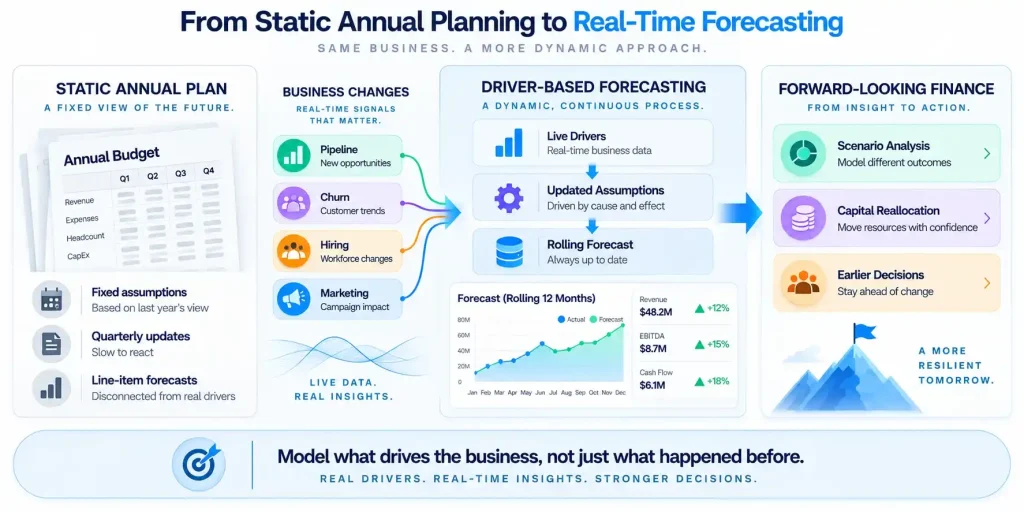
A plan fixed to fiscal quarters assumes predictability the business rarely delivers. Pipeline velocity, marketing attribution, churn signals, and hiring pace are not footnotes to the financial story. They are early warnings that an assumption made in October may not survive until March.
Real-time data changes what finance has to relinquish. Timing control has to go. Quality control cannot. That trade only works with real infrastructure behind it. APIs, unified data layers, and event-driven systems have to ingest live information instead of batch updates. Without that architecture, real-time data becomes noise rather than signal.
Driver-Based Planning as the Backbone of Scenario Modeling
Driver-based planning replaces line-item forecasting with cause-and-effect modeling. Instead of projecting a ledger line forward, finance models the driver behind it. That might be revenue per user, gross margin per shipment, or cost of acquisition by region. Each driver can flex up or down to simulate a different scenario, which turns forecasting into analysis rather than arithmetic.
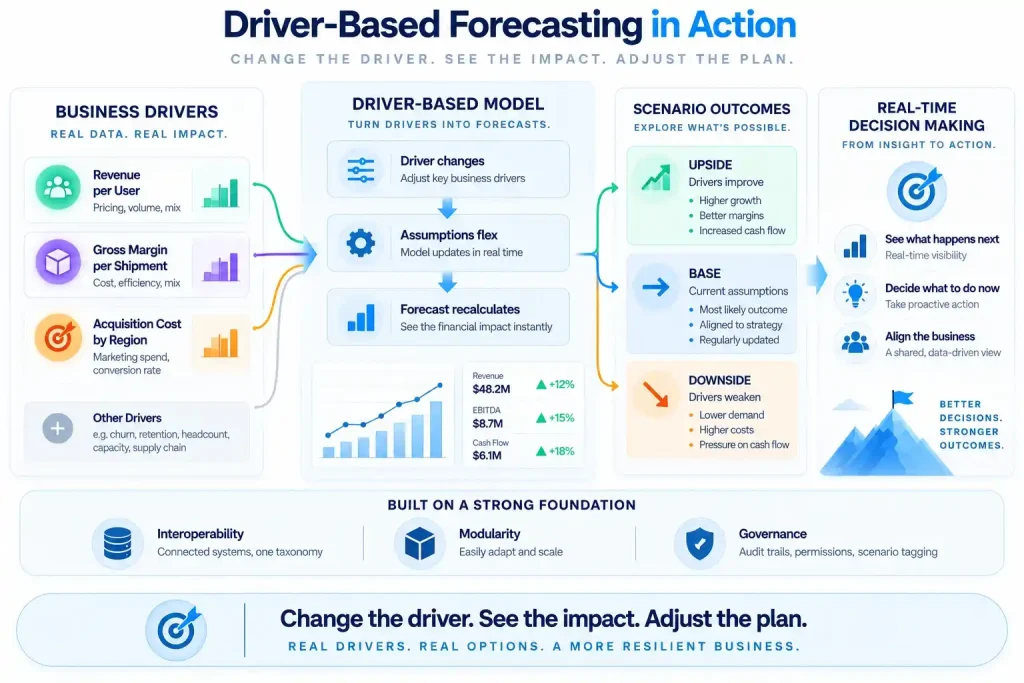
Four elements make this kind of modeling durable rather than fragile.
- Interoperability, so the general ledger, the CRM, and the HRIS share one taxonomy instead of three conflicting ones
- Modularity, so a CFO can swap a pricing assumption or add a revenue stream without rebuilding the whole model
- Real-time visualization, so dashboards update as assumptions shift instead of waiting for the next reporting cycle
- Governance, including user permissions, audit trails, and scenario tagging, so speed never comes at the cost of credibility
Case: Building the Model Before the Business Outgrows It
A high-growth cybersecurity and identity access management company built exactly this kind of driver-based forecasting engine, paired with a matching capacity model and a disciplined reporting cadence. The result held actuals within five percent of forecast for eight consecutive quarters. That accuracy did not come from predicting the future perfectly. It came from a model built around the actual drivers of the business. Each new data point sharpened the forecast, instead of invalidating it.
Protecting Data Integrity When Reports Never Stop Updating
Real-time reporting removes the old buffer of a measured close cycle. A team once could manually review and reconcile before anything reached a decision-maker. A single inconsistency can now reach a boardroom before anyone catches it. An overstated revenue figure or a misaligned churn definition is often all it takes.
Three habits protect data integrity once reporting runs continuously.
- Consistency, achieved by aligning definitions of revenue, headcount, and active users across every system that touches them
- Clarity, achieved by pairing every metric with enough context to explain what changed and why
- Control, achieved by logging and timestamping every adjustment so it stays auditable after the fact
Driver-based forecasting depends on this discipline more than traditional planning does. A model built on flawed drivers compounds the error every time it runs, rather than catching it once a quarter.
How Driver-Based Forecasting Changes the Role of Finance
Finance used to ask how the company did last quarter. Driver-based forecasting reframes the question. It asks what the current drivers suggest happens next. It also asks what the company should do about it before the quarter ends.
Case: Forecasting Accuracy as a Strategic Asset
A mission-driven education institution built its board reporting around exactly this kind of forward-looking model. Its financial planning ran multiple years of scenarios under variable funding conditions, rather than defending a single fixed number. A specific driver moved. The institution already had a response ready, instead of scrambling to explain a miss after the fact. The board came away with confidence in the process itself, not just the numbers a single scenario happened to produce.
This shift changes what a finance team spends its time doing. Reallocating capital based on a shifting driver matters more than restating a number that already happened. A rolling forecast, rebuilt continuously from live drivers, replaces a budget frozen in January and defended until December.
Three Key Takeaways
- Driver-based forecasting works because it models cause and effect, not a fixed line item. A driver can flex to simulate a new scenario, while a static number can only be defended or abandoned.
- The infrastructure behind driver-based planning matters as much as the model itself. Interoperability, modularity, and governance turn scenario modeling into something a CFO can trust. A spreadsheet that wobbles under its own assumptions cannot offer that.
- Once reporting runs continuously, data integrity becomes the real bottleneck. A driver-based model amplifies a bad definition just as fast as it amplifies a good one. That makes consistency and control part of the forecasting discipline itself.
Disclaimer: This article is intended for informational purposes only and does not constitute legal, tax, or accounting advice. You should consult your own tax advisor or counsel for advice tailored to your specific situation.
Hindol Datta is a four-time CFO and senior finance executive with over 25 years of leadership experience across cybersecurity, SaaS, gaming, logistics, digital marketing, medical devices, consumer products, and nonprofit organizations. He has led more than $120M in fundraising and over $150M in M&A transactions while building the financial and operational systems that let complex businesses scale with confidence. He is the author of seven books in the Systems CFO Series and holds active CPA, CMA, and CIA credentials.
AI-assisted insights, supplemented by 25 years of finance leadership experience.