
Executive Summary
A dividend recapitalization lets a company borrow new debt and pass the proceeds to shareholders as a dividend, delivering liquidity without a sale or a change of control. For private equity sponsors and founders, a dividend recap can return capital early, lock in part of a gain and preserve the upside of a later exit.
That liquidity carries a cost, and the business pays it instead of the investor. This article covers the mechanics, the incentive shifts, the US tax rules and the systemic risk behind debt-funded payouts.
What Is Dividend Recapitalization and Why Do Sponsors Use It?
At its simplest, dividend recapitalization is a financing event in which a company raises debt for the sole purpose of paying its owners. The product, team and strategy stay the same, while the balance sheet now carries debt where retained capital once sat.
In the early leveraged buyout era, sponsors used recaps to realize gains, reduce equity at risk and return capital to limited partners while still holding the asset. Bloomberg reported that private equity firms borrowed roughly $94B in 2025 to fund payouts, a sign that slow exit markets keep pushing sponsors toward this route.
A dividend recap is, at heart, a choice about timing that brings distributions forward and leaves repayment for later years. One question deserves an answer before any deal closes: when capital leaves before value is fully created, who carries the obligation that remains?
How a Dividend Recap Works: Debt, Distributions and the Leverage Loop
A typical candidate is a private, sponsor-owned business with steady cash flow and a few years of operating improvement behind it. The company layers a new term loan or second-lien tranche onto its existing capital structure. Those proceeds skip capital expenditure, research and acquisitions and flow straight up to equity holders as a declared dividend.
The Dividend Recap Transaction Flow
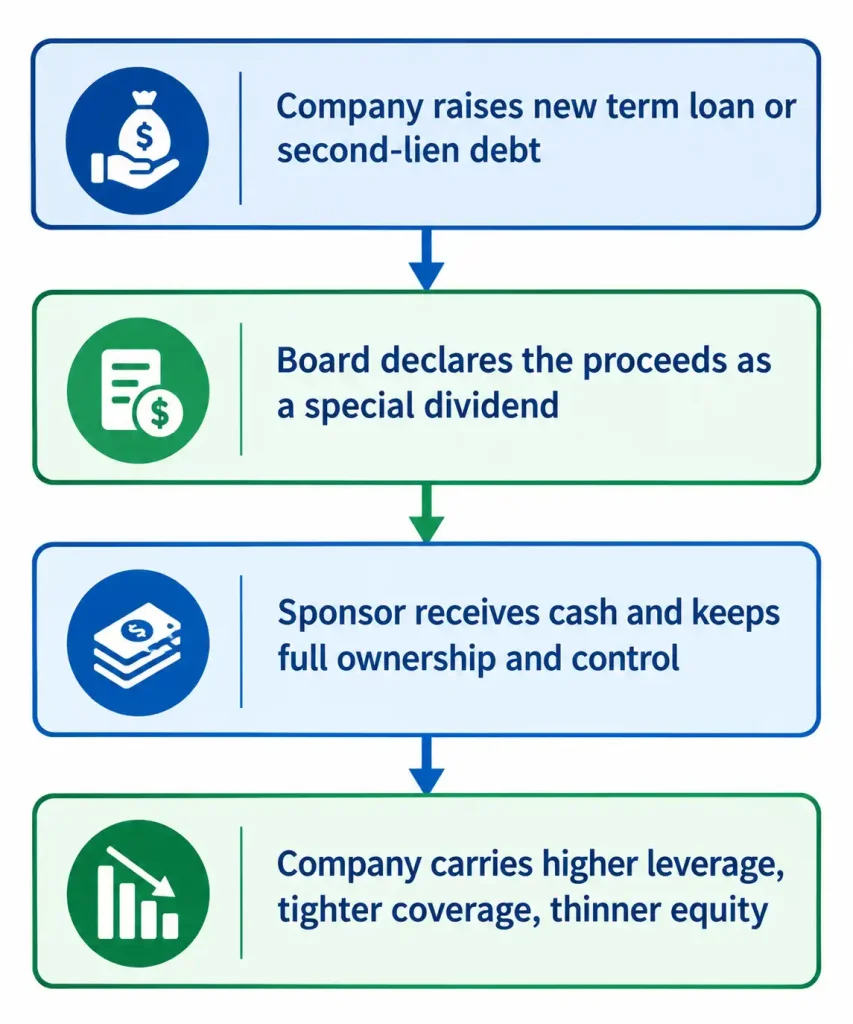
Afterward, leverage climbs and coverage narrows, yet the company issues no new equity and control stays put. Ownership survives intact, but its tolerance for bad news shrinks.
Why Lenders Underwrite Debt-Funded Dividends
Lenders agree to these deals when credit appetite, a credible operating history and favorable timing line up. Recaps cluster in the middle of a holding period, once EBITDA has stabilized or grown, and in low-rate markets where lenders accept more leverage for better spreads.
Underwriters stress-test post-recap cash flow against the heavier interest load, often modeling EBITDA shocks of 20% to 30%. A $30M ARR cybersecurity and identity SaaS business that held actuals within 5% of forecast for 8 consecutive quarters shows the kind of record that reassures a credit committee. Without that record, lenders price the uncertainty into the loan or decline the transaction.
Prudent Recaps Versus Financial Extraction
Many dividend recaps are prudent, and a well-structured deal tends to share several features:
- Moderate leverage that leaves real headroom under downside scenarios
- Substantial equity retained by the sponsor and management after closing
- Timing tied to proven, recurring cash flow instead of projected growth
- Continued investment in the business alongside the distribution
Problems emerge when a recap comes too early, too aggressively or late in a weakening market. In those cases, employees, vendors and lenders absorb the volatility while the sponsor has already secured part of its return.
Incentives and Game Theory Behind the Dividend Recap
Beyond moving value, a dividend recap rewires the incentive architecture of the company, and misaligned incentives tend to compound fragility over time.
The Sponsor’s Asymmetric Payoff
A recap lets the fund deliver interim distributions, lift fund-level IRR and hedge portfolio exposure without giving up control. If the business keeps performing, the sponsor benefits twice: once from the dividend and again at exit. Should the business falter, only the second benefit disappears. This reflects risk optimization under a fund mandate, not malice, yet game theory warns that asymmetric payoffs erode cooperation.
How Management, Lenders and Employees Experience the Recap
Once the debt service clock starts, the company’s time horizon splits from the investor’s. The effects tend to surface across every stakeholder group:
- Management delays capital spending, slows hiring and mutes strategic risk to protect covenants
- Lenders rely on covenants and security packages but rarely see performance in fine detail
- Employees inherit more performance pressure, fewer resources and a smaller margin for error
- Board members must now prove resilience to cash flow schedules, not only to markets
The Leverage Feedback Loop
In systems terms, higher leverage raises the cost of failure, which changes decisions, which then shapes performance and future capital allocation.
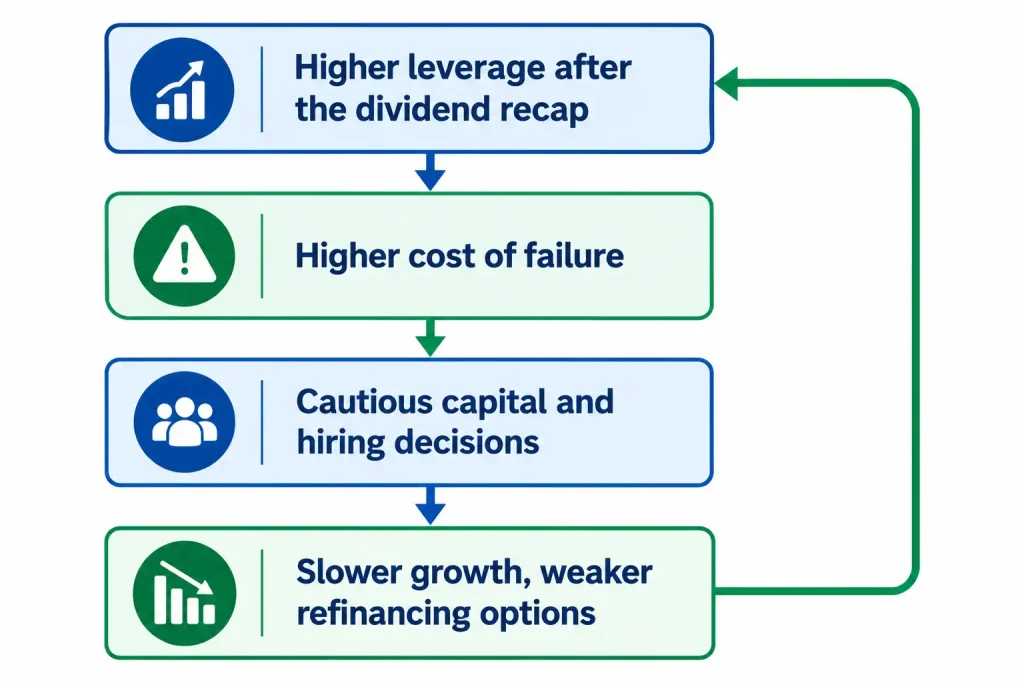
This loop amplifies good and bad outcomes alike. A digital marketing company that had to cut monthly burn from $800K to $200K shows how fast fixed cash commitments reshape operating choices once conditions turn.
How a Dividend Recap Is Taxed: Character, Basis and Hidden Triggers
Tax law looks past liquidity to form, source and intent, and its label for a recap dividend decides the rate, timing and future basis.
Section 301 and the Distribution Ordering Rules
Most recap dividends fall under Section 301, which sorts a distribution in three steps:
- Dividend income, up to the corporation’s current and accumulated earnings and profits (E&P)
- Tax-free return of capital, which reduces the shareholder’s stock basis
- Capital gain on any excess once that stock basis reaches zero
Debt-funded payouts often exceed E&P soon after a leveraged buyout, so part of the distribution escapes immediate tax as a deferral against basis.
Qualified Versus Ordinary Dividend Treatment
For individuals and pass-through owners, qualified dividends face rates of 15% to 20%, while ordinary dividends can reach 37% federally. Qualification depends on three tests set out in the Code:
- The shareholder held the stock more than 60 days within the 121-day window around the ex-dividend date
- A qualified US corporation paid the dividend under the Internal Revenue Code
- Section 1059 extraordinary dividend rules do not reach the distribution
Partnerships and the Disguised Sale Risk
When the recipient is a partnership or sponsor LLC, distributions are generally tax-free up to outside basis, with any excess taxed as gain under Section 731. The real danger arises after a Section 721 contribution of appreciated property. Treasury regulations presume that a distribution within two years of such a contribution is a disguised sale under Section 707(a)(2)(B). The IRS can then recast the whole sequence as a sale and tax the gain immediately.
Serial Recaps, Basis Erosion and QSBS
Any return of capital is deferred instead of forgiven. Each dollar received lowers basis, which enlarges the gain on a later sale. Multiple recaps in one holding period can leave holders with low-basis equity and large latent gains, a serious exposure if the exit is delayed.
Qualified Small Business Stock under Section 1202 adds another trap. It can shelter up to $10M of gain, or $15M for stock issued after July 4, 2025. Significant redemptions near issuance can disqualify that stock, so a recap structured with redemptions may cost more than the dividend delivers.
Systemic Risk in the Dividend Recapitalization Cycle
At the firm level, a recap turns retained capital into debt, and financing outflows surge with debt service even when operating cash flow holds steady. The recap behaves like an accelerant, boosting returns in good years and deepening brittleness in bad ones.
Spread across a portfolio, that exposure becomes systemic. Later-stage funds face pressure to show interim liquidity, and cheap credit makes the dividend recap look routine. During expansion, spreads tighten, covenants loosen and recap volume spikes. When rates rise, refinancing turns punitive and amortization schedules strain cash flow.
The 2006 to 2007 period remains the archetype. Dividend recaps surged alongside covenant-lite lending, and many of those companies later suffered impairment from capital structure rigidity, not operating failure. The liquidity had long since departed, while the debt stayed behind on the balance sheet.
Underwriting models also miss behavior, since leaders under pressure may delay investment or squeeze working capital while covenant compliance masks operational decay.
Alternatives Worth Testing First
Internal cash release is sometimes the better path to liquidity. A $127M global consumer products company that lifted inventory turns from 3x to 7x freed trapped working capital without adding any leverage.
Governance Discipline for a Dividend Recapitalization
Used well, a dividend recapitalization is a legitimate tool for strong businesses with recurring revenue, stable margins and patient owners, provided governance keeps pace with structuring. A board reviewing a proposed recap should confirm a few points:
- Downside cases show the company can service the new debt without starving growth
- A solvency opinion and fraudulent conveyance review protect the directors and the sponsor
- Tax counsel has mapped E&P, basis, disguised sale and QSBS exposure in advance
- Management incentives still reward long-term value creation after the distribution
Three Key Takeaways
- A dividend recap does not remove risk; it moves risk from the investor to the company. A sound recap reflects a calibrated shift in the capital structure, stress-tested well beyond the base case.
- Tax character decides the real value of a recap distribution. E&P, basis, partnership rules and QSBS status belong in the structuring phase, because recharacterization after closing is costly and hard to reverse.
- Leverage is an active force that reshapes behavior across management, lenders and employees. Every dividend recapitalization needs governance that protects investment capacity and long-term incentives.
Disclaimer: This article is intended for informational purposes only and does not constitute legal, tax, or accounting advice. You should consult your own tax advisor or counsel for advice tailored to your specific situation.
Hindol Datta is a four-time CFO and senior finance executive with over 25 years of leadership experience across cybersecurity, SaaS, gaming, logistics, digital marketing, medical devices, consumer products, and nonprofit organizations. He has led more than $120M in fundraising and over $150M in M&A transactions while building the financial and operational systems that let complex businesses scale with confidence. He is the author of seven books in the Systems CFO Series and holds active CPA, CMA, and CIA credentials.
AI-assisted insights, supplemented by 25 years of finance leadership experience.