
Executive Summary
Digital transformation in financial controls is no longer a back-office upgrade cycle. One finance function finds problems only after the damage occurs. Another catches issues early. That means spotting a misclassified vendor payment or a revenue recognition gap. It means catching a policy violation while there is still time to act. For growth-stage and pre-IPO companies, this is the shift from manual, periodic oversight to embedded, continuous control logic. That shift determines whether the business can scale without its headcount, risk, and audit exposure scaling at the same rate.
This article traces that shift across four dimensions. It covers why legacy controls fail under modern operating speed, what a digitally embedded control environment looks like, and how control sophistication should match company stage and risk. It also covers why a mature control architecture signals enterprise readiness to boards, auditors, and acquirers.
Why Traditional Financial Controls Break Down in Digital Environments
Companies built their financial controls for a slower era. Approvals moved through email. Reconciliations happened once a month. Expense reviews ran on a quarterly clock. That cadence assumed a business that operated in one system, in one time zone, with a finance team that could physically see most of what was happening. Modern companies do not meet any of those assumptions, and the controls inherited from that earlier era tend to fail in three specific ways.
The first is latency. Most legacy controls are retrospective by design, so a discrepancy surface only after the transaction has already flowed through the books. The second is fragmentation. Financial data now lives across an ERP, a CRM, a payroll system, and a procurement tool. Controls that a team designed for a single ledger rarely travel across that many systems cleanly. The third is manual enforcement, which relies on people remembering policy and interpreting exceptions correctly, a dependency that compounds error as transaction volume grows.
In a $30M ARR cybersecurity and identity access management company spanning five countries, the absence of a unified forecasting and controls engine meant that variance surfaced weeks after it occurred rather than days. Building a driver-based forecasting model and a NetSuite implementation across those entities compressed the monthly close from eighteen days to ten and held actuals within five percent of forecast for eight consecutive quarters. The lesson generalizes well beyond one industry: a policy that exists on paper but is not enforced by the systems processing the transactions is not a control, it is a hope.
What Digital Transformation in Financial Controls Actually Looks Like
Digital transformation in financial controls is not simply the automation of an existing manual step. It represents a structural change in where control logic lives, moving it from a person checking a box after the fact to a system enforcing a rule as the transaction happens. Several categories of embedded control now do work that used to require a headcount:
- Automated approval workflows tied to budget thresholds and predefined business rules
- Real-time exception alerts on duplicate invoices, spend anomalies, or policy violations
- Integration triggers that block journal entries until source data reconciles
- Access controls enforcing data visibility and segregation of duties across systems
- Usage tracking that validates software licenses and vendor subscriptions against actual need
These controls do not wait for month-end close. They run continuously, and in a healthy system they are invisible until the moment something needs attention. A useful way to think about this shift is that digital controls behave less like a checklist and more like a nervous system, sensing and transmitting across the organization without requiring constant conscious oversight.
Proportional Design: Matching Controls to Stage and Risk
Not every company needs the same depth of control. A pre-revenue SaaS startup should prioritize cash discipline and vendor approval hygiene long before it needs intercompany elimination logic. A Series B e-commerce company needs stronger inventory, returns, and fraud detection. A later-stage international company must manage FX exposure, tax reporting integrity, and cross-border consolidation. The discipline is matching control sophistication to actual enterprise complexity rather than over-engineering a control stack the business does not yet need.
A helpful framework separates controls into three functional categories:
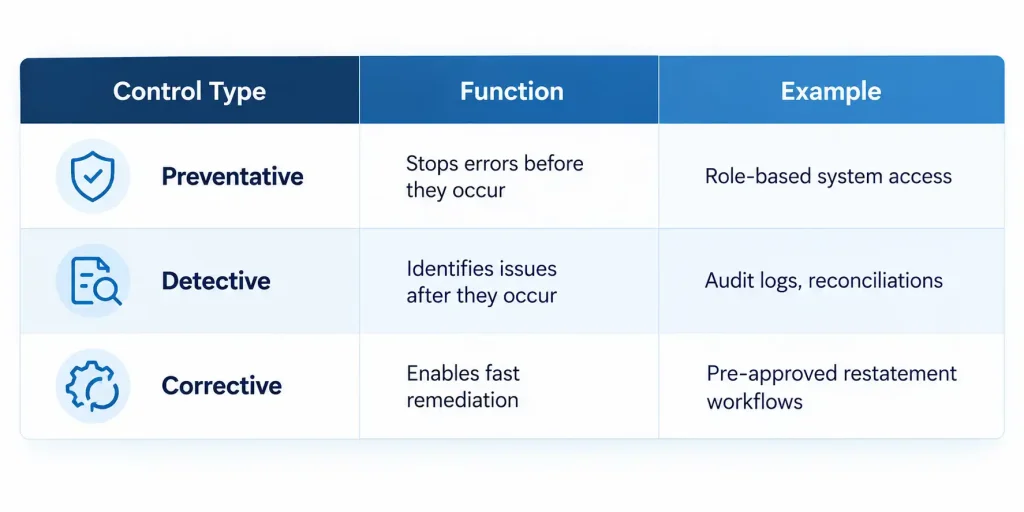
The objective is coverage and clarity, not volume. In a $127M global consumer products company selling direct-to-consumer, on Amazon, and through wholesale, with manufacturing across China and Vietnam, demand planning and SKU rationalization more than doubled inventory turns, from three times to seven times, while the business still delivered four consecutive clean external audits, evidence that tighter controls and operational speed are not in tension when the architecture is right.
Building an Integrated Control Architecture
An ERP remains the transactional core of any control environment, but it cannot function as an island. Controls become real when the ERP is wired to the systems that actually generate the underlying activity: a CRM passing contract terms for revenue planning, a procurement platform feeding vendor approvals into payables, a payroll system syncing headcount into budget tracking in real time, and a data warehouse unifying operational metrics that inform financial logic. Middleware and APIs bridge these flows, but governance, meaning clear ownership of data lineage, versioning, and exception handling, is what actually holds the system together.
Ownership Clarity Through RACI
Scalable controls require explicit ownership. Ambiguity between finance, operations, and IT is where gaps quietly form. A RACI structure applied to a control area such as revenue recognition might look like this:
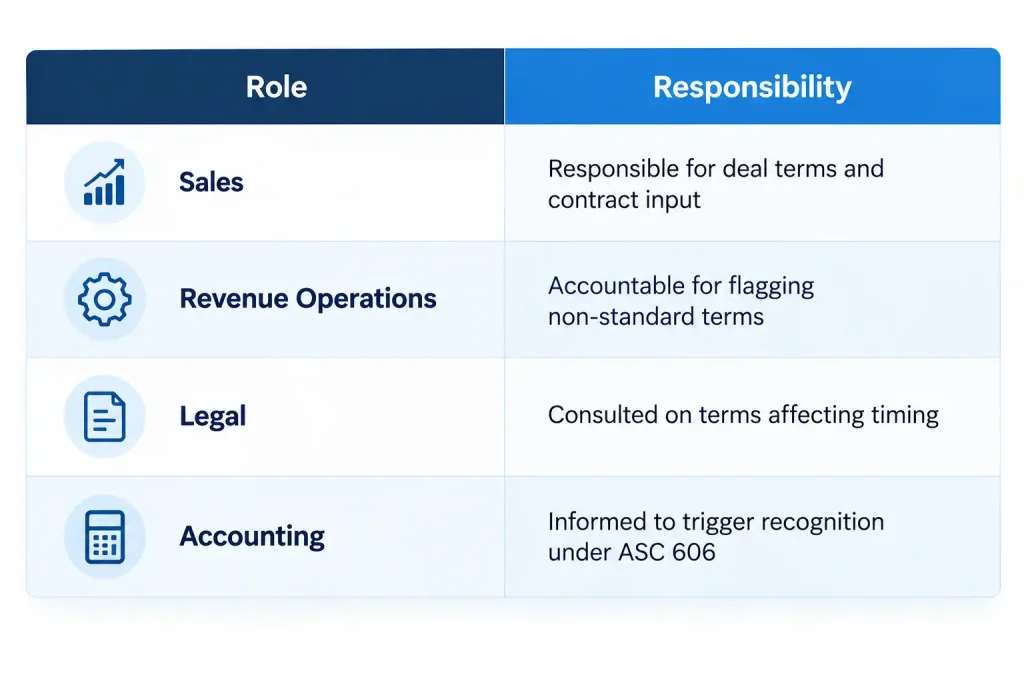
At a Euronext Paris-listed gaming and digital entertainment company operating across five countries, a global Oracle Financials and MicroStrategy rollout created a single definition of revenue across every subsidiary, cutting statutory reporting cycles under both IFRS and US GAAP while supporting more than $100M in cross-border M&A execution and an S-1 filing process with Big Four auditors. None of that consolidation would have held up without clearly assigned ownership at every handoff between systems.
Automation inside this architecture must also be calibrated rather than applied by default. A firm that auto-approved vendor invoices under $5K without requiring procurement sign-off discovered $120K in non-compliant spend before the gap was caught, a reminder that automation must remain auditable and exception-aware rather than a source of false confidence.
Embedding a Culture of Control Without Slowing Execution
Speed and control are frequently framed as opposing forces, but that framing does not hold up under scrutiny. Companies that scale durably are not the ones moving recklessly; they are the ones moving decisively inside a system their teams trust. Controls that live in the behavior and language of an organization stop feeling like friction and start feeling like confidence.
The behavior of the people operating a control system determines its actual strength, regardless of how well it is automated:
| Behavior | Resulting Control Outcome |
| Ownership mindset | Controls are self-enforced and proactive |
| Policy treated as suggestion | Controls are bypassed, then rationalized |
| Fear of delay | Controls are circumvented quietly |
| Trust in finance | Controls are viewed as value-added |
| Adversarial posture | Controls trigger resistance or gaming |
Cross-Functional Ownership and Training
Cross-functional control councils, small working groups spanning finance, operations, IT, and legal that meet quarterly to review exceptions and upcoming system changes, close the gap that opens when finance owns policy but not process. Training reinforces this only when it explains the reasoning behind a control rather than simply listing the rule; employees resist meaningless controls, not controls in general.
At a mission-driven education and research institution in Silicon Valley, running Finance, HR, IT, Legal, and Facilities simultaneously while raising $37M in equity and venture debt made clear that audit committee engagement depends on the same cultural buy-in that governs a spend policy on the ground floor. The structure only worked because department heads understood why the reporting cadence existed, not merely that it was required.
Financial Controls as a Strategic Advantage
Mature control systems change how a company is perceived externally, not only how it operates internally. Investors, auditors, and acquirers increasingly treat control maturity as a proxy for management quality. A well-instrumented control environment signals that policies are system-enforced rather than aspirational, that forecasts are tethered to verified data, and that compliance runs continuously instead of being reconstructed before an audit.
This has a direct effect on forecast accuracy, since clean input data reduces manual adjustment and gives finance a stable baseline for scenario planning. It also affects deal timelines. In a venture-backed digital marketing company scaled from $9M to $180M in revenue over twenty-four months, building CAC, LTV, and contribution margin discipline alongside the finance function itself supported three acquisitions and $36.5M raised across three funding rounds, work that would have been far harder to defend to investors without numbers that were consistent and auditable on demand.
Three Key Takeaways
- Digital transformation in financial controls succeeds when control logic is embedded directly into operational workflows rather than layered on afterward, since a policy the systems do not enforce functions as a suggestion rather than a control.
- Control sophistication should scale with company stage and risk profile, not with the availability of new tools; the goal is coverage and clarity across preventative, detective, and corrective categories, not the accumulation of controls for their own sake.
- A control environment is ultimately a cultural asset as much as a technical one, and the companies that sustain scale are those where ownership, training, and incentives reinforce the same discipline that the systems are designed to enforce.
Disclaimer: This article is intended for informational purposes only and does not constitute legal, tax, or accounting advice. You should consult your own tax advisor or counsel for advice tailored to your specific situation.
Hindol Datta is a four-time CFO and senior finance executive with over 25 years of leadership experience across cybersecurity, SaaS, gaming, logistics, digital marketing, medical devices, consumer products, and nonprofit organizations. He has led more than $120M in fundraising and over $150M in M&A transactions while building the financial and operational systems that let complex businesses scale with confidence. He is the author of seven books in the Systems CFO Series and holds active CPA, CMA, and CIA credentials.
AI-assisted insights, supplemented by 25 years of finance leadership experience.