
Executive Summary
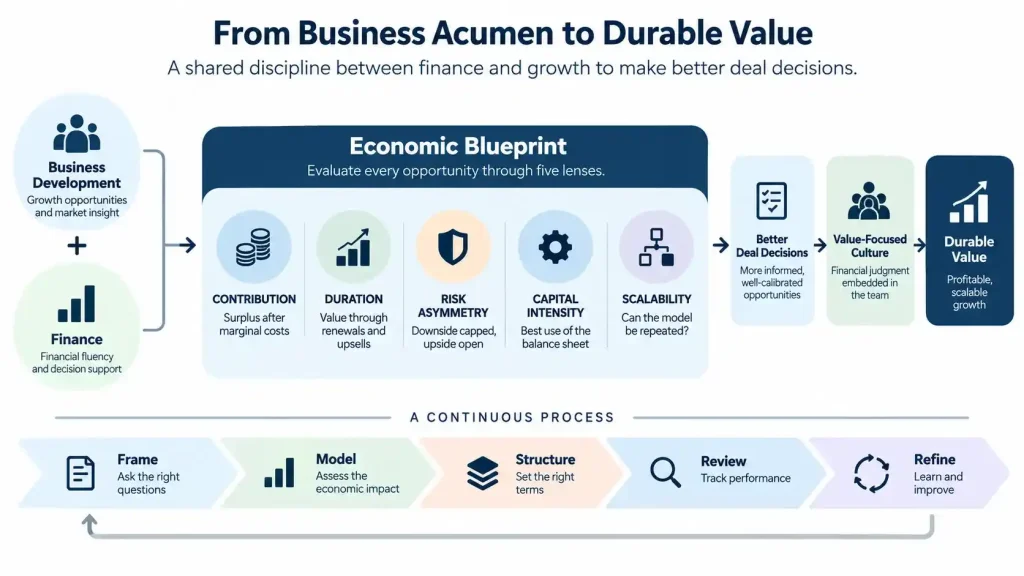
Business development teams that develop business acumen stop chasing volume and start compounding value. Without financial fluency, a promising deal can compress margin, slow cash, and absorb capital long before anyone notices. This article frames business acumen development as a shared discipline between finance and growth, not a final checkpoint in the pipeline.
The sections ahead diagnose the cost of uninformed growth and set out an economic blueprint for every opportunity. They also reposition the CFO as a partner in the field and show how financial judgment becomes part of team culture.
Why Growth Without Business Acumen Erodes Enterprise Value
Growth has a talent for hiding its own costs behind the language of momentum, market share, and new logos. To an untrained eye it resembles success, yet beneath the surface it may be erosion wearing a confident smile.
Seasoned finance leaders know this pattern from experience. One deal glows in the pipeline but leaves a shadow on the P&L. A partnership excites the boardroom while draining the balance sheet. Market entries can lift the topline and quietly dismantle the margin structure underneath. These outcomes are not accidents; they follow predictably when business development runs without financial fluency.
How Small Exceptions Compound into Structural Damage
The root cause is rarely bad intent; far more often, it is momentum. In the name of growth, organizations grant exceptions to pricing discipline, contract safeguards, and cost recognition. A deal that “opens a door” receives permission to underperform, and a new vertical opens on market size alone.
Early signals look encouraging, since the pipeline thickens and revenue climbs. Over time, though, gross margins compress, collections slow, and complexity multiplies. The company becomes busier without ever becoming better at what it does.
A professional services firm that scaled from $12M to $63M in revenue within 8 months shows why visibility matters. Engagement-level profitability analytics across its five business units finally showed leadership where the business created margin. The same analytics exposed where margin was quietly leaking across service lines, a view that growth alone had obscured.
The Hidden Cost of Organizational Drag
Uninformed growth misallocates capital, distorts incentives, and creates an illusion of scale where none exists. Every new partner also adds systems, contracts, and exceptions that never appear as a line item. These costs surface instead in meetings, manual workarounds, and operational friction.
Business development professionals are often among the most strategic thinkers in any company, and what they lack is instrumentation, not intelligence. Finance helps most when it teaches the reasoning behind four early questions:
- What is the true cost of acquiring this customer?
- How long will this deal take to convert into cash?
- In what ways does this initiative affect operating leverage?
- What structural risks sit inside this customer segment?
An Economic Blueprint to Develop Business Acumen Across BD Teams
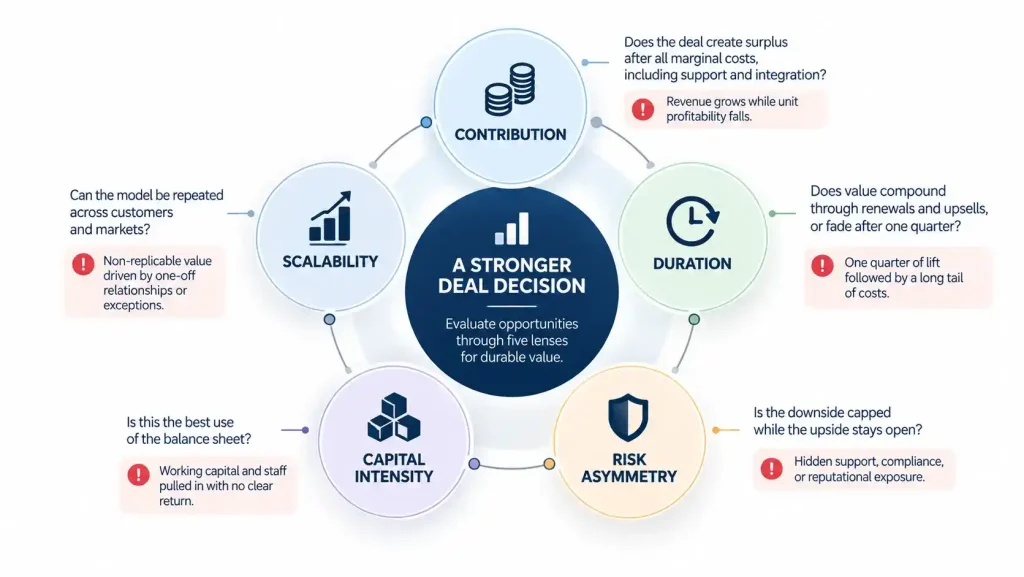
Business development rarely suffers from a lack of vision; it suffers from a lack of calibration. The most dangerous opportunity is not a bad idea but a partially informed one. An economic blueprint closes that gap with a shared decision grammar built on five lenses.
The Five Lenses of the Economic Blueprint
| Lens | Core Question | Warning Sign |
| Contribution | Does the deal create surplus after all marginal costs, including support and integration? | Revenue grows while unit profitability falls |
| Duration | Does value compound through renewals and upsells, or fade after one quarter? | One quarter of lift followed by a long tail of costs |
| Risk asymmetry | Is the downside capped while the upside stays open? | Hidden support, compliance, or reputational exposure |
| Capital intensity | Is this the best use of the balance sheet? | Working capital and staff pulled in with no clear return |
| Scalability | Can the model be templatized and repeated? | Value that works once but cannot be replicated |
Reading the Five Lenses Together
Contribution is the first gate, because a flashy deal that burdens delivery is dilution in disguise. Duration asks teams to think in arcs instead of events, and risk asymmetry turns deal makers into portfolio managers. Capital intensity asks whether a deal deserves scarce capital, while scalability separates deals that deepen with volume from those that dilute.
A cybersecurity and identity SaaS company with roughly $30M in ARR shows the payoff. Gross margin improved by twelve percent through pricing discipline, workforce composition, and delivery cost management. That gain came from seeing contribution before signing, not from a policy memo issued after the fact.
Tools That Make Business Acumen Development Practical
The blueprint only works when it lives inside the daily workflow, not in a quarterly slide deck. A few simple tools make that possible:
- Deal calculators that project IRR from configurable inputs
- Pricing models that show contribution across several volume scenarios
- Decision trees that link economic triggers to strategic thresholds
- Time-to-breakeven curves grounded in real acquisition and retention data
Joint modeling sessions, live case debriefs, and shared deal reviews build fluency in both directions. Business development learns the logic of capital allocation, while finance learns the cadence of commercial work.
The CFO as a Strategic Partner in Business Acumen Development
Many executives see the CFO as the keeper of history, yet few roles face forward more directly. Traditionally, finance arrives after the deal team has built a deal and can only approve or veto terms already set. At that stage the CFO can only sponsor or spoil, and neither role creates much value.
From Gatekeeper to Partner
| Dimension | Gatekeeper Model | Partner Model |
| Timing | Final approval gate | Opportunity framing stage |
| Core question | Does this meet the hurdle rate? | Which assumptions are most sensitive? |
| Tone | Veto and validation | Design and co-creation |
| Outcome | Weak deals rejected late | Strong deals structured early |
Asking Creative Questions Instead of Policing Ones
Partnership means translating financial thresholds into commercial levers that a deal team can pull. Suppose the business needs a 25% contribution margin; which delivery model gets there? When breakeven must arrive within 12 months, the team needs a phased investment plan. For a high-risk client, the right contract terms limit exposure while preserving upside.
A venture-backed digital marketing company that scaled from $9M to $180M in 24 months offers a useful reference point. Disciplined analytics on CAC, LTV, and contribution margin sustained that growth instead of slowing it. Commercial teams gained a shared view of which revenue was worth pursuing and which would dilute the business.
Strategic Empathy and Knowing When to Step Back
Effective CFOs respect the pressure to land deals and link each one to liquidity and investor narrative. External partners notice when finance joins the room and read it as seriousness, not bureaucracy. The art lies in being available without being omnipresent, so finance never becomes a bottleneck.
Embedding Business Acumen Development into Team Culture
Culture in business development has little to do with office perks or celebratory messages. It is a collective way of seeing, shaped by the questions teams ask without prompting. The goal is not a department of part-time CFOs, but a team that seeks out numbers instead of fearing them.
Changing the Language and the Scorecard
Leadership sets the tone by modeling financial curiosity in every pipeline review. A strong margin profile deserves the same applause as a famous logo, and walkaway discipline deserves recognition as stewardship. Even the question changes, from “Can this deal close?” to “Should the company invest in this customer?” Teams repeat what leaders celebrate, so the scorecard has to evolve alongside the language.
From Volume Metrics to Value Metrics
| Volume-Focused Scorecard | Value-Focused Scorecard |
| Number of deals closed | Contribution margin per deal |
| Logo size and brand prestige | Lifetime value relative to acquisition cost |
| New geographies entered | Time-to-breakeven by market |
| Gross contract value | Revenue quality and volatility |
| Pipeline volume | Capital efficiency and time-to-cash |
Deal Postmortems That Build Instinct
Postmortems on wins, not only losses, are among the fastest ways to develop business acumen inside a commercial team. After each deal closes, the team can revisit four questions:
- Did the deal meet its modeled contribution margin?
- How accurate were the initial acquisition cost estimates?
- Did cash arrive faster or slower than planned?
- Which risks surfaced that the original model missed?
These reviews work as learning rituals, not punishments, and over time the team spots poorly shaped deals on its own. In this setting the CFO acts more like a gardener than an enforcer, making models accessible and praising good structure.
Recasting Growth as a Discipline of Value
Financial acumen is not the enemy of ambition; it is what turns ambition into durable value. The cycle below shows how business acumen development becomes a repeatable habit instead of a one-time initiative.
The Business Acumen Development Cycle
| Frame | Model | Structure | Review | Refine |
| Finance joins at the idea stage | Test the five lenses | Shape terms around thresholds | Compare results to the model | Feed lessons into the next deal |
Investors reward growth that endures across revenue, margin, retention, and reinvestment efficiency. When business development thinks like a capital allocator and finance listens like a strategist, the line between them fades. What remains is a company that chooses its opportunities wisely and grows stronger as well as bigger.
Three Key Takeaways
- Growth that ignores contribution, time-to-cash, and capital intensity can look like success while eroding value. Business acumen development must therefore begin at opportunity framing, not at final approval.
- A shared economic blueprint built on contribution, duration, risk asymmetry, capital intensity, and scalability gives business development and finance a common language for every deal review.
- Lasting change comes from culture, which means rewarding margin quality alongside volume. Postmortems on wins help teams develop business acumen as an instinct instead of a compliance exercise.
Disclaimer: This article is intended for informational purposes only and does not constitute legal, tax, or accounting advice. You should consult your own tax advisor or counsel for advice tailored to your specific situation.
Hindol Datta is a four-time CFO and senior finance executive with over 25 years of leadership experience across cybersecurity, SaaS, gaming, logistics, digital marketing, medical devices, consumer products, and nonprofit organizations. He has led more than $120M in fundraising and over $150M in M&A transactions while building the financial and operational systems that let complex businesses scale with confidence. He is the author of seven books in the Systems CFO Series and holds active CPA, CMA, and CIA credentials.
AI-assisted insights, supplemented by 25 years of finance leadership experience.