
Executive Summary
Decision models matter most when the future refuses to behave. Historical data no longer predicts demand with confidence, supply chains snap instead of stretching, and costs shift without warning. Yet boards still expect leaders to allocate capital, fund operations, and enter or exit markets. Executive decision making in this setting needs models built to orient the company, not to predict a single outcome.
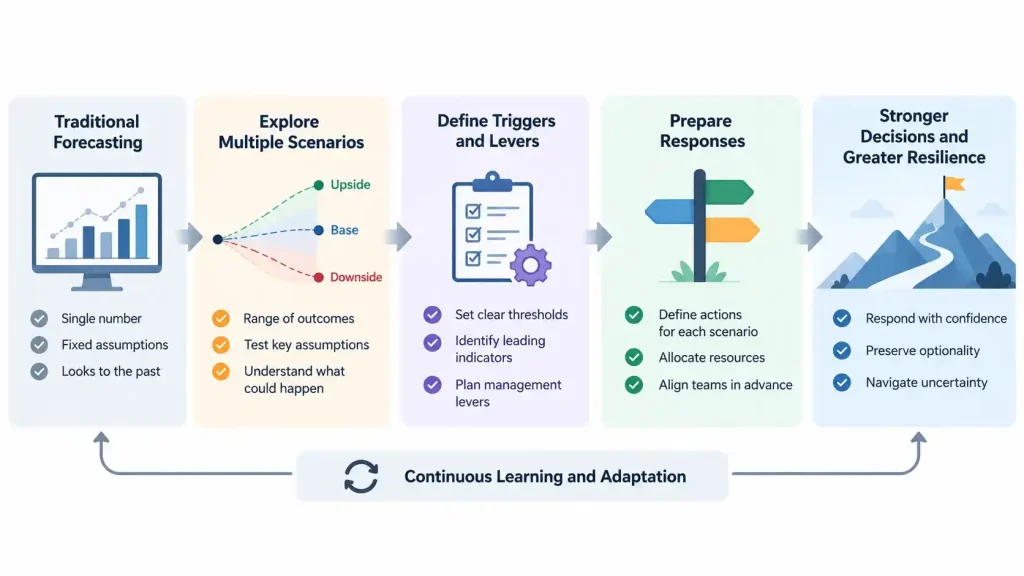
The sections ahead explain how CFOs build decision models for uncertainty in five steps. They cover the move from forecasts to flexible scenarios and the work of teaching boards to think in ranges. They also address why some models earn trust, how to govern the assumptions underneath them, and how decision frameworks build resilience. Together they show modeling as a discipline of readiness instead of prediction.
From Forecasts to Flexible Decision Models
Traditional forecasting assumed a relatively stable and predictable world. Each quarter, finance gathered inputs, layered assumptions, and produced a single number with the soft glow of credibility. Leaders treated variances as exceptions instead of warnings.
Why the Single Number No Longer Works
Volatility now sets the baseline for most businesses. Demand can surge and collapse within one fiscal year, and costs can stabilize before swinging again. In this environment, the old question of what the company expects gives way to a harder one. Leaders must ask what could happen and how the company will respond.
Deterministic Forecasts Versus Decision Models
| Dimension | Deterministic Forecast | Decision Model |
| Core question | What does the company expect? | What could happen, and how will the company respond? |
| Output | Single-point estimate | Range of plausible outcomes |
| Structure | Linear projection from prior year | Branching if-then logic with triggers |
| Role of assumptions | Fixed inputs | Testable hypotheses with owners |
| Purpose | Defend a plan | Preserve the ability to pivot |
A strong decision model begins with questions, not inputs. Leaders identify which levers matter most, which variables move disproportionately under stress, and which assumptions depend on unknowns. The result is a system of branches that defines responses in advance. It might set out the response if gross margin drops below 40% or if funding dries up by the third quarter.
Flexibility in this sense reflects design, not vagueness. A well-built model is precise in structure and deliberate in its thresholds. It shifts the tone of executive decision making from reaction to preemptive adaptation.
A pre-Series A AI governance and assurance platform shows how this thinking applies early in a company’s life. Finance built the operating model, multi-year scenario analyses, and capital strategy alongside the investor narrative. Those scenarios helped leaders weigh funding paths against a range of possible outcomes.
Teaching Boards to Think in Ranges
A boardroom often falls silent when a CFO says, in effect, that there is no single number but there is a shape. Directors used to firm commitments may wonder whether this signals prudence or evasion. That pause marks the start of a shift toward range-based reasoning.
Narrative Fluency in Executive Decision Making
Board members tend to prize clarity because they rose by making decisive bets. Many of them also distrust hedging language from management. The CFO must therefore offer a different kind of clarity. It states what the company believes and fears, how likely each outcome is, and what it plans to do across that spectrum.
This approach demands narrative fluency as well as modeling skill. It is not enough to say that EBITDA could fall 20% in a downside case. The CFO must explain why that outcome is plausible and which assumptions would drive it. The explanation should also cover available levers and the leading indicators that will signal its approach.
A director might challenge a three-scenario projection by asking what the CFO actually believes. A useful answer is that the center scenario is most likely, but the company must prepare for the tails. Reality usually stays near the middle, yet when it departs, it departs suddenly, and survival depends on having rehearsed that move.
Building this habit requires cultural change across the company:
- Integrate scenario planning into regular reviews instead of treating it as a quarterly event
- Train functional leaders to speak in levers and triggers instead of certainties
- Prepare investor relations to communicate resilience as well as upside
- Build planning cycles around frequent updates and boundary testing
A mission-driven education and research institution in Silicon Valley offers a relevant example. Finance leadership there reported to a board and audit committee while building multi-year models under variable funding conditions. Range-based planning helped the board make decisions when funding was uncertain.
Why Some Decision Models Earn Trust
No model influences a leadership team unless its audience believes in it. A less precise model delivered with clear narrative and context often carries more weight than a flawless one presented in isolation. Executive decisions draw on memory, culture, and trust as well as logic.
Building Models With Conversational DNA
Many models fail because they are either too opaque or too cautious. Executives nod politely, skip to the base case, and treat the rest as theater. When that happens, the organization falls back on instinct and last year’s patterns.
Trust starts with dialogue before anyone fills the first cell. The CFO should ask operating teams what they fear, what they believe, and what they see coming. These conversations supply the cultural raw material for a model that feels embedded instead of foreign, even when it challenges the preferred story.
In decision models, tone matters as much as content. Imagine a model revealing that the company’s breakeven point has shifted because fixed overhead grew unnoticed. Framed as discovery instead of indictment, with an open invitation to test sensitivities in the meeting, the finding becomes a shared problem to solve. Trust grows from interpretive humility, not from added complexity.
A cybersecurity SaaS company with roughly $30M in ARR shows how credibility builds over time. Its driver-based forecasting engine and capacity model kept actuals within plus or minus five percent of forecast for 8 consecutive quarters. That consistency gave leaders a reason to rely on the model when making decisions.
Governing the Assumptions Behind Decision Models
Assumptions form the terrain beneath every decision model, yet leaders often examine them least. They arrive from last quarter’s benchmarks or convention and settle into spreadsheets with ease. Many poor decisions stem from unexamined assumptions instead of bad data.
An Assumption Taxonomy and Traceability
Not every assumption deserves the same level of scrutiny. Grouping them by type helps finance decide how often each one needs review and who should own it.
Assumption Types and Governance Approaches
| Assumption Type | Examples | Governance Approach |
| Mechanical | Exchange rates, tax rates, payroll inflation | Update on a fixed schedule from external sources |
| Behavioral | Conversion, customer acquisition cost, churn | Track against leading indicators monthly |
| Strategic | Market entry timing, pricing, regulatory change | Review with leadership and stress-test regularly |
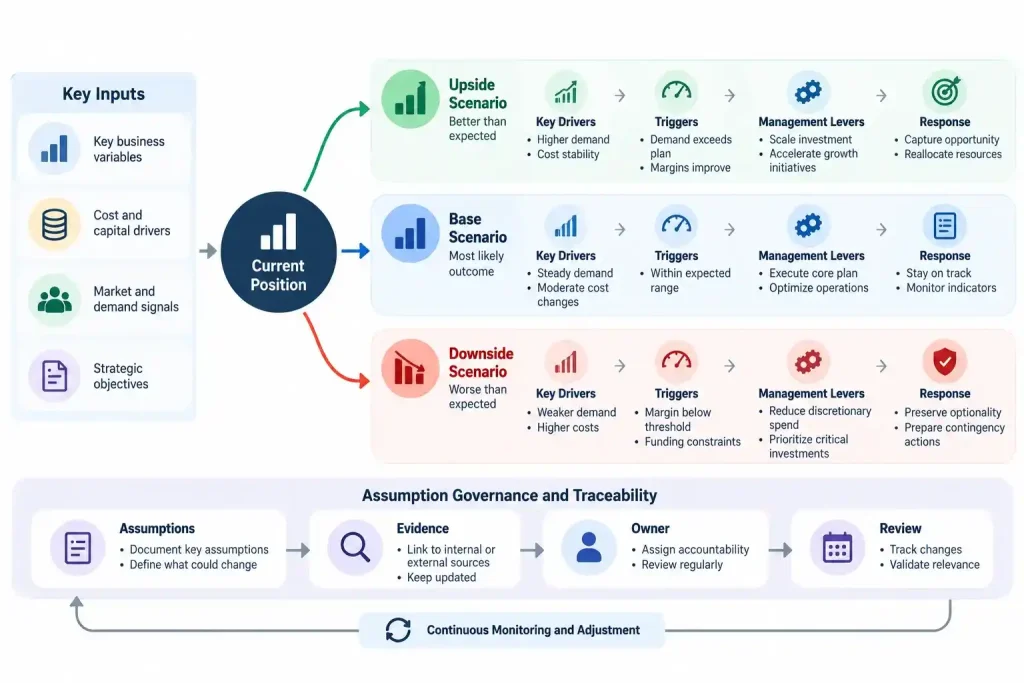
A traceability matrix turns hidden assumptions into accountable ones. For each key input, it records the owner and the supporting evidence. It also notes when the assumption was last updated and what conditions would trigger a review. Conversations then begin with what the company is assuming, which often reveals more risk than any model output.
Data proves its value as a signal, not as proof. If a model assumed a 15% renewal rate and early indicators point closer to 8%, the system should raise an alert. Someone must own the response, because modeling should continue long after someone saves the file.
An early-stage email marketing SaaS company illustrates the value of acting on what the numbers reveal. A financial turnaround there reduced monthly burn from $800K to $200K. Decisions of that scale depend on assumptions that leaders understand and trust.
Decision Frameworks That Build Resilience
The true legacy of a decision model lies in the quality of attention it creates, not in forecast accuracy. Good models train leaders to hold competing ideas, accept ambiguity, and still act with judgment. Over time, executives stop asking for the number and start asking about the drivers.
From Reaction to Readiness
That discipline takes several concrete forms inside a company. It appears in pre-defined response plans and escalation protocols tied to trigger points. It also shapes investment frameworks that weigh returns across scenarios instead of only the base case. Operating reviews trace variances back to their assumptions instead of explaining them away.
A resilient organization does not avoid risk; it plans for fragility. It builds buffers where others cut margins, treats optionality as an asset, and values recoverability over precision. Its decision models act as living hypotheses with triggers and feedback loops.
When a shock arrives, such organizations are less surprised. They did not predict the event, but they expected something and built the capacity to adapt. Decision models, used this way, help executive decision making stay clear when the fog is thick.
Three Key Takeaways
- Decision models replace single-point forecasts with ranges, triggers, and pre-planned responses, which improves executive decision making under uncertainty.
- Boards and leaders learn to think in distributions when CFOs pair scenarios with clear narrative about drivers, levers, and leading indicators.
- Governed assumptions, traceable ownership, and embedded response plans turn modeling into a lasting source of organizational resilience.
Disclaimer: This article is intended for informational purposes only and does not constitute legal, tax, or accounting advice. You should consult your own tax advisor or counsel for advice tailored to your specific situation.
Hindol Datta is a four-time CFO and senior finance executive with over 25 years of leadership experience across cybersecurity, SaaS, gaming, logistics, digital marketing, medical devices, consumer products, and nonprofit organizations. He has led more than $120M in fundraising and over $150M in M&A transactions while building the financial and operational systems that let complex businesses scale with confidence. He is the author of seven books in the Systems CFO Series and holds active CPA, CMA, and CIA credentials.
AI-assisted insights, supplemented by 25 years of finance leadership experience.



