
Executive Summary
The most consequential executive decisions rarely arrive with clean information. A decision-making tree gives CFOs a structured way to map choices, uncertain events, and payoffs before capital is committed. It replaces the brittle best-case and worst-case spreadsheet with branching logic and probability-weighted consequences that leaders can debate.
This article explains why linear planning breaks down under complexity and how a scenario tree is built, node by node. It then shows how finance leaders embed branching logic into capital planning, board communication, and risk management. The final section covers how an organization learns to think in branches as a matter of culture, not ceremony.
Why Linear Thinking Fails in Executive Decision Making
Executives crave clarity, and the pace of the modern enterprise rewards anyone who can supply it quickly. Under that pressure, leadership teams anchor to forecasts, extrapolate last year’s trends, and build slides with arrows pointing one way. The world does not move in straight lines, however, and planning as though it does breeds false confidence.
Linear models offer an illusion of control because one variable moves and the spreadsheet obediently follows. Reality is more entangled than any single forecast line suggests. A price change touches retention as well as revenue, and a new market adds operational complexity alongside sales. A procurement saving today can invite reputational risk upstream tomorrow.
How Annual Budgeting Hardens the Problem
Traditional planning cycles codify linear logic in ways few leadership teams notice. Business units forecast last year plus a percentage, and risks sit in an appendix instead of inside the model. When surprises arrive, the system lurches into reactive correction, often at great cost. Leaders are not short of strategic thought; the systems they think through are too brittle to hold it.
Linear framing also distorts how leadership teams communicate. When strategy is presented as a single path, dissent sounds like disloyalty and alternative views get labeled as pessimism. Boards receive forecasts dressed in certainty because showing ambiguity feels like weakness. The real weakness lies in pretending that anyone can avoid ambiguity.
For the CFO, this tension sits at the center of the role. Finance must deliver reliable forecasts while knowing that volatility lives in every model. Irreversible decisions made under false precision are the ones that haunt an organization longest. The answer is not to abandon planning but to reshape it as a decision-making tree.
Building a Decision-Making Tree: The Architecture of Scenario Trees
A scenario tree is not a forecast but a structured map of conditional possibility. It shows how choices, events, and uncertainties might unfold over time, one fork after another. Its value lies in making chains of consequence visible before anyone commits capital to them.
The Four Building Blocks of Decision Tree Analysis
Every decision-making tree, however large, draws on the same four components:
- Decision node: the point where leadership makes a choice, such as launching this quarter or waiting.
- Event node: an outcome outside full company control, such as a competitor response, a regulatory ruling, or a demand shift.
- Probability: an estimated likelihood for each event branch, informed by data or, failing that, by judgment.
- Payoff node: the financial or strategic result at the end of each path, including revenue, EBITDA, cash timing, or optionality.
Branches fan outward as each event opens new decisions. If a competitor matches a price cut, leadership must choose between cutting again and leaning on differentiated value. This is not complexity for its own sake, since it forces thinking about second and third order effects.
A Worked Scenario Tree Example
Consider a mid-market software company deciding whether to enter Europe now or wait two quarters to prove its model. Waiting lowers entry cost to $3M because validation trims launch spend, but it also delays revenue. The table below sets out each branch, its probability, and its risk-weighted value.
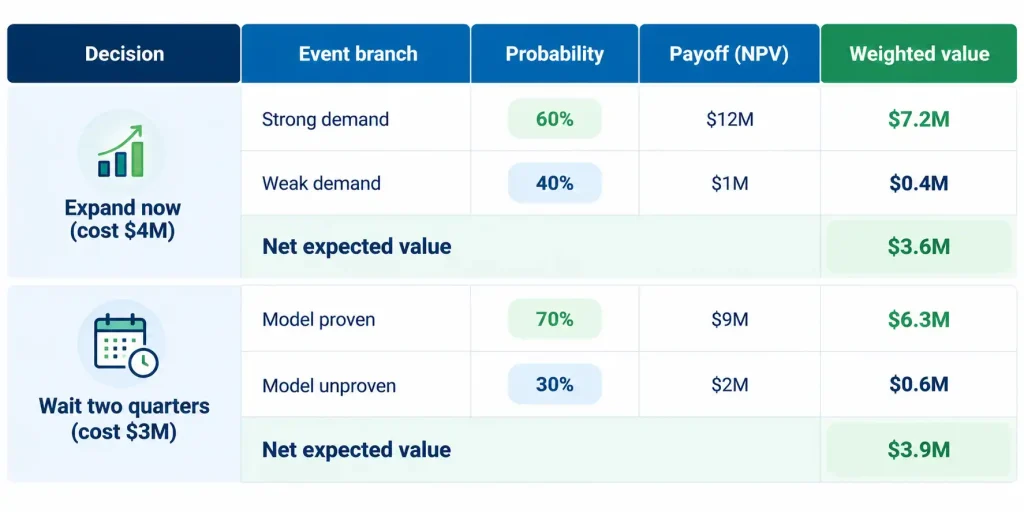
Waiting wins by a narrow margin, and the reason matters more than the number. The delay buys information, and that information lowers the cost of being wrong. A decision-making tree makes the value of optionality visible in a way that a single NPV calculation never can.
Choosing the Right Granularity and Refresh Cadence
A tree too sparse reveals little, and a tree too dense overwhelms the room. CFOs calibrate by materiality, timing, and relevance to the decision at hand. The useful question is which events would reshape the logic of the plan. Those branches deserve precise modeling, while the rest can remain directional.
A decision-making tree also needs a steady refresh cadence. As signals emerge, probabilities shift, some branches collapse, and new paths open. One cybersecurity and identity SaaS company, at roughly $30M in ARR, paired driver-based forecasting with scenario modeling. Actuals held within five percent of forecast for 8 consecutive quarters. That consistency came from revisiting assumptions on a disciplined rhythm, not from predicting the future.
Operationalizing the Decision-Making Tree Across the Executive Agenda
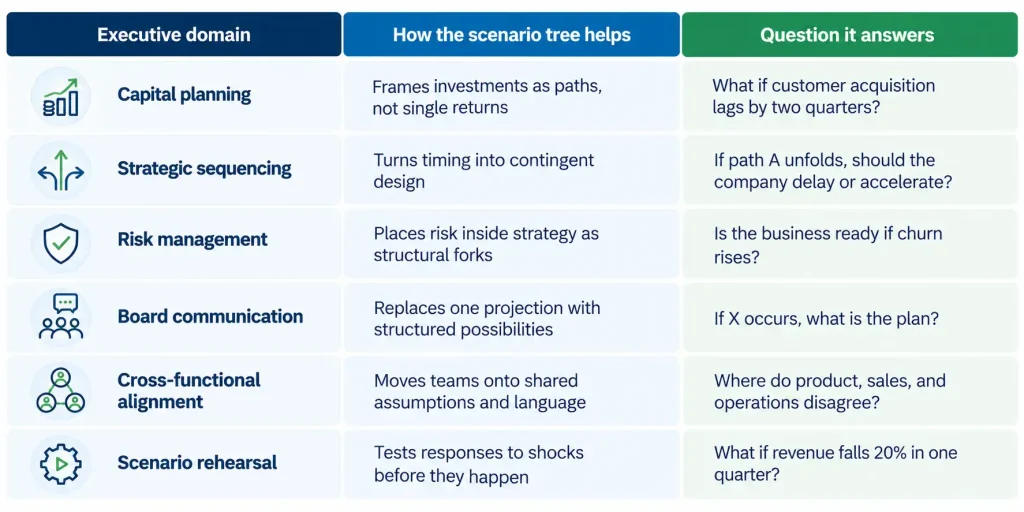
A model achieves nothing until it enters the bloodstream of the organization. Scenario trees that leaders admire once and then shelve change nothing. Their power comes from deployment inside the rituals and rhythms of executive work.
Where Scenario Trees Earn Their Keep
Capital Planning and Board Communication
Capital committees benefit most visibly from branching logic. Every investment is a bet on assumptions, yet capital reviews often reduce risk to a single discount rate. A $127M global consumer products company sourcing from China and Vietnam used freight and demand scenarios. Those branches shaped SKU rationalization and demand planning. Inventory turns more than doubled, from 3x to 7x, releasing working capital that a single-line plan would have left trapped.
Board conversations shift from critique to collaboration when the CFO walks directors through the branches. A mission-driven education and research institution modeled funding under variable philanthropic and earned-revenue conditions. That decision making tree gave its board a clear view of long-term sustainability. That structured transparency supported a $37M raise across equity and venture debt.
Rehearsing the Future Before It Arrives
Pilots train in simulators for rare emergencies, and executives can rehearse shocks in the same way. A decision-making tree lets a team ask how it would respond to a failed supplier or a data breach. During a turnaround at an early-stage digital marketing SaaS company, rehearsed contingencies helped cut monthly burn from $800K to $200K. Rehearsal is not pessimism, because it turns theory into reflex.
Modern planning platforms support collaborative modeling, but the platform matters less than the logic. A decision-making tree sketched on a whiteboard can still yield real insight, provided budget cycles and quarterly reviews test actuals against its paths.
Teaching the Organization to Think in Branches
A scenario tree is also a way of seeing the business. When it shapes how an organization thinks, people ask better questions and speak with precision about uncertainty. The challenge lies less in the math than in the muscle, because most organizations quietly reward linearity.
Language, Ritual, and Incentives That Build the Habit
Making the decision-making tree a cultural habit rests on a few practices that reinforce one another:
- Language: leaders speak in “if-then” terms instead of “will-be” terms.
- Ritual: monthly reviews update scenario variables, and quarterly planning tests edge cases.
- Visual fluency: product, operations, and marketing teams build their own trees as learning tools.
- Depersonalized debate: disagreement sits in a branch, not with a person, which creates psychological safety.
- Incentives: teams that surface alternative outcomes early earn recognition, and scenario awareness counts as competence.
Over time the mindset becomes self-reinforcing across the organization. Teams stop treating the unexpected as a crisis and start treating it as a new fork to navigate. The tree shows up on walls, in decks, and at all-hands meetings. In that culture the CFO holds the pen, acting as neither prophet nor gambler but as the architect of preparedness.
Three Key Takeaways
- A decision-making tree replaces single-line forecasts with branching logic. It makes the value of timing and optionality visible before capital is committed.
- Scenario trees deliver value only when they live inside capital reviews, board meetings, and quarterly planning. Refreshing probabilities on a steady cadence keeps the tree aligned with reality.
- Thinking in branches is a cultural discipline built through language, ritual, and incentives. When disagreement sits in a branch, teams debate assumptions openly and move faster when conditions shift.
Disclaimer: This article is intended for informational purposes only and does not constitute legal, tax, or accounting advice. You should consult your own tax advisor or counsel for advice tailored to your specific situation.
Hindol Datta is a four-time CFO and senior finance executive with over 25 years of leadership experience across cybersecurity, SaaS, gaming, logistics, digital marketing, medical devices, consumer products, and nonprofit organizations. He has led more than $120M in fundraising and over $150M in M&A transactions while building the financial and operational systems that let complex businesses scale with confidence. He is the author of seven books in the Systems CFO Series and holds active CPA, CMA, and CIA credentials.
AI-assisted insights, supplemented by 25 years of finance leadership experience.