
Executive Summary
Data-driven budget planning does not mean building the most detailed spreadsheet possible. A budget can be perfectly precise, down to dozens of line items, and still be strategically useless if the market shifts faster than the assumptions behind it. The real goal is a model that helps a company allocate resources intelligently and adapt quickly, not one that predicts the future to the decimal point.
This guide covers why precision often misses the point in budget planning, how to design a flexible and modular budget architecture, how to embed continuous forecasting into the executive rhythm, and how to align budgeting with capital discipline and long-term value creation.
Why Precision Often Misses the Point in Budget Planning
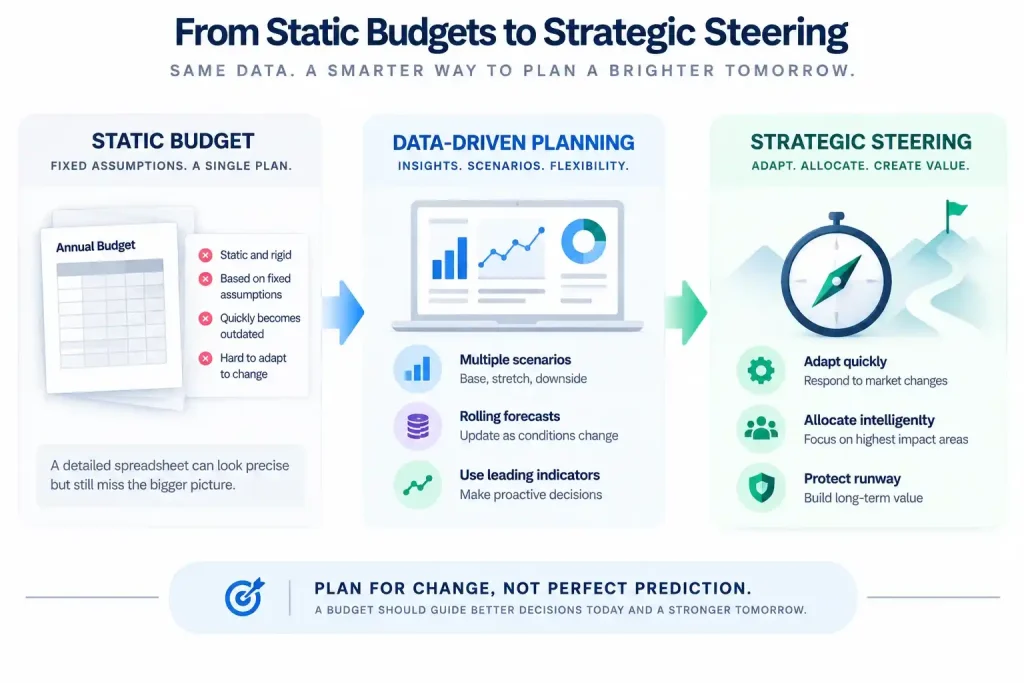
Every CFO eventually hears the same request: build a budget the company can stick to. That request sounds reasonable, but in volatile markets, a static budget can go stale the moment it is finalized. Companies want certainty, yet they operate in systems defined by change. When the unexpected happens, a rigid budget offers no mechanism for response, and variance conversations turn defensive instead of productive.
Rethinking the purpose of a budget starts with a different set of goals. A good budget should allocate resources intelligently, align teams around priorities, surface underlying assumptions, and create a shared understanding of constraints and opportunity, rather than attempt decimal-level accuracy.
What Data Should Actually Do in a Budget
- Highlight the true leverage points in the business model, not just every cost category
- Illuminate the cost of delay or inaction on a decision
- Expose risk concentration and blind spots before they become surprises
- Enable forward-looking scenario modeling rather than a single fixed path
- Guide capacity planning and hiring strategy directly
Many budget models fail simply because their structure does not match how the business actually operates. Sales gets modeled by region while targets are set by vertical. Engineering gets budgeted by headcount while the roadmap is driven by feature delivery. That mismatch causes teams to ignore the budget and forces finance to explain variances that are really just structural artifacts. Aligning cost centers to how work is organized, and using leading indicators like sales cycle velocity to drive lagging categories like hiring, closes that gap.
Moving From a Single Forecast to Scenario Thinking
- Base case: grounded in the current trajectory
- Stretch case: reflecting upside with known resource accelerants
- Downside case: accounting for macro or execution headwinds
- Break-even case: mapping the path to cash self-sufficiency
Each scenario needs clear triggers defining what moves the company from one path to another. A growth-stage SaaS company that pre-maps cost levers and hiring slowdowns under a downside scenario can execute a response in under two weeks when pipeline softens, rather than scrambling into reactive layoffs. Scenario-based budgeting turns planning into a preparedness exercise rather than a single bet.
Budgeting also carries a behavioral dimension. Poorly communicated budgets encourage hoarding and last-minute spend. Rigid budgets discourage honest re-forecasting. A budget narrative session, where each functional lead presents the story behind their numbers, not just the numbers themselves, tends to surface misalignments early and build genuine ownership.
Designing a Flexible, Data-Driven Budget Architecture
A budget built in January around a fixed plan can look outdated by the third quarter once a regulatory delay or an unexpected product-market fit signal reshapes priorities. Flexible architecture, not more detail, is what prevents that.
Build Modularity Around Decision Units
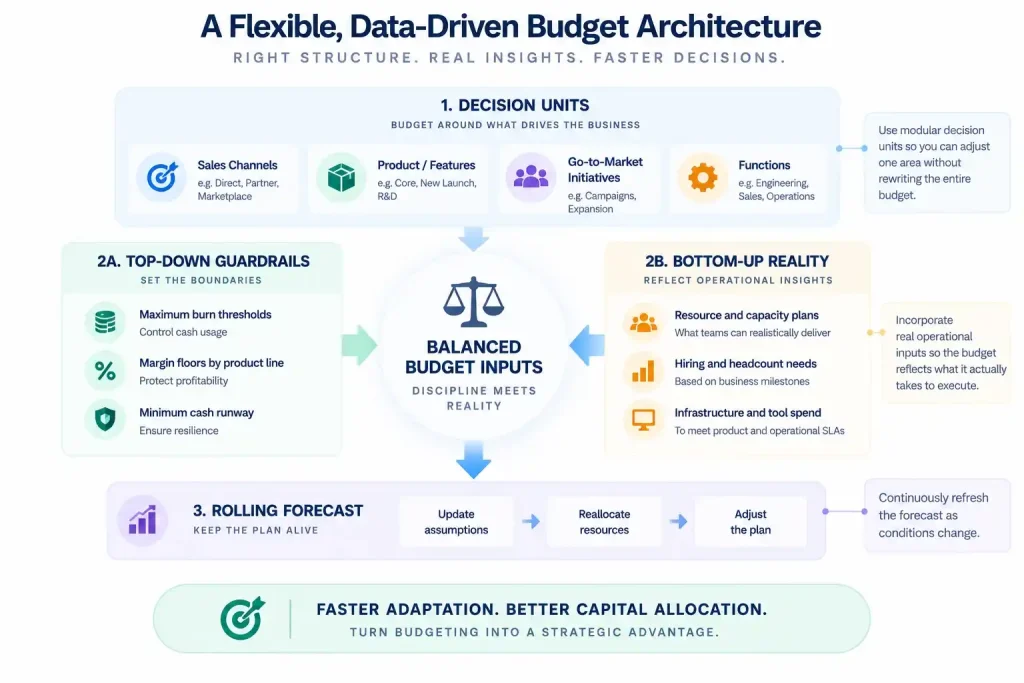
Structuring a budget around decision units, such as a specific sales channel, a product feature rollout, or a go-to-market experiment, rather than rigid departments, lets leaders isolate the impact of a single change and adjust it without rewriting the entire plan. It also gives each functional lead a module to own and defend, which builds accountability instead of budget dependency.
Balance Top-Down Guardrails With Bottom-Up Inputs
Guardrails such as maximum burn thresholds, margin floors by product line, and cash runway minimums set the boundaries. Bottom-up inputs, like how many reps marketing can support or what infrastructure spend is needed to hit product SLAs, reflect operational reality. The budget becomes a negotiation between the two, which produces better capital allocation than either approach alone.
Replace Static Budgets With Rolling Forecasts
A static annual budget locks in assumptions early and discourages course correction. Rolling forecasts update revenue projections monthly against pipeline data, re-model CAC and LTV quarterly against campaign results, and adjust hiring plans against real productivity benchmarks. A company that moves from a static twelve-month plan to a rolling four-quarter forecast typically sees better scenario planning and more board confidence in executive discipline.
As complexity outgrows spreadsheets, integrated forecasting tools that pull from CRM, ERP, and HRIS systems become worth the investment, but only once the underlying planning logic mirrors how the business actually earns revenue. Non-financial data belongs in the model too: product telemetry that predicts infrastructure cost, NPS trends that shape churn assumptions, and recruiting funnel data that predicts hiring delays all sharpen the forecast beyond what financial data alone can do.
Embedding Continuous Forecasting Into Executive Decision-Making
A budget reviewed once in January and revisited only when actuals miss badly is not really a forecasting practice. It is an annual ritual with a cleanup step attached whenever numbers drift too far. Continuous forecasting turns the budget into a living control panel instead.
| Cycle | Frequency | Focus |
| Monthly check-in | Monthly | Actuals vs. forecast, pipeline movement, near-term hiring and spend adjustments |
| Quarterly reforecast | Quarterly | Refreshed core assumptions, capital planning, runway, and board communication |
| Event-driven reforecast | As triggered | Material shifts such as a lost deal, product delay, or hiring freeze, scoped to specific modules |
These cycles only matter if they connect to execution through leading indicators. CAC assumptions should map to campaign-level performance. Revenue projections should reflect weighted pipeline and historical close rates. When these links are explicit, a churn spike triggers a customer success conversation immediately, rather than surfacing as an abstract variance months later.
An executive dashboard gives this rhythm a home, but it works best capped around fifteen core metrics that each answer a real strategic question. Forecast ownership should sit with the functional leaders closest to the data: marketing owns CAC forecasts, sales owns bookings ramps, and engineering owns cost-of-delivery assumptions, with short monthly forecast councils keeping everyone aligned on what changed and why.
The same discipline shapes investor confidence. Including a forecast assumptions tracker in board materials, showing which inputs changed and why, tends to build the kind of transparency that speeds up diligence in the next funding round rather than slowing it down.
Aligning Budget Planning With Capital Discipline and Long-Term Value
Budgeting eventually becomes a form of capital signaling, not just internal resource planning. A CFO who ties every forecast revision back to strategic logic and a clear capital efficiency narrative can walk a board through a lowered revenue expectation and still leave the room with more confidence, not less.
Initiative-based budgeting, where spend gets allocated to the specific bets expected to drive incremental revenue rather than to departments by default, lets a company reallocate away from underperforming initiatives within the quarter instead of waiting until year-end. That shift alone tends to improve capital velocity and investor perception together.
What Investor-Grade Budgeting Looks Like
- High, base, and low case projections presented with the triggers that move between them
- Budget updates tied explicitly to strategic KPIs such as CAC, NRR, and burn multiple
- Forecast deltas explained through operational leading indicators, not vague market commentary
- Runway calculations updated at least quarterly, not left stale between raises
Long-range planning should resist the temptation toward false precision. A five-year plan built around target business model economics, milestone-based investment, and sensitivity analysis earns more board trust than one built around exact line items nobody can verify years out. Ultimately, the CFO’s most valuable role in this process is translating tradeoffs clearly: what gets deferred if headcount grows, how long the runway lasts if burn holds steady, and what a churn improvement would actually free up to reinvest.
Three Key Takeaways
- Data-driven budget planning is not about maximum precision. It is about building a model flexible enough to guide real decisions when market conditions shift faster than the plan can be revised.
- Modular budget architecture, built around decision units and balanced against top-down guardrails, lets a company reallocate quickly without rebuilding the entire plan from scratch.
- Continuous forecasting, embedded into a monthly, quarterly, and event-driven cadence, turns the budget from a once-a-year ritual into a real-time tool for both internal decisions and investor trust.
Disclaimer: This article reflects general professional perspectives on financial operations and strategy. It is not intended as legal, accounting, or investment advice. Companies should consult their own advisors before applying these principles to their specific operating context.
Hindol Datta is a four-time CFO and senior finance executive with over 25 years of leadership experience across cybersecurity, SaaS, gaming, logistics, digital marketing, medical devices, consumer products, and nonprofit organizations. He has led more than $120M in fundraising and over $150M in M&A transactions while building the financial and operational systems that let complex businesses scale with confidence. He is the author of seven books in the Systems CFO Series and holds active CPA, CMA, and CIA credentials.
AI-assisted insights, supplemented by 25 years of finance leadership experience.