
Executive Summary
A well-built customer experience strategy treats every touchpoint as a financial lever, not a marketing courtesy. The CFO holds the strongest position to make that case. Experience shapes acquisition cost, churn, pricing power, and revenue quality long before those effects reach the income statement. That makes it a matter of fiduciary accountability.
This article follows the discipline in four stages: mapping the journey to financial levers, building the data that connects behavior to revenue, applying capital discipline to experience investment, and governing the effort through enterprise planning. Readers gain a practical framework for ranking initiatives by strategic return instead of sentiment.
Why a Customer Experience Strategy Belongs on the CFO Agenda
For decades, customer experience sat with marketing, product, and customer success, the functions charged with reducing friction and building loyalty. As revenue resilience and cost discipline now compete for the same executive attention, that division of labor no longer holds.
CFOs have traditionally focused on margin, capital allocation, pricing, and risk, with limited involvement in customer dynamics. The modern role requires understanding where value is created and how it is delivered. It also requires knowing why customers choose to pay for it.
Experience initiatives also sit between OPEX and CAPEX, and each one competes for scarce capital. Streamlined onboarding, faster support SLAs, and redesigned digital interfaces all need ROI discipline. Only finance is built to enforce it. A credible CX strategy therefore ranks initiatives by strategic return rather than by sentiment.
The Financial Architecture of Customer Experience
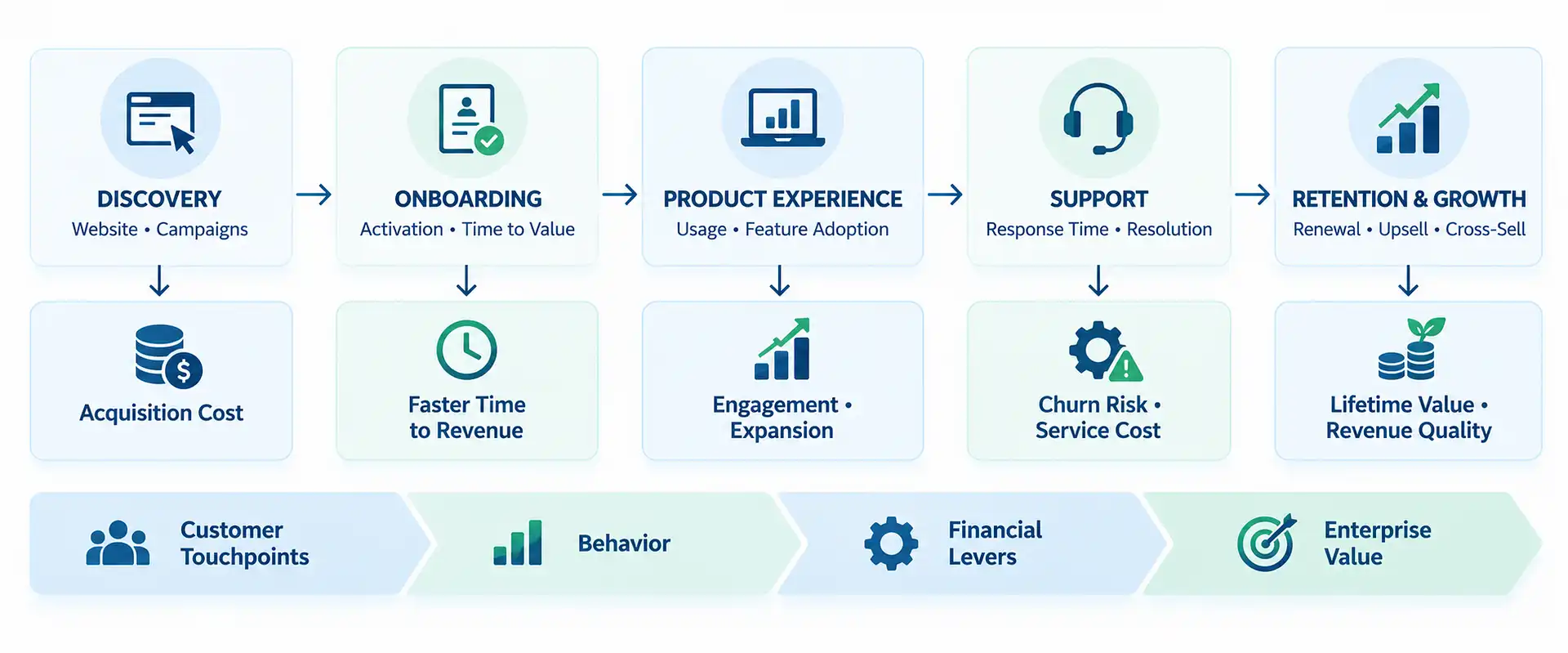
The Customer Journey as a Cash Flow Engine
Aggregate figures such as revenue, gross margin, acquisition cost, and lifetime value describe outcomes. They conceal the interactions that produced them. A better starting point is the journey itself, treated as a cash flow engine. Every touchpoint in that engine carries a cost and a return.
- A confusing website raises bounce rates and drives up cost per acquisition.
- A seamless onboarding flow improves activation and accelerates time to revenue.
- A delayed support resolution raises churn risk and increases the cost of reacquisition.
The income statement aggregates these effects without explaining them. Mapping each stage to a financial lever shows where value is created, where it is destroyed, and which stages correlate most closely with margin, retention, and growth.
Experience Metrics as Leading Indicators
Lagging indicators such as bookings and net revenue retention arrive too late to guide decisions. Operational signals belong in the financial architecture as early warnings:
- Net Promoter Score and customer effort score reveal loyalty and friction before renewals are decided.
- First-response time and ticket volume often forecast churn when either one spikes.
- Onboarding satisfaction and feature adoption may decline ahead of a slowdown in upsells.
Experience also protects pricing power, because customers who perceive high value are less price sensitive and more loyal. That stability gives the firm room to expand margins, launch premium offerings, or accelerate cross-sell.
Diminishing Returns and Long-Tail Payback
Not every improvement pays back within the quarter. Onboarding upgrades, for instance, lower the support burden and lift net revenue retention over a longer horizon, which calls for wider ROI windows and scenario analysis.
Equally, experience is not an unbounded good. A second support channel may cut response time sharply, while a third adds cost without measurable benefit, so the CFO’s task is to locate the point where the efficiency curve flattens.
Building the Data Spine for Customer Experience Strategy
Marketing holds campaign engagement, product holds usage, and support holds satisfaction scores, yet these datasets rarely share a timeline or a common definition. Finance receives the summary only after signals have matured into revenue or loss, and that lag is where opportunity disappears.
Unifying Customer Data Around One Customer ID
A unified customer data model aligns every lifecycle interaction with time-stamped financial transactions. Cloud platforms such as Snowflake, Databricks, and Google BigQuery can join CRM, ERP, product analytics, and support data, while Tableau, Looker, or Power BI surface the leading signals.
Architecture alone does not produce insight, so CFOs must partner with data scientists to test whether daily logins predict upsell or whether a service spike foreshadows churn. A SaaS company may find that users who complete three onboarding milestones in the first week are twice as likely to renew at full price, which turns onboarding into a quantifiable investment in revenue durability.
Marketplace SaaS offers a useful reference point. Cohort and unit economics models built for a $20M Series B anchored investor diligence and withstood scrutiny, which shows the value of tying customer behavior to financial results before a board or an investor asks for proof.
Behavioral Cohorts and Simulation
Behavioral cohorts built on usage intensity, service interaction, and satisfaction outperform traditional industry or revenue segments. High-potential but underengaged customers may warrant concierge service, while low-value, high-cost customers may need automation or restructuring. Professional services provide a comparable case: engagement-level profitability analytics supported a scale-up from $12M to $63M in eight months and gave leadership the first clear view of where margin was created and where it leaked.
The same foundation supports simulation. If onboarding conversion improves by 15%, what happens to annual recurring revenue? If ticket backlog falls by 25%, what follows for churn and gross margin?
Forecasting then moves from static extrapolation to dynamic modeling, pilots run with control groups, and boards receive evidence such as a 22% lift in feature adoption that correlated with a 17% rise in expansion revenue. A shared source of truth also ends the debate between competing dashboards and anecdotes.
Capital Discipline for Customer Experience Investment
Experience benefits are diffused across time and functions. A redesigned onboarding flow touches product, support, marketing, and engineering, and its return appears months later through usage, support cost, or retention.
Structuring CX as an investment portfolio rather than a set of disconnected projects brings coherence to the customer experience strategy. Short-cycle wins such as chat automation sit beside long-horizon bets such as rearchitecting a customer portal.
Investment Theses and Stage Gates
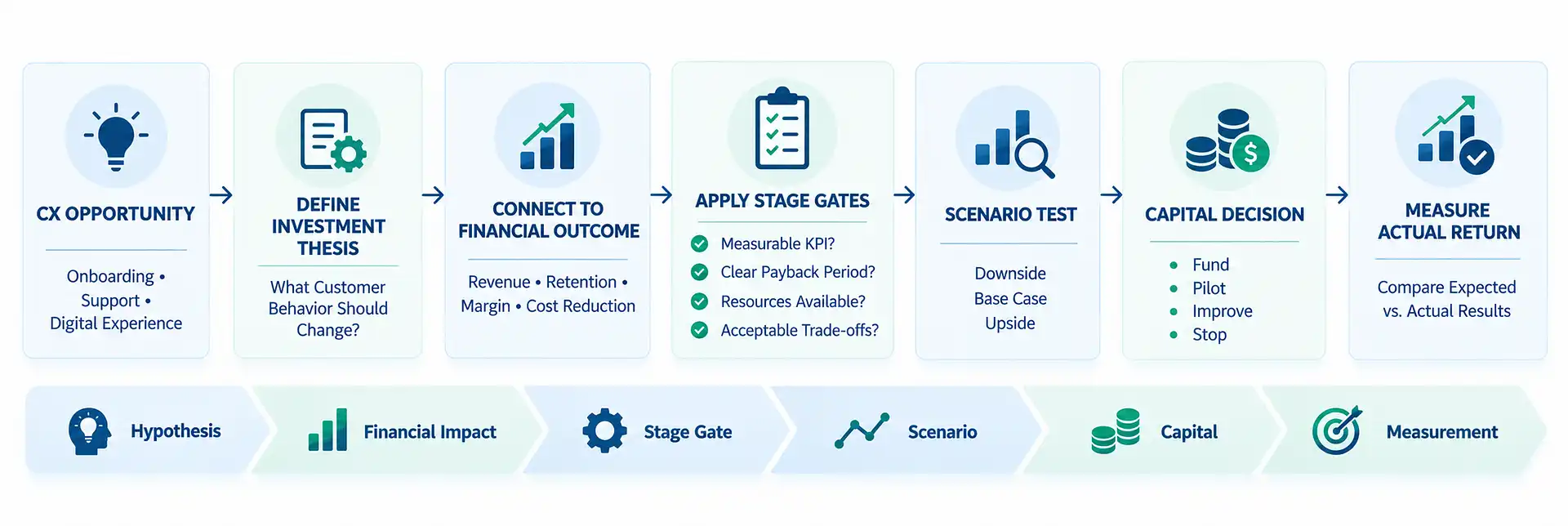
Each initiative begins with a hypothesis that names the customer behavior to change and the financial outcome expected. A personalization engine may target average order value, a loyalty program may target churn, and a community forum may deflect support cost. A gating framework then tests readiness:
- Does the initiative have measurable KPIs causally linked to financial performance?
- What payback period is expected, and how will it be tracked?
- Which technical, human, and financial resources are required, and what trade-offs follow?
Scenario Modeling, Time Horizons, and Portfolio Balance
Scenario modeling tests adoption: if 40% of customers engage, what is the margin lift, and what is the downside at 25%? Projects that fail to scale can be sunset early, while overperformers are fast-tracked.
Expectations about timing belong at the outset, since demanding ROI too soon misjudges the maturity curve and pursuing an initiative indefinitely ignores it. A balanced portfolio also includes defensive projects that protect against churn or meet compliance, alongside speculative tests of new interfaces or segments. Consumer products offer a parallel: inventory turns at a $127M global company rose from 3x to 7x through demand planning and SKU rationalization, and the same lever-first logic applies to experience spending.
Measurement and Cost Attribution
Post-implementation reviews should be standard practice. They compare planned uplift in NPS or net revenue retention with actual results and diagnose whether flawed assumptions, poor execution, or market shifts explain the gap.
Activity-based costing or time tracking exposes the true resource burn of shared design, data engineering, and content teams, which makes project-level ROI calculable. Capital discipline does not mean austerity; it channels experience teams toward economic value and earns CX a place at the capital planning table.
Governing Customer Experience Strategy Through Enterprise Planning
Governance institutionalizes priority and moves strategy from aspiration to execution. Without it, CX efforts remain discretionary projects that produce localized wins and rarely scale.
Goals, Forecasts, and Ownership
Planning must set experience targets beside revenue and margin. If the enterprise aims to grow net revenue retention by 12%, the plan should state how much of that growth depends on onboarding, support, engagement, or account expansion.
Forecasts should also track whether churn is rising in segments with weak support satisfaction, because forecasts that ignore experience are incomplete. Cybersecurity and identity SaaS illustrates the value of cadence: a driver-based forecasting engine at a company with roughly $30M in ARR held actuals within plus or minus 5% of forecast for 8 consecutive quarters, and experience metrics belong inside that same rhythm.
Ownership then follows the moments each function controls: product owns time to value, sales owns handoff quality, and support owns resolution efficiency. Each role should be encoded in incentive plans, OKRs, and planning documents.
Cadence, Board Reporting, and Capacity
- Operating reviews combine customer health dashboards, voice-of-customer synthesis, and financial overlays to keep spending tied to value creation.
- Board reporting links CX metrics to customer expansion, pricing, and platform growth instead of surfacing them only during complaints or crises.
- Capacity planning accounts for experience load, since adding customers without scaling onboarding and support creates hidden liabilities.
Incentives, Technology, and Culture
Incentives should reward long-term behavior: a customer success manager who prevents churn through proactive engagement creates more value than one who rescues accounts at the brink of cancellation. Experience platforms, from CRMs to analytics tools, deserve evaluation as growth infrastructure and retirement when they fail to reduce friction or improve conversion.
Culture follows leadership. When the CFO asks how customers behave and what drives their loyalty, the enterprise conversation links economics to customer value and treats the company as a manager of long-term relationships rather than only a seller of products.
Three Key Takeaways
- Map every touchpoint to a financial lever, and treat operational CX metrics such as NPS, effort score, and first-response time as leading indicators of revenue rather than as operational noise.
- Build a unified customer data model that links behavior to renewal, margin, and expansion, then fund initiatives through explicit theses, stage gates, scenario models, and post-implementation reviews.
- Embed experience in goals, forecasts, incentives, and board reporting, because governance is what turns a customer experience strategy into durable, high-quality revenue.
Disclaimer: This article is intended for informational purposes only and does not constitute legal, tax, or accounting advice. You should consult your own tax advisor or counsel for advice tailored to your specific situation.
Hindol Datta is a four-time CFO and senior finance executive with over 25 years of leadership experience across cybersecurity, SaaS, gaming, logistics, digital marketing, medical devices, consumer products, and nonprofit organizations. He has led more than $120M in fundraising and over $150M in M&A transactions while building the financial and operational systems that let complex businesses scale with confidence. He is the author of seven books in the Systems CFO Series and holds active CPA, CMA, and CIA credentials.
AI-assisted insights, supplemented by 25 years of finance leadership experience.