
Executive Summary
Cross-functional finance leadership is not a reporting discipline bolted onto the business. It is the practice of building guardrails that sales, product, and operations teams actually trust. That trust is what lets discipline scale instead of slowing everything down. Twenty-five years of running finance functions across cybersecurity, gaming, consumer products, and mission-driven organizations have taught one clear lesson. The controls a company keeps say something about its character. So do the ones it quietly lets slide, more than any board deck ever will.
This article walks through what that looks like in practice. One example is the deal desk that says no. Another is the pricing model that scales revenue without eroding margin. It closes with three takeaways for any CFO leadership team. The goal: moving from scorekeeper to strategic partner.
Internal Controls Are an Expression of Character
Finance appears numerical from the outside. Counting, reporting, forecasting. Yet the most consequential work in the function rarely shows up on the balance sheet. It lives in the decisions prevented, the risks anticipated, and the principles defended when a shortcut looks tempting. Every control a company compromises becomes a decision to build complexity into its own core, and every exception granted teaches the organization what actually gets rewarded.
A high-growth cybersecurity and identity access management company was generating roughly $30M in annual recurring revenue. Its finance function inherited a forecasting process with almost no discipline behind it. The fix was a driver-based forecasting engine and capacity model, built from scratch. Actuals held within five percent of plan for eight consecutive quarters. That did not happen because the market became more predictable. It happened because finance treated forecasting as a control point rather than a reporting exercise. Scenario checks got embedded into the weekly cash cadence long before pressure arrived.
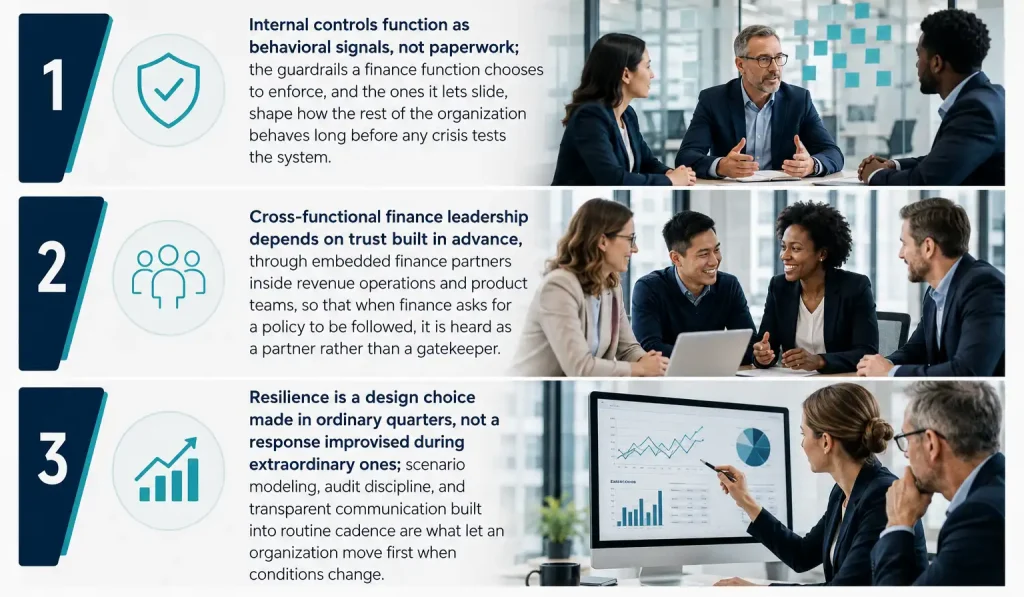
That is the essence of strategic CFO leadership: controls are not paperwork they are behavioral nudges. A deal desk that pushes back on late-stage discounting protects margin, but it also teaches the sales organization to respect pricing integrity. A finance team that reviews implementation cost against contracted scope is not being pedantic; it is anchoring revenue recognition in economic reality rather than in whatever a closing deal happened to promise.
Why Cross-Functional Finance Leadership Requires Resilience Before the Crisis
Crisis management gets treated as a reactive art, something finance activates once the headlines arrive. Genuine resilience is built earlier than that, embedded into the ordinary rhythm of forecasting, budgeting, and cross-functional review long before any single event forces the issue. Companies that let internal audit and compliance atrophy in the name of speed tend to discover, when regulatory scrutiny or a market shock finally arrives, that their exposure was never a data problem. It was an institutional habit problem, a failure to ask hard questions on a schedule rather than under duress.
At a $127M global consumer products company operating across DTC, Amazon, and wholesale channels, with a supply chain running through China and Vietnam, resilience meant owning the full P&L and the logistics P&L simultaneously. Doubling inventory turns from three times to seven times released working capital that had been trapped in the system for years, and it happened alongside four consecutive clean external audits, proof that speed and control are not actually in tension when the systems are designed correctly from the start.
The pattern repeats across industries. Finance leaders who embed scenario modeling into routine operating cadence, rather than reserving it for crisis response, give their organizations the option to move first when conditions shift. That optionality, more than any forecast accuracy metric, is what boards and investors are actually paying for when they fund a finance function.
Guardrails, Not Gates: Designing Controls That Scale Trust
One of the more durable ideas in cross-functional finance leadership is the distinction between guardrails and gates. Gates, no matter how well intentioned, eventually get circumvented once the business outgrows them. Guardrails, when designed with the end user in mind, get embraced because they remove ambiguity rather than adding friction.
A pricing framework built for a venture-backed performance marketing organization scaling from $9M to $180M in revenue in twenty-four months illustrates the point. The framework embedded margin thresholds and delivery cost assumptions directly into the tool sales teams used to price deals, rather than routing every exception through an approval queue. Sales moved faster because the guardrail was structural, not procedural, and finance gained predictable revenue without becoming the department of no.
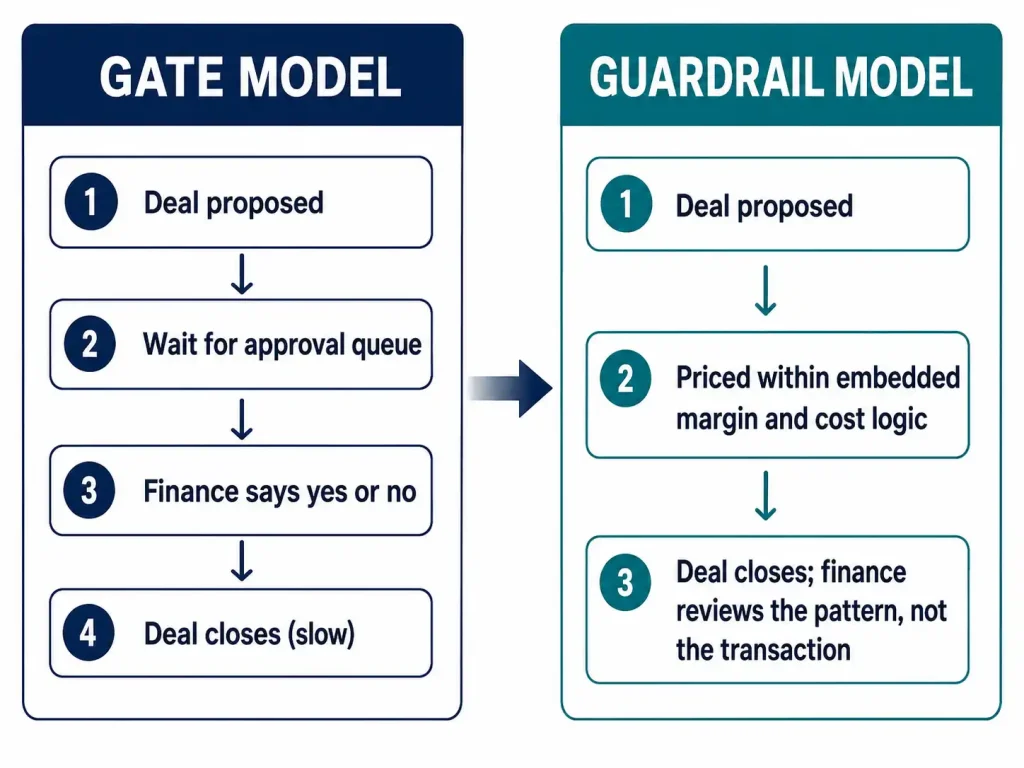
A short list captures what tends to separate the two in practice:
- A guardrail lives inside the tool the team already uses; a gate lives in someone else’s inbox.
- A guardrail explains its own logic; a gate simply withholds approval.
- A guardrail scales with volume; a gate becomes the bottleneck volume exposes.
From Boardroom Narrative to Cross-Functional Finance Leadership
Finance leaders operate in two worlds at once. One tracks receivables aging, revenue leakage, and working capital trends. The other explains to a board or an investor group how the organization is absorbing risk and sustaining momentum. The bridge between those worlds is rarely the precision of the numbers. It is the narrative built around them, and whether the rest of the leadership team trusts that narrative enough to act on it.
As Chief Financial Officer of a mission-driven education and research institution, raising $37M across equity and venture debt required more than a capital stack; it required owning the investor narrative, the audit committee relationship, and, because the organization was lean, the operational leadership of HR, IT, Legal, and Facilities alongside finance. That breadth is not unusual in cross-functional finance leadership roles once an organization reaches a certain scale. The CFO becomes a translator of strategic clarity, not simply a monitor of activity, and that translation only works when the rest of the executive team has already learned to trust the source.
Trust of that kind gets built by embedding finance inside revenue operations, sales planning, and product decisions rather than positioning it as an external auditor of other people’s work. Sales leaders follow deal desk guidance when they believe finance understands customer nuance. Legal teams accelerate approval cycles when they see finance aligned with their own risk thresholds. None of that happens through a memo. It happens through the accumulated evidence of finance showing up as a partner rather than a checkpoint.
Compliance, Culture, and the CFO as Cultural Architect
Regulatory compliance is often treated as overhead, a box-checking function that exists to keep the company out of trouble. In practice it functions as an amplifier of trust, and its absence becomes a liability the moment a company begins interfacing with enterprise buyers or institutional investors who expect audit readiness as a baseline, not a bonus.
Internal controls also function as a mirror of culture. An organization that tolerates informal pricing approvals or silent deviations from policy tends to tolerate similar ambiguity everywhere else, and the reverse holds just as reliably: companies that honor their own control boundaries usually communicate expectations with more clarity across the board. By the time a company reaches a later growth stage, the CFO’s role shifts from transactional precision toward something closer to cultural architecture, shaping how truth circulates through the organization rather than simply reporting what already happened.
That shift rarely comes through edict. It comes through the deal a finance team is willing to walk away from, the forecast a team is willing to defend under pressure, and the clarity a leadership team offers employees during a downturn rather than after one. Companies that invest in that kind of transparency build more than resilient operations. They build reputations that outlast any single quarter.
Three Key Takeaways
Disclaimer: This article is intended for informational purposes only and does not constitute legal, tax, or accounting advice. You should consult your own tax advisor or counsel for advice tailored to your specific situation.
Hindol Datta is a four-time CFO and senior finance executive with over 25 years of leadership experience across cybersecurity, SaaS, gaming, logistics, digital marketing, medical devices, consumer products, and nonprofit organizations. He has led more than $120M in fundraising and over $150M in M&A transactions while building the financial and operational systems that let complex businesses scale with confidence. He is the author of seven books in the Systems CFO Series and holds active CPA, CMA, and CIA credentials.
AI-assisted insights, supplemented by 25 years of finance leadership experience.