
Executive Summary
Credit risk management best practices are rarely tested when markets are calm. It is when constancy gives way to chaos that the true cost of credit reveals itself. No longer a line item buried in the treasury function, it touches supplier relationships and sales confidence. It shapes the pace at which a company can grow. A finance organization that treats credit as a commodity in good times often has no framework to lean on. A downturn is when that gap shows.
This article sets out a practical approach to credit risk management. It covers how to define the real cost of credit, design a policy that flexes without collapsing, and measure and narrate credit exposure for the executive table. It also covers using credit proactively as a lever for growth even as liquidity tightens. Lessons are woven throughout from finance leaders who built these systems. Their work spans companies from venture-backed SaaS businesses to global consumer products operations. Credit discipline, like most financial architecture, is learned in the doing rather than in the abstract.
The True Cost of Credit: Why Credit Risk Management Best Practices Start with Better Questions
When markets are predictable, credit tends to be treated as financial hygiene, an accessory tucked behind the more visible metrics on a board deck. Uncertainty changes that calculus entirely. The cost of credit stops being a flat number and becomes a story with several chapters: interest spread in basis points, but also deferred revenue, renegotiated covenants, and, in its harshest form, disruption to the capital the business needs to operate. Credit extended too freely can mask poor underwriting discipline. Credit withheld too tightly can choke the very growth a company is trying to protect.
This is where corporate credit risk management earns its keep as a strategic function rather than a back-office task. A CFO who has run finance for a high-growth cybersecurity and identity access management company generating roughly $30M in annual recurring revenue learns this distinction quickly, because every extension of terms to a customer or a channel partner carries a cost that shows up months later in the forecast, not in the invoice. The discipline required is not merely arithmetic. It is the ability to see a balance sheet as a ledger of promises made and kept, and to price those promises honestly.
Building a Credit Policy That Bends Without Breaking
A rigid credit policy behaves like a corset. It promises structure but snaps the moment conditions demand flexibility. A reckless one behaves like an overly generous host, inviting exposure in the name of growth. Effective credit risk management sits between these failure modes, built around trigger points that respond to macro shocks such as slowdowns, currency swings, or fiscal tightening, while preserving room for discretion when a client’s reputation, sector position, or competitive standing warrants it.
Early-Warning Indicators That Matter
The policies that hold up under stress tend to share a common architecture:
- Tiered credit limits mapped to customer segment and payment history, with defined mobility between tiers rather than fixed classifications
- Early-warning indicators tracked continuously, including payment velocity, dispute frequency, and covenant drift
- Discretion built into the framework for cases where financial health, leadership quality, and relationship history diverge from the standard scoring model
- Scheduled policy reviews tied to macroeconomic triggers rather than an arbitrary annual calendar
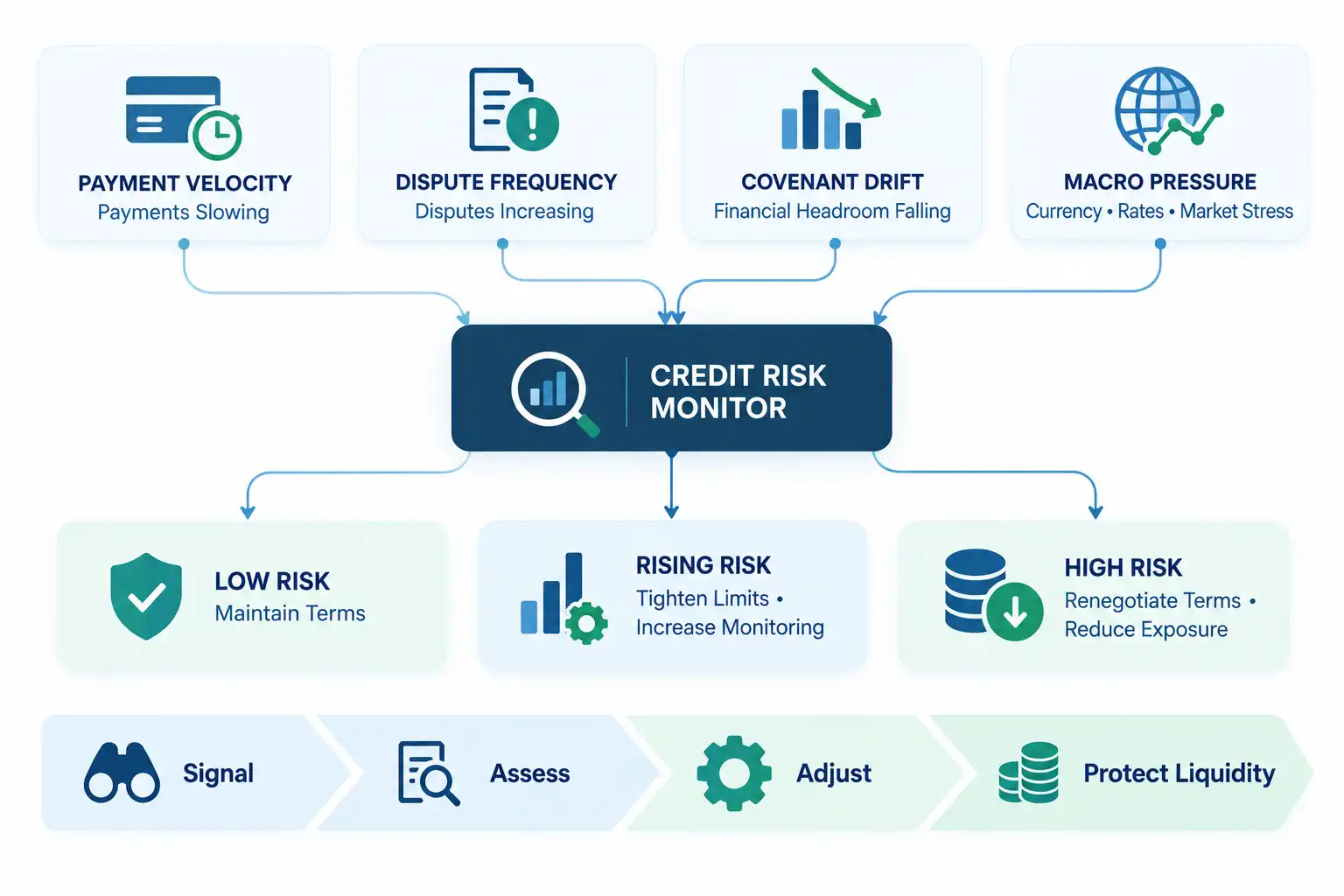
A finance leader who joined a $127M global consumer products company with direct-to-consumer, marketplace, and wholesale channels, and a supply chain spanning two continents, faced exactly this tension. More than doubling inventory turns while managing customer and supplier credit terms across three channels required a policy flexible enough to extend generous terms to strategic partners while tightening quickly around segments showing early signs of stress.
Measuring and Narrating Credit Risk at the Executive Table
Historical delinquency rates and aging reports are useful, but they are chapter headings, not the story itself. Real credit risk analysis requires a richer vocabulary: exposure velocity, customer segment fragility, scenario volatility, and correlation with macro indicators. Days sales outstanding, receivables aging, and credit exposure by segment mean little in isolation. They mean a great deal when read against each other.
Building Dashboards That Tell a Story
Dashboards built for board and executive consumption should plot segment exposure against revenue velocity, place country risk alongside receivables cycle length, and surface covenant breaches in a way that changes the tone of the conversation in the room. A CFO who has consolidated financial reporting across five countries for a publicly listed gaming and digital entertainment company understands how quickly currency exposure, local payment norms, and regulatory variance can distort a single global credit picture if the reporting framework does not account for them individually before rolling them up.
The most useful credit monitoring systems answer generative questions rather than simply confirming what already happened. If revenue in a given segment falls five percent, how does exposure shift. If a supplier’s payment slips by two weeks due to geopolitical stress, what is the resulting erosion in working capital, and what needs to be hedged or reallocated. Credit risk, framed this way, becomes a live conversation rather than a quarterly report.
Turning Credit Risk Management Best Practices into a Growth Lever
When liquidity tightens, through closed capital markets, elevated rates, or investor caution, credit risk management best practices shift from a defensive posture to an offensive one. The question changes from how to protect the balance sheet to how to use credit deliberately to gain market share while still protecting internal liquidity.
Trade Credit and Working Capital as Strategic Tools
This is not a contradiction. It is a matter of aligning several objectives at once:
- Structuring voluntary early-payment discounts calibrated to genuine cash flow benefit rather than habit
- Extending conditional trade lines to strategic partners, gated by clear repayment monitors
- Preserving internal cash through working capital restructuring while deploying nonoperational credit facilities to help smaller suppliers finance their own expansion
- Treating every extension of credit as a signal of confidence rather than a favor
A finance leader who oversaw a $37M capital raise for a mission-driven education institution, while simultaneously running finance, HR, IT, legal, and facilities, learned that credit and trust are difficult to separate once an organization is under real financial pressure. Extending flexibility to a partner during a difficult stretch, backed by real monitoring rather than blind faith, tends to build the kind of relational equity that a spreadsheet cannot capture but a renewed contract eventually will.
Credit as Culture: Embedding Trust into the Balance Sheet
Credit policy that lives only in a compliance document rarely survives contact with a downturn. The kind that becomes part of how an organization tells its own story, referenced at onboarding, discussed at finance forums, and visible in how deals get structured, tends to hold. It signals that credit is not a constraint bolted onto the business but an expression of the company’s values: trust extended deliberately, promises tracked carefully, and boundaries respected on both sides of a transaction.
A four-stage framework for elevating credit risk management:
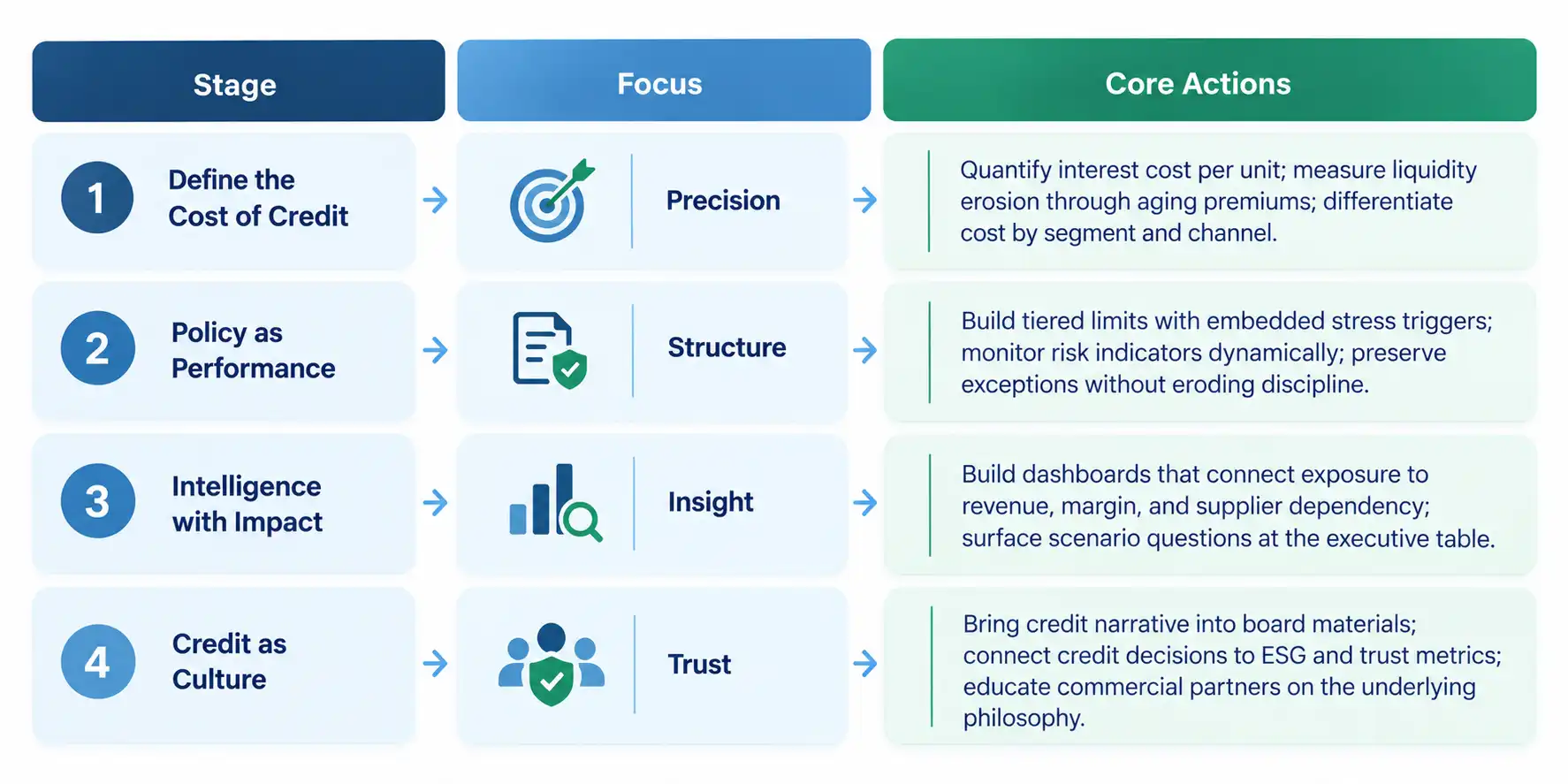
These four stages are less a sequence than a set of practices that reinforce one another. A company that only masters the first two ends up with a technically sound but culturally invisible credit function. One that masters all four turns finance from a tollkeeper into a genuine collaborator with the rest of the business.
Three Key Takeaways
- The true cost of credit extends well beyond interest rates, and any credit risk management best practices worth adopting must account for deferred revenue, covenant renegotiation, and the relational capital at stake in every extension of terms.
- A credit policy built around early-warning indicators such as payment velocity, dispute frequency, and covenant drift will hold up better under stress than one built purely around static tiers, because it gives the organization room to respond before a relationship deteriorates into a write-off.
- Credit risk management earns its place at the executive table only when it is measured and narrated well, connecting exposure to revenue, margin, and supplier dependency so that the numbers prompt real decisions rather than simply confirming what already happened.
Disclaimer: This article is intended for informational purposes only and does not constitute legal, tax, or accounting advice. You should consult your own tax advisor or counsel for advice tailored to your specific situation.
Hindol Datta is a four-time CFO and senior finance executive with over 25 years of leadership experience across cybersecurity, SaaS, gaming, logistics, digital marketing, medical devices, consumer products, and nonprofit organizations. He has led more than $120M in fundraising and over $150M in M&A transactions while building the financial and operational systems that let complex businesses scale with confidence. He is the author of seven books in the Systems CFO Series and holds active CPA, CMA, and CIA credentials.
AI-assisted insights, supplemented by 25 years of finance leadership experience.