
Executive Summary
Covenant management is often treated as a legal chore, a set of thresholds that finance teams watch nervously each quarter. Viewed as feedback loops, covenants show lenders how a business is moving and reward companies that interpret those signals early.
This article explains how real-time covenant intelligence, liquidity modeling, and scenario forecasting turn compliance into a structured dialogue with lenders. It also shows how adaptive design, peacetime negotiation, and disciplined disclosure build the trust that matters most when crisis management becomes necessary.
Why Covenant Management Begins with a Shift in Mindset
Lenders do not write covenants in the hope that borrowers will fail. They set thresholds so that a company can alert them early, forecast conservatively, and adapt before small problems compound. Through the lens of systems thinking, each covenant is a signal inside a feedback loop. Search theory adds a useful corollary: the earlier a change is detected, the more options remain open.
Once covenant dashboards reach operating leaders, finance stops playing the role of compliance police. Teams begin to treat headroom as a shared stewardship duty instead of a checkbox at quarter end.
Building Real-Time Covenant Intelligence
Signals help only when they arrive in time to act on them. A practical early warning system pulls ERP and treasury data into one dashboard that places covenant metrics beside leading operational indicators.
How a Covenant Early Warning System Works
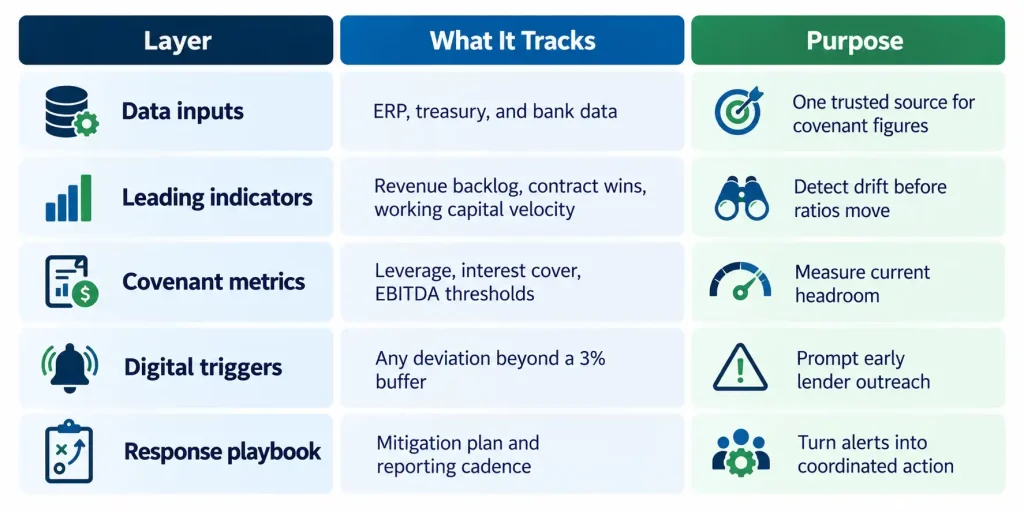
When EBITDA drops without warning because of supplier delays, the system flags the deviation before quarter end. The effective response is an immediate call to the bank covering the cause and an inventory optimization plan. Weekly forecast updates then track progress until recovery. Lenders often grant a short covenant amendment in exchange for enhanced reporting of this kind.
Forecast credibility is what makes these conversations possible. In a $30M ARR cybersecurity and identity access management business, a driver-based forecasting engine can hold actuals within plus or minus 5% of forecast for 8 consecutive quarters. That record gives lenders a reason to believe the next forecast, and belief is the currency of covenant flexibility.
Liquidity Modeling and Forecasting Under Uncertainty
Uncertainty is not a flaw in a forecast; it is one of its inputs. Sound liquidity modeling runs covenant ratios under several weighted scenarios instead of a single expected case.
Scenario Weights for Covenant Testing
| Scenario | Weight | Role in Covenant Management |
| Base case | 60% | Primary compliance forecast |
| Upside case | 20% | Capacity for investment or prepayment |
| Downside case | 20% | Early signal of covenant drift and mitigation needs |
When the downside case shows covenant drift, the right response is a calm, data-rich conversation instead of alarm. Management presents the scenario, the offsetting actions, and the mitigation playbook together. Banks then ask clarifying questions instead of punitive ones, and when markets recover, the same narrative can support a refinancing with better terms and a longer tenor.
Stress-Testing and Adaptive Covenant Structures
A static covenant library ignores how volatile most operating environments have become. Adaptive covenants, designed jointly with lenders, move with market reality and illustrate a more mature form of covenant management.
- Indexed revenue covenants: headroom adjusts with key commodity prices or currency rates, so thresholds fall with the index during a price collapse.
- Rolling amortization covenants: amortization pauses for a defined period when volatility pushes debt-to-EBITDA past an agreed trigger, with triggers documented and tested through simulation.
When a headwind arrives, the company triggers the pause, shares its monitoring report, and proceeds as designed. Renegotiation becomes unnecessary because both sides agreed on the risk parameters before the stress appeared.
Covenant Management as Collaborative Governance
Covenants also serve as instruments of corporate governance. They create regular engagement between management and lenders, hold leadership accountable, and keep strategy from drifting. Banks respect humility over hubris, so a plain statement of the challenge and the plan builds credibility.
Credit renewals can extend this idea further by tying covenants to digital transformation milestones agreed through iterative dialogue. Real-time indicators can pause covenant tests if milestones lag, making the covenants co-created guardrails instead of penalties.
The same discipline applies in mission-driven education and research institutions, where a $37M raise across equity and venture debt depends on steady board reporting.
From Tactical Fixes to Strategic Financial Architecture
Mature covenant management treats covenants as inputs to long-term planning, not leftovers from a credit negotiation. In margin-sensitive businesses, volatile working capital often leads banks to price in tighter covenants and higher fees.
A joint workshop between relationship banks, finance, and operations offers a better path than transactional term sheet negotiation. Stock-and-flow diagrams show how inventory delays, supplier lead times, and customer payment behavior create cash flow shocks. Once lenders see the volatility as structural, a hybrid package of fixed and floating thresholds with milestone-linked step-downs becomes possible. The borrower, in return, commits to quarterly variance reporting, shared dashboards, and real-time liquidity coverage ratios.
Working capital discipline strengthens this kind of case. For a $127M global consumer products company, lifting inventory turns from 3x to 7x releases trapped cash and supports growth financing such as a $12M facility.
Institutionalizing the Covenant Conversation
A single dashboard or war room cannot sustain this approach on its own. A Covenant Readiness Index helps embed covenant awareness by scoring each business unit on four pillars.
The Covenant Readiness Index
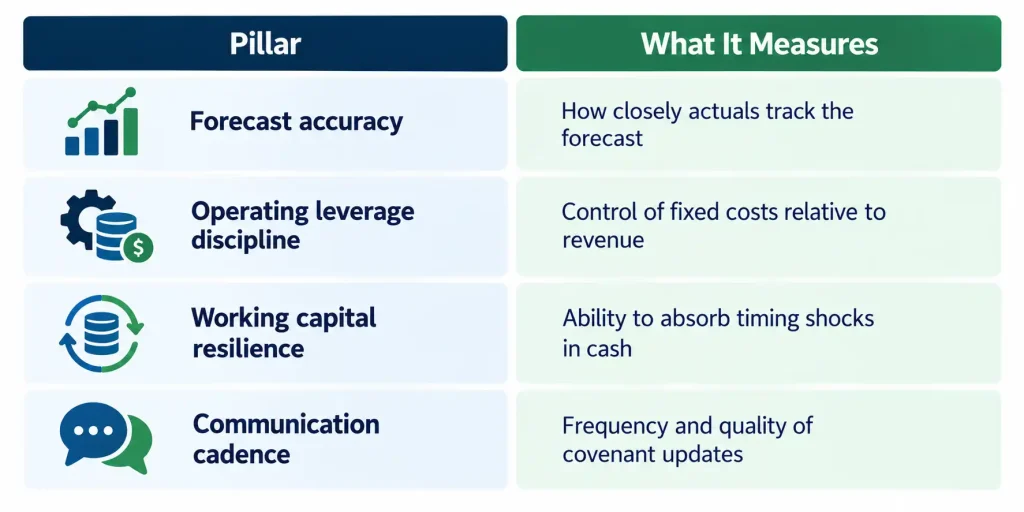
The scores reveal weak links before they cascade into enterprise risk. Gamification reinforces the habit: units that lift their index by 20% quarter over quarter receive priority in capital allocation reviews. Good covenant management then spreads, as procurement asks how payment timing affects ratios and sales phases revenue to protect EBITDA.
Pre-Negotiation and Crisis Management in Peacetime
Most borrowers renegotiate only when thresholds are already at risk. A stronger approach earns covenant credibility in peacetime. After a record quarter, finance can share forecasts of a coming dip tied to product investment and market expansion. The same session can propose re-baselining EBITDA targets and resetting leverage covenants.
Banks may question the timing, yet trust peaks when performance is high. A step-down framework over 6 quarters, matched to the investment curve, lets covenants flex as planned when the dip arrives.
Effective crisis management, in other words, begins long before the crisis. In an early-stage digital marketing SaaS turnaround, cutting monthly burn from $800K to $200K requires transparent liquidity modeling to keep stakeholders aligned.
Designing Next-Generation Covenants
Next-generation covenants reflect real business complexity and reinforce shared accountability between lenders and borrowers.
- ESG-linked margins: interest rate margins tied to carbon intensity reduction, which lowered borrowing costs once external verification was in place.
- Supply chain diversity sweeps: excess cash sweep requirements tied to supplier regional diversity, so greater diversity earned amortization flexibility.
Lenders accept such designs when the covenant management behind them is thoughtful, data-backed, and mutually beneficial.
Information Theory and the Quality of Disclosure
Information theory holds that communication creates value by reducing uncertainty, not by adding volume. For covenant management, the quality of disclosure therefore matters more than its quantity. Strategic parsimony means giving enough detail to remove ambiguity and enough structure to allow comparison.
Quarterly lender updates can follow a Bayesian sequence of prior assumptions, observed data, and posterior updates. This format shows banks how management processes change, not only what changed. Every dashboard also needs a narrative explaining the movement, because a dashboard without a story is noise.
The Strategic Dividend of Trust in Covenant Management
Flexibility is not a product of legal terms; it is the dividend of trust built through cadence and honest disclosure. Once established, that trust becomes a flywheel in which banks grant waivers without fear and extend terms without resistance. Companies that practice disciplined covenant management tend to enjoy a lower cost of capital and better access to liquidity.
Covenants are not chains but chords, connecting operational rhythm to the pulse of the market. For operators, investors, and lenders alike, the message holds: start the conversation early, keep it open, and ground it in systems-level understanding.
Three Key Takeaways
- Treat covenant management as a communication system instead of a compliance exercise. Real-time dashboards, leading indicators, and early triggers give lenders reasons to grant flexibility before a breach looms.
- Build liquidity modeling into every lender conversation, with weighted scenarios and documented mitigation plans. Adaptive structures such as indexed thresholds let covenants move with market reality.
- Negotiate in peacetime and disclose with discipline, so that trust is already banked when conditions turn. Crisis management works best when step-down frameworks and clear narratives exist before the stress arrives.
Disclaimer: This article is intended for informational purposes only and does not constitute legal, tax, or accounting advice. You should consult your own tax advisor or counsel for advice tailored to your specific situation.
Hindol Datta is a four-time CFO and senior finance executive with over 25 years of leadership experience across cybersecurity, SaaS, gaming, logistics, digital marketing, medical devices, consumer products, and nonprofit organizations. He has led more than $120M in fundraising and over $150M in M&A transactions while building the financial and operational systems that let complex businesses scale with confidence. He is the author of seven books in the Systems CFO Series and holds active CPA, CMA, and CIA credentials.
AI-assisted insights, supplemented by 25 years of finance leadership experience.