
Executive Summary
Most finance functions still treat cost accounting metrics as a compliance artifact, something produced for the auditor and filed away rather than used. That framing is a historical accident, not a design choice, and it leaves enormous strategic value on the table. Cost accounting metrics, built well, tell a company how it digests capital, which activities scale and which quietly erode margin, and where the next dollar of investment should go.
This article sets out how to measure metrics that function as a decision system rather than a scorecard: what qualities a strong cost metric needs, how to embed those metrics across product, pricing, talent, and capital decisions, and how to translate the resulting insight into a narrative that boards and investors trust.
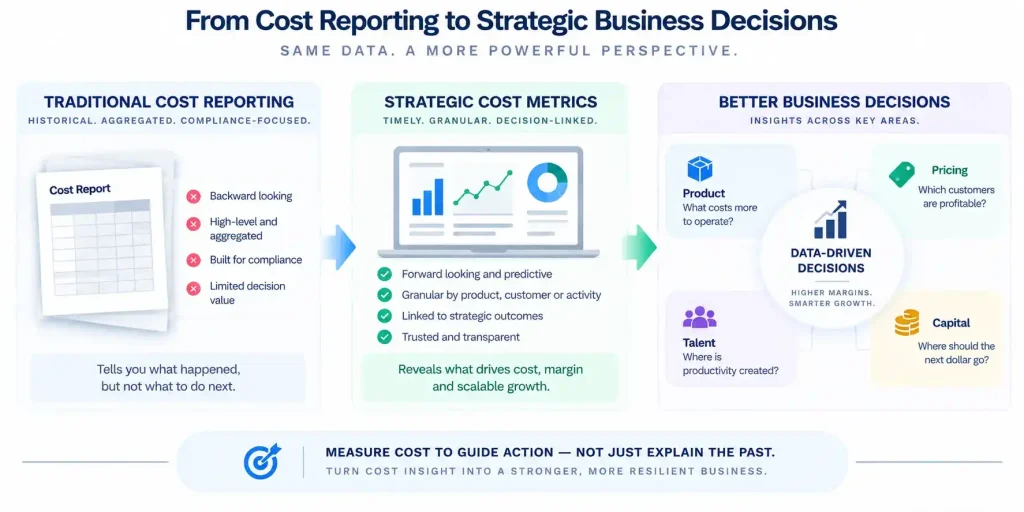
From Compliance Ledger to Strategic System
Cost accounting carries the vocabulary of its industrial origins. Overhead, variance, absorption rate: these terms describe a world of physical plant and linear production runs, and they still shape how many finance departments think even when the business in question sells software or services rather than goods. The result is a set of cost accounting metrics built to satisfy an auditor rather than to inform a decision. They report on a monthly cycle, describe what happened after the fact, and offer little guidance on what to change next week.
A business that scales through platforms rather than factories needs a different relationship with its numbers. Cost accounting metrics in that context must be predictive rather than merely reconcilable. They must connect to specific activities and customer behaviors, not sit in a generic overhead bucket. Take a granular cost model on a software business. It can reveal that support costs for a mid-market segment are quietly eating margin. That margin looks healthy on a traditional income statement, but it is not. That is a pricing and segmentation signal, and it never shows up in a report built for tax purposes.
How to Measure Metrics That Reveal Strategic Insight
The question of how to measure metrics that matter starts with rejecting one idea. A cost report does not exist just to describe the past. A useful cost accounting metric behaves more like an instrument panel than a rearview mirror. It should be built around four properties.
- Causally linked to a strategic outcome, not just an operational input
- Timely enough to support a mid-course correction rather than a post-mortem
- Disaggregated to the level where a manager can see the behavior of a specific unit, segment, or cohort
- Transparent in its source and its calculation, so the people using it trust what it says
Building Cost Structures Around the Value Chain
A cost architecture designed around a value chain, rather than around a department, tends to surface hidden insight. A conventional structure often buries it. Consider one high-growth cybersecurity and identity access management company, generating roughly $30M in annual recurring revenue. Its finance function had no forecasting discipline and no reliable capacity model when the engagement began. The team built a driver-based forecasting engine and a matching capacity model, alongside a disciplined reporting cadence. Actuals landed within five percent of forecast for eight consecutive quarters. That level of predictability changed how the board evaluated every subsequent investment decision.
A similar principle applies in a $127M global consumer products business with a supply chain spanning two continents. Inventory carrying cost had been buried in a generic cost-of-goods line, obscuring a working capital problem that no income statement could reveal. Once isolated and tracked by SKU and by channel, inventory turns moved from three times to seven times, releasing trapped capital and reframing how the leadership team thought about growth: not as a function of sales volume, but of cash conversion.
Designing Cost Accounting Metrics That Change Behavior
Metrics are not neutral. A poorly structured cost accounting metric encourages local optimization, where a manager hits a target at the expense of the wider system, while a well structured one creates system-wide clarity. Consider customer onboarding cost in an enterprise software business. Rather than folding this into a generic SG&A line, the more useful approach isolates:
- Average onboarding hours per customer segment
- Onboarding cost per dollar of annual contract value
- Ramp time to first renewal
These three numbers reveal a productivity curve, not just a burden, and they inform decisions in product design, implementation staffing, and customer segmentation at once. A manufacturing business can apply the same logic to a cost-to-serve model that quantifies the embedded overhead of a low-volume SKU, and a logistics business can isolate fixed versus variable transportation cost by geography to inform routing and fleet strategy. Each case shares a common feature: disaggregating the cost driver, rather than reporting the aggregate, is what unlocks a pricing decision, a capital allocation decision, or a sharper investor narrative.
Embedding Cost Metrics Across Product, Pricing, Talent, and Capital
Cost data earns its keep only when it moves out of Finance and into the workflow of every function making a decision that touches cost.
Product. Tagging support tickets by feature and measuring infrastructure usage per module exposes which parts of a product are quietly expensive to run. A venture-backed digital marketing organization that scaled revenue from $9M to $180M in twenty-four months relied on exactly this kind of feature-level visibility, built alongside a customer acquisition cost, lifetime value, and contribution margin framework, to keep growth from outrunning unit economics.
Pricing. Strategic pricing begins with a clear view of the blended cost of acquiring, onboarding, and servicing a customer, broken out by size, vertical, and geography. Small deals often carry higher churn and consume more implementation hours per dollar of revenue than they appear to on the surface, and a pricing tier built without that visibility tends to subsidize its least profitable customers.
Talent. People cost dominates most modern income statements, yet few organizations connect cost-per-hire and productivity ramp to the hiring plan itself. A professional services firm supporting a scale from $12M to $63M in revenue within eight months did so by building engagement-level profitability and utilization analytics from a blank page, giving leadership its first clear view of where margin was created and where it leaked.
Capital. Every allocation decision, from automation versus outsourcing to a new market entry, is a portfolio decision once cost accounting metrics are mature enough to model payback periods and margin-per-dollar-invested across the options on the table.
Turning Cost Metrics into Boardroom and Investor Narratives
Boards and investors do not respond to cost data in isolation. They respond to three connected dimensions, which can be read as a simple progression:
Efficiency → Elasticity → Optionality
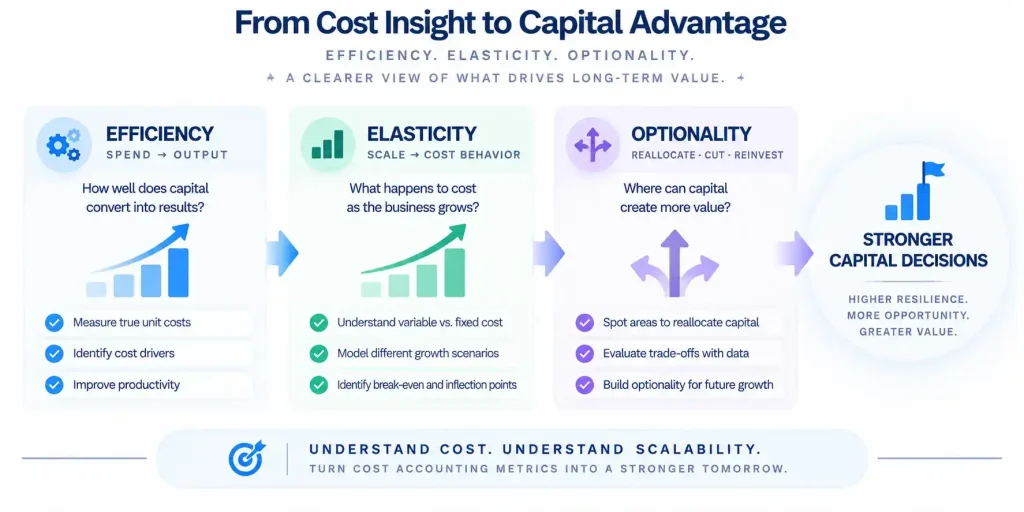
Efficiency shows how well spend converts into output. Elasticity shows how cost behaves as the business scales. Optionality shows where capital can be reallocated, cut, or reinvested. A mission-driven education institution raising $37M in equity and venture debt anchored its investor narrative in exactly this progression, pairing multi-year financial modeling under variable funding scenarios with monthly board reporting that gave the audit committee confidence in the process, not only the numbers.
Benchmarking sharpens the same story. Mapping cost ratios against comparable peers, tracking cohort-level gross margin, and preparing cross-industry comparisons turn a cost accounting metric from an introspective report into a market-facing argument. A Euronext Paris-listed gaming and digital entertainment company operating across five countries used a single, unified revenue and cost definition, built on a consolidated finance system rolled out firmwide, to compress statutory reporting cycles under both IFRS and US GAAP ahead of an IPO-readiness process, a level of coherence that reduced diligence risk considerably when the company later executed more than $100M in cross-border acquisitions.
Building an End-to-End Framework That Lasts
A durable cost performance framework rests on five commitments, and they apply regardless of industry or stage:
- Design cost accounting metrics for decisions, not for compliance
- Push cost data to the edge, where the actual choices are made
- Narrate cost as an enabler of strategy rather than a constraint on it
- Align roles, rhythms, and incentives so that behavior follows the metric
- Keep revisiting the model, because cost behavior evolves as the business does
Systems should serve this model rather than dictate it. A venture-backed manufacturing company with no prior finance function needed a chart of accounts, a GAAP framework, and a forecasting model built from a blank page before any of the above was possible, a reminder that architecture, not sophistication, is the real precondition for strategic cost accounting metrics.
Three Key Takeaways
- A cost accounting metric earns its place in the business only when it is causally linked to a decision, timely enough to act on, disaggregated to the unit level, and transparent enough that the people using it trust the number.
- Cost data creates value only once it moves out of Finance and into product, pricing, talent, and capital decisions, where a disaggregated view of cost-to-serve or cost-to-build changes what a team actually does next.
- Boards and investors reward cost accounting metrics that demonstrate efficiency, elasticity, and optionality together, because that combination signals a business that understands its own scalability rather than one that has simply controlled spend for a quarter.
Disclaimer: This article is intended for informational purposes only and does not constitute legal, tax, or accounting advice. You should consult your own tax advisor or counsel for advice tailored to your specific situation.
Hindol Datta is a four-time CFO and senior finance executive with over 25 years of leadership experience across cybersecurity, SaaS, gaming, logistics, digital marketing, medical devices, consumer products, and nonprofit organizations. He has led more than $120M in fundraising and over $150M in M&A transactions while building the financial and operational systems that let complex businesses scale with confidence. He is the author of seven books in the Systems CFO Series and holds active CPA, CMA, and CIA credentials.
AI-assisted insights, supplemented by 25 years of finance leadership experience.