
Executive Summary
A control premium isn’t a courtesy sellers extend to the buyer with the deepest pockets. It’s a price the market places on the ability to redirect a company’s cash, its strategy, and its capital structure. Every CFO who has sat across the table during a live negotiation knows this: the number is never clean. Precedent transaction data always suggests otherwise. A buyer pays a valuation premium. A seller accepts a minority discount. Both then face an illiquidity discount. None of this is an academic footnote. They are the mechanics that turn an enterprise value on a spreadsheet into a number two parties can actually sign.
This piece works through each adjustment in turn: what it prices, where the ranges typically fall. It also explains why stacking them in a straight line produces a distorted answer. Boards, auditors, and the IRS demand a certain discipline before they’ll accept how you built the number. The piece closes with the practitioner framework for sequencing control premiums, minority discounts, and illiquidity discounts. The goal: a final figure that reflects deal economics, not a set of assumptions bolted together under deadline pressure.
What a Control Premium Actually Prices
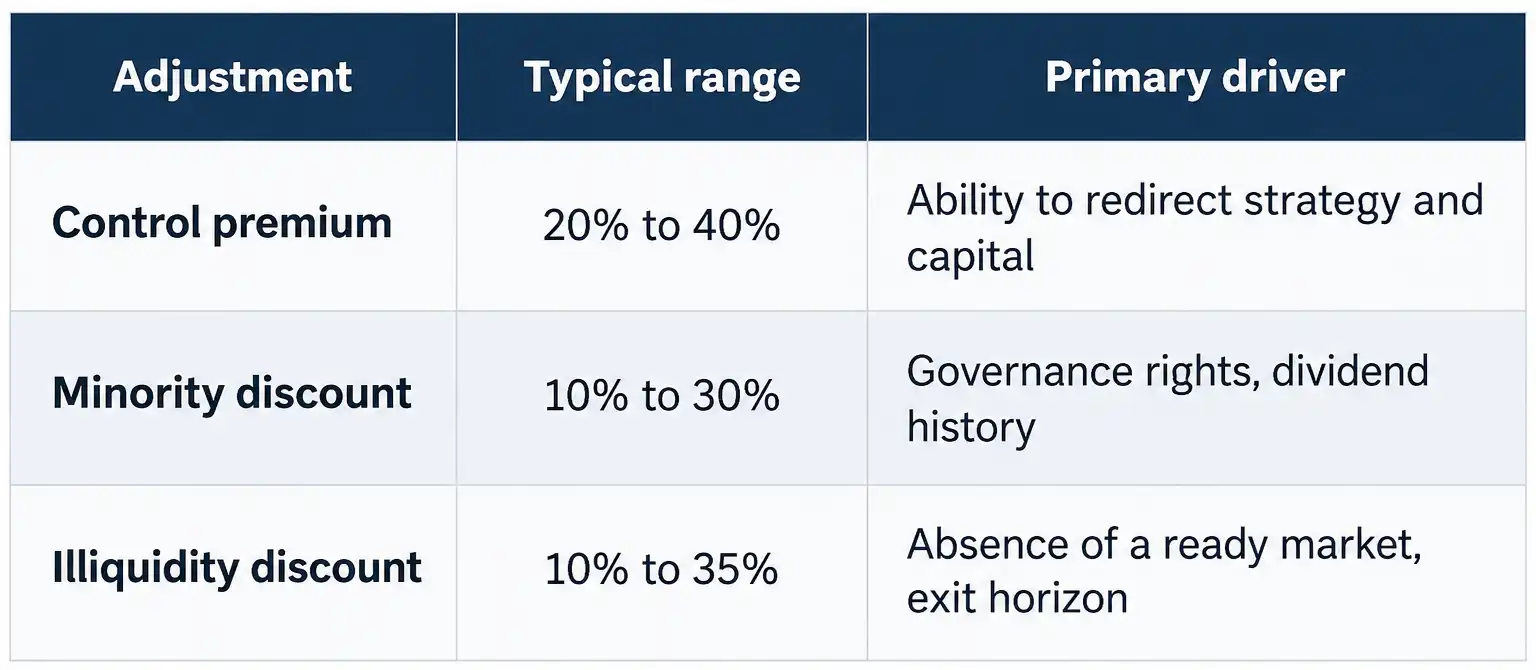
A control premium prices one thing: the right to direct a company’s operations, capital allocation, and strategy. It’s the price for steering, not just watching from the sidelines. Public-to-private transactions make this visible with unusual clarity. The market price of a minority share sits right next to the price a controlling buyer eventually pays. The gap between them is the premium in its purest form, typically 20 to 40 percent. The number depends on what the buyer believes it can do once the keys change hands.
Work involved a gaming and digital entertainment company that trades on Euronext Paris. Deals exceeding $100M there carried full due diligence and post-merger integration responsibility across five countries. That work made a related point unavoidable: a control premium needs a modeled path to value creation. Without one, it isn’t a premium at all, it’s overpayment wearing valuation language. The buyer earns that premium through a specific plan. Rationalize overlapping cost structures. Unlock underused assets. Refinance debt carried at an inefficient rate. A buyer who skips that roadmap tends to discover the gap later. It shows up on the balance sheet as an impairment.
Buy-side due diligence on an IT services acquisition target reinforced the same discipline from the other side of the table. Quality-of-earnings analysis often surfaces adjustments to reported EBITDA that shift the entire basis for calculating a control premium. Negotiating a premium before that adjustment is final means negotiating on the wrong number.
A Practitioner Note on Premium Negotiation
Control premium negotiations rarely resolve on the first number either side proposes. A seller anchored to precedent transaction data will often start high. A buyer grounded in operational specifics will counter with a figure tied to what the model can actually defend. Deals frequently land in between, conditioned on the buyer committing to the operational plan that justifies the gap, which is precisely the discipline that separates a defensible control premium from an aspirational one.
Minority Discount: The Cost of Standing Outside the Boardroom
A minority discount is the inverse expression of the same logic. When an ownership position carries no ability to direct strategy, appoint management, or influence the timing of a liquidity event, that position is worth less than its pro-rata share of enterprise value, and the market generally prices that gap between 10 and 30 percent depending on the specific governance rights attached to the stake.
The size of the discount tracks closely with three factors:
- Board representation, or the absence of it
- Contractual protections such as tag-along rights, information rights, or veto rights over major decisions
- The company’s history of returning capital to shareholders through dividends or distributions
A minority position with no board seat, no tag-along protection, and a paused dividend history sits at the higher end of that range, and the discount in that case is not a judgment on the company’s performance. It is a reflection of position within the capital structure, and CFOs who have run finance and revenue operations through a private equity-backed growth phase recognize this distinction well, since the same enterprise value can support very different per-share outcomes depending entirely on where in the cap table an investor sits.
Illiquidity Discount: Valuing Capital That Cannot Move
Private company shares carry a further penalty that has nothing to do with control: there is no ready market for them. An illiquidity discount, sometimes called a discount for lack of marketability, typically falls between 10 and 35 percent, and it exists because an investor holding an illiquid position bears real risk and real time cost even when the underlying business is performing well.
The following table summarizes the typical range for each adjustment discussed in this article, though actual figures always depend on deal-specific facts.
Calibrating the Discount with Recognized Frameworks
Restricted stock studies and option pricing models remain the accepted tools for calibrating an illiquidity discount, and both the SEC and the IRS accept these frameworks as long as analysts document the underlying assumptions with care. A preferred shareholder holding a strong liquidation preference on paper can still find that the only available offer for a partial sale sits well below stated value, and the reason is straightforward: no market, no immediate buyer pool, and no clear exit timeline. The value on paper and the value in hand are not the same number until a transaction actually clears.
Why These Valuation Premium Adjustments Do Not Simply Add Up
The most common error in applying these three adjustments is treating them as additive, when they are properly modeled as multiplicative. A 25 percent control premium followed by a 20 percent minority discount does not net out to a 5 percent adjustment, and treating it that way produces a materially wrong answer.
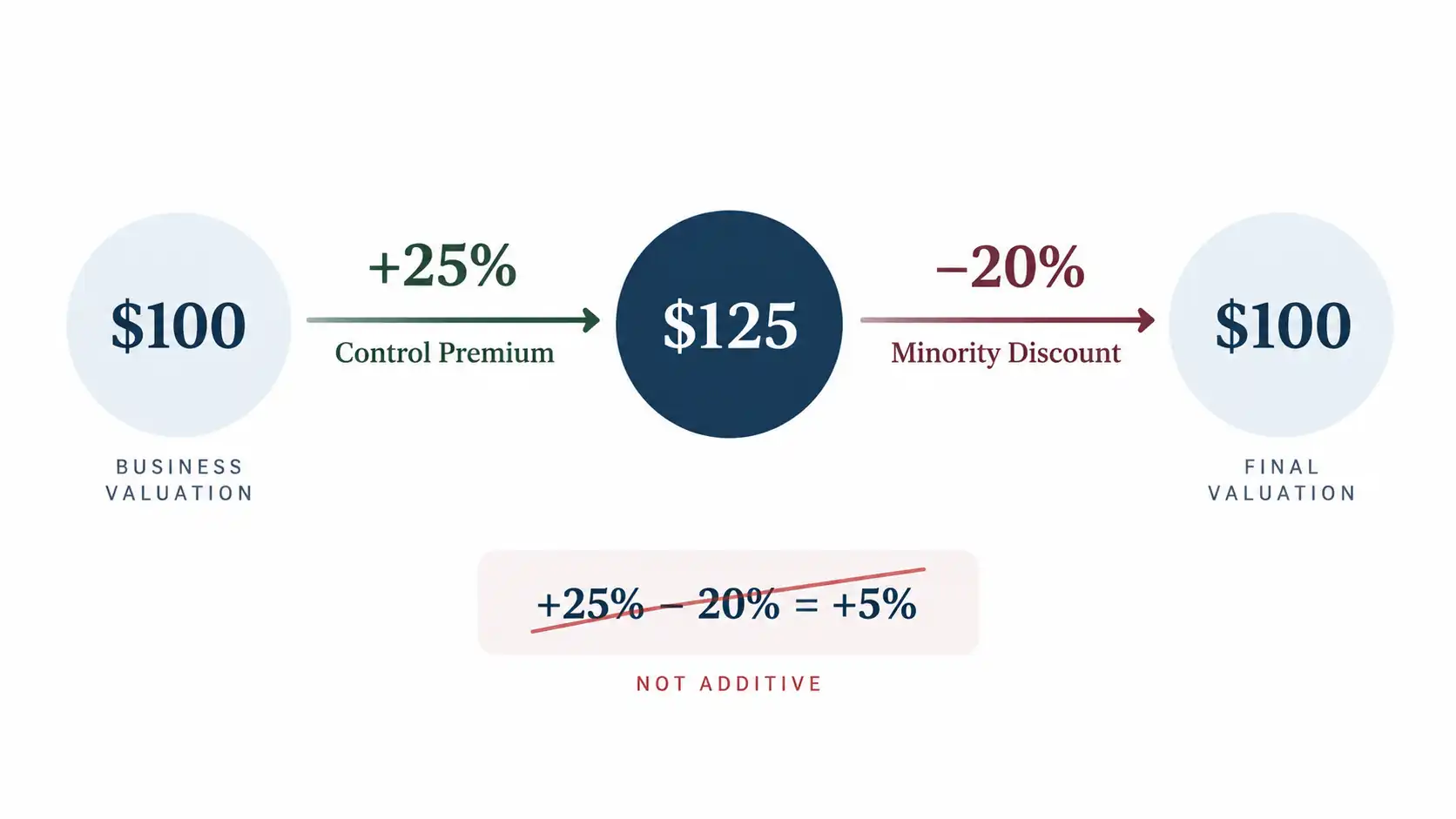
Consider the arithmetic directly. A control premium moves a base value up by its stated percentage, and a subsequent discount moves the resulting figure down by its own percentage, applied to the new base rather than the original one. The compounding effect can be substantial, and any model that simplifies this into simple subtraction should be treated with skepticism, regardless of how tidy the resulting number looks on a summary page.
Scenario testing across a range of assumptions is the only reliable way to see how sensitive a final valuation is to each individual adjustment. Small shifts in the control premium assumption or the illiquidity discount can move the final number by an amount large enough to determine whether a deal clears or collapses, and a CFO who has structured a capital raise combining equity and venture debt for a mission-driven institution knows that the board and audit committee will ask precisely this question: what happens to the number if this one assumption moves.
Making the Adjustments Defensible in Financial Reporting and Negotiation
Premiums and discounts live inside deal negotiations even when neither side states them explicitly, but the standard shifts entirely once the same adjustments appear in a fairness opinion, an ASC 820 valuation, or a tax filing. At that point, disclosure is not optional, and the documentation trail becomes the primary defense against later challenge.
A disciplined finance function maintains a library of valuation memos for exactly this reason, and each memo should articulate:
- The rationale behind every adjustment applied
- The benchmark and precedent transaction data used to support the range selected
- The output of scenario testing across a reasonable set of assumptions
This kind of documentation does more than satisfy an auditor. It aligns a board around how a number was reached before the board is asked to approve a transaction built on that number, and it converts what could otherwise be a contentious after-the-fact review into a straightforward walkthrough of already-recorded logic.
These adjustments also function as negotiation levers in their own right, separate from their role in formal valuation. A control premium can be offered upfront but conditioned on alignment around a specific post-close restructuring plan, giving the seller a visible path to the value being paid for. A price can be held firm while a liquidity path is offered to minority holders over a defined window, preserving headline economics while addressing the underlying risk concern that a discount was meant to capture in the first place. Both approaches recognize the same underlying truth: voting rights, exit rights, transfer rights, and participation rights each carry independent economic value, and pricing that ignores those distinctions is pricing that will eventually be challenged by whichever party feels the number failed to account for what they actually hold.
Three Key Takeaways
- A control premium is a price on demonstrated capability, not a number pulled from precedent transactions, and it should be tied to a specific, modeled plan for the value it claims to unlock, or it risks becoming overpayment recorded as goodwill and written off later.
- Control premiums, minority discounts, and illiquidity discounts compound rather than add, and any valuation model that treats them as simple subtraction will misstate the final number by an amount large enough to matter in a live negotiation.
- Documentation is not a formality reserved for auditors. A valuation memo that records the rationale, the benchmarks, and the scenario testing behind every adjustment is what allows a board to approve a number with confidence and what allows that same number to survive scrutiny months or years after the deal closes.
Disclaimer: This article is intended for informational purposes only and does not constitute legal, tax, or accounting advice. Readers should consult their own tax advisor or counsel for advice tailored to their specific situation.
Hindol Datta is a four-time CFO and senior finance executive with over 25 years of leadership experience across cybersecurity, SaaS, gaming, logistics, digital marketing, medical devices, consumer products, and nonprofit organizations. He has led more than $120M in fundraising and over $150M in M&A transactions while building the financial and operational systems that let complex businesses scale with confidence. He is the author of seven books in the Systems CFO Series and holds active CPA, CMA, and CIA credentials.
AI-assisted insights, supplemented by 25 years of finance leadership experience.