
Executive Summary
A check-the-box election is one of the few moments in international tax where a single form reshapes a cross-border structure. Filed within a narrow window, that form determines outcomes for years afterward. For finance executives overseeing foreign subsidiaries, the CTB election decides how a foreign entity is classified under U.S. tax law. A German GmbH, a UK Ltd, or a Polish Sp. z o.o. can be classified as a corporation. Depending on the election, it may instead be treated as a partnership or a disregarded entity. That determination cascades into Subpart F exposure and GILTI calculations. It also shapes Form 5471 obligations and the mechanics of intercompany cash movement.
This article works through the practical logic behind check-the-box planning. Disregarded status simplifies operations in some cases and quietly creates tax leakage in others. The 75-day filing window has punished finance teams that missed it. The election also intersects with cross-border M&A and systems architecture. It runs into local law that does not always recognize what the IRS allows. The goal is a working framework, built from having made these calls inside real organizations.
What a Check-the-Box Election Actually Determines
Under the check-the-box regime, an eligible foreign entity can elect its United States federal tax classification. That choice is largely independent of how the entity is organized under local law. A corporation under Canadian, German, or French law can be treated as a disregarded entity for U.S. purposes. This depends on having the right ownership structure. That choice is made on Form 8832. It decides whether income consolidates automatically and how the IRS views transactions between parent and subsidiary.
A multi-entity finance architecture spanning the United States, India, Nepal, Canada, and Mexico for a cybersecurity and identity access management company illustrates the point. The classification of each foreign entity shaped the consolidation logic in the general ledger. It also determined which entities required a full Form 5471 filing. Getting that wrong at formation does not surface immediately. It surfaces eighteen months later, during a close or a diligence process, when nobody remembers why an entity was classified the way it was.
Disregarded, Partnership, or Corporation: The Practical Difference
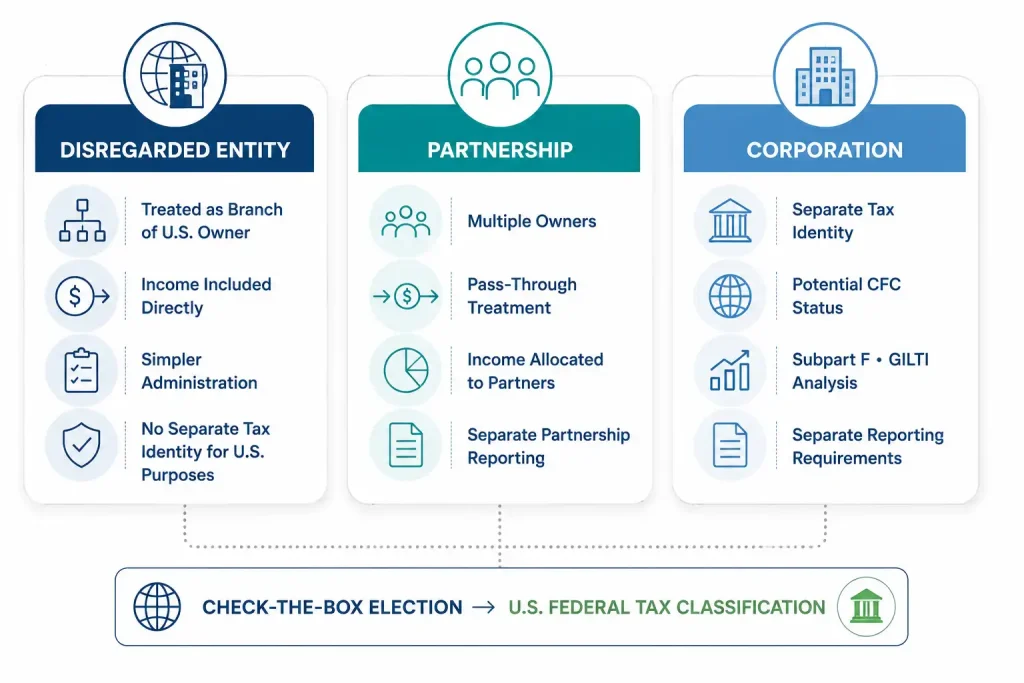
A disregarded entity is treated as a branch of its U.S. owner. Its income flows directly onto the U.S. return, without deferral and without the dividend mechanics that ordinarily govern repatriation. A foreign corporation retains its own tax identity, which means separate reporting, potential CFC status, and exposure to Subpart F and GILTI rules built to prevent indefinite deferral of low-taxed foreign income. Partnership treatment sits between the two and applies most often where multiple owners exist rather than a single U.S. parent.
When Disregarded Status Serves the Business
Disregarded treatment earns its keep when a foreign entity is low-margin, tightly integrated with U.S. operations, and unlikely to raise third-party capital on its own. Early in my career, a Series B fintech company opened a wholly owned Canadian entity, structured locally as a ULC, to manage compliance operations. Under Canadian law it was a corporation, but because it carried a single U.S. owner, disregarded status was available. We modeled both paths and elected disregarded treatment because the entity functioned as an extension of the parent rather than a standalone business, eliminating separate income reporting and removing an entire category of complexity from a finance function with more urgent problems to solve.
The same logic scales. In a later global expansion involving several cost centers across Southeast Asia, all wholly owned and operating in jurisdictions without meaningful withholding tax relief, classifying the entities as disregarded allowed their earnings to aggregate directly with the U.S. parent. The tax outcome was largely neutral, but the administrative savings in filings and treasury management were considerable, and the structure gave a clean answer to any investor asking who bore the economic risk of the global enterprise.
When Corporate Status Is the Safer Choice
Disregarded status is not the default answer, and treating it as one is where CTB election planning goes wrong. A healthtech platform with meaningful development activity in Eastern Europe illustrates the opposite case. The local entity, structured as a Polish Sp. z o.o., had its own HR infrastructure, growing intellectual property, and licensing income of its own. Disregarded treatment would not have shielded the U.S. parent from local taxation, and it would have offered little separation in the event of a legal dispute. We elected corporate status, accepted CFC treatment, and absorbed the compliance burden of Form 5471 and GILTI in exchange for structural integrity and credibility with local regulators.
A separate pattern shows up in high-tax jurisdictions. A single-member Irish entity classified as disregarded, profitable but taxed at an effective rate just under the U.S. rate because of research credits and expense timing, produced incremental U.S. tax even though its earnings stayed offshore, because disregarded income includes directly rather than deferring. Corporate classification, paired with the GILTI high-tax exclusion, would likely have avoided that outcome. The irony of the check-the-box regime is that the simplest election is often the one that creates the most exposure.
Timing, Deadlines, and the Cost of a Missed CTB Election
A CTB election must generally be filed within 75 days of the entity’s formation, or within 75 days of the desired effective date, and the IRS grants leniency for late elections only where reasonable cause exists. A missed election on an Israeli subsidiary once triggered default corporate classification and a cascade of reporting nobody had modeled. We filed a late election with a supporting memo citing administrative oversight and no intent to avoid tax, and the IRS accepted it, but the episode made the point permanently: every new foreign entity needs a checklist spanning legal, tax, and systems setup at formation.
CTB Elections, Subpart F, and GILTI Exposure
Because a disregarded entity’s income is included directly rather than deferred, the election interacts with Subpart F and GILTI planning. In high-tax jurisdictions, direct inclusion can be advantageous, since foreign tax credits offset the resulting U.S. liability. In lower-tax jurisdictions, the same mechanism can produce the opposite result, as the Irish example above shows. Modeling both classification paths against Subpart F, GILTI, and the high-tax exclusion before filing is the point of the analysis.
The CTB Election in Cross-Border M&A
U.S. corporate acquirers generally prefer asset purchases, which step up tax basis and limit exposure to historical liabilities, but a foreign target complicates that preference when local law rules out a direct asset deal. Where the target entity is eligible and the buyer makes a timely election, the transaction can be structured as a stock purchase for legal purposes and an asset purchase for tax purposes, an approach sometimes described as an F reorganization. In a Euronext Paris-listed gaming and digital entertainment company where I served as CFO, cross-border M&A execution exceeding $100M depended on this kind of precision: coordinating counsel across jurisdictions and aligning classification timing with closing without disrupting employee contracts or regulatory licenses. A well-timed election in a separate transaction saved more than $2M in anticipated tax leakage.
Local Law, Systems, and the Limits of the Election
Certain foreign entities are ineligible to elect at all, and certain jurisdictions do not recognize disregardability the way the IRS does. India is the clearest example, where legal form and tax status remain fully intertwined. The IRS allowing a classification does not mean the rest of the world honors it, and local counsel functions as a prerequisite rather than a formality.
Classification decisions also ripple into systems architecture. A disregarded entity must integrate into the U.S. parent’s chart of accounts, tax provision, and treasury workflows, with intercompany transactions becoming intra-company. In rolling out Oracle Financials and MicroStrategy across every subsidiary of a public gaming company operating in five countries, creating one consistent definition of revenue under IFRS and U.S. GAAP required the ledger to mirror the tax classification, since a mismatch between the two turns into rework of deferred tax assets during audit.
A Framework for the CTB Election Decision
A consistent process removes the guesswork:
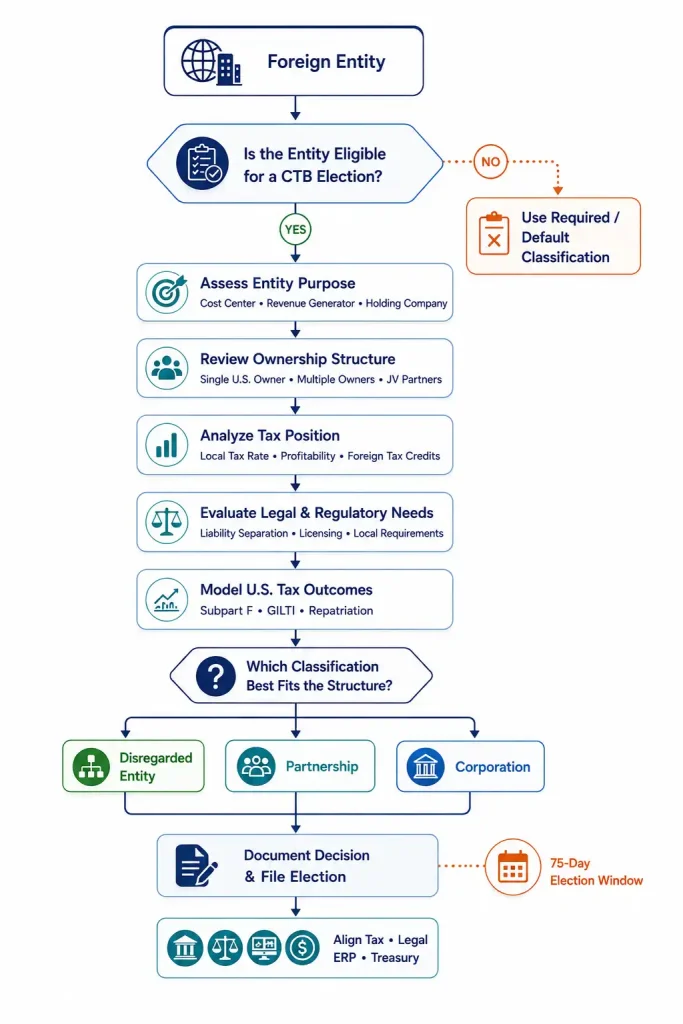
- Assess the purpose of the entity: cost center, revenue generator, or holding company.
- Evaluate ownership structure, including any third-party investors or joint venture partners.
- Analyze local tax rates, expected profitability, and foreign tax credit availability.
- Consider legal separation needs for liability, licensing, or regulatory reasons.
- Model Subpart F risk, GILTI exposure, and repatriation paths under both classification outcomes.
- Document the decision with a memo strong enough to withstand audit, M&A diligence, or SEC inquiry.
Common pitfalls:
- Treating classification as a formation-day checkbox rather than a modeled decision.
- Missing the 75-day window and defaulting into an unplanned classification.
- Assuming disregarded status is always simpler without testing it against GILTI.
- Failing to align the ERP and consolidation logic with the entity’s tax classification.
Three Key Takeaways
- Check-the-box elections determine consolidation treatment, CFC exposure, and repatriation mechanics, which makes the analysis a board-level topic for any company with foreign subsidiaries, not a task delegated silently to outside counsel.
- Disregarded status simplifies administration but is not automatically the lower-tax outcome, since corporate classification paired with the GILTI high-tax exclusion can outperform direct inclusion in high-tax jurisdictions, so both paths deserve modeling before a form is filed.
- Timing discipline protects the strategy: the 75-day window is unforgiving, and every new foreign entity should trigger a coordinated legal, tax, and systems checklist at formation rather than a late election filed under reasonable-cause pressure.
Disclaimer: This article is intended for informational purposes only and does not constitute legal, tax, or accounting advice. You should consult your own tax advisor or counsel for advice tailored to your specific situation.
Hindol Datta is a four-time CFO and senior finance executive with over 25 years of leadership experience across cybersecurity, SaaS, gaming, logistics, digital marketing, medical devices, consumer products, and nonprofit organizations. He has led more than $120M in fundraising and over $150M in M&A transactions while building the financial and operational systems that let complex businesses scale with confidence. He is the author of seven books in the Systems CFO Series and holds active CPA, CMA, and CIA credentials.
AI-assisted insights, supplemented by 25 years of finance leadership experience.