
Executive Summary
A signed-off plan looks tidy. The numbers reconcile, the roadmap moves in a straight line, and the slide deck reads like a promise. But most change management strategies fail for reasons a spreadsheet never captures. An emotional cost goes unpriced. A sequence overloads the organization. A failure mode never gets modeled. Or a change simply chases modernity instead of purpose.
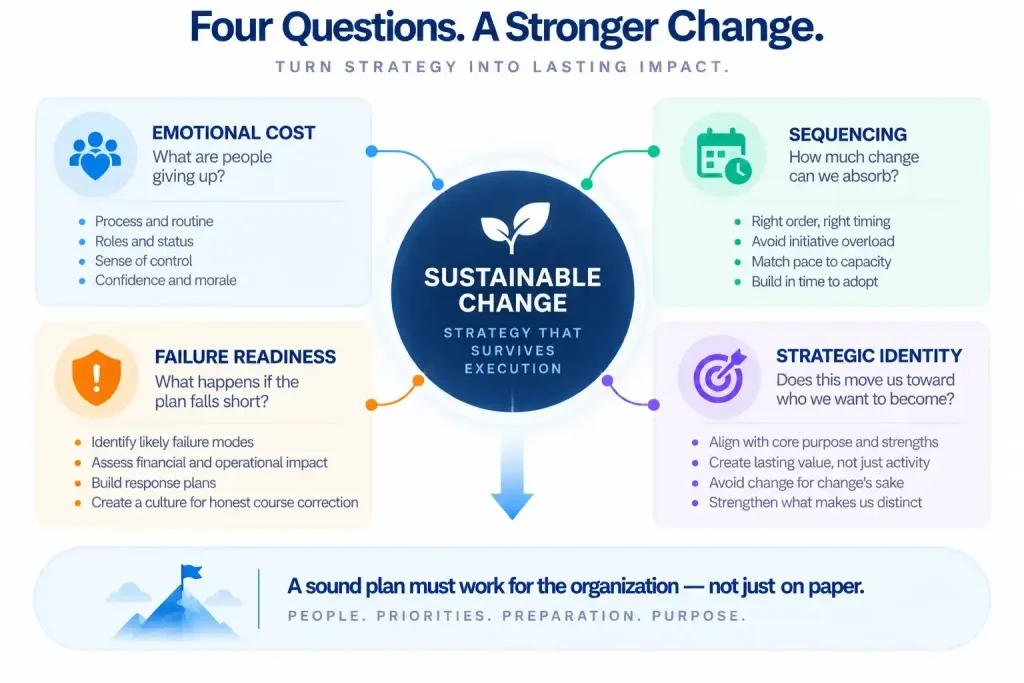
This article sets out four questions that separate a change management strategy that sticks from one that stalls. It covers the emotional toll of disruption, and how sequencing protects an organization’s capacity to absorb change. It also covers how to plan for failure before it happens. And it covers how to tell whether an initiative deepens strategic identity or just performs progress.
What Is the Emotional Cost of This Change?
Every reorganization asks people to give something up: a familiar process, a known hierarchy, a hard-won sense of competence. Finance rarely puts a number on that loss. Yet that loss shapes whether a change management strategy survives contact with the organization.
A high-growth technology company learned this the hard way during a go-to-market restructuring. The math behind rebalanced territories and leaner management layers held up under scrutiny from an outside advisory team. Managers still felt discarded. Senior reps felt surveilled. Within two quarters, attrition climbed and morale dropped. The plan that had worked on paper met quiet, persistent resistance in practice.
Three moves would have changed that outcome.
- Naming the disruption openly, in the CFO’s own voice, rather than letting silence fill the gap
- Building deliberate pauses into the rollout so feedback could surface before resistance hardened
- Funding structured conversations, not just surveys, as a real line item rather than an afterthought
Pricing in the emotional cost is not a soft gesture. It is a fiduciary one. A model can flex for headcount and capital expenditure alone. If it never flexes for morale, it will underestimate what a transformation actually costs.
Have We Sequenced Initiatives to Match Capacity for Disruption?
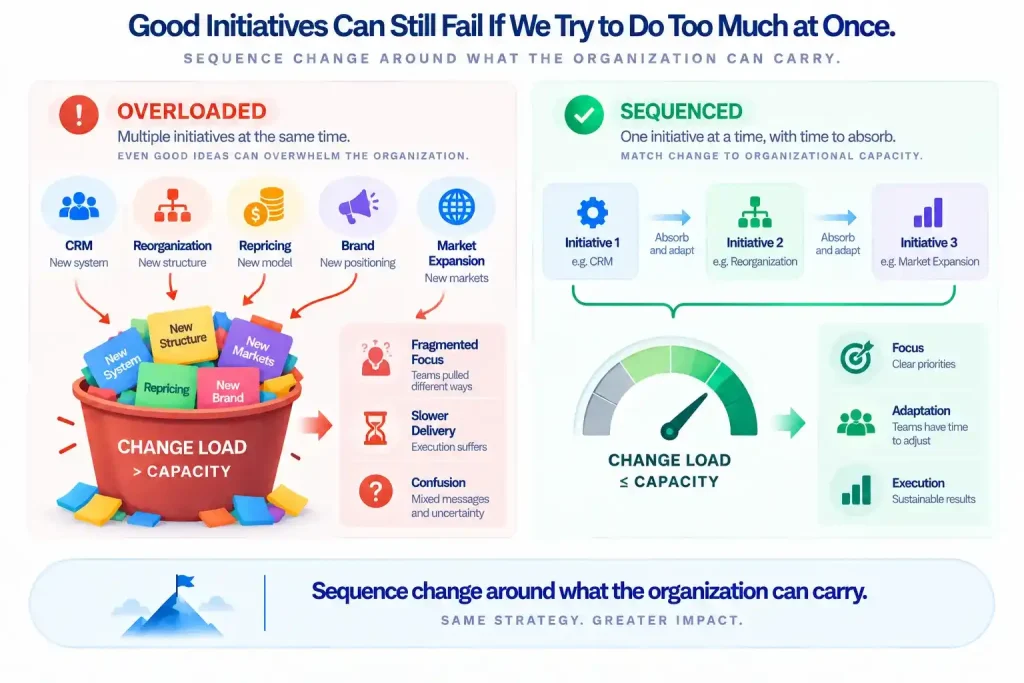
Timing often matters more than substance. A sound strategy can still fail simply because it lands in the wrong order or at the wrong moment. Every organization has a finite capacity to absorb novelty, no matter how strong its infrastructure or how devoted its leadership.
Case: When Simultaneous Initiatives Fragment a Company
A late-stage SaaS firm once launched five initiatives inside a single year. It rolled out a brand overhaul, a new CRM, a reorganization, a product repricing, and an expansion into two markets. Each initiative made sense on its own. Together, they fractured the company. Sales teams lost track of which product version to pitch. Marketing struggled to align messaging across regions. Engineering, stretched across every effort at once, shipped slower and broke more. Confidence gave way to confusion, even though leadership kept citing urgency as the justification.
Sequencing change management strategies well means asking a different question than what must we achieve. It means asking what the organization can carry at once. And it means treating the answer as a real constraint, not a suggestion.
What Are the Failure Modes, and How Will We Absorb Their Cost?
Failure in a strategic initiative rarely announces itself. It tends to show up as drift. A sales transformation ships new scripts but never moves the close rate. A system migration hits its technical targets while quietly fragmenting the team behind it. Five failure patterns recur often enough to name directly.
- Scope creep, where a precise objective slowly expands into something diffuse
- Cultural mismatch, where resistance actually signals misalignment with how the organization works
- Underestimated complexity, where dependencies surface only once the work is underway
- Leadership turnover, where a new sponsor arrives with a different vision and momentum stalls
- Incomplete integration, where the change lands but its downstream effects on people and workflows never get reconciled
Case: Planning for a Rollout That Falls Short
A mission-driven education institution built exactly this kind of planning into a $37M capital raise. Its financial model ran multiple years of scenarios under variable funding conditions. It never assumed just one clean path to the target. A specific metric fell short of plan. The institution already had a defined response ready, instead of scrambling to explain the shortfall after the fact. The initiative held for a different reason. Everything did not go as expected, but the plan had room built in for the parts that would not.
Absorbing failure well takes more than a financial buffer. It takes a culture where retrospectives stay honest. Leaders can pause, redirect, or end a struggling initiative without treating that decision as a personal defeat.
Does This Change Advance Strategic Identity, or Just Chase Modernity?
Some transformations move a company forward. Others simply keep it in motion, generating dashboards and announcements that fade without leaving a mark. The difference sits in one question. Does this initiative deepen who the organization is becoming? Or does it just decorate that identity for an audience of competitors and analysts?
Case: Walking Away From a Tool That Didn’t Fit
A professional services firm built its reputation on high-touch, white-glove client relationships. When an AI-driven efficiency tool came up for evaluation, the pilot metrics looked compelling and the vendor case was strong. But the firm recognized a trade-off. The tool would swap intimacy for speed, and speed was not what its clients actually valued. It walked away from the investment, even though the tool would have made the firm look more current.
Discernment like this is not obstruction. It is precision. It depends on knowing what the organization is trying to become, before evaluating whether a change serves that goal.
Three Key Takeaways
- Effective change management strategies price in the emotional cost of disruption alongside the financial one. A model that only tracks headcount and capital spend will always miss the reason execution actually stalls.
- Sequencing protects an organization’s limited capacity to absorb novelty. Stacking too many initiatives at once fragments focus even when each initiative makes sense on its own.
- A change worth making advances strategic identity rather than simply signaling modernity. The discipline to walk away from a fashionable but misaligned initiative matters. It often protects the thing that makes a company distinct.
Disclaimer: This article is intended for informational purposes only and does not constitute legal, tax, or accounting advice. You should consult your own tax advisor or counsel for advice tailored to your specific situation.
Hindol Datta is a four-time CFO and senior finance executive with over 25 years of leadership experience across cybersecurity, SaaS, gaming, logistics, digital marketing, medical devices, consumer products, and nonprofit organizations. He has led more than $120M in fundraising and over $150M in M&A transactions while building the financial and operational systems that let complex businesses scale with confidence. He is the author of seven books in the Systems CFO Series and holds active CPA, CMA, and CIA credentials.
AI-assisted insights, supplemented by 25 years of finance leadership experience.