
Executive Summary
Innovation is often framed as a creative act that lives far from the finance function. A sound CFO strategy treats it differently, as the allocation of scarce capital toward an uncertain future. Every decision about where to deploy resources, when to prune, and when to place a bet is already an innovation decision. The CFO sits at the center of that work, whether the organization admits it or not.
This article covers four dimensions of that role. It shows how to manage innovation as a portfolio, measure progress before revenue arrives, and bridge creativity with accountability. It closes with the culture that lets good ideas survive long enough to matter.
Why CFO Strategy Must Treat Innovation as Capital Allocation
Most organizations account for innovation in the language of control. R&D becomes an expense, transformation programs become line items, and digital pilots become budget codes. Under this model, finance enforces discipline but never shapes discovery. Breakthrough ideas then die from suffocation, starved of capital before they can prove anything.
Innovation, properly understood, is how a company acquires future relevance. That process is probabilistic, not chaotic, so finance can model it, shape it, and govern it with clarity. This reframing sits at the heart of any modern CFO strategy.
From Cost Line to Portfolio of Bets
The shift begins when the CFO stops seeing a list of projects and starts seeing an ecosystem of bets. Each initiative, whether a new product or a new revenue model, carries an investment thesis. Finance should push every thesis to answer a consistent set of questions:
- Market gap: which need does the initiative target, and how large is the prize?
- Feasibility: how confident is the team that the technology will work?
- Desirability: what customer evidence supports the idea so far?
- Viability: which credible path leads to commercial returns?
- Next stage: what would leadership need to believe to fund it?
The answer is rarely a binary approve or reject. Good CFO strategy favors structured progression, holding early ideas to a learning process, not a mature hurdle rate.
The Four-Stage Innovation Portfolio Framework
Each stage carries different economics, risk profiles, and time horizons, so each warrants its own investment logic.
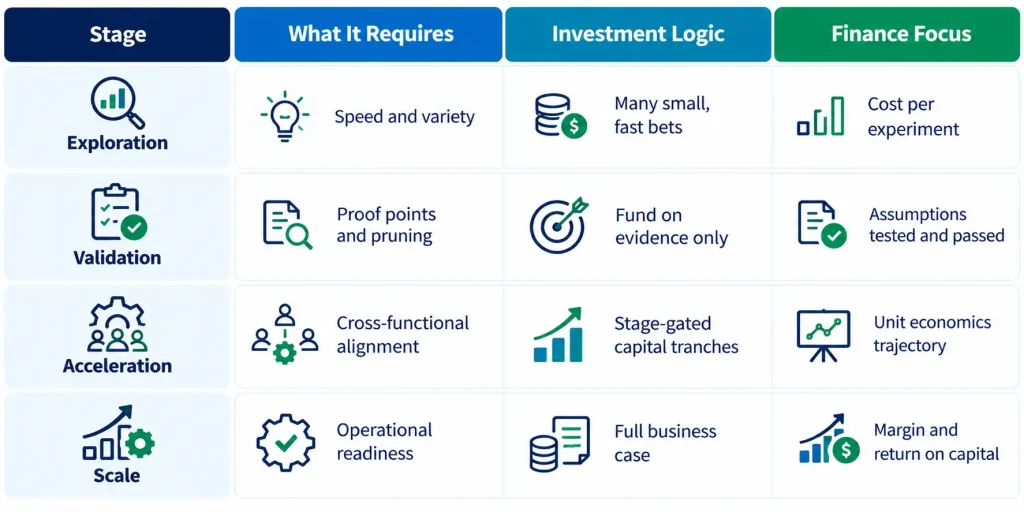
Like a private equity fund segmenting holdings by risk and maturity, the enterprise should separate core optimizations from transformative plays. The purpose is not to predict winners but to deploy capital where learning compounds and upside justifies uncertainty.
A venture-backed digital marketing company that scaled from $9M to $180M in 24 months offers a useful illustration. Growth held because every new channel had to earn further funding through CAC, lifetime value, and contribution margin evidence.
Defending Innovation When Budgets Tighten
Innovation is often the softest target in a downturn. A CFO with a portfolio view can argue for continuation on structural grounds, not sentiment. The portfolio shows which bets carry momentum, which need a pivot, and which should retire. At an early-stage email marketing technology company, a turnaround cut monthly burn from $800K to $200K. Evidence guided those cuts and preserved the initiatives with real traction.
Measuring Innovation Progress Through CFO Transformation
A persistent corporate myth holds that what cannot be measured cannot be managed. With innovation, that myth produces two failures: ignoring the work until it becomes material, or demanding clarity too early. Finance can offer a third path by building a grammar for progress while results remain distant.
Leading Indicators Over Lagging Returns
Startup investors already work this way, and they track cohort behavior, retention curves, funnel conversion, and time to insight long before profit arrives. Enterprise finance should bring that sensibility inside, so every initiative must state its critical assumptions about market size, customer need, and feasibility. The CFO then asks which assumptions matter most and how the team will know they hold.
For a digital product whose revenue sits years away, engagement patterns, usage retention, and unit cost trajectory can still tell a coherent story. The question for a strategic CFO is not ROI today but whether the logic of the initiative remains intact.
Input Metrics Versus Learning Metrics
Too many dashboards measure innovation by spend, an input that reveals nothing about pace, quality, or customer relevance. A real CFO transformation moves reporting from the left column below to the right.
| Input Metrics (Traditional) | Learning Metrics (Innovation-Ready) |
| Dollars allocated | Experiments completed per quarter |
| Headcount deployed | Cycle time from hypothesis to result |
| Tools acquired | Assumptions validated or invalidated |
| Projects launched | Pivots made with a clear rationale |
| Budget variance | Movement toward unit economic viability |
This is where CFO technology earns its place in the strategy. An AI governance platform in its pre-Series A phase rebuilt its entire finance workflow around AI tooling. Modeling, reporting, and diligence ran AI-first, which compressed the time from question to decision. The same tools let finance track learning velocity across a portfolio without adding headcount.
Retirement and Reporting with Integrity
Retirement is also a form of progress, since many initiatives linger from political inertia, not promise. A mature measurement system lets the CFO advocate for termination when the signals no longer support the thesis. That choice protects the portfolio and honors the capital behind it.
Reporting must then tell the full story, and traditional dashboards rarely suffice. The CFO should build a quarterly format that pairs data with narrative. Board members do not expect guarantees; they expect candor, coherence, and a robust process. At a mission-driven education institution, board reporting worked best when it explained what the organization learned, not only what it spent.
Bridging Creativity and Accountability in Finance Leadership
Most organizations build a wall between possibility and performance, and the enterprise loses coherence between the two. Adaptive companies build a bridge instead, with a CFO strategy grounded in partnership.
Inquiry Before Judgment
Partnership starts when the CFO drops the posture of adjudicator. The better opening question asks what problem an idea solves and what logic connects it to value. That framing invites teams to narrate the path from spark to signal.
Partnership still requires structure, and finance helps turn a fuzzy vision into hypotheses, and hypotheses into experiments with learning milestones. It also shields ideas from the demand to prove too much too soon.
Presence in the Design Room
Real partnership happens early in the design process, not only at budget reviews. When finance shows up at that stage, several habits take hold across teams:
- Pricing becomes part of product design, not an afterthought.
- Unit economics inform go-to-market choices from the start.
- Feasibility reviews start to account for integration friction.
- Teams invite finance into their thinking well before budget season.
Over time, the CFO becomes the translator of innovation before the board. Creativity without accountability is fragile, and accountability without creativity is sterile.
Innovation Leadership as the Next Stage of CFO Strategy
Leadership is less about control than about widening the aperture through which others see the future. For the CFO, leading innovation means creating conditions under which good ideas survive long enough to matter.
How Finance Shapes Innovation Culture
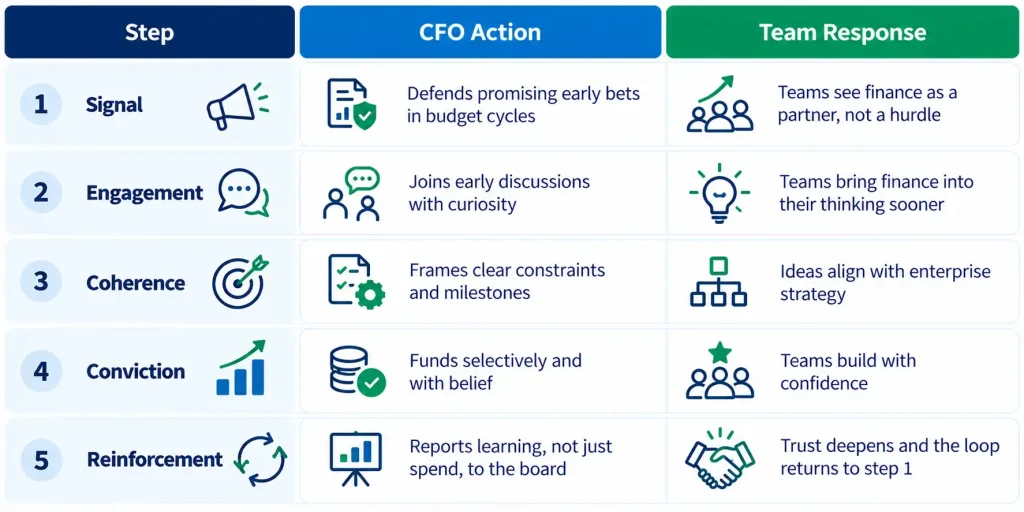
The CFO sets the tone of seriousness in an organization. If only proven ideas earn permission, creativity flees to the margins; when ambiguity is welcome alongside rigor, innovation takes root. That tone comes from choices, not proclamations, and the loop below shows how those choices compound.
The Innovation Culture Loop
Strategic Coherence and Belief with Boundaries
Without guidance, innovation turns ornamental, full of pet projects that never scale or align. A disciplined CFO strategy supplies coherence by asking three questions of every major bet:
- Ambition: does this move the company toward its stated goals?
- Advantage: will it deepen a durable competitive position?
- Capability: can the organization serve the future it creates?
Clear constraints sharpen creativity by giving it something to push against. The best finance leaders also model intellectual humility and fund with conviction, even though they never fund everything. When reinvention arrives, a mature CFO strategy does not slow things down; it allocates wisely and guides the organization forward.
Three Key Takeaways
- Treat innovation as a staged portfolio of investment theses, with different funding logic for exploration, validation, acceleration, and scale. This turns finance from a cost gatekeeper into the architect of enterprise optionality.
- Measure learning, not spending alone, by tracking experiments, cycle times, and validated assumptions. A CFO transformation built on these indicators and the right CFO technology gives boards candor and enables timely termination.
- Lead innovation through presence and culture by joining teams early and funding with conviction. Innovation needs a guide more than a guardian, and a sound CFO strategy makes finance that guide.
Disclaimer: This article is intended for informational purposes only and does not constitute legal, tax, or accounting advice. Readers should consult a qualified tax advisor or legal counsel for advice tailored to their specific situation.
Hindol Datta is a four-time CFO and senior finance executive with over 25 years of leadership experience across cybersecurity, SaaS, gaming, logistics, digital marketing, medical devices, consumer products, and nonprofit organizations. He has led more than $120M in fundraising and over $150M in M&A transactions while building the financial and operational systems that let complex businesses scale with confidence. He is the author of seven books in the Systems CFO Series and holds active CPA, CMA, and CIA credentials.
AI-assisted insights, supplemented by 25 years of finance leadership experience.