
Executive Summary
A strategic partnership looks simple at the signing stage. A press release goes out, a revenue projection gets modeled, and two leadership teams shake hands. What happens after that moment is where the CFO strategic role actually matters. A partnership is a capital decision wearing strategic clothing.
This article sets out how strategic finance leadership should evaluate a partnership at four stages. It covers how to measure what a partnership actually contributes to enterprise value. It covers how to weigh risk-adjusted return against building or buying instead. It covers the infrastructure a partnership needs to scale without unraveling. And it covers how partnership economics should tie back to long-term strategy and shareholder expectations.
Measuring What a Partnership Actually Contributes
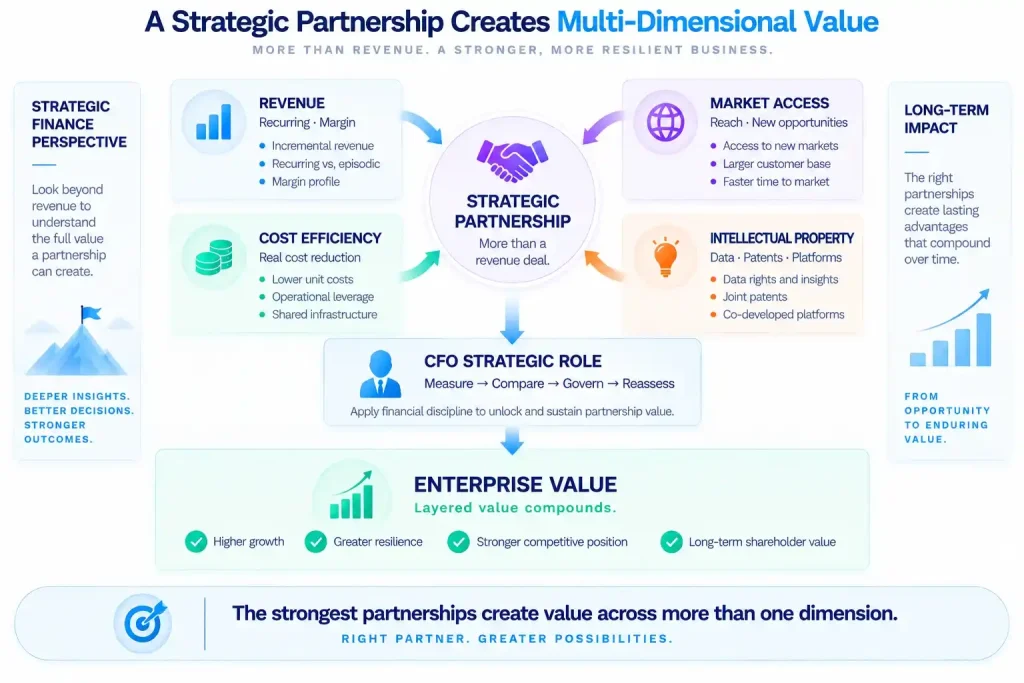
A partnership rarely earns its place through revenue alone. Four vectors capture the fuller picture, and most partnerships only get evaluated against one or two of them.
- Revenue, weighted by whether it is recurring or episodic and what margin profile it actually carries
- Market access, valued against the total addressable market it unlocks and what building that access independently would cost
- Cost efficiency, measured by whether savings come from real variable cost reduction or simply shift dependency onto the partner
- Intellectual property, captured through data rights, joint patents, or co-developed platforms that create option value even without an immediate P&L impact
A partnership that touches several of these vectors at once compounds in a way a single-vector deal never does. The CFO strategic role here is to ask how layered the value is. The simpler question of whether the deal adds value matters less.
Weighing Risk-Adjusted Return Against Build or Buy
Every partnership sits in a capital hierarchy alongside two alternatives: building the capability internally, or acquiring it outright. Each path carries a different risk-adjusted return profile.
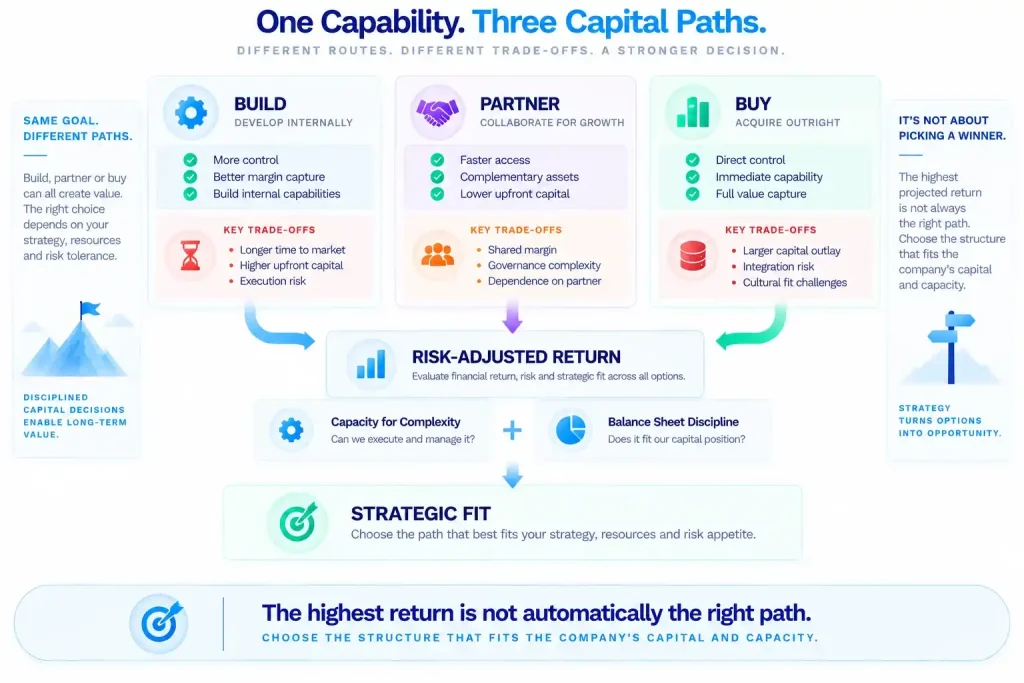
- Building offers more control and better margin capture, at the cost of a longer time to market and higher upfront capital
- Partnering offers speed and access to complementary assets, at the cost of governance complexity and shared margin
- Acquiring offers the cleanest path to control, at the cost of integration risk and a larger capital outlay
A risk-adjusted IRR model across all three paths rarely points to the highest number as the right answer. It points to whichever path fits the company’s capacity for complexity and its current balance sheet discipline.
Case: When Financial Fit Isn’t Enough
A high-growth SaaS company once pursued a partnership with a much larger platform player. The financial model held up on paper. The cultures did not. One team moved fast and stayed close to customers. The other moved slowly, layered in compliance, and resisted change. The partnership unwound within eight months, and the goodwill and internal fatigue it cost took far longer to repair. A model can show a strong return and still miss the strategic tempo. That tempo often determines whether a deal survives contact with two different ways of working.
Building the Infrastructure to Scale a Partnership
A partnership does not scale itself once the agreement is signed. It scales only if the internal systems, incentives, and governance can carry the weight of it.
- Integration cost, which usually hides in engineering nights and mismatched systems rather than a clean capex line
- Performance incentives, tied to shared metrics rather than a single commercial agreement that assumes execution will simply follow
- Data transparency, through a shared source of truth rather than reconciliation over email threads
- Governance controls, including defined exit rights, a steering committee, and a cadence of joint review rather than a review that only happens when something breaks
Case: A Shared Data Portal Changes the Conversation
A marketplace SaaS platform, built around consolidated US and Polish reporting for a $20M Series B, extended that same transparency discipline into its partner relationships. A shared dashboard covering revenue contribution and pipeline activity by segment replaced a slower back-and-forth built on emailed spreadsheets. The shift changed the tone of partner conversations, from defending a number to jointly fixing it. Both sides were finally looking at the same data at the same time.
Aligning Partnership Economics With Long-Term Strategy
Revenue share, cost allocation, and capital commitments each say something about a company’s priorities. That message is not always intentional.
Revenue share works as a strategic dial, not a fixed line item. A split that looks fine at small volume can quietly erode margin once the deal scales. That risk grows if one side carries most of the delivery and support burden. Reconciling the split annually protects fairness as the economics shift.
Cost allocation reveals discipline more than ambition. A clear cost-to-value trail, reviewed on a real cadence, keeps a partnership from decaying into resentment over unexplained charges. Capital commitments deserve the same scrutiny given to any other capex decision. That means a defined payback period, and a way to recover the investment if the partnership underperforms.
Three Key Takeaways
- The CFO strategic role in a partnership starts with measuring contribution across revenue, market access, cost efficiency, and intellectual property. Judging the deal on revenue alone misses most of the picture.
- A risk-adjusted comparison against building or acquiring the same capability internally reveals whether a partnership deserves the capital. Cultural fit can still undo a deal that looks strong on every financial model.
- Strategic finance leadership treats partnership economics as a living structure. Revenue share, cost allocation, and governance all need a regular cadence of review. The terms that made sense at signing rarely stay fair once the partnership actually scales.
Disclaimer: This article is intended for informational purposes only and does not constitute legal, tax, or accounting advice. You should consult your own tax advisor or counsel for advice tailored to your specific situation.
Hindol Datta is a four-time CFO and senior finance executive with over 25 years of leadership experience across cybersecurity, SaaS, gaming, logistics, digital marketing, medical devices, consumer products, and nonprofit organizations. He has led more than $120M in fundraising and over $150M in M&A transactions while building the financial and operational systems that let complex businesses scale with confidence. He is the author of seven books in the Systems CFO Series and holds active CPA, CMA, and CIA credentials.
AI-assisted insights, supplemented by 25 years of finance leadership experience.