
Executive Summary
The CFO’s role in disruptive innovation is less about predicting the future. It is about preparing a balance sheet, a team, and reporting habits that can absorb a future nobody forecast correctly. This article draws on practitioner experience to show how financial leadership changes. The shift comes when new technology, compressed time horizons, and algorithmic decision making arrive together.
Readers will find a working view of how the modern CFO role differs from the traditional steward model. The article also covers how to account for the emotional costs of transformation. It explains how to report on long-term bets without losing credibility with the market. Finally, it shows how to interpret data tools without surrendering judgment.
How Disruptive Innovation Redefines the CFO Role
Disruptive innovation rarely arrives with force. It appears as a product that looks more like a toy than a threat. A lean startup builds it and attracts people who can afford curiosity. Finance leaders whose training teaches them to measure and wait notice it only after the pattern hardens into a market. By the time a new technology reaches the financial radar, the window for cheap experimentation has usually narrowed. That is why the CFO role cannot remain purely retrospective.
From Historian of Cost to Architect of Optionality
The forces that threaten stability often carry the seeds of renewal. Protecting the enterprise from volatility and positioning it for rebirth become one task rather than two. Most disruption fails, much of it distracts, and some of it burns capital like a bonfire in the wind. The real discipline lies in separating the inevitable from the ephemeral. Prudence in this setting means the intelligent allocation of risk rather than its avoidance. Standing still is often the riskiest posture available.
Early-stage companies make the point plainly. At an AI governance and assurance platform at the pre-Series A stage, we rebuilt the finance workflow around AI tooling from the first day, running modeling, reporting, and diligence on a lean footprint that compressed the distance between a question and a decision.
Scenario Thinking Instead of Extrapolation
Scenario thinking, the genuine kind and not the sanitized version found in corporate decks, remains the least developed muscle in most finance teams. Models that rely on history extrapolate along lines that disruption sets out to break. The cloud transition shows this well, since the shift from capex to opex upended cost structures, weakened traditional ROI metrics, and turned forecasting into an act of interpretation, and organizations that waited for data to prove the case missed the pivot entirely.
Credible scenarios still need a sound base. In a cybersecurity and identity access management company at roughly $30M ARR, a driver-based forecasting engine and capacity model held actuals within 5% of forecast for 8 consecutive quarters, and that predictability is what allowed leadership to debate bolder scenarios without doubting the starting point.
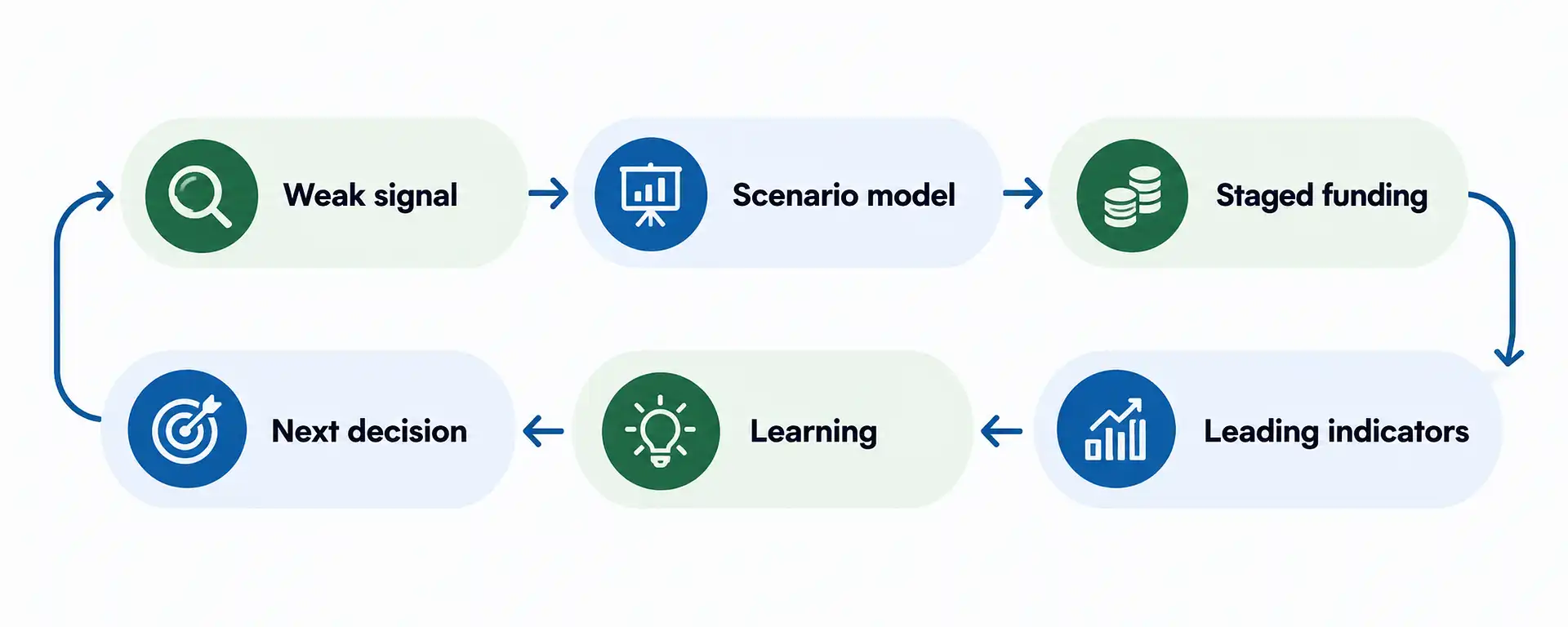
The practical habits of a CFO navigating disruptive innovation tend to include the following.
- Fund experiments in stages with explicit learning goals before committing scale capital.
- Model unit economics forward from negative gross margins instead of dismissing early results.
- Listen to engineers, junior analysts, and outlier data that do not fit the existing model.
The sequence below shows how these habits connect.
The Emotional Cost Carried by the CFO Role
The language of finance stays unyielding, with EBIT, NPV, and ROIC leaving little room for feeling, yet the lived experience of a CFO guiding a company through innovation is an emotional algebra of risk, hope, and consequence. After a board meeting where a brilliant roadmap has been unveiled, the question that lingers is the one nobody asked aloud, which is what happens if the organization is wrong. The CFO is expected to be skeptic and catalyst in the same hour, challenging assumptions without crushing spirit, and beliefs do not amortize easily.
The Shadow Ledger
An internal ledger runs alongside the formal one, with credits and debits measured in judgment, resolve, and integrity. It does not close at quarter end. It accumulates, much like gravity, with the weight of prudence on one side and the pull of possibility on the other, and the balance between them is something a CFO survives rather than solves.
Failure, Accountability, and Learning
A machine learning engine promised to transform demand forecasting, the pilot dazzled, and the underlying assumptions were fragile. Approval was given, the predictions degraded over time, implementation costs spiraled, and organizational patience frayed. The failure still taught precise lessons about overlooked dependencies and cultural resistance, which no model had captured.
The harder side of the work appears in turnarounds. At an early-stage digital marketing technology company, monthly burn fell from $800K to $200K, and the arithmetic was the easy part, since the real task was explaining to teams why funds were moving and holding the reporting systems steady while morale absorbed the impact.
Emotional fluency matters here, though not as sentimentality. It means naming what is happening beneath the surface, listening for what is avoided in meetings, and engaging innovation teams as partners rather than auditors.
Short-Term Metrics Against Long-Term Transformation
Quarterly earnings calls ask for certainty about ninety days while the company’s survival depends on the next decade. Transformation does not run on a quarterly clock, and genuine innovation needs quarters just to disprove a hypothesis and years to validate a new model. Capital allocation becomes a moral act under this pressure, because funding the unproven is a declaration about the future a company is willing to underwrite.
Numbers and Narrative as Twins
Smart communication alone does not buy time from an impatient market. A durable narrative, however, connects today’s costs to tomorrow’s vision, and it works best when the numbers beneath it are trusted. In a publicly listed gaming company spanning five countries, one unified definition of revenue across every subsidiary under both IFRS and US GAAP gave the board a shared basis for debating long-term bets, because arguments about the future cannot be settled while the present is measured five different ways.
A full product re-platforming offers the harder example. Margins were questioned, investors left, and the stock fell 20%. The CFO walked into the board meeting with a single slide comparing five failed incumbents that had waited too long to change, then allowed ten minutes of silence to do its work. The company stayed the course and was later called visionary, though the market had not changed. Time had simply caught up.
Reporting That Points Forward
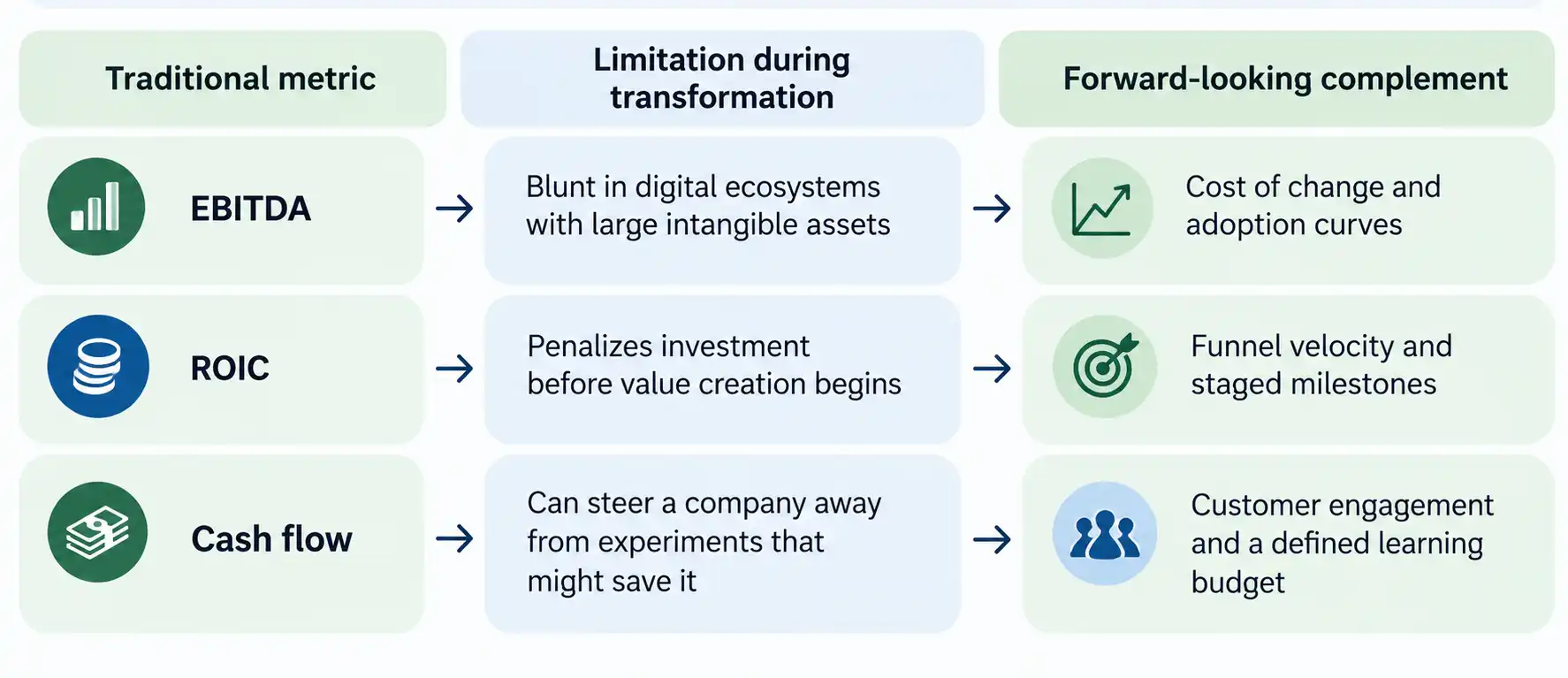
Variance analysis looks backward, so transformation needs signals that show what the company is becoming.
- Adoption curves that reveal whether customers are choosing the new model.
- Funnel velocity that shows how quickly interest converts into revenue.
- Customer engagement measures that precede financial results.
- Cost of change tracked as its own line instead of buried in operating expense.
Financial patience belongs beside these signals. It is the discipline to resist premature optimization, and many promising initiatives die because they failed to produce results in two quarters, as if innovation owed dividends on a schedule.
Financial Leadership in an Age of Algorithms
Machines once obeyed. They now anticipate, suggest, and learn, and the dashboard in some organizations has made variance review almost ceremonial. The central question for modern financial leadership is what role judgment plays when models govern so much of the work.
Precision Is Not Wisdom
Every dashboard is a product of design and every algorithm is trained on a history. A demand model projected a return to pre-pandemic norms after customer behavior had changed for good. A revenue recognition tool missed contract renegotiations buried in footnotes. A cost optimization engine proposed headcount reductions with no awareness of the people involved. None of these systems malfunctioned, and that is what makes them dangerous.
Buy-side diligence on an IT services acquisition target taught the same lesson. A quality-of-earnings review surfaced material EBITDA adjustments where reported earnings diverged from economic reality, a gap that a model reading the same ledger would likely have accepted without objection.
Where Human Judgment Stays in Charge
An automated capital budgeting tool can rank dozens of proposals across NPV, IRR, and strategic fit, but it cannot sit across from a founder and explain why funding will not be renewed. It also cannot weigh a 14% IRR against a 12% IRR when the lower return builds a bridge to a new business model. T. S. Eliot once asked where the wisdom went that knowledge had consumed, and the finance version asks where stewardship goes when automation takes over.
A CFO can test any model with three questions.
- What history was this model trained on, and does that history still apply?
- Who designed the output, and which assumptions did they embed?
- Which decisions must remain with a named human owner regardless of what the model recommends?
Teams should be rebuilt accordingly, with analysts hired for intellectual courage as well as quantitative skill, and trained to challenge their own outputs and honor the limits of precision.
How Disruptive Innovation Reshapes the Person in the CFO Role
The title suggests control, yet guiding a company through disruption asks the CFO to surrender a good deal of it. Doubt arrives first, in airport lounges at 2 a.m. and in the pause before a board presentation, and when nurtured it becomes humility, the recognition that a perfect balance sheet can still miss the pivot.
Empathy follows. Cutting a program removes someone’s purpose, and backing a risk spends part of the organization’s psychological safety. At a mission-driven education and research institution in Silicon Valley, raising $37M across equity and venture debt meant owning the investor narrative while also running HR, IT, Legal, and Facilities, and that breadth made the human consequence of each allocation impossible to abstract away.
Loneliness comes last and lasts longest. The CEO dreams aloud, the CTO evangelizes, and the CFO observes, absorbs, and says what others will not. Conviction in this setting is chosen repeatedly in rooms where no one applauds, and over time it turns a defender of the past into a curator of the future who sees every spreadsheet row as a decision and every cell as a bet on human potential.
The deepest result is cultural. A CFO who stands in the current of disruptive innovation without resisting or controlling it helps build a culture of intelligent risk, reflective urgency, and principled ambition. The measure of the CFO role is therefore not only whether disruption was led well, but whether it refined the leader into a steward of meaning as well as of capital.
Three Key Takeaways
- The CFO role in disruptive innovation is to prepare the company to survive and thrive when the future arrives, which means building a balance sheet that can bend, funding ideas that may fail, and using scenario thinking in place of simple extrapolation.
- Short-term metrics and long-term transformation can coexist when forward-looking indicators and a coherent narrative sit beside traditional reporting, so that the quarter is preserved without mortgaging the decade.
- Models and algorithms can optimize, but only a CFO can prioritize, so every automated output deserves interrogation and every consequential decision needs a human owner who can account for its cost.
Disclaimer This article is intended for informational purposes only and does not constitute legal, tax, or accounting advice. You should consult your own tax advisor or counsel for advice tailored to your specific situation.
Hindol Datta is a four-time CFO and senior finance executive with over 25 years of leadership experience across cybersecurity, SaaS, gaming, logistics, digital marketing, medical devices, consumer products, and nonprofit organizations. He has led more than $120M in fundraising and over $150M in M&A transactions while building the financial and operational systems that let complex businesses scale with confidence. He is the author of seven books in the Systems CFO Series and holds active CPA, CMA, and CIA credentials.
AI-assisted insights, supplemented by 25 years of finance leadership experience.



