
Executive Summary
A strong CFO change management strategy turns finance from a guardian of the past into a guide for what comes next. Transformation rarely fails for lack of a plan; it fails when people lose belief, momentum fades, and old habits return. The CFO holds the clearest view of where capital sleeps and where the business drifts, which makes the role central to any lasting change.
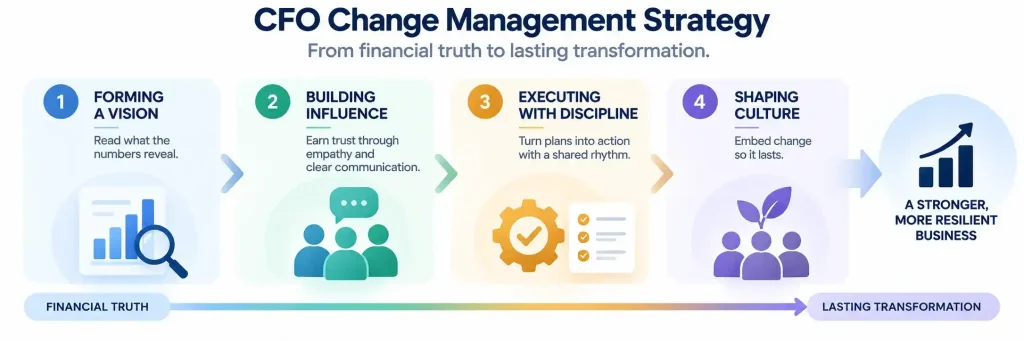
The sections ahead follow four stages of CFO-led change: forming a vision, building influence, executing with discipline, and shaping culture. Each stage of a CFO change management strategy shows how financial truth, paired with empathy and clear communication, moves an organization from intention to action.
Why Vision Belongs in a CFO Change Management Strategy
Boards and executives expect finance leaders to bring clarity, precision, and discipline into every room. They expect vision only in a narrow sense, such as a five-year forecast or a margin improvement thesis. Real vision reshapes the tempo of an enterprise, and it rarely arrives dressed for the boardroom.
Reading What the Numbers Are Saying
The CFO sits on the richest repository of truth inside the company. That data reveals unrealized momentum, misapplied assets, and capital that is not working hard enough. In a business caught in efficiency without direction, the numbers may be accurate yet lifeless. Someone has to stop counting long enough to start reimagining, and that responsibility often falls to finance.
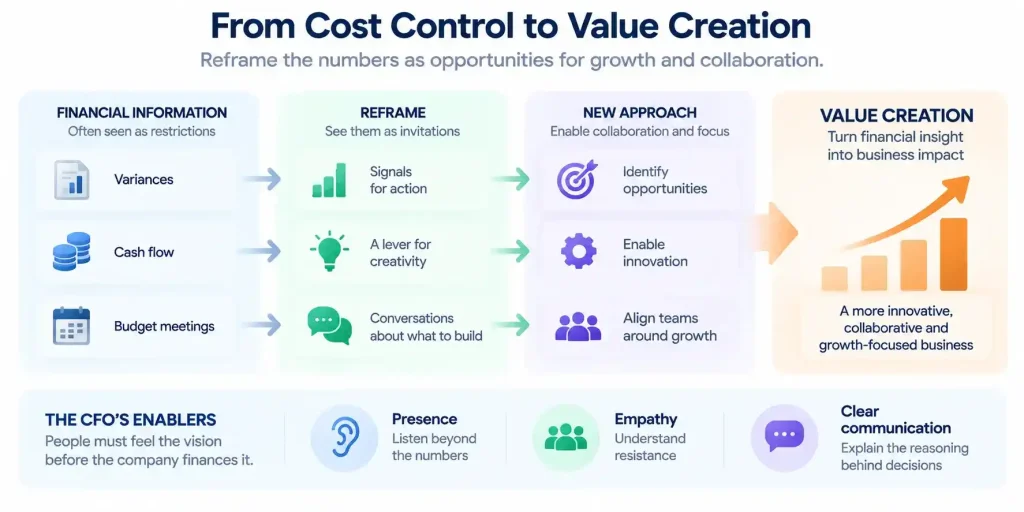
Vision cannot live in spreadsheets alone, since people must feel it before the company finances it. Belief usually belongs to the CEO, who declares the destination and inspires through mission. No CEO can drive transformation, however, without a CFO who believes in it rationally and constructively.
From Cost Control to Value Creation
A practical CFO change management strategy reframes the numbers as invitations instead of restrictions. Variances become signals, cash flow becomes a lever for creativity, and budget meetings become conversations about what each team hopes to build. Presence matters in a CFO change management strategy as much as analysis does. Hallway conversations and offhand remarks often reveal resistance, and that resistance usually reflects fear more than defiance.
Building Influence as Part of a CFO Change Management Strategy
The CFO touches every domain without owning most of them outright. Sales, culture, and product each have their own leaders, yet finance shapes pricing, hiring pace, resource allocation, and the investor narrative. Influence in this position comes from earned respect, built by being right when it counted and gracious when wrong.
Practicing Financial Empathy
People rarely resist change because they are illogical; they resist because change threatens their identity. A marketing leader asked to cut acquisition costs by 15 percent may see a diminished voice, not just a smaller budget. An operations leader asked to automate may fear redundancy for the team.
Financial empathy means listening to business pain points as signs of strategic misalignment, not simply as cost centers. Sitting with a resistant division to understand its concerns may slow a restructuring by a few weeks. That pause often prevents months of attrition and quiet resistance later.
Influence of this kind grows through deliberate habits, not through title or budget authority, and the following habits help a CFO build it:
- Asking thoughtful questions before offering any projections
- Attending product reviews and operating meetings, not only budget sessions
- Explaining the reasoning behind decisions, not just the decisions themselves
- Using stories from past decisions to show how difficult choices paid off
Knowing When to Hold Firm
Influence alone has limits, especially during a financial crisis. There are moments when the CFO must say “no,” “now,” or “not yet,” even against broad opposition. An early-stage email marketing SaaS company offers a relevant case, where an operational turnaround reduced monthly burn from $800K to $200K. Decisions of that scale rarely win applause in the moment, yet they often keep the company stable when competitors struggle.
Executing a CFO Change Management Strategy with Discipline
Every idea must pass through the narrow gate of execution. Execution in a transformation involves unlearning, because it asks people to give up habits that made them feel competent. The CFO must frame new ways of working in terms of why they matter, not only what is changing.
Creating a Shared Rhythm
Each function tends to describe progress in its own dialect, from engagement in HR to uptime in IT and throughput in operations. Well-calibrated financial KPIs give the enterprise one shared heartbeat. Dashboards and review cadences act as scaffolding, but they should illuminate instead of intimidate. Over-measured execution turns into theater, while thoughtful measurement turns into progress.
A cybersecurity SaaS company spanning five country entities shows how structured execution supports change. A NetSuite implementation across the US, India, Nepal, Canada, and Mexico compressed the monthly close from 18 days to 10. Projects like this depend on clear milestones, steady communication, and patience with teams learning new systems.
Absorbing Shocks and Owning the Pace
Transformation brings turbulence as cash tightens, productivity dips, and anxiety rises. The CFO acts as a shock absorber, explaining a temporary margin dip as the cost of new learning instead of a lapse. When a migration stumbles, owning the pacing of the plan instead of assigning blame can reset trust across the leadership group.
Transparency strengthens this shock-absorbing role in every transformation. A regular internal update that maps financial results to each stage of the change helps teams see where they stand. People ask better questions, and finance shifts from enforcer to co-pilot in the eyes of the organization.
Shaping Culture Through Financial Language
Culture shows up in how people react when someone takes a risk and fails. It is the recurring behavior that the numbers either enable or deny. How finance talks about money shapes how people think about worth, and budget reviews signal which ideas are welcome.
Changing the Words Finance Uses
Small shifts in language can reshape the climate across an organization. Replacing defensive phrases with forward-looking ones helps teams treat trade-offs as opportunities.
How Finance Language Shapes Culture
| Defensive Language | Forward-Looking Language |
| Holding the line | Choosing where to invest |
| Cutting costs | Freeing capital |
| What will this cost? | What will this unlock? |
| Treating deviation as a threat | Treating deviation as a signal |
Over time, finance teams using this language often find themselves invited into product brainstorms instead of only quarterly reviews. Engineers start reading margin reports and suggesting improvements, and dashboards begin to encourage experimentation instead of fear.
Balancing Morale and Rigor
Morale and rigor are not opposing forces, but their timing matters. During a cost realignment, honest acknowledgment of difficulty builds more trust than promises of comfort. A mission-driven education and research institution in Silicon Valley offers a useful reference. There, the CFO role extended across Finance, HR, IT, Legal, and Facilities, which placed culture and financial discipline in the same set of hands.
A healthy culture built through a CFO change management strategy is sharp, not soft. It surfaces the truth faster, flags drift earlier, and allows course correction without shame. That resilience makes execution stronger, influence more authentic, and vision more widely shared.
The Four Stages of CFO-Led Change
| Vision | Influence | Execution | Culture |
| Read what the numbers reveal and imagine what could be | Earn trust through empathy, presence, and consistency | Build shared rhythm, absorb shocks, and stay transparent | Use language and behavior that reward curiosity |
The CFO as the Keeper of Belief
The CFO in a transformation holds a paradox, balancing precision with possibility. Credibility should dignify change instead of resisting it, and the greatest contribution to culture comes from what a leader embodies. A lasting CFO change management strategy recognizes that culture works like a balance sheet of belief, earned over time and paid forward in trust. That intangible equity sustains the company long after teams execute the plan and the numbers settle.
Three Key Takeaways
- An effective CFO change management strategy begins with vision. Financial insight reveals where capital and momentum are stuck, and the CFO must tell that story in a way people believe.
- Influence comes from financial empathy and consistent presence, yet the CFO must also hold firm when discipline protects the company from the wrong trend.
- Execution and culture sustain change, so finance should create a shared rhythm of KPIs, communicate transparently, and use language that rewards curiosity over defensiveness.
Disclaimer: This article is intended for informational purposes only and does not constitute legal, tax, or accounting advice. You should consult your own tax advisor or counsel for advice tailored to your specific situation.
Hindol Datta is a four-time CFO and senior finance executive with over 25 years of leadership experience across cybersecurity, SaaS, gaming, logistics, digital marketing, medical devices, consumer products, and nonprofit organizations. He has led more than $120M in fundraising and over $150M in M&A transactions while building the financial and operational systems that let complex businesses scale with confidence. He is the author of seven books in the Systems CFO Series and holds active CPA, CMA, and CIA credentials.
AI-assisted insights, supplemented by 25 years of finance leadership experience.