
Executive Summary
Carried interest sits at the center of private equity economics and remains hotly debated. Supporters see a clean alignment tool that pays fund managers only after investors are made whole. Critics see a tax-advantaged reward that favors proximity to capital over the creation of value.
This article explains what carry in private equity means, how the distribution waterfall works, and where incentives tend to bend under pressure. It then examines the tax debate in the US and UK. It closes with five reforms that could restore the legitimacy of carry without abandoning its purpose.
What Is Carry in Private Equity?
Carried interest is the share of fund profits paid to the general partner (GP) after investors recover their money. Those investors, the limited partners (LPs), first receive their capital plus a preferred return. The convention is 20% of profits above a hurdle, usually set near 8%. It sits alongside an annual management fee of roughly 2%, which gives the industry its familiar “2 and 20” shorthand.
From Ship Captains to Fund Managers
The term reaches back to maritime trade in the sixteenth and seventeenth centuries. Ship captains often received no fixed salary for a dangerous voyage. Instead, they “carried” a share of the profit, often 20%, after merchants recovered their outlay. That arrangement gave the captain skin in the game and made sure reward followed return. Modern buyout and venture funds still rest on the same idea, now wrapped in partnership agreements and clawback clauses.
Core Terms Behind the Carry Calculation
- Hurdle rate: the minimum annual return, often 8%, that LPs receive before the GP earns any carry.
- Catch-up: a provision that gives the GP a larger share of distributions after the hurdle until it reaches 20% of total profits.
- Clawback: an obligation for the GP to return carry if later losses show it took too much.
- GP commitment: the manager’s own capital in the fund, typically 1% to 3% of total commitments.
How the Carried Interest Waterfall Works
A simple model shows the order of operations. Consider a $500M fund with a 2% management fee, an 8% hurdle, 20% carry, and a $10M GP commitment. LPs contribute $490M, the investment period runs five years, and the fund life is 10 years.
A Worked Carry Example
Assume the fund distributes $1B over its life. For simplicity, the preferred return here is about $400M, since funds call and return capital gradually. The example also leaves out a catch-up so the arithmetic stays visible.
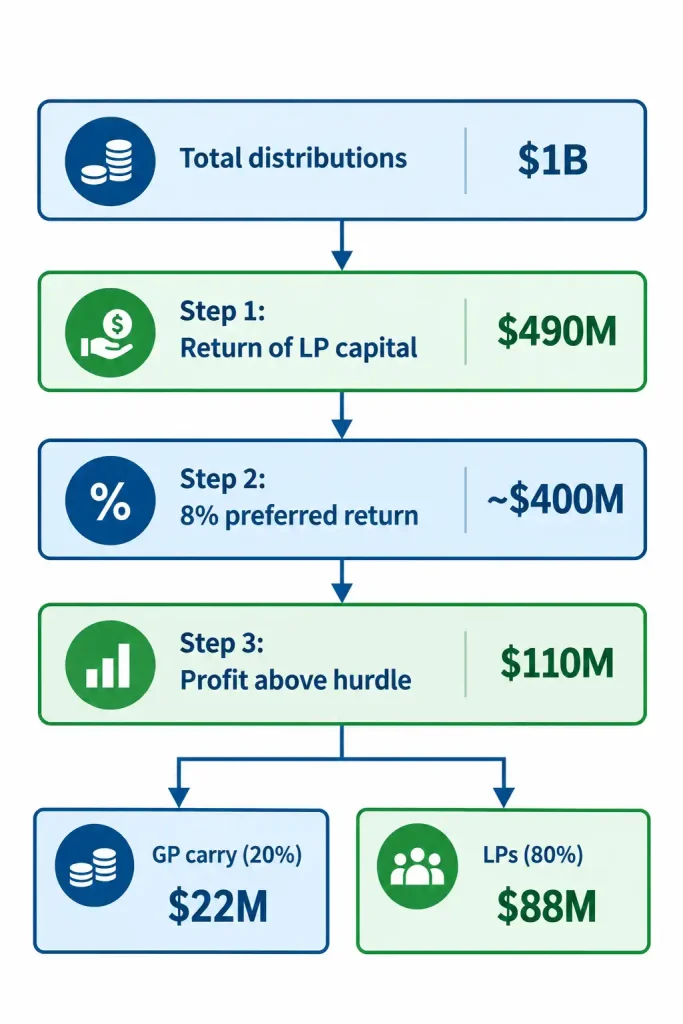
LPs receive $978M in total, and the GP earns $22M in carried interest. With only $850M returned, the fund would miss the $890M hurdle and the GP would earn no carry. That cliff is the whole point of the structure, since managers profit only once investors are whole.
European Versus American Waterfalls
| Feature | European (whole-of-fund) | American (deal-by-deal) |
| When carry flows | After the fund returns all capital and clears the hurdle | After each deal clears its own hurdle |
| Investor protection | Strong and favored by LPs | Weaker and reliant on clawback |
| Timing for the GP | Later in the fund life | Earlier, sometimes before overall success is clear |
| Main risk | Delayed GP economics | Overpayment if later deals lose money |
Deal-by-deal structures can enrich managers early, which explains why clawback provisions carry so much weight in American waterfalls.
Where Carried Interest Aligns and Where It Distorts
At its best, carried interest links performance to persistence. Delayed payouts discourage short-termism, and a share of the upside discourages excessive caution. A partner who expects 20 cents of each marginal dollar behaves like an owner, not an employee. Yet the same structure can produce prudence in one fund and recklessness in another.
Pressure Points in Fund Behavior
- Convexity: the GP shares in upside but not in LP losses, which can reward volatile bets.
- Early exits: selling a strong asset early can lift IRR and trigger carry while sacrificing compounding.
- Marked-up portfolios: unrealized valuation gains can support interim carry before any cash arrives.
- Fundraising pressure: late-cycle funds often chase DPI to show liquidity before the next raise.
- Platform sprawl: carry success tempts firms to launch adjacent funds that reward expansion over focus.
The gap between paper value and real value is not theoretical. Buy-side quality-of-earnings reviews often show how far reported EBITDA can drift from economic reality. The gap widens once one-time items and integration risk come into view. Carry earned on marked valuations inherits that same exposure.
Carried Interest and Internal Firm Culture
Inside the firm, carried interest often becomes the currency of hierarchy. Allocation, vesting, and recycling rules quietly shape who holds power and who waits. Junior professionals spend years before they participate, mid-level partners compete for attribution, and senior partners guard their economics. Over time, a firm that once acted as a single mind can start to behave like a coalition of separate balance sheets. Firms that ignore this dynamic tend to pay for it through turnover and weaker decisions.
The Carried Interest Tax Debate
In the United States, carried interest generally qualifies for long-term capital gains rates. That means a top federal rate of 20%, plus the 3.8% net investment income tax. Ordinary income can face a top federal rate of 37%. Section 1061 requires a holding period of more than three years for that treatment. Repeated proposals to close the so-called carried interest loophole have left the core rule intact.
The United Kingdom has moved further and faster on carried interest reform. From 6 April 2026, carried interest in the UK falls within the income tax regime. Only 72.5% of qualifying carry is taxable, producing an effective top rate of about 34.1%. Separate disguised investment management fee rules already treat fee-like returns as ordinary income.
Labor, Capital, or a Hybrid?
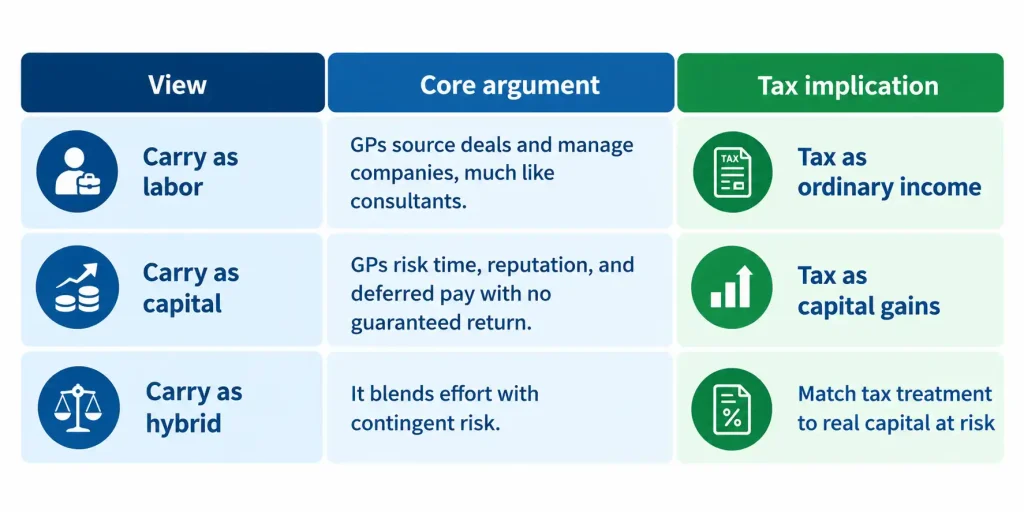
Tax law prefers binaries, and carry does not fit neatly into either one. That ambiguity invites engineering, where managers optimize for code sections instead of LP alignment. The optics matter as well, because public trust erodes when nurses and teachers face higher marginal rates than fund managers.
Reforming Carried Interest for a New Era
Longer hold periods, continuation funds, co-investments, GP stakes, and secondaries have made fund economics harder to read. The simple logic of the ship captain now sits beneath layers of structure that few outsiders understand. Abolition is not the answer, although refinement is overdue.
Five Principles for Better Carry Design
- Reward durability over timing by tying carry to MOIC across long holding periods, not IRR alone.
- Require real capital at risk, so any GP claiming capital gains treatment commits disclosed and proportionate capital.
- Vest on contribution instead of tenure, allocating carry by value added and clawing it back when behavior proves misaligned.
- Make transparency standard, with clear disclosure of who earns what and on what basis.
- Restore the original covenant, where managers and investors share success and the manager earns nothing from failure.
Durable growth supports the first principle of carried interest reform. Companies that scale fast tend to keep their gains only when CAC, lifetime value, and contribution margin discipline grow alongside revenue. Consistent definitions matter just as much for transparency. After cross-border acquisitions, only a single firmwide revenue definition makes reported performance trustworthy across subsidiaries. Carried interest calculations deserve that same rigor and consistency.
Three Key Takeaways
- Carried interest works best as a covenant that pays the GP only after LPs recover capital and a preferred return, and a whole-of-fund waterfall offers investors the strongest protection.
- The structure can distort behavior through early exits, marked-up valuations, and internal hierarchy, so governance and clawbacks deserve as much attention as the headline 20%.
- The legitimacy of carry depends on real capital at risk, durable value measured by MOIC, and transparent disclosure, as tax regimes in the US and UK continue to shift.
Disclaimer: This article is intended for informational purposes only and does not constitute legal, tax, or accounting advice. You should consult your own tax advisor or counsel for advice tailored to your specific situation.
Hindol Datta is a four-time CFO and senior finance executive with over 25 years of leadership experience across cybersecurity, SaaS, gaming, logistics, digital marketing, medical devices, consumer products, and nonprofit organizations. He has led more than $120M in fundraising and over $150M in M&A transactions while building the financial and operational systems that let complex businesses scale with confidence. He is the author of seven books in the Systems CFO Series and holds active CPA, CMA, and CIA credentials.
AI-assisted insights, supplemented by 25 years of finance leadership experience.