
Executive Summary
Capital forecasting does more than predict whether a company can afford its plans. It shows whether strategy is fundable, believable, and shared across the leadership team. When capital flows follow a different story from the one leaders tell, marketing overpromises, operations overbuilds, and finance overcorrects.
The sections ahead explain how capital forecasting builds strategic alignment in five ways. They cover the architecture of a sound forecast, its role as a strategic editor, and its influence on culture. They also address forecasting under volatility and the steady leadership that foresight requires. Together they show the forecast as a compass that turns ambition into a sequence the business can sustain.
The Architecture of a Capital Forecast
A capital forecast is a bridge between the present and the plausible. Like any bridge, it needs a stable base, a flexible span, and the right destination. The first task is not modeling but listening to sales cycles, hiring plans, and the confidence of functional leaders.
Layers That Make a Forecast Sound
Strong forecasts combine several layers, each with a distinct purpose. They rest on history, carry strategic intent, and leave room for surprise.
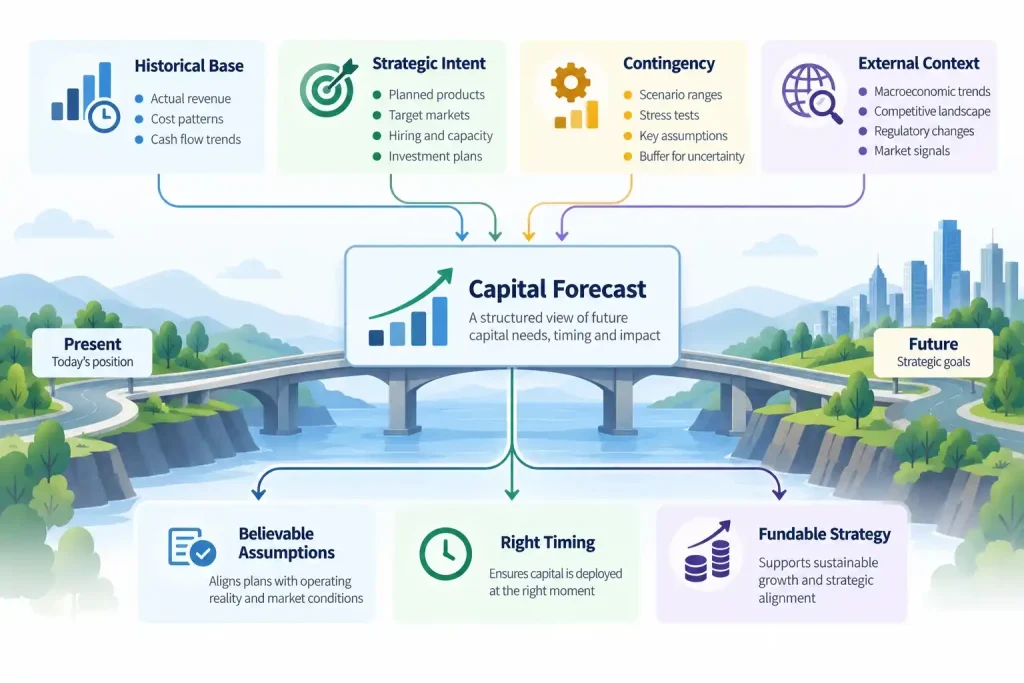
Core Layers of a Capital Forecast
| Layer | What It Contains | Purpose |
| Historical base | Actual revenue, cost, and cash patterns | Grounds projections in observed behavior |
| Strategic intent | Planned products, markets, and hiring | Links capital to stated priorities |
| Contingency | Scenario ranges and stress tests | Prepares the business for surprise |
| External context | Macroeconomic, competitive, and regulatory signals | Keeps assumptions connected to the market |
In capital forecasting, accuracy matters less than narrative integrity. Finance should ask whether marketing investment correlates believably with customer acquisition and whether the hiring plan matches the workload it must carry. It should also test whether the product roadmap justifies requested infrastructure capital.
Timing matters as much as the amount of capital itself. Many companies falter not from a lack of capital but from capital deployed at the wrong moment. They build too soon, scale too late, or fund too timidly. A good forecast works like a musical score, with each department entering at the right time.
A cybersecurity SaaS company with roughly $30M in ARR shows the value of this architecture. Its driver-based forecasting engine and capacity model kept actuals within plus or minus five percent of forecast for 8 consecutive quarters. That reliability let leaders time investments with confidence.
Capital Forecasting as an Editor of Strategy
Every planning cycle reaches a moment when the model stops reporting what the company can afford and starts showing what it is becoming. A capex line slips a quarter, or headcount shrinks in a market leaders once called ripe for growth. Finance training seldom covers what to do when a forecast contradicts a vision.
From Refusal to Sequencing
A capital forecast does not passively reflect strategy; it edits it. Each number acts as a vote, and each limit tests a priority. When capital cannot fund everything at once, the useful question becomes what the company must fund first, and why.
Consider a chief revenue officer who proposes entering three new regions within twelve months, each with its own sales pods and aggressive ramp targets. The forecast shows that the company can fund two regions, while a third would leave liquidity too thin. A strong leader responds by choosing the two that matter most and earning the right to fund the third later. At that point, the model stops being a plan and becomes a strategy.
In this sense, strategic alignment means shared sequencing, not unanimous optimism. The forecast succeeds when it provokes the right questions, turns vanity projects into deferred options, and converts hope into discipline. Its message is not a flat refusal but a clear path forward with a set order, tempo, and cost.
A pre-Series A AI governance and assurance platform shows how early this discipline can start. Finance built the operating model, multi-year scenario analyses, and capital strategy alongside the investor narrative. That work linked fundraising plans directly to the order in which the company would build and sell.
The Cultural Weight of Capital Forecasting
Culture shows up most visibly in what a company funds, not in what it celebrates. Departments may call innovation core or customer success sacred, yet chronic underfunding tells employees the real priorities. The forecast becomes the clearest signal of values because constraint enforces it.
What the Forecast Teaches
Imagine a startup that praises experimentation in every town hall while its forecast leaves no room for pilots. Every dollar goes to initiatives that have already proven themselves. Teams soon stop taking risks, not because anyone forbids it, but because the ledger has no space for failure.
Thoughtful CFOs use this influence over culture with care. They forecast ranges instead of fixed points and set aside modest capital for experiments that cannot yet justify themselves. When forecasting becomes a shared monthly conversation instead of an annual ordeal, every function grows more financially fluent:
- Sales leaders learn to speak in CAC and payback periods
- Engineering heads defend capitalized R&D assumptions with clear logic
- People teams model the return on retention programs
- Each department explains why it needs capital now instead of later
Tone determines whether this discipline helps or harms. A punitive process makes culture wither, while a rigorous but generous one builds strategic alignment. Teams that see how their forecasts shape the whole begin to plan with care, and the company moves in harmony instead of in fragments.
Capital Forecasting Under Volatility
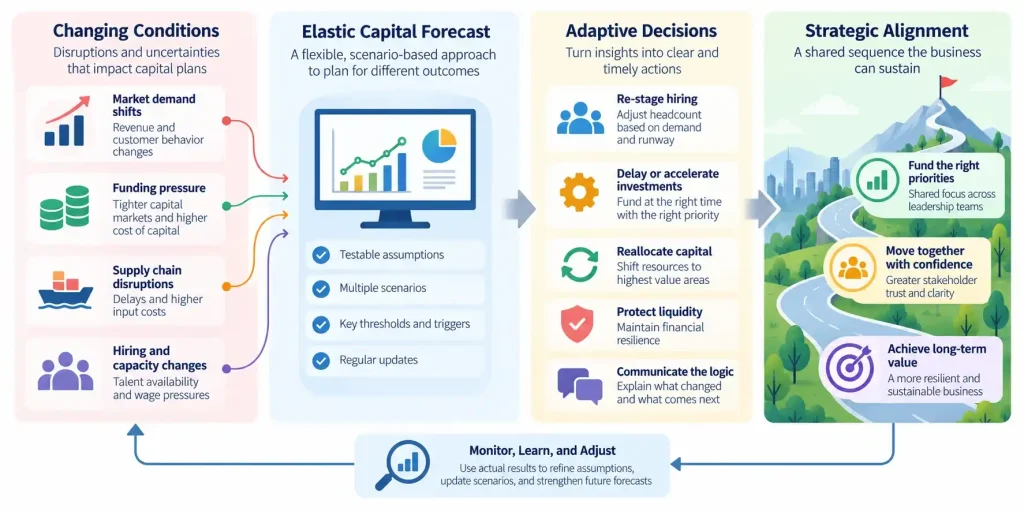
Every forecast will diverge from reality, so the real test is how gracefully it lets the company adapt. Currency shocks, inflation spikes, supply chain breaks, and funding contractions now arrive more often and with less warning. In this environment, elasticity matters more than precision.
From Static Promise to Living System
A forecast treated as a fixed promise becomes brittle. Consider a company with a sound operating model that suddenly faces cascading shipping delays across several revenue segments. Small delays turn into missed targets and then into tight receivables. A rebuilt model with optimistic, restrained, and disruption scenarios lets leaders re-stage hiring and delay investments with logic instead of panic.
Static Versus Elastic Capital Forecasts
| Dimension | Static Forecast | Elastic Forecast |
| Assumptions | Treated as guarantees | Written as testable hypotheses |
| Scenarios | Single plan with minor variance | Several cases built around key thresholds |
| Headcount | Fixed hiring schedule | Paced within upper and lower bounds |
| Response to shocks | Delayed and reactive | Pre-planned triggers for reallocation |
| Stakeholder message | Defends the original plan | Explains what changed and what follows |
Agility does not mean modeling every signal in the market. An elastic forecast focuses on the four or five variables that truly change the shape of the enterprise and prepares for structural thresholds. It also supports clear communication, because investors and employees want evidence that leaders see change and respond with logic.
A $127M global consumer products company with a supply chain spanning China and Vietnam shows why this matters. Finance there built both an annual operating plan and a long-range plan while managing ocean freight, trucking, and warehousing. The company also secured $12M in growth financing, which required forecasts that lenders could trust.
The Steady Leadership Behind Foresight
Responsible forecasting requires its own tempo: reflective, patient, and deliberate. The CFO must weigh competing visions of the future, each argued with passion, against the long calculus of sustainability. The task calls for interpretation, not a simple veto.
Stewardship Over Prediction
Saying no is not enough; finance must explain why in a way that redirects energy instead of rejecting vision. When a CEO sees that a revised forecast makes the strategy more credible, trust grows in finance and in the planning process. That trust can outlast missed quarters and market shifts.
The real victories of capital forecasting often stay invisible. Examples include a funding round timed well, an investment held until its case matured, or a cost structure reshaped months before a downturn. An early-stage email marketing SaaS company illustrates the last of these. A financial turnaround there reduced monthly burn from $800K to $200K, extending runway and protecting the core business.
The CFO, in the end, is a steward of conditions instead of an oracle of outcomes. Good forecasting prepares instead of predicts, and it gives the company a way to move forward together. That shared sequence is the truest form of strategic alignment finance can offer.
Three Key Takeaways
- Capital forecasting builds strategic alignment when it combines historical data, strategic intent, contingencies, and external context into a believable narrative.
- A forecast that edits strategy through sequencing helps leaders fund the right priorities first and shapes a culture of financial fluency.
- Elastic forecasts with clear thresholds let companies adapt to volatility while keeping stakeholders informed and confident.
Disclaimer: This article is intended for informational purposes only and does not constitute legal, tax, or accounting advice. You should consult your own tax advisor or counsel for advice tailored to your specific situation.
Hindol Datta is a four-time CFO and senior finance executive with over 25 years of leadership experience across cybersecurity, SaaS, gaming, logistics, digital marketing, medical devices, consumer products, and nonprofit organizations. He has led more than $120M in fundraising and over $150M in M&A transactions while building the financial and operational systems that let complex businesses scale with confidence. He is the author of seven books in the Systems CFO Series and holds active CPA, CMA, and CIA credentials.
AI-assisted insights, supplemented by 25 years of finance leadership experience.



