
Executive Summary
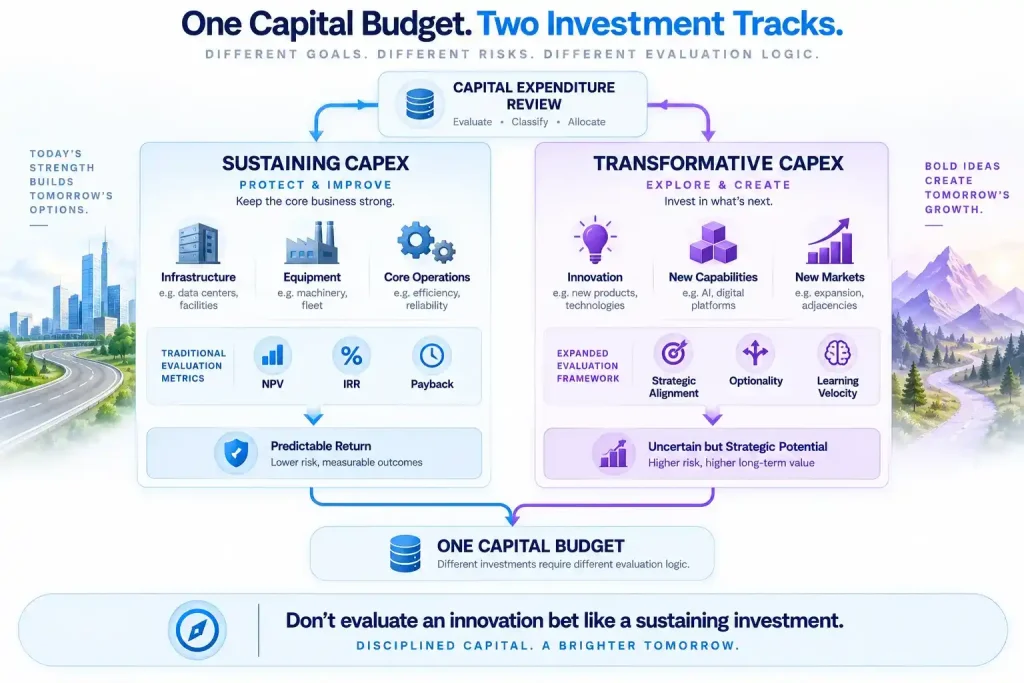
A capital expenditure review determines whether an innovation bet ever gets funded at all. Most companies run every capital request through the same filter. That filter is net present value, internal rate of return, or a payback period. It works well for a new data center or a delivery fleet. It fails an early-stage innovation bet almost by design, because the returns are uncertain and the comparables barely exist.
This article sets out how a capital expenditure review should split into two tracks. It covers why sustaining and transformative investments need different evaluation logic. It covers frameworks that go beyond ROI for high-uncertainty projects. And it covers the governance structure that lets a capital budgeting process move at the speed the innovation actually requires.
Why One CapEx Review Process Cannot Serve Two Kinds of Investment
A new manufacturing line and a prototype for an AI-powered analytics platform are not the same kind of bet. One protects a margin that already exists. The other tries to reimagine it. Scoring both through the same net present value model makes little sense. It is like using a thermometer to measure the weight of an idea.
A capital expenditure review that treats every project as sustaining will always underfund the transformative ones. The fix starts with classification, not with looser standards. Sustaining CapEx should stay on traditional financial metrics. Transformative CapEx needs a different toolkit built around strategic alignment, optionality, and the company’s capacity to absorb failure.
Redesigning the Capital Budgeting Process Around Two Tracks
A transformative project asks a different set of questions than a sustaining one. What market insight does this investment unlock? What is the path to scale if the pilot succeeds? What capability survives even if the product itself does not?
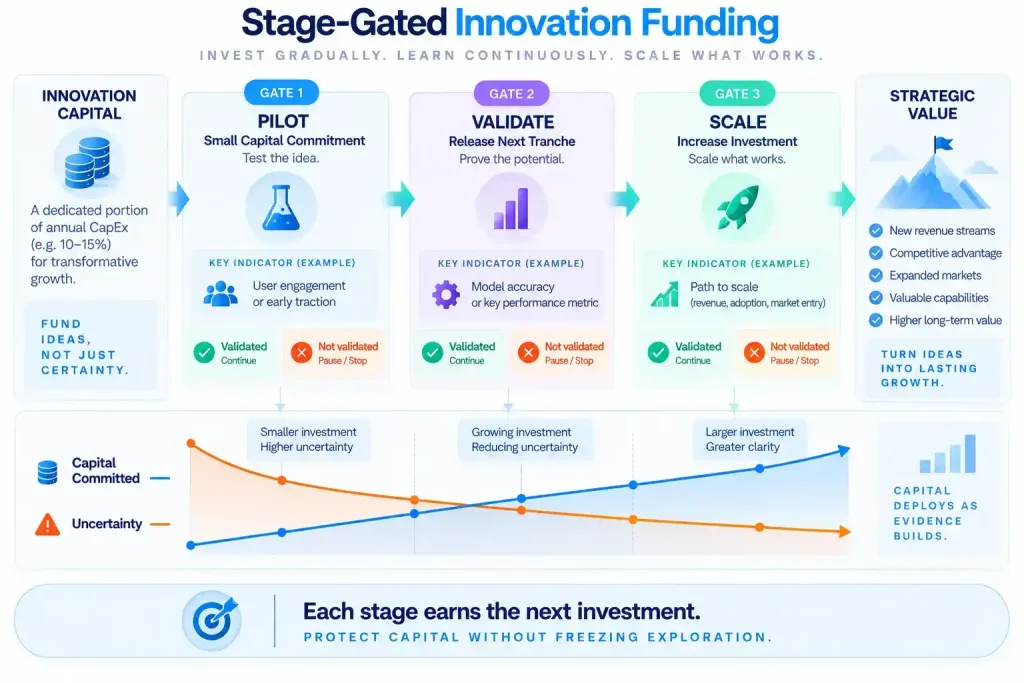
Three habits keep this second track disciplined rather than speculative.
- Stage-gated funding, so a moonshot gets released in tranches instead of all at once
- Leading indicators tied to each gate, such as user engagement or model accuracy, rather than lagging financial results
- A fixed share of annual CapEx, often 10 to 15 percent, set aside for transformative projects by design rather than funded only when the core business overperforms
Case: Staging Capital Instead of Betting It All at Once
A pre-Series A AI governance and assurance platform built its funding around exactly this logic. Its capital strategy tied a phased approach to a multi-year scenario model. Each fundraising conversation then carried a specific resource ask attached to a specific outcome. The company never had to defend one large, undifferentiated ask. Each stage earned the next one based on what it had actually validated.
Evaluation Frameworks Beyond ROI
Net present value and internal rate of return distort an early-stage, high-ambiguity investment. They demand predictability where the honest answer is still emergence. Two tools fill that gap without abandoning financial rigor.
- Real options analysis treats an innovation investment as the right to invest more later, not an obligation to commit everything up front
- Strategic value mapping scores a project across axes like market expansion potential, capability adjacency, and learning velocity, alongside financial viability
A three-horizon framework helps separate these bets by time scale. Horizon one covers incremental improvements with a near-term payback. Horizon two covers adjacent innovations needing twelve to twenty-four months. Horizon three covers moonshot territory, with three-to-five-year timelines and no proven market yet. Each horizon carries its own capital threshold and its own reporting cadence. Leadership never confuses a radical bet with a core operating investment as a result.
Governance That Moves at the Speed of Learning
Traditional CapEx governance assumes predictability: a linear approval chain, document-heavy review, and a natural skepticism toward anything unproven. That structure works for a warehouse expansion. It stalls a small, time-sensitive pilot until the opportunity has already changed.
A tiered governance model matches the review to the size and risk of the request.
- Fast-track approval for low-interdependence projects under a modest threshold, needing only department-level sign-off
- A standing cross-functional council for mid-sized initiatives with implications across product, finance, and technology
- Formal executive or board review for major investments, supported by a strategic alignment brief rather than a plain budget request
Case: Funding a Reserve Instead of Waiting for the Annual Cycle
A high-growth cybersecurity and identity access management company built the tracking discipline this kind of governance depends on. Its driver-based forecasting engine paired with a matching capacity model. Together, they held actuals within five percent of forecast for eight consecutive quarters. That same visibility let leadership see where capital was flowing and what each dollar was yielding. No one had to wait for a quarterly close to find out. A mission-driven education institution applied a similar principle to a $37M raise. It ran multi-year financial models under variable funding scenarios, instead of committing to one fixed capital plan.
Three Key Takeaways
- A capital expenditure review needs two tracks, not one. Sustaining investments belong on traditional ROI metrics. Transformative ones need a framework built around optionality, learning velocity, and strategic alignment.
- Stage-gated funding and real options analysis protect capital without freezing exploration. Each stage should earn the next one based on what it actually validated. It should not depend on how convincing the original pitch sounded.
- A capital budgeting process only stays agile if governance is tiered to match the size and risk of each request. A fast-track lane for small pilots matters. So does a cross-functional council for larger bets. Both matter more than a single approval chain built for warehouse-scale decisions.
Disclaimer: This article is intended for informational purposes only and does not constitute legal, tax, or accounting advice. You should consult your own tax advisor or counsel for advice tailored to your specific situation.
Hindol Datta is a four-time CFO and senior finance executive with over 25 years of leadership experience across cybersecurity, SaaS, gaming, logistics, digital marketing, medical devices, consumer products, and nonprofit organizations. He has led more than $120M in fundraising and over $150M in M&A transactions while building the financial and operational systems that let complex businesses scale with confidence. He is the author of seven books in the Systems CFO Series and holds active CPA, CMA, and CIA credentials.
AI-assisted insights, supplemented by 25 years of finance leadership experience.