
Executive Summary
Capital efficiency is often treated as a topic for treasury or the investor relations deck. In practice, it is decided years earlier, inside the depreciation policy buried in the fixed asset ledger. A company depreciating a building, a server farm, or a production line as one block is making a decision. It is a capital efficiency decision. It simply does not name it that way. That decision eventually surfaces as distorted return metrics, mistimed capital budgets, and audit conversations nobody enjoys.
This article examines component depreciation as a lever for capital efficiency. The view comes from twenty-five years inside the finance function of manufacturing, technology, and regulated companies. It covers why composite depreciation erodes the capital efficiency ratio boards use to judge management. It also covers how a finance leader decides when component treatment is worth the effort.
What Is Capital Efficiency, and Why Depreciation Quietly Shapes It
Capital efficiency, at its simplest, describes how much output a business generates from every dollar of capital it deploys. That capital might sit in equipment, facilities, inventory, or invested cash. Boards approximate it through return on invested capital and return on capital employed. A more direct measure is the capital efficiency ratio, which compares revenue against invested capital. A company producing two dollars of revenue for every dollar invested is, on paper, twice as capital efficient. The company producing one dollar is not. That is the arithmetic, at least. Every one of those calculations depends on the denominator. That denominator is the value of the assets on the books.
Depreciation policy sets that denominator. A building depreciated on a single thirty-nine-year schedule is one example. A server rack depreciated over five years is another. Both feed the same fixed asset base. Analysts use that base to judge capital deployment. This shows up across capital-intensive industries. A global medical device manufacturer running plants on three continents is one example. A marketplace platform scaling on leased infrastructure is another. Some businesses treated depreciation as a compliance afterthought. Their capital efficiency ratio told a story operations could not confirm.
The Composite Fallacy: How Broad-Brush Depreciation Erodes Capital Efficiency
Composite depreciation is attractive because it is easy: one schedule, one useful life, one line in the fixed asset register. The problem is that a facility does not age as a single organism. A roof may need replacement within fifteen years. An industrial oven may burn out in seven. The building around both keeps producing decades later, largely indifferent to either event.
When the accounting does not reflect that rhythm, neither does the capital plan built on top of it, and capital efficiency suffers twice: once when the asset base is overstated, and again when replacement spend arrives as a surprise instead of a forecast.
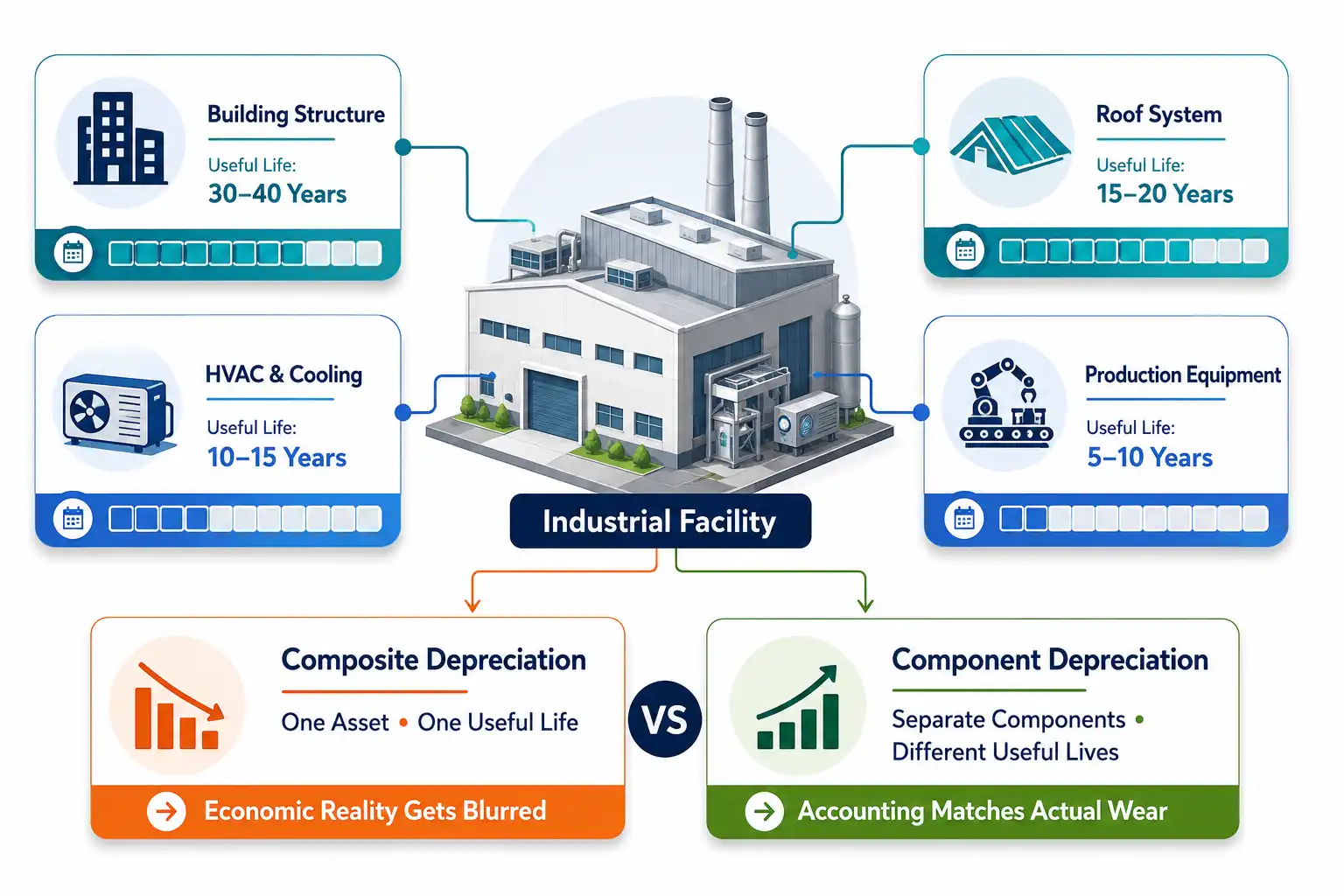
A Regulated Manufacturing Lens on Component Life Cycles
This pattern showed up directly while building the operations controllership function at a $170M global medical device manufacturer with plants in Copenhagen, Cork, and Taiwan. Standard costing and bill of materials management there demanded a precision no single blended depreciation schedule could support, since the specialized production equipment inside each plant wore out on a curve entirely different from the facility housing it. Regulated manufacturing forces this discipline, since auditors and inspectors expect the asset ledger to reflect physical reality, not convenience, a conviction carried into every subsequent role: capital efficiency is the sum of many small decisions about how assets are tracked and retired, not an abstraction calculated once a quarter.
Why Component Depreciation Strengthens the Capital Efficiency Ratio
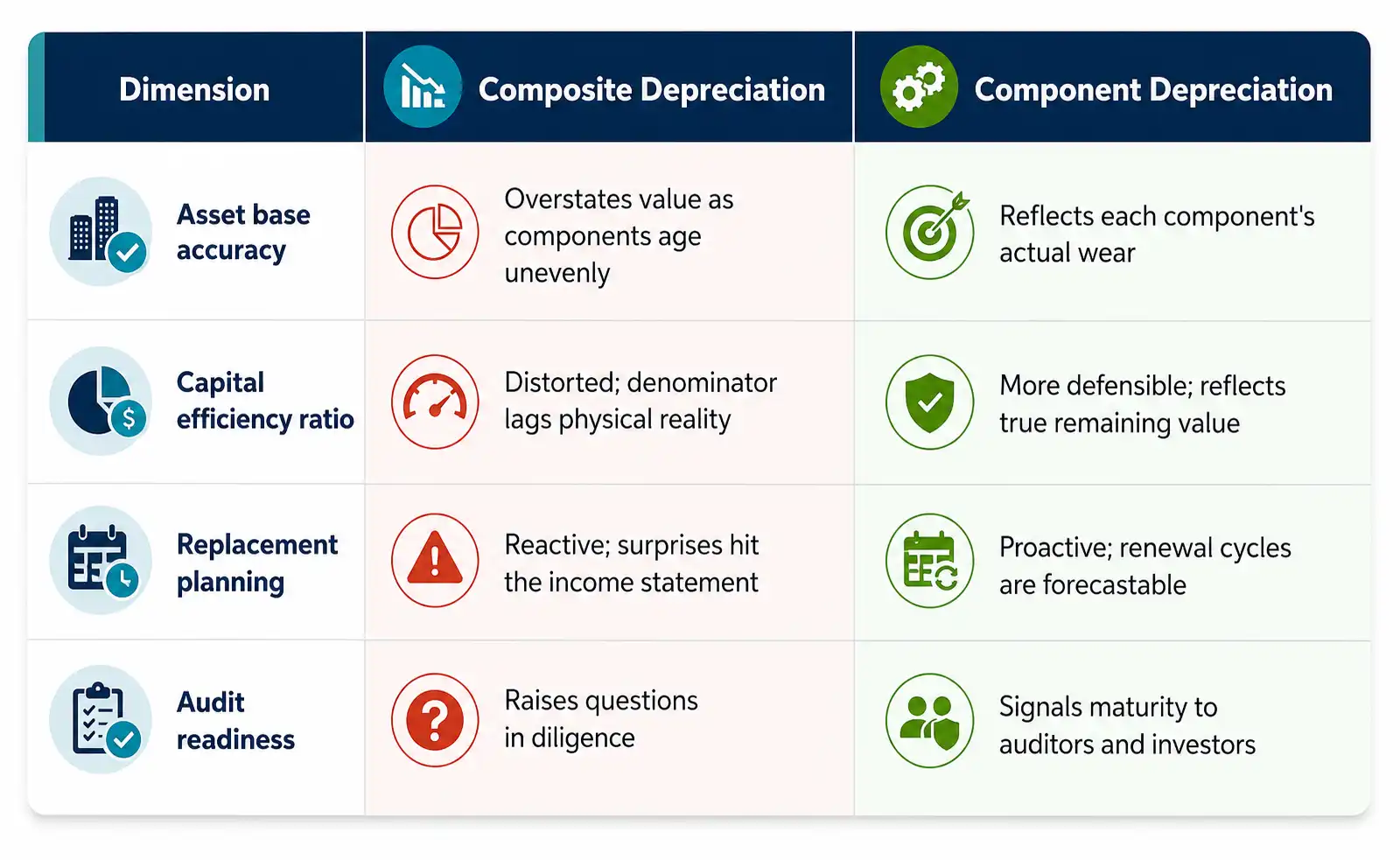
The rationale for component depreciation sits in capital stewardship, not academic preference. Treating a multi-part asset as a single unit overstates the asset base, understates real wear, and inflates the return-on-asset and capital efficiency ratio calculations investment committees rely on when funding the next facility or data center buildout. It also blurs the maintenance signals operations teams need to plan replacement spend before failure forces the issue.
Component depreciation lets finance align with operations, opening the door to differentiated useful lives and reporting that reflects how the business actually consumes its assets. This matters most where utilization and reliability drive unit economics: energy infrastructure, logistics, healthcare facilities, and increasingly, technology environments built around physical infrastructure.
From Server Racks to Refrigeration: Component Curves Across Industries
Leading the finance function of a cybersecurity and identity access management company scaling toward $30M in annual recurring revenue meant building a capacity model distinguishing core infrastructure’s useful life from the shorter cycles of the hardware inside it. Cooling systems, battery backups, and server modules each follow their own performance curve, and a finance team depreciating the entire investment as one asset class will be blindsided when hardware fails years before the infrastructure around it does. The same pattern appears in refrigeration-heavy operations, where cooling equipment embedded inside a leased facility can consume a third of its energy load while depreciating on a schedule built for the building, producing a confusing write-down when replacement costs arrive early against a low remaining book value.
The Implementation Paradox: Cost, Discipline, and the Payoff of Segmentation
The most common objection to component depreciation is operational, not theoretical: disaggregating a facility’s cost across roof, walls, electrical, HVAC, and specialized fixtures requires engineering input and judgment a lean finance team may lack the bandwidth to exercise. For companies without a centralized fixed asset system, the setup cost can look disproportionate to the benefit, at least until the first unplanned replacement lands on the income statement.
Building the Policy from Nothing
Joining a venture-backed manufacturing company as its first finance hire meant building the chart of accounts, the GAAP framework, and the fixed asset policy from a blank page, with no legacy schedule to inherit. Building that discipline early, before the asset base grew complex, proved far less expensive than retrofitting it later, and gave the organization a forecasting model investor could trust because it matched the shop floor.
Passing Diligence with a Public-Company Lens
Leading an S-1 and IPO-readiness process for a publicly listed gaming and digital entertainment company operating across five countries showed how much weight underwriters and Big Four auditors place on fixed asset policy as a company approaches public markets. Component depreciation, once adopted, becomes a signal of maturity there instead of a compliance burden: schedules match economic reality, investors read transparency into the disclosure, and capital renewal planning tends to improve alongside it.
Judgment and Segmentation: Knowing Where Component Depreciation Belongs
Not every asset warrant component treatment. For lower-value or shorter-lived items, composite or straight-line depreciation remains sufficient, and the threshold for moving past it is materiality, measured in both financial and operational terms.
Component depreciation earns its cost when the following conditions hold:
- The asset contains identifiable subcomponents with materially different useful lives.
- Those subcomponents represent a meaningful share of the asset’s total cost.
- The subcomponents are expected to be replaced independently of the larger asset around them.
A facility roof, a ship’s engine, a power plant turbine, and a server room’s cooling system all satisfy that test, as do tenant improvements such as partition walls or electrical rewiring inside an office lease. Once adopted, the schedules require ongoing precision, tracking disposal, replacement cycles, and accumulated depreciation with a care many startups have not yet built into their systems, though the tradeoff tends to justify itself within a few replacement cycles.
Impacts on Book Value and Capital Efficiency Metrics
Overstating book value through oversimplified depreciation distorts the metrics that drive real decisions. It inflates net property, plant, and equipment, depresses depreciation expense, and flatters return on invested capital in ways that do not survive a quality-of-earnings review. Investment committees may keep funding asset-heavy projects whose performance is propped up by under-depreciated assets, while budget variance reports quietly miss the wear-and-tear signals the accounting was never built to capture.
For companies raising capital or preparing for an exit, an overstated book value invites the adjustment that slows diligence and erodes trust. Component depreciation becomes a defensive tool there, demonstrating the precision investors look for when testing whether a company’s capital efficiency claims hold up under scrutiny.
When Simplicity Becomes a Liability
Earlier in a finance career, simpler asset schedules feel like the right tradeoff: closing goes faster, reconciliations are easier, and compliance looks straightforward on paper. Across enough asset-intensive environments, though, simplicity taken past its useful point turns into opacity, hiding problems, delaying renewals, and weakening the case for upgrades operations teams are often already asking for.
Component depreciation is not complexity for its own sake. It matches the accounting to the economic truth sitting inside the walls, the racks, and the production lines a company depends on, and when the schedule reflects the lived experience of those assets, capital decisions improve alongside the credibility of the numbers behind them.
Three Key Takeaways
- Capital efficiency is decided earlier than most finance teams assume, often inside a depreciation policy nobody has revisited since the asset was first capitalized, so reviewing that policy is a strategic exercise, not an accounting formality.
- Component depreciation pays for itself fastest in asset-intensive or infrastructure-heavy businesses, where subcomponents such as roofs, cooling systems, or production equipment carry materially different useful lives than the structure around them.
- The effort to segment assets is real, but it builds the discipline underwriters, auditors, and investors reward during diligence, making component depreciation as much a governance signal as a technical accounting choice.
Disclaimer: This article is intended for informational purposes only and does not constitute legal, tax, or accounting advice. You should consult your own tax advisor or counsel for advice tailored to your specific situation.
Hindol Datta is a four-time CFO and senior finance executive with over 25 years of leadership experience across cybersecurity, SaaS, gaming, logistics, digital marketing, medical devices, consumer products, and nonprofit organizations. He has led more than $120M in fundraising and over $150M in M&A transactions while building the financial and operational systems that let complex businesses scale with confidence. He is the author of seven books in the Systems CFO Series and holds active CPA, CMA, and CIA credentials.
AI-assisted insights, supplemented by 25 years of finance leadership experience.