
Executive Summary
Capital allocation during a strategic pivot is the clearest statement a company makes about its future. Every dollar moved toward a new bet tells the board, the market, and employees what the organization now believes. The CFO’s task is to separate conviction from nostalgia and fund the future with discipline.
A five-part capital allocation model brings structure to that task and clarifies the capital allocation meaning that matters most in a pivot. Its tools include staged funding tranches, expected value comparisons, and governance cadences built for a faster strategic tempo.
Capital Allocation Meaning When Strategy Changes Direction
In stable periods, capital allocation means distributing resources across operations, growth, debt reduction, and shareholder returns to maximize long-term value. That textbook definition still holds, but a pivot changes its weight. The decision moves beyond optimization and becomes a question of identity.
A pivot begins quietly, with forecasts that no longer reconcile and board questions that sting more than they should. Capital then becomes the instrument that turns a new strategy from a slide into a commitment.
Sound capital allocation in a pivot is therefore less a formula than a discipline practiced under pressure. The CFO must weigh return profiles alongside reversibility, and burn rate alongside belief rate, meaning the real conviction behind each initiative.
The Five-Part Capital Allocation Model for Strategic Pivots
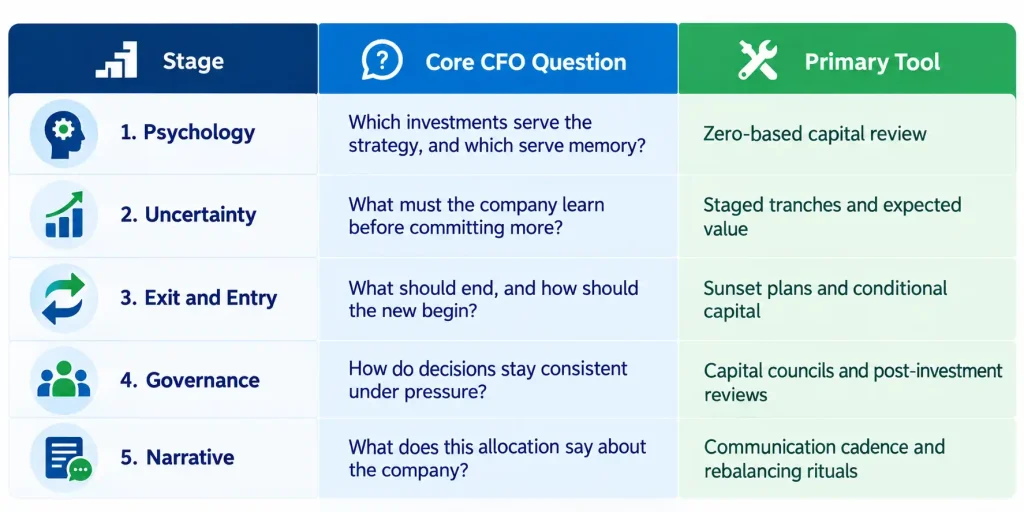
Sunk Cost and the Psychology of Capital Allocation
The greatest enemy of intelligent capital allocation in a pivot is rarely bad arithmetic. It is the sunk cost fallacy, dressed in corporate robes and defended in the language of continuity. Companies keep funding a mobile app because it was their first major launch, or protect a division because it once led the business.
None of this signals failure, but left unexamined it becomes a tax on renewal. The CFO must ask whether each investment serves the current strategy or a memory of the old one.
Auditing Beliefs Before Auditing Budgets
Finance leaders should test what the company still believes about its market position and which assumptions drive its valuation models. They should also measure how much spending rests on forecasts that customers, costs, or competitors have already invalidated.
Zero-based capital planning helps by forcing every dollar to justify itself on forward return instead of historical spend. At a $127M global consumer products company, SKU rationalization and demand planning lifted inventory turns from 3x to 7x. The working capital it released became fuel for new priorities.
Spotting Zombie Projects Before They Drain Capital
The most dangerous initiatives are not the ones openly failing but the ones almost working, where “one more quarter” becomes the standing request. Several warning signs tend to recur across industries:
- Milestones deferred for two or more consecutive review cycles
- Metrics redefined to show progress the original plan never anticipated
- Declining internal advocacy, even among the original sponsors
- Justifications that cite past investment over future return
The CFO’s role is to surface the opportunity cost of such projects by modeling alternative capital paths and comparing return on invested capital.
A Capital Allocation Model for Decisions Under Uncertainty
Pivots unfold in uncertainty, which differs from risk because no one can assign probabilities with confidence. In these conditions, the purpose of capital shifts from optimization to learning.
Staged Tranches and Decision Checkpoints
A strong capital allocation model for a pivot funds initiatives to a decision node, not to full conclusion. Each tranche carries resources to explore and explicit criteria to graduate. In this structure, every dollar funds work and buys feedback at the same time.
Staged Funding Structure for Pivot Investments
| Stage | Capital Released | Graduation Criteria |
| Discovery | Small, fixed budget | Problem validated with target customers |
| Validation | Moderate tranche | MVP shows measurable traction in one market |
| Scale | Larger, milestone-based tranche | Unit economics meet agreed thresholds |
| Full Commitment | Inclusion in the annual plan | Sustained performance across review cycles |
Each checkpoint works as a hypothesis audit, not a performance review. Leaders ask whether the premise still holds and whether a cheaper path to the next signal exists. Stopping early then counts as a win, because it shows capital moving with discernment instead of fear.
A cybersecurity SaaS company with roughly $30M in ARR shows the value of this rhythm. Its driver-based forecasting engine held actuals within 5% of forecast for 8 consecutive quarters. That predictability gave leadership the confidence to release capital in stages.
Asymmetric Payoffs and Reversibility
Under expected value thinking, a modest chance of a large payoff can deserve more attention than a safe bet with thin returns.
Expected Value Comparison of Two Pivot Bets
| Metric | Project A | Project B |
| Probability of success | 20% | 80% |
| Payoff multiple if successful | 10x | 1.2x |
| Expected value multiple | 2.0x | 0.96x |
| Allocation approach | Small tranche, fast checkpoints | Fund only if no better use exists |
Assuming a failed project returns nothing, Project A carries more than double the expected value of Project B. Bayesian updating and real options logic help CFOs model the full range of outcomes, not just the median forecast. Reversibility matters just as much, which means contracts that can unwind and teams that can take on new missions. Before each commitment, the CFO should ask what happens if the company turns out to be wrong.
Exiting Legacy Programs and Seeding New Bets
Every serious pivot reaches a moment when something that once carried institutional pride must end. Failing to exit obsolete programs ties up executive attention, emotional loyalty, and reputational bandwidth along with money.
Ending Legacy Programs with Dignity
The CFO must explain each exit to the board in economic terms and to internal teams in human terms. An initiative rarely ends because its leaders lacked ability. More often, it has reached the limit of its productive arc, and continuing would dilute value.
At an early-stage email marketing technology company, an operational turnaround cut monthly burn from $800K to $200K. A reduction of that scale holds only when teams understand the reasoning and capture what they learned. Without respect for what is ending, whatever begins next will struggle to earn conviction.
Funding New Initiatives with Restraint
New investments deserve the same rigor as exits. Pivots invite narrative overreach, where an embryonic product line gathers a halo of inevitability. The CFO should begin with tranches over torrents, and with conditional capital over blank checks.
Governance That Institutionalizes Capital Allocation Discipline
Improvisation may feel agile in the heat of a pivot, but only governance turns individual judgment into repeatable discernment. Gartner has reported that CFOs who practice capital responsiveness can add 2.5 percentage points to economic value added.
Strong capital governance during a pivot rests on a few core mechanisms:
- Transparent tradeoffs: every proposal shows the opportunity cost of the alternatives it displaces.
- Common evaluation frameworks: standard templates and scenario-adjusted business cases replace the loudest voice in the room.
- Precommitted criteria: leaders set review thresholds in advance, guarding against selective scrutiny.
- Post-investment reviews: each funded initiative faces checkpoints framed as learning events, not compliance rituals.
Matching Governance Cadence to Strategic Tempo
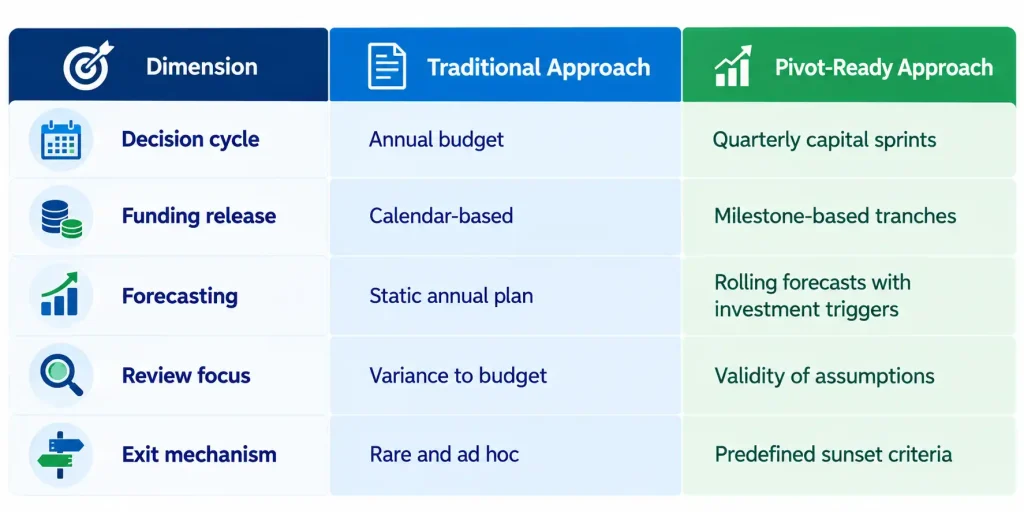
A pivoted strategy often moves faster than the annual budget. When product experiments evolve monthly but capital decisions happen yearly, misalignment follows.
Traditional Versus Pivot-Ready Capital Governance
Capital Allocation as Corporate Narrative
During a pivot, budgets start to read like autobiography. Employees, customers, and investors interpret what gets funded and what gets cut as signals of corporate identity. Doubling R&D while closing legacy revenue streams announces a commitment to exploration. Starving customer service to fund a failing initiative sends a damaging message.
Narrating with integrity starts with alignment, since a pivot toward customer intimacy that never funds training or analytics reads as incoherent. Erratic capital signals undermine a pivot faster than almost anything else, so every change in direction needs an explanation.
A venture-backed digital marketing company that scaled revenue from $9M to $180M in 24 months illustrates the point. Its CAC, LTV, and contribution margin discipline gave every team a shared view of where capital went and why. Scheduled capital reviews and transparent post-mortems reinforce that kind of narrative and keep leadership honest about its own coherence.
Three Key Takeaways
- Capital allocation during a pivot is a statement of identity, so the CFO must audit beliefs as rigorously as budgets and move funds away from programs sustained by memory.
- A staged capital allocation model, built on tranches, checkpoints, and expected value thinking, lets a company fund its way into knowledge while preserving the ability to change course.
- Governance and narrative make reallocation durable, because precommitted criteria and clear communication turn individual funding decisions into a strategy people can trust.
Disclaimer: This article is intended for informational purposes only and does not constitute legal, tax, or accounting advice. You should consult your own tax advisor or counsel for advice tailored to your specific situation.
Hindol Datta is a four-time CFO and senior finance executive with over 25 years of leadership experience across cybersecurity, SaaS, gaming, logistics, digital marketing, medical devices, consumer products, and nonprofit organizations. He has led more than $120M in fundraising and over $150M in M&A transactions while building the financial and operational systems that let complex businesses scale with confidence. He is the author of seven books in the Systems CFO Series and holds active CPA, CMA, and CIA credentials.
AI-assisted insights, supplemented by 25 years of finance leadership experience.



