
Executive Summary
A capital allocation framework is often treated as a technical tool for ranking investments and setting budgets. In practice, it is also the clearest statement of what a company values, since every funding decision teaches employees what the firm rewards and tolerates.
This article examines how financial integrity shapes culture through discipline, fair budgeting, honest forecasts, and sound incentives. It also traces how bent numbers erode trust and why the CFO serves as a steward of culture.
Why Financial Integrity Shapes Organizational Culture
No one celebrates a balanced ledger, and accruals rarely earn applause at a town hall. Yet the most lasting leadership a CFO offers may be moral rather than analytical. The word moral comes from mores, the Latin for customs, and finance quietly sets the customs of the firm.
Culture forms around what a company rewards and what it tolerates, and leaders express those choices through budgets, not slogans. Financial integrity behaves like oxygen, invisible when present and felt at once when missing. When numbers match the narrative, teams trust that decisions flow from stated values. Once adjustments become accommodations, that trust thins and rarely recovers in full.
Seen this way, financial integrity is not a constraint on culture but its strongest catalyst. A sound capital allocation framework turns quarterly reviews, forecasting cycles, and investment prioritization into touchstones instead of burdens. The CFO then acts less like a gatekeeper and more like a gardener.
The Emotional Texture of Financial Discipline
A particular silence settles over a boardroom when the budget finally reaches the table. An honest forecast, a fully explained variance, or a firm denial of discretionary spend is an act of care, not caution.
What Teams Learn from How Finance Behaves
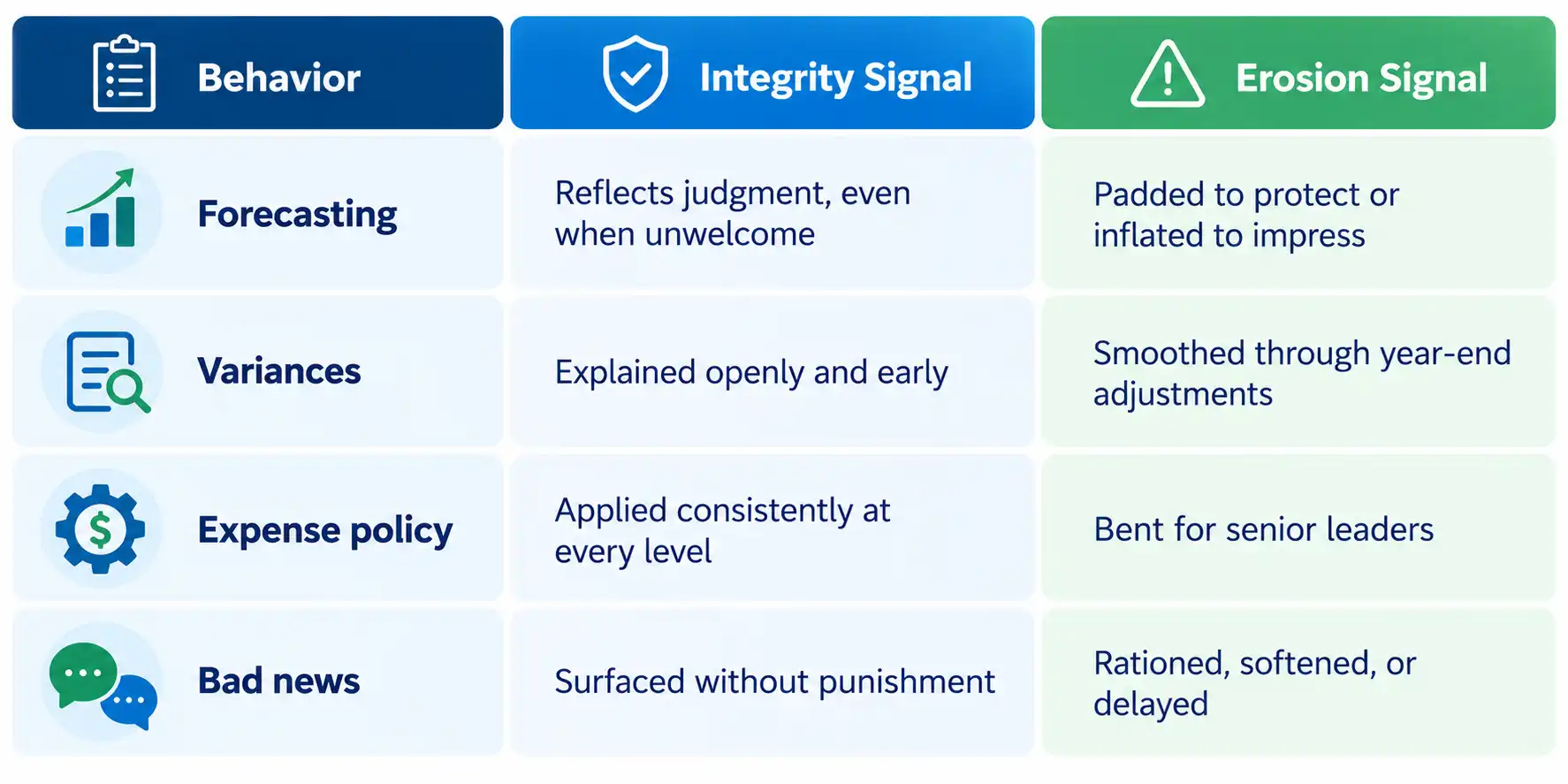
Employees watch how finance handles expense reports and whether bonus criteria match stated targets. They notice whether a reforecast is realistic or wishful, and they adjust their own behavior to match. When leaders bury a 20% forecast miss in year-end adjustments, the message is that perception outranks precision. Forecasts soon become aspirations, and the culture turns performative.
A cybersecurity and identity access management company with $30M in ARR saw the opposite effect. Its driver-based forecasting engine held actuals within 5% of forecast for 8 consecutive quarters. That record did more than satisfy the board, because it gave teams the confidence to take real risks.
Leading with integrity means correcting a miscategorized expense that no one else would notice. It also means letting the company feel consequences, since a CFO who cushions every miss turns finance into an anesthetic.
Integrity Signals Versus Erosion Signals
Building a Capital Allocation Framework Rooted in Fairness
Treated only as arithmetic, a budget controls without inspiring anyone. Approached with judgment, a capital allocation framework becomes an instrument of justice. It answers the hardest question any company faces: what, and whom, it is willing to resource.
Fairness here means proportionality and purpose, not equal shares for every department. Department heads rarely fight for money alone; they fight for meaning, because to be funded is to be seen. When allocation turns opaque or political, the culture begins to fray.
Sequencing Instead of Splitting Capital
In a common inflection point, the commercial team needs investment to break through a plateau, while engineering has a credible multi-year roadmap. Both asks are strategic, but the budget cannot cover both in full.
The easy move is to split the difference and underfund both teams. A stronger capital allocation framework chooses a sequence, walking every executive through the assumptions and trade-offs. It shows how commercial acceleration could unlock cash within two quarters to fund engineering from surplus. The team that waits still feels heard, because the logic is visible and the promise to return sits on paper.
A venture-backed performance marketing company that scaled from $9M to $180M in revenue within 24 months shows this discipline at work. Capital flowed where customer acquisition cost, lifetime value, and contribution margin pointed to the strongest return. Because leadership shared those criteria openly, teams that waited understood why.
Budgeting as Storytelling
Performative budgeting follows a familiar script: ask for more than needed, expect cuts, and pad the model. Budgeting as storytelling offers a better path, explaining why this team, why now, and what the investment unlocks or defers. Asking a manager to write a funding case in paragraphs often reveals friction, exhaustion, and technical debt that spreadsheet rows hide.
Four Tests for a Fair Capital Allocation Framework
| Test | Question to Ask | What It Protects |
| Strategic fit | Does this investment advance the mission now? | Focus |
| Proportionality | Does funding match the expected return and risk? | Fairness |
| Transparency | Can every executive explain the choice? | Trust |
| Sequencing | If not now, when, and what triggers a revisit? | Patience and dignity |
Forecasts, Incentives, and the Moral Voice of the Firm
How a company forecasts, measures, and pays is a form of ethics, not just planning. Employees and investors read these systems as texts that carry values.
Teams often push forecasts up to impress or down to protect themselves, turning estimates into theater. A forecast built to be “optimistic enough to be safe” is a common symptom of this problem. Such systems reward beating predictions more than predicting accurately, so the truth becomes negotiable. The fix is to reward good news only when earned, never punish bad news, and separate ego from estimation.
Designing Incentives People Can Understand
If the budget declares what a company values, compensation proves it. Many organizations mistake complexity for sophistication, building cascading goals that blur the line of sight. When a product team earns bonuses for on-time delivery alone, features get split and definitions blur to hit dates. Releases then meet the calendar but miss the customer, and dashboards stay green while the culture turns yellow.
A professional services firm that grew from $12M to $63M in revenue within eight months faced a similar blind spot. Engagement-level profitability analytics revealed where margin was leaking, which utilization metrics alone had hidden. The best compensation systems tend to share four traits:
- They reward contribution, not choreography.
- They stay simple enough for every participant to explain.
- They link targets to outcomes customers value, not activity alone.
- They feel proportional, so people believe the system is not rigged.
How Small Distortions Erode a Capital Allocation Framework
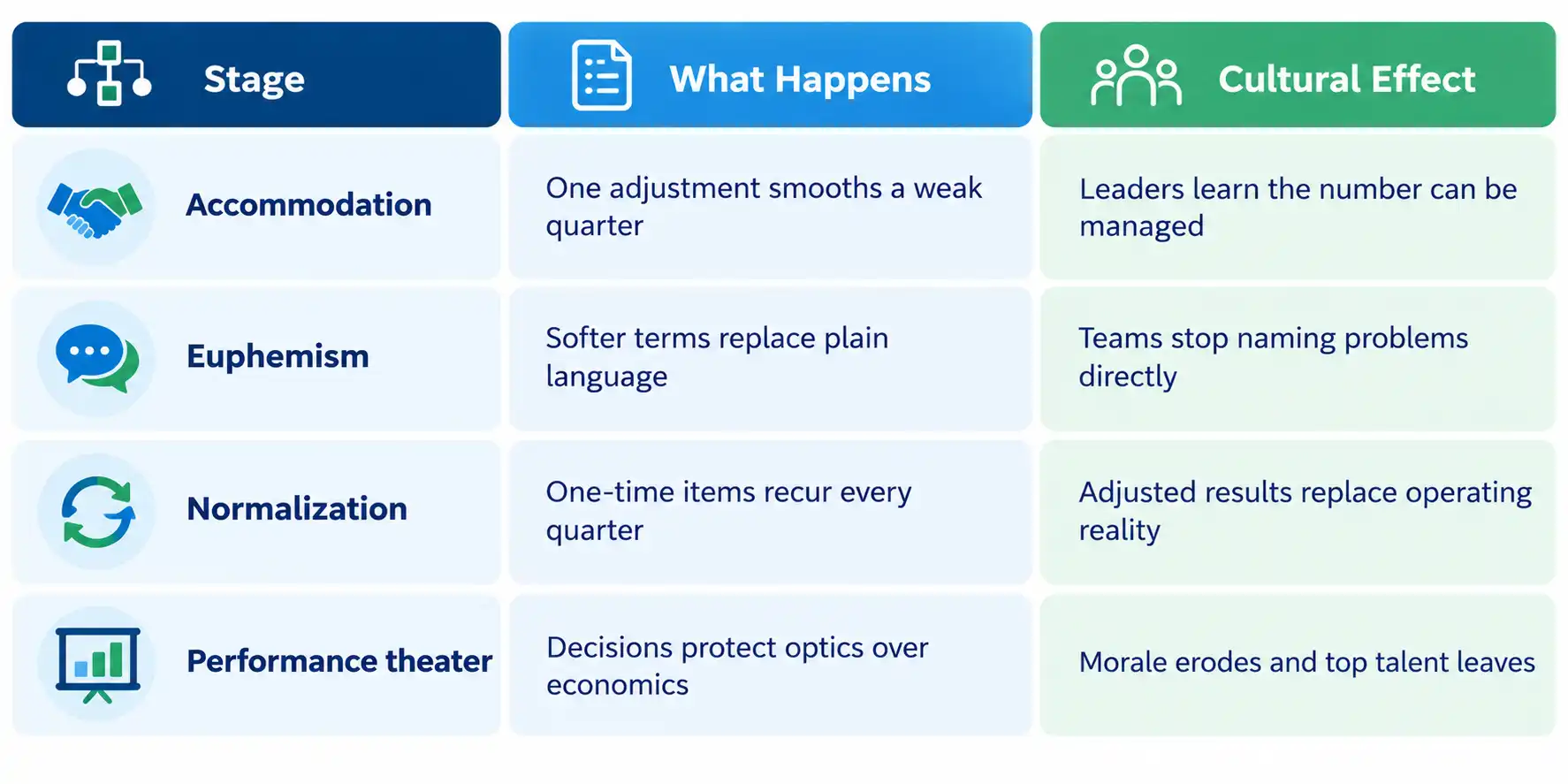
No culture collapses in a single moment, and the decline begins with something small. It might be an uncorrected accrual, a projection polished for the board, or a non-GAAP adjustment applied “just this once.” The danger lies in normalization, because bent numbers rarely snap back.
This erosion comes from fatigue and pressure among sincere people who say they are smoothing, not lying. Language changes first: “missed” becomes “soft,” and “cut” becomes “rescope.” With each euphemism, the organization loses some of its ability to name things plainly.
Adjusted EBITDA shows this drift, as stock compensation, restructuring, and legal settlements get added back each quarter until one-time items become routine. Quality-of-earnings work on an IT services acquisition surfaced this pattern, where EBITDA adjustments revealed a gap between reported earnings and economic reality. Any capital allocation framework built on such numbers starts funding illusions.
The Four Stages of Financial Erosion
The way back requires reporting results cleanly, even when the market reacts badly. Companies that own a hard quarter often see their culture respond with strength, because people would rather work where truth is owned than where fictions are polished.
The CFO as the Conscience of Culture
The CFO sits at the hinge of hope and reality, asking whether a plan is real without dampening ambition. Organizations become what they repeat, they repeat what they measure, and they measure what the CFO allows to matter.
Elegant dashboards can still hide padded KPIs and normalized cash burn. The remedy starts with changing the culture of interpretation, holding sessions that ask whether the team trusts its numbers. At an early-stage email marketing technology company, honest reporting exposed the true cost structure, and monthly burn fell from $800K to $200K.
Financial integrity is the foundation of courage, not a virtue of caution. A company that knows where it stands can be bold without becoming reckless. At their best, CFOs serve as witnesses, holding what is real so that others can build toward what is next.
Three Key Takeaways
- A capital allocation framework is a cultural document as much as a financial one, so explain every major funding decision openly, including trade-offs and the timeline for revisiting deferred requests.
- Forecasts and incentives teach people what the firm values, so reward accuracy over optimism and keep compensation simple enough that every participant can explain it.
- Financial erosion starts with small accommodations and euphemisms, so treat recurring adjustments as warning signs and report hard quarters cleanly to protect long-term trust.
Disclaimer: This article is intended for informational purposes only and does not constitute legal, tax, or accounting advice. Readers should consult their own tax advisor or counsel for advice tailored to their specific situation.
Hindol Datta is a four-time CFO and senior finance executive with over 25 years of leadership experience across cybersecurity, SaaS, gaming, logistics, digital marketing, medical devices, consumer products, and nonprofit organizations. He has led more than $120M in fundraising and over $150M in M&A transactions while building the financial and operational systems that let complex businesses scale with confidence. He is the author of seven books in the Systems CFO Series and holds active CPA, CMA, and CIA credentials.
AI-assisted insights, supplemented by 25 years of finance leadership experience.



