
Executive Summary
Capital allocation reveals more about executive leadership than any mission statement or brand campaign. Every funding decision embeds beliefs about time, risk, and value, even when leaders frame it in the neutral language of returns and payback periods. The pattern of those choices, viewed over several years, becomes a portrait of what the company truly values.
The sections ahead examine capital allocation through five lenses, starting with the worldview hidden inside financial models and the politics that shape the portfolio. They then cover how allocation frameworks drive behavior, why mature leaders fund what may not work, and how integrity guides every dollar. Together they show why the CFO must act as an interpreter of capital and not only its guardian.
The Worldview Hidden in Capital Allocation Models
Many finance teams treat the allocation process as the one place where objectivity rules. Hurdle rates and return profiles appear to judge every project by the same fair logic. Behind every model, however, sits a worldview that leaders rarely state and seldom examine.
How Models Treat Time and Risk
The treatment of time offers the clearest example of this hidden worldview. A model that asks how quickly an initiative will pay back assumes that near-term certainty is the highest proof of value. Many firms overweight short-term returns because distant outcomes feel ambiguous, and that choice decides how much weight the future receives.
Risk carries similar hidden judgments within most spreadsheets. Models often present risk as volatility, a quantifiable ripple that analysts can compute with ease. Yet the operational risks of keeping the status quo rarely receive the same attention as the financial risks of transformation. The safer path then wins, not because it is safer in truth, but because the model never confronted the cost of inaction.
Hidden Biases in Capital Allocation Models
| Model Element | Hidden Assumption | Question the CFO Should Ask |
| Payback period | Near-term returns matter most | What value appears only after year three? |
| Risk as volatility | Only computable risks count | What does inaction cost the business? |
| Hurdle rate | Today’s cost of capital fits every project | Which exploratory ideas never reach review? |
| Preserved capital | Holding cash shows discipline | Is caution masking indecision? |
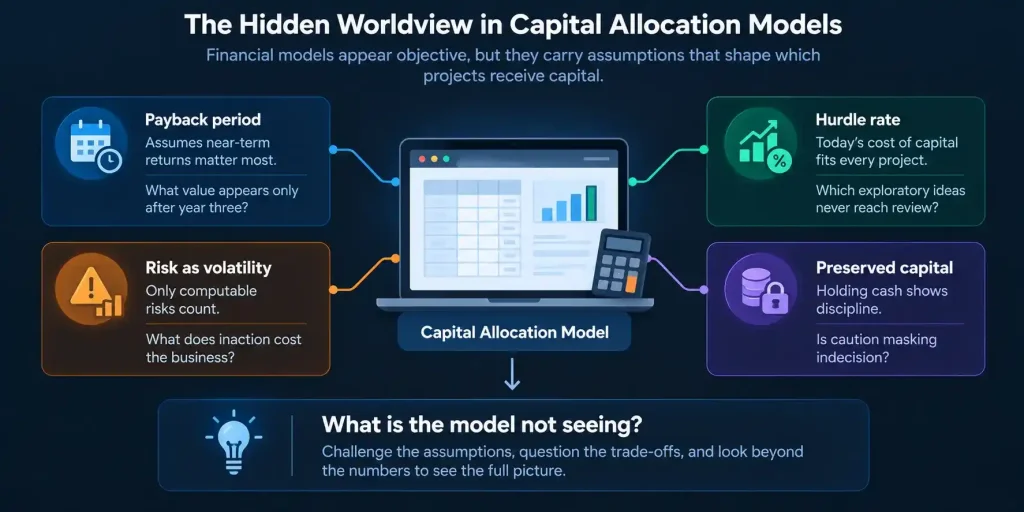
The CFO must act as an interrogator of the model instead of its servant. Sound capital allocation means asking which assumptions slipped in unnoticed and which timelines received undue weight. It also means noticing which cultural or human risks never entered the math. Value is not always visible in the first year, and good executive leadership accepts a meaningful risk instead of avoiding every risk.
Politics, Language, and Power in the Portfolio
The most dangerous myth in capital allocation is that reason alone decides who receives funding. Every CFO who has spent time in the boardroom knows that analysis tells only half the story. The other half reflects power, which gathers in hierarchies, relationships, and the pull of prestige.
Why Words Shape Funding Outcomes
Language often decides which initiatives live and which fade away. One team describes its project as strategic acceleration, while another team, no less bold, calls its work still experimental. A request framed around shareholder alignment signals safety, while one framed around long-term experimentation sounds abstract. The first proposal secures funding, and the second waits on hold despite comparable substance.
Politics is not corrosive by nature, since it follows naturally from choice under scarcity. Allowing it to operate without reflection, however, abandons a core duty of executive leadership. The CFO can serve as an editor of the process by listening to how each proposal lands, not only to what it says. Practical steps that restore balance include the following:
- Invite quieter initiatives into the center of portfolio discussions
- Ask senior leaders to restate pitches without jargon so reviewers judge mechanics, not polish
- Track which departments receive ongoing support and which must justify themselves repeatedly
- Require each major request to note how sponsorship and influence shaped its path
These steps create a portfolio that is aware of its politics instead of blind to them. Each dollar spent acts as a vote for a project and for a way of deciding. Over time, those votes signal to the organization what matters and who must ask permission before imagining too much.
A venture-backed digital marketing company that raised $36.5M across three funding rounds offers a useful reference. Leadership there grew revenue from $9M to $180M in 24 months and completed three acquisitions along the way. Disciplined analysis of CAC, LTV, and contribution margin gave each funding debate a shared factual base instead of a contest of voices.
How Capital Allocation Frameworks Shape Behavior
Elegant systems tend to persist long after the conditions that created them have vanished. Capital allocation frameworks follow this pattern, as tidy processes that appear to discipline decisions slowly become the shape of organizational ambition. Structure governs imagination as much as it governs efficiency.
Hurdle Rates, Zero-Based Budgets, and Annual Cycles
Each common capital allocation framework carries side effects that leaders seldom intend. A fixed annual cycle makes any urgent initiative awkward to propose. A rolling forecast may still bend toward quarterly constraints, and rigid pitch formats can quietly predetermine which ideas succeed.
Allocation Frameworks and the Behaviors They Create
| Framework | Intended Benefit | Unintended Behavior | Possible Redesign |
| Hurdle rates | Consistent return standard | Excludes exploratory, long-horizon projects | Scenario ranges and learning milestones |
| Zero-based budgeting | Fresh justification each year | Penalizes continuity in long-cycle investments | Multi-year commitments with checkpoints |
| Fixed annual cycle | Orderly planning rhythm | Discourages urgent or emerging ideas | Monthly working sessions and open intake |
| Rigid ROI targets | Clear accountability | Rewards small, safe proposals | Capital as a vote of confidence in a thesis |
The portfolio then drifts toward safety disguised as discipline. Over time, the boldest thinking stops reaching the table. Executive leadership must therefore ask what behavior the structure rewards and which thinkers have stopped applying. Sometimes the fix is a new rhythm, such as replacing annual pitch days with continuous dialogue. In other cases, it means modeling learning curves alongside returns.
A cybersecurity and identity SaaS company with roughly $30M in ARR shows the value of structure built for adaptation. A driver-based forecasting engine and capacity model kept actuals within plus or minus five percent of forecast for 8 consecutive quarters. That reliability gave leaders the confidence to adjust investment pace as conditions changed instead of waiting for the next annual cycle.
Funding What May Not Work
Most companies praise the idea of failing fast, yet few tolerate real failure when it touches quarterly results or reputations. A leadership team that funds only what will work manages a portfolio of probabilities instead of potential. Mature capital allocation must learn to withstand failure and learn from it.
Protecting Teams and Tracking Learning
Prudence still matters in this kind of funding decision. Finance must test risks thoroughly, forecast with discipline, and make failure points visible before committing. After that rigor, the question shifts from whether the idea will work to whether it deserves a try even if it falls short.
The modern organization often punishes visible failure in quiet ways. Leaders whose bets miss are seldom penalized openly, yet their judgment becomes a concern and their next proposals attract extra scrutiny. The CFO can act as a cultural counterweight by protecting these teams and running blameless postmortems. Trusting a team with its next idea also matters, because that team now understands what the model missed.
The strongest capital allocators build systems that make thoughtful failure survivable. They track learning as rigorously as return and hold reserves for strategic incompleteness, meaning projects that are worthy but still forming.
An early-stage email marketing SaaS company shows the other side of this balance. A financial turnaround there reduced monthly burn from $800K to $200K, which extended runway while keeping core product investment alive. Disciplined restraint in one area created room for measured bets in another.
The Capital Ethic in Executive Leadership
Some funding decisions turn on character instead of math. The model may satisfy every financial test, yet leaders must still ask whether the allocation reflects what the company claims to value. Capital becomes a public expression of private values, and a firm’s spending pattern over time forms its true autobiography.
When the Numbers Are Not Enough
Consider a proposed expansion of a high-margin partnership with a firm known for poor labor practices. The synergies may be real and the returns attractive, yet funding the deal would contradict public commitments. In such moments, executive leadership requires naming what the model omits, calmly and without moralizing. Capital acts as a megaphone, announcing to employees and customers what kind of company leaders are willing to build.
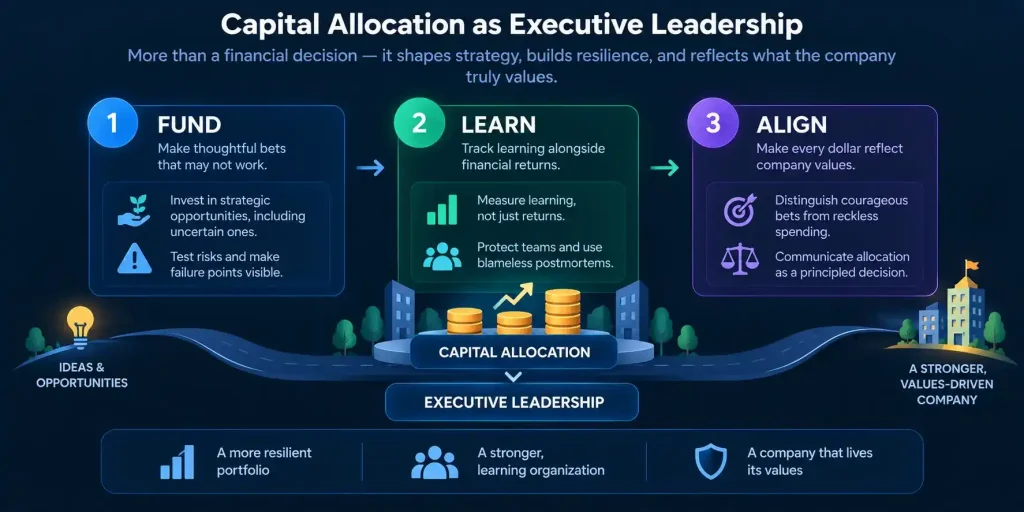
This capital ethic applies across the whole portfolio, not only to visible investments. The ethic shapes several recurring capital allocation decisions across the business:
- Incentives that reward managers who steward capital thoughtfully, even when outcomes take time
- Funding for underinvested units, internal tools, and programs that support morale
- Clear distinctions between reckless spending and courageous bets
- Communication that presents allocation choices as principled decisions instead of apologies
A mission-driven education and research institution in Silicon Valley offers a relevant example. Finance leadership there helped raise $37M and built multi-year models under variable funding conditions while reporting to a board and audit committee. Each allocation had to balance financial sustainability with the mission that donors and staff trusted the institution to protect.
Principled capital allocation does not mean perfect results. Every company will fund some projects that fail and decline others that later succeed. Over time, however, the pattern of those choices becomes the legacy of executive leadership and reveals more than any vision statement.
Three Key Takeaways
- Capital allocation models carry hidden assumptions about time and risk. The CFO must interrogate each model instead of treating its output as neutral truth.
- Politics, language, and framework design shape funding outcomes, and executive leadership must redesign those structures so promising ideas reach the table on merit.
- Mature allocators fund thoughtful bets that may fail and protect the teams behind them. They also ensure every dollar reflects the values the company claims in public.
Disclaimer: This article is intended for informational purposes only and does not constitute legal, tax, or accounting advice. You should consult your own tax advisor or counsel for advice tailored to your specific situation.
Hindol Datta is a four-time CFO and senior finance executive with over 25 years of leadership experience across cybersecurity, SaaS, gaming, logistics, digital marketing, medical devices, consumer products, and nonprofit organizations. He has led more than $120M in fundraising and over $150M in M&A transactions while building the financial and operational systems that let complex businesses scale with confidence. He is the author of seven books in the Systems CFO Series and holds active CPA, CMA, and CIA credentials.
AI-assisted insights, supplemented by 25 years of finance leadership experience.



