
Executive Summary
Capital allocation is not a spreadsheet exercise. It is the operating system that decides whether a growing company scales with intention or drifts into expensive inefficiency. This article draws on more than two decades of finance leadership across cybersecurity, SaaS, gaming, logistics, digital marketing, medical devices, and nonprofit organizations. It treats capital allocation as a discipline of design rather than denial. The discipline begins with the earliest funding decisions of a young company. It grows into the portfolio level thinking required at later stages of growth. The article also studies how finance leaders say no to a proposal without losing trust. It draws on real patterns from capital raises, mergers, and turnaround work across multiple industries. The goal is simple. Capital should behave like a weapon, not a wall, and every CFO has the tools to make that true.
Why Capital Allocation Is Strategy, Not Bookkeeping
Capital does not move a business forward on its own. Choices do. Behind every dollar deployed sits a quiet matrix of assumptions, tradeoffs, and unwritten rules. Together they decide whether an organization compounds its progress or stalls in polished inefficiency. I have spent more than twenty five years in finance leadership across a wide range of sectors. They include cybersecurity, software as a service, digital marketing, gaming, logistics, medical devices, and nonprofit education. Across all of it, I have come to see capital allocation differently. It is not a control function. It is an organizing principle for execution.
Every growth stage company eventually meets the same morning after problem. The environment that once rewarded experimentation begins to demand precision. Investors celebrate the freedom to explore, yet operating capital rewards the discipline to converge. Early in my career, while leading a budgeting process for a rapidly scaling organization, I believed deeply in decentralization. Every department received flexible funding tied loosely to strategic themes. What followed was not chaos. It was something quieter and more dangerous, a kind of entropy. No single team broke a rule, yet collectively the organization optimized for nothing in particular.
That experience made something clear that I had only sensed before. Capital allocation is strategy. It is not an output of planning, it is the architecture on which execution either rises or falls. Finance, in that light, is not an enforcer. It is a designer, building the scaffolding that makes the right decision easy and the wrong one visible.
This idea echoes strongly through the work of Kaplan and Norton in The Balanced Scorecard. Their work shows how financial, customer, process, and learning metrics must align with operating priorities. Their deeper insight, often overlooked, is that strategic alignment requires resource alignment. Fund sales growth without funding support, and churn quietly erodes the gain. Invest in innovation without investing in enablement, and feature fatigue follows close behind.
The Discipline of Saying No
Saying no is uncomfortable. Finance often dresses the word in softer language such as tightening the forecast or rebalancing the portfolio. Teams still hear it as loss. A lesson I carried from an early mentor was that a denied budget feels personal unless the system behind the choice is explained. So I began narrating capital. Every no was paired with a why, framed not as an absolute but as an opportunity cost. Choosing to expand a sales team in one region meant delaying a technology overhaul elsewhere. Teams stopped lobbying for line items and started building capital narratives instead, which changed the tone of every planning conversation that followed.
What Is Capital Allocation, Really
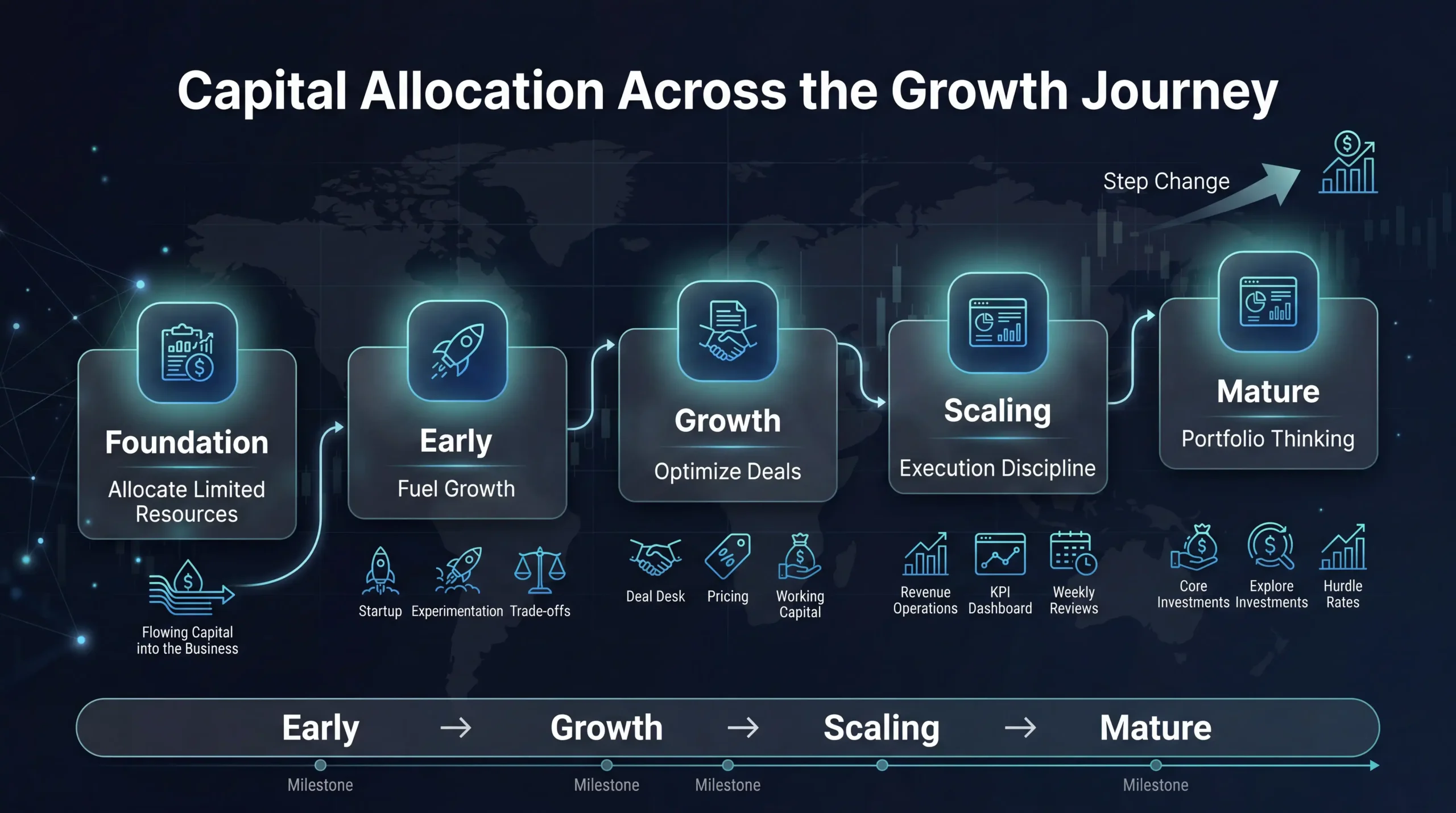
At its simplest, capital allocation is the practice of deciding where a company’s limited financial resources will do the most good, and just as importantly, where they will wait. It is not only about how much money moves. It is about sequencing, timing, and the discipline to protect optionality for the decisions that matter most. Having led fundraising efforts exceeding one hundred and twenty million dollars and overseen mergers and acquisitions surpassing one hundred and fifty million dollars, I have watched the same pattern repeat across sectors as different as gaming and medical devices. The dollar amount rarely determines the outcome. The clarity of the decision behind it does.
This also raises a practical question every finance leader eventually has to answer for their own organization: what capital can you allocate today without compromising the flexibility you will need tomorrow? Answering that question well requires more than a model. It requires a philosophy of enablement that treats access to capital as something curated rather than universal.
From Fuel to Leverage Across the Growth Journey
Companies grow in phases of punctuated equilibrium rather than in a straight line, and capital allocation is often the quiet pulse that defines each transition. In the earliest stage, capital behaves like fuel, applied broadly to generate velocity. As the organization matures, capital shifts toward leverage, focused tightly on scaling what already works while protecting the core from self inflicted complexity.
Early Stage: Introducing the Language of Tradeoffs
In a young company, budgets barely exist and founders spend from conviction. The most useful thing a finance leader can do here is introduce the language of tradeoffs before spreadsheets ever enter the room. The questions matter more than the numbers. What will this decision unlock. Where will it create a constraint. And if it turns out to be wrong, what will the organization learn from it. In one early stage engagement, tying engineering resourcing to usage thresholds avoided a costly overbuild entirely. The team did not underinvest. It sequenced.
Growth Stage: The Deal Desk as Capital Arbiter
As revenue models stabilize, many organizations stand up a deal desk, and too often it begins life as a reactive function, little more than a form checker or margin enforcer. A deal desk built well becomes a capital arbiter instead. Every deal is a capital event. Discounting is a cash flow deferral and a valuation lever, payment terms shape working capital, and commit lengths drive retention predictability. In my own work leading revenue operations and deal desk functions for a fast growing cybersecurity and identity services organization, tagging deals by region, product mix, discount type, and cycle duration created a scoring model that predicted which deals were likely to convert into durable, high quality revenue. Sales leaders came to see finance as a coach rather than a gatekeeper.
Scaling Stage: Revenue Operations as the Central Nervous System
Once an organization is scaling, the question shifts from whether it can grow to how efficiently it can grow. Revenue operations becomes the central nervous system of execution, tying pipeline hygiene, sales productivity, customer acquisition efficiency, and net retention directly into the capital model. Metrics alone are not enough without ritual. Weekly reviews where each metric owner presents the action behind the number, not just the number itself, reshape culture over time. Teams stop explaining variance and start owning velocity.
Mature Stage: Portfolio Thinking and the Step Change
At later stages, annual planning can no longer be an exercise in extrapolation. Capital markets expect a step change in performance, not simple continuation, which means every investment must be weighed in portfolio terms. Some initiatives belong in the core, others in the explore category, and each carries a different risk surface. Borrowing internal hurdle rates and investment memos from venture practice, much as one might apply to a logistics and wholesale operation moving one hundred and twenty million dollars through its supply chain, brings the same discipline that private capital markets demand into the internal planning process.
The Three Lenses of Capital Discipline
Cross functional capital reviews work best when every investment proposal passes through the same three lenses before a decision is made. Visualizing these lenses together, rather than debating them separately, allows product, marketing, and finance leaders to challenge their own roadmaps with a shared vocabulary.
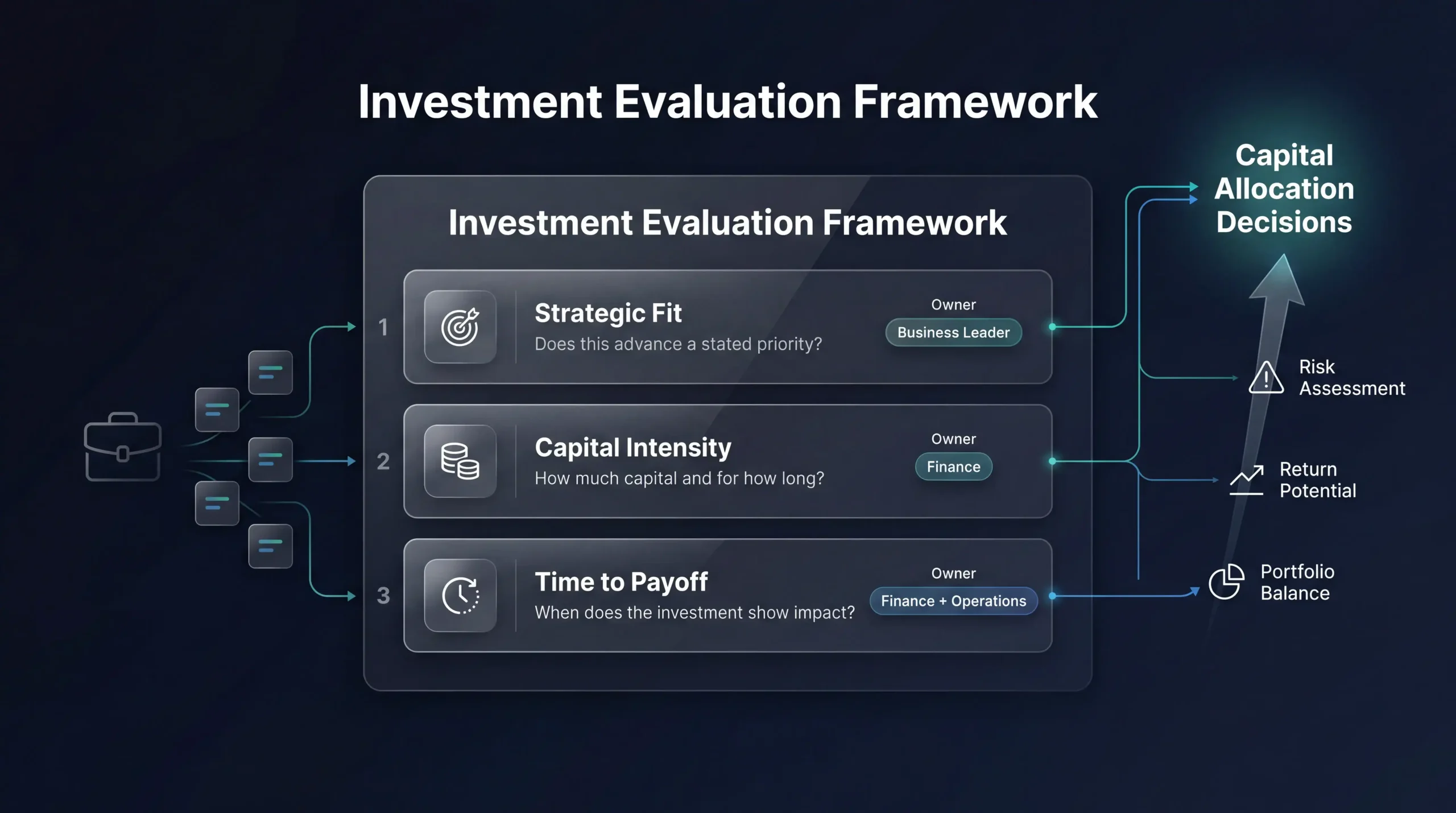
Designing alternatives matters as much as denying a request. When a market entry proposal did not clear the bar, redesigning it as a partnership strategy with deferred spend preserved the opportunity without the full capital exposure. When headcount expansion was declined in one region, investing instead in enablement programs improved productivity per existing employee. Finance works best as a creative constraint rather than a hard stop.
Saying No With Clarity, Not Just Constraint
The stakes of a misallocation rise as an organization scales, because a wrong bet now touches valuation, hiring runway, and strategic optionality all at once. In one planning cycle, a regional expansion pitch looked solid on historical growth alone, yet the capital lens revealed weak acquisition efficiency, elevated churn, and limited customer support in that geography. The expansion was declined, but the metrics that would change the answer were mapped out at the same time. Months later, new data justified a different decision. The discipline had not delayed growth. It had positioned it for the right moment.
This same pattern held true during a turnaround effort where reducing monthly burn from eight hundred thousand dollars to two hundred thousand dollars required saying no far more often than saying yes, yet the organization emerged with a stronger reporting foundation and a clearer sense of its own priorities.
Capital Choreography Across Sectors
Every sector moves to its own rhythm, yet the underlying choreography of capital allocation stays consistent. A gaming enterprise integrating more than one hundred million dollars in acquisitions faces different operational textures than a nonprofit education institution raising forty eight million dollars in growth capital, yet both require the same intentionality about sequencing, timing, and opportunity cost. Andy Grove argued that clarity in execution mattered more than exhaustive consensus, and capital under that model is not centrally optimized but contextually deployed. Jack Welch, by contrast, prized speed, believing that simple decisions executed quickly beat sophisticated ones delivered late. Both instincts have their place, and the best finance leaders learn to draw from each depending on the moment.
Systems thinking adds one more layer worth remembering. Every capital decision carries a feedback delay. A pricing change may not reveal its full effect on churn until the next renewal cycle, and a product investment may not show up as adoption until enablement and awareness catch up. Finance must anticipate that signal through simulation, lag analysis, and time series thinking, then teach the rest of the organization to see capital effects as waves rather than single points in time.
Conclusion
Capital allocation is ultimately an act of design. It is the discipline that decides whether a company scales with intention or drifts into complexity it did not choose. Across cybersecurity, software, gaming, logistics, medical devices, and nonprofit work, the same truth holds. The amount of capital deployed matters less than the clarity behind where it goes and where it deliberately does not. Saying no well requires empathy as much as logic, because every declined proposal represents a dream deferred rather than a door permanently closed. When finance narrates its choices instead of simply enforcing them, tradeoffs become a shared language rather than a source of friction. That shared language is what allows a growing organization to move with speed and coherence at the same time. Capital, handled with intention, becomes a quiet weapon in the hands of leaders willing to make the hard calls early and explain them clearly. That is the real work of capital allocation, and it never truly ends.
Disclaimer: This blog is intended for informational purposes only and does not constitute legal, tax, or accounting advice. You should consult your own tax advisor or counsel for advice tailored to your specific situation.
Hindol Datta is a seasoned finance executive with over 25 years of leadership experience across SaaS, cybersecurity, logistics, and digital marketing industries. He has served as CFO and VP of Finance in both public and private companies, leading $120M+ in fundraising and $150M+ in M&A transactions while driving predictive analytics and ERP transformations. Known for blending strategic foresight with operational discipline, he builds high-performing global finance organizations that enable scalable growth and data-driven decision-making.
AI-assisted insights, supplemented by 25 years of finance leadership experience.