
Executive Summary
A buy-and-build strategy promises to turn a fragmented market into a scaled platform. The harder truth is that value comes from orchestration rather than aggregation, and most platforms stumble in the gap between financial logic and operational absorption.
This article examines why fragmentation persists, how to read market ripeness and platform readiness, and how to execute after close. It ends with the quieter risk of success, when a growing platform starts losing its coherence.
Why a Buy-and-Build Strategy Needs More Than Capital
Nearly every buy-and-build thesis contains a moment of confident geometry. A bar chart shows EBITDA expanding through acquisition while a dotted line marks the synergies. Between that memo and the first milestone lies a trench filled with integration drift, talent dilution, margin erosion, and cultural entropy. Pursued without clarity, the strategy becomes less a path to value than an act of organizational indigestion.
The concept itself is sound, because fragmented industries carry redundant cost structures, inconsistent pricing power, and underleveraged assets. Financial architecture can look elegant while the operating system collapses under weight it was never built to carry. Timing therefore becomes a thesis, not an input, and execution becomes a strategy in its own right.
Reading Fragmentation Before Committing to a Buy-and-Build Strategy
Fragmentation looks like inefficiency at first glance, with dozens of subscale operators duplicating overhead and lacking bargaining power. Yet fragmentation is often a product of design, whether economic, regulatory, cultural, or temporal.
Accidental Versus Structural Fragmentation
Specialty healthcare clinics in the US remain fragmented despite years of private equity attention, often because trust-based patient acquisition and physician autonomy are embedded advantages. Professional services firms show a similar pattern, since culture, founder reputation, and client intimacy create friction against scale.
Any buy-and-build strategy must therefore separate structural fragmentation, where atomization supports performance, from accidental fragmentation caused by immaturity, capital limits, or talent bottlenecks. Accidental fragmentation tends to share three recognizable features:
- Operational redundancy: multiple firms doing the same work with no unique process architecture.
- Margin pressure: subscale operators unable to reinvest, price competitively, or retain talent.
- Underutilized assets: physical, technological, or human assets trapped in local optima.
Further Signals of Consolidation Readiness
Regulatory coherence and customer expectations add two more diagnostic axes. State-by-state licensing insulates incumbents, but harmonizing standards or cheaper digital reporting can signal softening barriers. When tech-enabled residential real estate platforms raised the bar for transparency, the logic of fragmentation weakened across that sector.
Industry readiness means little without firm readiness, and a common error is mistaking capital readiness for system readiness, since a balance sheet cannot replace scalable onboarding or unified data. Absorptive capacity, the ability to make sense of what is added, decides whether integration produces coherence or indigestion. Supplier and channel concentration can add leverage as volume consolidates, while digitized data from the periphery can turn scale into intelligence. These factors reduce to five practical diagnostic questions:
- Are unit economics and workflows standardizable?
- Is regulatory variance shrinking or growing?
- Are customer expectations converging across geographies or channels?
- Does the platform have the system memory to absorb difference?
- Can data flow from the periphery to the center in usable form?
Timing a Buy-and-Build Strategy: Market Ripeness and Platform Readiness
Timing in a buy-and-build strategy is a system constraint, not a calendar variable. Enter too early, and the firm becomes a laboratory for integration trauma. Arrive too late, and sellers have already priced synergies into every asset while differentiation has vanished. The skill lies in recognizing when the market’s arc and the firm’s arc align.
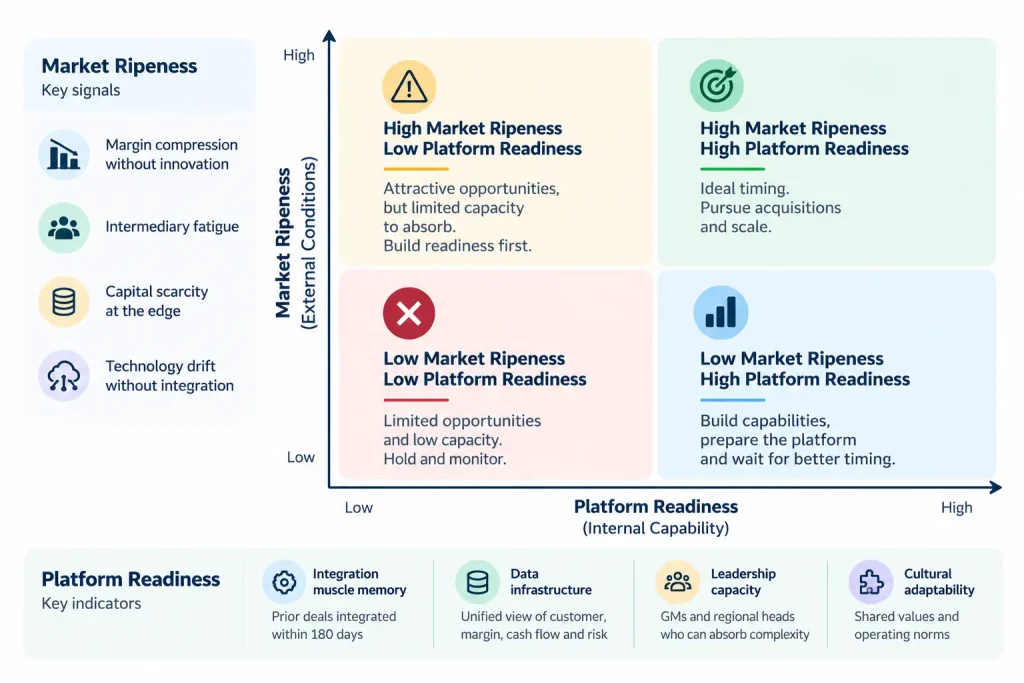
Four Signals of Market Ripeness
Fragmented markets reveal readiness through a recognizable rhythm, and misreading it leads to overreach. Four external signals deserve close attention from acquirers:
- Margin compression without innovation: small players lose margin but offer no new process or technology moat.
- Intermediary fatigue: distributors and brokers consolidate or retreat, leaving a platform room to rewire value flows.
- Capital scarcity at the edge: rising rates strip away founder loans and vendor credit, so operators welcome a partner with lifeboats.
- Technology drift without integration: point solutions create islands that a platform can connect into shared infrastructure.
Four Indicators of Platform Readiness
Internal readiness matters at least as much, because an acquirer that is not metabolically fit turns each deal into a burden instead of fuel. The four indicators below measure the platform’s systems bandwidth:
- Integration muscle memory: at least one prior deal aligned in brand, technology, compliance, and culture within 180 days.
- Data infrastructure coherence: a unified view of customer, margin, cash flow, and risk.
- Leadership surface area: GMs and regional heads who can absorb complexity without routing everything through the CEO and CFO.
- Cultural elasticity: alignment on what matters and freedom elsewhere.
Data coherence often decides the outcome, as a publicly listed gaming company with more than $100M in cross-border acquisitions learned. Its subsidiaries defined revenue differently until a firmwide Oracle Financials and MicroStrategy rollout gave leadership one definition across five countries.
Sequencing Through a Progressive Layering Model
Many buy-and-build strategies fail through misordered execution, not poor target selection. Firms acquire geographies before capabilities, integrate technology before people, or add headcount before standardizing process. The progressive layering model below trades early speed for an architecture that can scale.
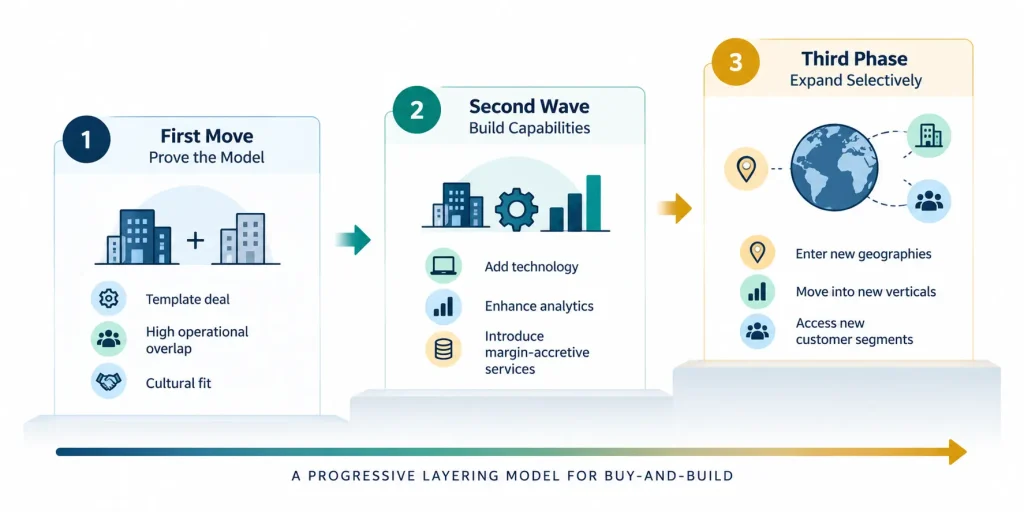
Pacing completes the timing picture, because organizations cannot grow faster than their ability to retain their own logic. A workable rhythm pulses deals quarterly, integrates monthly, and evaluates every half year. A venture-backed performance marketing company that scaled from $9M to $180M in 24 months completed three acquisitions inside that window. Its CAC, LTV, and contribution margin discipline kept each deal tied to unit economics.
Executing a Buy-and-Build Strategy as One System
Acquisition makes the headline, but execution writes the story. Most platforms fall prey to integration entropy, confusing visibility with control and standardization with coherence. Five execution vectors help turn separate businesses into one learning organism.
Process Modularity and Integration Interfaces
Standardizing everything is a common and costly instinct, because it erodes local capability and alienates acquired leaders. Modular standardization unifies only the processes that drive margin, compliance, or speed, such as billing, revenue recognition, and customer onboarding. A cybersecurity company operating across five countries standardized core finance on a single NetSuite implementation, cutting monthly close from 18 days to 10.
Integration works best as interface design, not org chart redesign. Each connection point, from data ingestion to escalation paths, needs a minimal and repeatable integration, much like an API. A logistics company acquiring a regional carrier might first require only shared fleet telemetry and unified incident reporting, leaving routing and shift management untouched.
Cultural Intelligence and Intelligence Loops
Culture is an embedded operating system of decision habits, time perception, and conflict resolution. Post-close cultural audits should map what teams fear, what they celebrate, and where they default under ambiguity. Archetypes such as builders, stabilizers, and explorers can match acquired teams to roles. Teams follow integration plans when they believe their story belongs in the larger narrative.
Feedback design is the most overlooked part of executing a buy-and-build strategy. Integration heatmaps and quarterly cross-unit retrospectives capture what each deal teaches. Over time the platform develops integration reflexes, and execution shifts from one-off heroics to institutional muscle.
Governance Architecture
Central teams that own every function tend to produce gridlock and talent exodus. Principled governance defines decision rights, risk thresholds, and escalation protocols, then lets local teams operate within that frame. The center acts as a conductor, measuring rigorously and intervening selectively instead of pulling every string.
Preserving Coherence in a Successful Buy-and-Build Strategy
The most insidious threat to a well-designed buy-and-build strategy is success, not early failure. Validated early deals breed a sense of inevitability as targets, capital, and markets reward acceleration. Coherence is never self-sustaining, because it depends on every manager knowing what the company is building and why. Silos of intent appear when that answer splinters.
Four Guardrails for Enduring Coherence
Once the platform matures, leadership must shift from growth to preserving directional fidelity. Four guardrails make that shift practical and measurable:
- Narrative discipline: each deal must answer what system capability it adds, beyond revenue.
- Governance constraint: centralize brand, compliance, and capital, but keep customer, labor, and product decisions local.
- Talent velocity: grow operators into integrators, since a platform without a leadership pipeline is a strategy awaiting a stall.
- Epistemic humility: watch for deals that succeed optically while exceptions multiply and decision latency rises.
Intentional reflection forums should ask what the platform must prune to preserve sense, not only what it can buy next. Some acquisitions are wedges, not building blocks, fitting for a season while deforming the system’s arc. Any buy-and-build strategy that lasts follows four principles: structure before scale, capability before capital, design before growth, and coherence above all.
Three Key Takeaways
- Diagnose fragmentation before building a buy-and-build strategy around it, because only accidental fragmentation rewards consolidation.
- Treat timing as the alignment of market ripeness with platform readiness. Prove integration on a template deal, then add capabilities before chasing volume.
- Execute through modular standards and principled governance, then guard coherence once success arrives. Platforms endure by pruning as carefully as they acquire.
Disclaimer: This article is intended for informational purposes only and does not constitute legal, tax, or accounting advice. You should consult your own tax advisor or counsel for advice tailored to your specific situation.
Hindol Datta is a four-time CFO and senior finance executive with over 25 years of leadership experience across cybersecurity, SaaS, gaming, logistics, digital marketing, medical devices, consumer products, and nonprofit organizations. He has led more than $120M in fundraising and over $150M in M&A transactions while building the financial and operational systems that let complex businesses scale with confidence. He is the author of seven books in the Systems CFO Series and holds active CPA, CMA, and CIA credentials.
AI-assisted insights, supplemented by 25 years of finance leadership experience.