
Executive Summary
Business model innovation often stalls at one familiar sentence: the cost structure will not support it. That reflex ends promising conversations before anyone tests whether a different cost structure could work. Cost simulations change the conversation by treating cost as design material instead of a fixed boundary.
The sections ahead cover five parts of business model innovation, starting with simulations as strategic tools and the challenge to inherited assumptions. They then address discovery-oriented models, wider participation, and leadership through ambiguity. Together they show how the CFO can use cost to shape the business model instead of simply defending it.
From Constraint to Canvas in Business Model Innovation
Every business model is a statement of belief about how the world works and where capital should go. The cost structure behind that belief reflects choices made visible through finance. Labor ratios, the SG&A profile, and the balance of fixed and variable costs all carry assumptions. When leaders never question those choices, they innovate around the edges of a structure they are afraid to disturb.
Using the Business Model Canvas as a Starting Point
The business model canvas offers a useful frame for this work. Its cost structure block sits alongside value propositions, channels, customer relationships, and revenue streams. Cost simulations bring that block to life by testing how changes in one part of the canvas ripple through the economics of the rest.
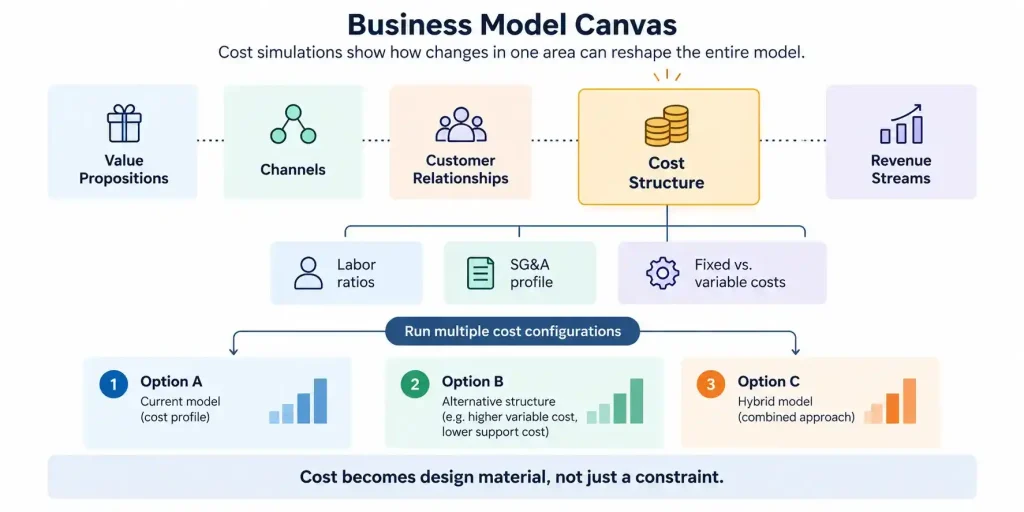
Too often, finance plays the realist who explains why the company cannot fund an idea. Over time, cost becomes code for refusal, and simulations become forensic tools that justify hesitation. Repositioned as instruments of design, they ask how else the business could work. They also ask what configuration might deliver the same outcome with a different anatomy.
Consider a distribution model that pushes complexity to the edge to keep the core simple. That shift raises front-line variable costs but may reduce churn and support load. Running several versions of the idea, each with a different cost profile, often reveals a hybrid that none of the original options described.
A $127M global consumer products company shows how cost choices reshape a model. Demand planning, SKU rationalization, and logistics optimization more than doubled inventory turns from 3x to 7x. The same company owned the logistics P&L across ocean freight, trucking, last-mile delivery, and warehousing. Each cost choice therefore changed how the model served customers.
Challenging Inherited Assumptions Through Simulation
Every company carries quiet beliefs about where value comes from and what it must cost. They live in model footnotes and in phrases about how things have always worked. Many once rested on sound analysis, yet they harden into doctrine because nobody challenges them.
Inverting the Sacred Truths
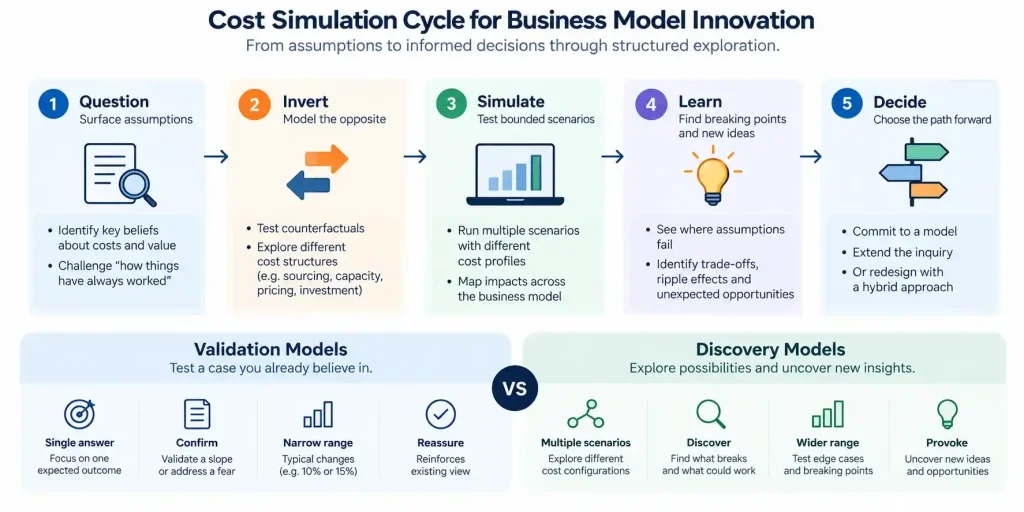
One effective method for business model innovation is to take a core assumption and model its opposite. The most useful inversions often include shifts like these:
- Sourcing: outsourcing low-variance components instead of insourcing everything
- Capacity: labor that flexes with seasonal demand instead of fixed year-round capacity
- Pricing: a flat-rate or tiered subscription instead of pure usage-based pricing
- Investment: staged commitments tied to proven demand instead of front-loaded spending
Many counterfactuals look absurd at first, yet some expose a real blind spot. Modeling a flat-rate option in a usage-based business might reveal that long-tail customers cost more to meter than they generate. That insight could lead to a hybrid tiering approach, not because the inversion won, but because it raised a better question.
A cybersecurity SaaS company with roughly $30M in ARR illustrates the value of rethinking fixed and variable costs. Optimizing the mix of full-time employees and subcontractors kept bench utilization under five to seven percent during rapid growth. Gross margin also improved by twelve percent through pricing discipline, workforce composition, and delivery cost management.
Designing Simulations for Discovery
Most simulations aim to validate a case that leaders have already embraced. They test a slope, confirm a fear, and answer questions whose terms are already set. Business model innovation needs models built to provoke instead of reassure.
Designing the Edges
Discovery-oriented models, mapped against the business model canvas, show where a system breaks, not just what happens at 10% or 15% change. They reveal where diseconomies turn into failure and where assumptions flip from asset to liability. A digital business opening physical stores, for example, should model whether store traffic might cannibalize online sales instead of adding to them.
Validation Models Versus Discovery Models
| Dimension | Validation Model | Discovery Model |
| Purpose | Confirm a decision already favored | Explore what the business could become |
| Timing | After teams commit emotionally | Before beliefs harden |
| Structure | Clean, linear, and polished | Modular, with nonlinear interactions |
| Inputs | Narrow ranges around the plan | Bounded ranges plus qualitative triggers |
| Output | A single answer | Better questions and breaking points |
Discovery models stay disciplined in their inputs yet generous in their configurations. Modular templates let teams toggle assumptions in real time, and probabilistic outcomes replace single points. Qualitative factors such as customer fatigue can also sit alongside cost curves. A model that confirms what leaders already believe is an expense, while one that surprises them becomes an asset.
Widening Who Shapes Business Model Innovation
Every company keeps an unwritten ledger of influence that records whose ideas are heard and whose doubts carry weight. Over time, the same voices present the same kinds of cases, and radical ideas from the margins die in draft. Simulations can disturb that pattern, because a strong model shifts attention from who asked the question to what the answer shows.
Access as a Governance Choice
A simulation acts as a sandbox where unproven ideas can play without committing capital or reputation. A junior analyst with no positional power can change the direction of a business unit by modeling a cost path nobody else saw. Timing matters too, since simulations shape ideas before anyone becomes emotionally invested in the outcome.
The CFO can widen this access by inviting simulations from across the organization and reviewing early scenarios for insight instead of polish. Key governance questions include who gets the tools, who gets time to experiment, and who receives cover when a model runs against the grain. When rigor becomes widely available, the best idea wins because it has the clearest shape, not the strongest champion.
Leading Through Ambiguity
Serious simulations eventually reach a point where the numbers blur and outcomes shift with every assumption. Real business model innovation begins in ambiguity, not clarity. Finance leaders must learn to stay in that uncertainty with discipline, demanding rigor without forcing premature certainty.
Holding Space for Emerging Models
The easy move is to declare a decision and close the loop. The harder and often wiser move is to extend the inquiry while the model is still teaching the company something. An adjacent model with erratic early economics may reflect a new logic in which customer intimacy outweighs scale. In that model, margins may be smaller but stickier.
Early experience building an HR technology venture from conception through launch shows why this patience matters. That work covered market research, product design, technology selection, and go-to-market strategy across the full product lifecycle. It gave firsthand insight into how new business models take shape long before their economics settle.
The Cost Simulation Cycle for Business Model Innovation
| Question | Invert | Simulate | Learn | Decide |
| Surface the assumptions behind the model | Model the opposite of core beliefs | Run several bounded scenarios | Identify breaking points and new ideas | Commit, extend inquiry, or redesign |
Discipline still matters in business model innovation, and every simulation must carry clear assumptions and risk bounds. Yet the most dangerous model is not the one that breaks; it is the one that never changes. Used well, cost simulations invite a company to imagine its business model again.
Three Key Takeaways
- Business model innovation accelerates when cost simulations act as design tools instead of ending conversations. They test the cost structure block of the business model canvas against every other block.
- Inverting inherited assumptions and building discovery-oriented models reveal blind spots and breaking points that validation models hide.
- Widening access to simulation and holding space for ambiguous early results lets better ideas emerge from anywhere in the organization.
Disclaimer: This article is intended for informational purposes only and does not constitute legal, tax, or accounting advice. You should consult your own tax advisor or counsel for advice tailored to your specific situation.
Hindol Datta is a four-time CFO and senior finance executive with over 25 years of leadership experience across cybersecurity, SaaS, gaming, logistics, digital marketing, medical devices, consumer products, and nonprofit organizations. He has led more than $120M in fundraising and over $150M in M&A transactions while building the financial and operational systems that let complex businesses scale with confidence. He is the author of seven books in the Systems CFO Series and holds active CPA, CMA, and CIA credentials.
AI-assisted insights, supplemented by 25 years of finance leadership experience.



