
Executive Summary
Business model innovation rarely fails because the underlying idea is weak. It fails when systems built around the old model quietly resist the new one. Each shift in how a company earns revenue, from licenses to subscriptions or products to services, is an economic question that belongs with the CFO.
The sections below explain why business model innovation meets resistance and offer a four-part framework for designing alternatives. They then cover how finance leaders manage the transition and build a lasting capacity for reinvention.
Why Business Model Innovation Is Hard and Why the CFO Must Lead It
On paper, a new model often looks compelling, with clean unit economics and enthusiastic early customers. Then implementation begins, and metrics break down, incentives misalign, and cash flows turn lumpy. The board starts asking uncomfortable questions, and the organization drifts back toward the familiar model.
What looks like a creative failure is usually a failure of economic integration. The CEO sets the vision and sales engages the market, but only the CFO sees where the company earns margin and where capital sits idle. Business model innovation lives or dies on the strength of that financial scaffolding.
Legacy Infrastructure Built to Protect the Current Model
Every established model builds its own support system of processes, compensation plans, and accounting policies. A shift from perpetual licensing to subscription, for example, triggers several changes at once:
- Revenue recognition moves from upfront to ratable over the contract term.
- Working capital tightens as large upfront payments disappear.
- Sales compensation must reward recurring value instead of one-time bookings.
- Churn becomes a first-order financial risk, not just a service metric.
A recurring model also demands a sound ASC 606 revenue recognition framework and board-grade reporting, since both must hold up under investor and acquirer scrutiny.
The Emotional Weight of Model Change
People become fluent in the model they know and learn how to win inside it. Even seasoned executives can carry quiet bias toward the model that made them successful.
For this reason, the CFO role in business model innovation extends into cultural leadership, framing the change as strategic evolution and not a rejection of past success.
Investor Optics and the Trap of the Partial Pivot
Investors do not always reward transition, because early phases often look worse on traditional metrics. Revenue may slow and margins may compress, so the CFO has to narrate each milestone with grounded confidence.
Many companies also stall halfway, carrying the burden of two parallel models with the benefit of neither. A clear transition path, with a firm date for sunsetting the old model, protects the economics of the new one.
A Framework for Evaluating and Designing New Business Models
Effective business model innovation calls for structured imagination, not open-ended ideation. The central question is which alternative would generate more value per unit of input while protecting strategic advantage. The goal may be revenue, resilience, scalability, or control, and the CFO reverse-engineers the architecture needed to deliver it.
A practical approach breaks any business model into four components, shown in the framework below.
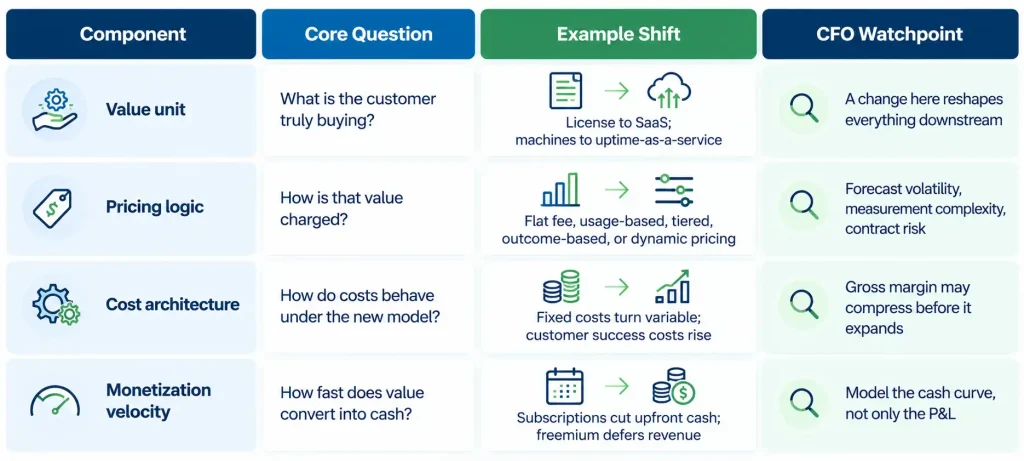
Monetization velocity deserves close attention, since liquidity is not strategy but it is survival. Faster inventory turns, shorter billing cycles, and upfront annual contracts all release working capital that a slower model would trap. In any business model innovation effort, the cash curve matters as much as lifetime value.
Scenario Models and Hidden Assumptions
Once the four components take shape, the CFO can build sensitivity matrices instead of simple best and worst cases, testing questions such as these:
- How does a 10% change in churn affect customer lifetime value?
- How resilient is the model under sustained gross margin compression?
- What happens to cash conversion if customer acquisition costs rise 20%?
These models work as decision devices, not predictions. Each also rests on assumptions about customer behavior and competitive response, such as the conversion rate a freemium tier depends on. Cohort and unit economics models earn investor trust when every assumption stays explicit and open to challenge.
Strategic Fit and Sequencing
The model must also fit strategic posture, since a firm pursuing defensibility may favor higher switching costs while a firm chasing scale may prioritize low acquisition costs.
Sequencing matters as much as design, since no company needs to adopt a new model all at once. Pilots in isolated segments need clear hypotheses, defined success criteria, and a rigorous postmortem. With that discipline, finance becomes the enabler of business model innovation instead of its skeptic.
Operationalizing Business Model Innovation: Risk, Capital, and Confidence
Implementation is where business model innovation reveals its true character, as new processes go live while legacy systems keep running. The CFO’s first task is a phased roadmap with go or no-go thresholds for each phase.
| Phase | Primary Focus | Go or No-Go Gate |
| 1. Design and pilot | Hypotheses, pilot segment, baseline metrics | Pilot unit economics meet the agreed threshold |
| 2. Controlled expansion | Billing, customer success, new dashboards | Cohort retention and cash burn stay within plan |
| 3. Scale and migrate | Compensation redesign, investor guidance, customer migration | Runway absorbs a one-quarter ramp-up delay |
| 4. Sunset the legacy model | Retire old metrics, contracts, and systems | New model carries the majority of revenue |
Financial Readiness and Capital Allocation
New models often bring delayed monetization and higher working capital needs, so the CFO must model cash burn against triggers, such as a quarter of ramp-up lag or weaker early retention. Many business model innovation efforts fail because runway ends, not because the model was wrong. Disciplined burn reduction, where needed, buys the time a new model requires to prove itself.
Capital should then flow toward the functions that enable the new model, prioritized by dependency as well as ROI:
- Expanded customer success capacity
- A redesigned billing system
- Updated analytics and reporting
Metrics, Communication, and Behavior
Old performance measures will distort behavior under a new model. Sales incentives must shift from upfront bookings to recurring value, and customer success may now carry a revenue target.
Internal teams need honest numbers and named risks, while investor guidance should move from static projections to scenario ranges. Compensation plans and performance reviews must reflect the new metrics so that behavior follows strategy.
Throughout any business model innovation journey, weekly cohort dashboards and rolling forecasts help the CFO balance discipline with belief.
Making Business Model Innovation a Repeatable Capability
Innovating a business model once is bold, but doing it repeatedly with fluency is rare. Every model is temporary, whether it decays through new technology or erodes through commoditization. Durable enterprises treat business model innovation as a recurring capability, not a heroic act.
The starting point is portfolio thinking, where model bets spread across time and risk just as capital spreads across assets.
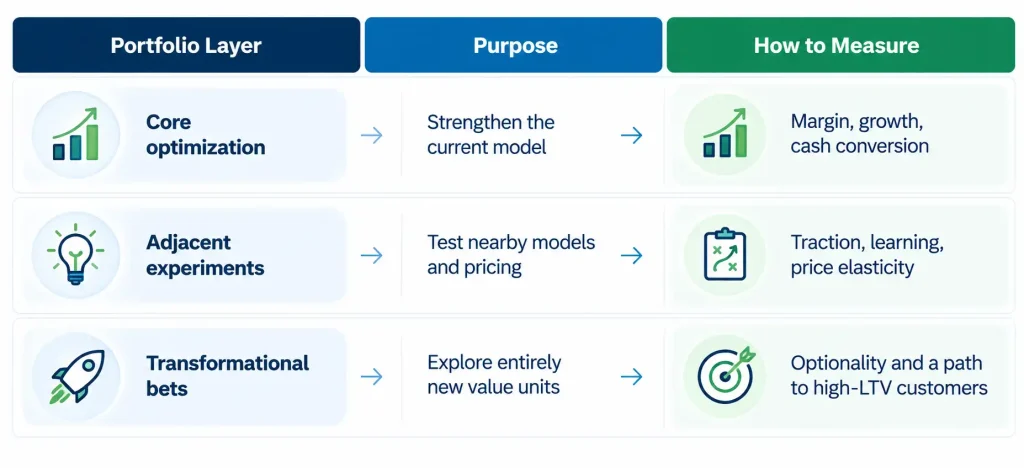
Experiments should not face core-business thresholds, yet they are never exempt from rigor.
Governance, Flexible Capital, and Culture
Readiness for business model innovation depends on decision architecture, such as sandboxed business units. The CFO acts as a pattern detector across experiments, making sure failure teaches instead of punishes. A supporting system typically includes the following elements:
- Pockets of flexible capital that can deploy mid-cycle, outside rigid annual plans
- Metrics that track learning and optionality, not only revenue
- Financial literacy across functions, so product managers grasp unit economics and engineers care about LTV
A single, unified definition of revenue across every business unit creates a shared economic language for debating new models. Above all, the CFO owns the narrative, explaining why a model is worth exploring and how leaders will judge success.
Three Key Takeaways
- Business model innovation fails most often at the point of economic integration, so the CFO must lead the redesign of systems, incentives, and investor narrative alongside the idea itself.
- Evaluating any new model through its value unit, pricing logic, cost architecture, and monetization velocity turns an appealing concept into a set of testable financial choices.
- Enduring companies treat business model innovation as a practiced capability, supported by portfolio thinking, flexible capital, and rituals that make reinvention routine.
Disclaimer: This article is intended for informational purposes only and does not constitute legal, tax, or accounting advice. You should consult your own tax advisor or counsel for advice tailored to your specific situation.
Hindol Datta is a four-time CFO and senior finance executive with over 25 years of leadership experience across cybersecurity, SaaS, gaming, logistics, digital marketing, medical devices, consumer products, and nonprofit organizations. He has led more than $120M in fundraising and over $150M in M&A transactions while building the financial and operational systems that let complex businesses scale with confidence. He is the author of seven books in the Systems CFO Series and holds active CPA, CMA, and CIA credentials.
AI-assisted insights, supplemented by 25 years of finance leadership experience.