
Executive Summary
Boards often view business expansion through add-on acquisitions as simple arithmetic, where one revenue line plus another equals a stronger company. In practice, a deal can add revenue while quietly eroding the capabilities that made the acquirer worth growing.
This article treats each add-on as a structural intervention and a test of any market expansion strategy. It covers true adjacency, the hidden cost of integration, sequencing that compounds, and coherence as an ethical obligation.
Why Business Expansion Through Add-Ons Often Fails
Used with clarity, an add-on is the sharpest tool in business expansion, though most acquirers wield it like a shovel. The model may pencil out, but cultural entropy, integration drag, and customer confusion can unravel more value than the deal creates.
With limited management bandwidth, every add-on is a structural intervention, and three questions should frame each target:
- Which load-bearing function in the business will the add-on support?
- How much stress will it introduce into existing processes and teams?
- Which new capabilities will it unlock at the core process level?
The best add-ons open customer segments, reduce go-to-market friction, unlock proprietary data, and introduce new margin structures. Deals that go sideways tend to show their symptoms early. Systems do not talk, and operators drift back to legacy methods within a week of Day One.
Strategic Adjacency as the Core of a Market Expansion Strategy
Private equity portfolios hold many add-ons that looked accretive and later drew regret, as cross-sell languished and integration slowed to a crawl. The usual cause is mistaking surface proximity, such as shared customers, for strategic adjacency, which lives in operating models, decision tempo, and culture.
Defining Strategic Adjacency as System-Level Fit
An add-on is strategically adjacent when it helps the core business do something better, faster, or more defensibly. Consider a B2B logistics company buying a fleet optimization startup with agile releases and flat governance. Set against the acquirer’s hierarchy and legacy ERP, that dissonance eclipses any synergy.
Now picture a specialty manufacturer buying a small R&D lab with advanced material science capability. The lab has little revenue and high fixed costs, yet it embeds proprietary innovation into core SKUs. That deal defends margin and preempts commodity pricing, enriching the existing market instead of expanding it. On a buy-side IT services acquisition, quality-of-earnings work and integration risk mapping revealed where reported earnings diverged from economic reality and where post-close risk sat.
Capability Mapping as the Acquisition Screen
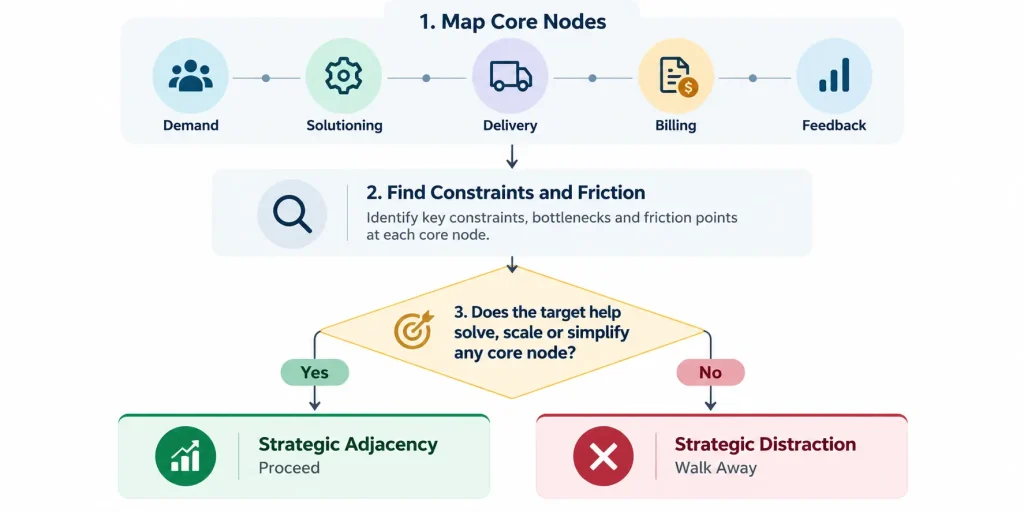
The first discipline in any market expansion strategy built on add-ons is to replace category match with systems resonance. The flow below tests a target against each core node.
Timing, Optionality, and Cultural Elasticity
An early-stage company that adds complexity too soon fractures its coherence. A mature company that waits too long ossifies, and the right add-on at the wrong time becomes the wrong add-on. In uncertain markets, value lies in optionality, so a small regional player bought for its permit structure can unlock company expansion that regulation would otherwise block.
Adjacency is also asymmetric, since rigid governance at the acquirer can choke the value the deal set out to capture. Cultural elasticity matters as much as technical complexity. The most fatal sentence in post-acquisition meetings is “That is not how we do things here,” and heard often, it becomes a prognosis. The acid test is whether the combined system grows smarter, more adaptive, and more resilient. If not, walk away, even at a discount.
The Hidden Cost of Integration in Company Expansion
Many finance teams treat integration as a back-office footnote. Anyone who has sat through weekly integration calls knows it is a transformation, with costs in cognitive load, culture, and decision friction.
Cognitive Load and Cultural Dissonance
Every add-on forces leadership to monitor a second risk environment and a second performance rhythm. Executive bandwidth, like RAM, is finite, and overload pushes management toward control instead of insight. Even a new time-tracking tool can create weeks of frontline micro-friction.
Culture, in operational terms, is the default way decisions get made. When one team expects top-down calls and another expects local discretion, meetings lengthen and trust decays. Eventually the higher-performing culture disengages, and the capability the deal targeted walks out the door.
The Limits of System Absorption
Every organization has a threshold beyond which added complexity degrades performance. A company that bolts on assets too quickly does not collapse; it plateaus, stuck between ambition and ability. Before approving any business expansion move, the prudent CFO asks whether the business can absorb it, not only afford it, by weighing four factors:
- Cultural elasticity: how adaptable the organization’s mindset is, beyond its structure.
- Governance bandwidth: whether management can absorb a new performance rhythm.
- Systems modularity: whether platforms extend easily or every new entity triggers a retrofit.
- Integration memory: whether past deals produced lessons or a pattern of expansion fatigue.
A publicly listed gaming company completing over $100M in cross-border acquisitions across five countries learned this firsthand. When each subsidiary defined revenue differently, a firmwide Oracle Financials and MicroStrategy rollout created one definition and shortened statutory reporting.
Pacing, Interface Insulation, and Post-Close Humility
Top operators stage changes in quarters, not months, with pause windows between major moves. Many also define clear interfaces that let the add-on run semi-independently until it earns fuller integration.
The first 180 days after close are for listening to asymmetry, not asserting control. Full integration needs an owner, a roadmap, milestones, and a narrative, because people tolerate uncertainty when they understand its arc.
Staging Add-Ons for Compound Business Expansion
Accumulation adds revenue and headcount without transforming the system, while compounding business expansion sequences add-ons so each amplifies the others. The starting question is what capability the business is building toward, such as owning the customer lifecycle or creating proprietary data loops.
A Buy-and-Build Sequence in Practice
Consider a healthcare compliance software firm strong in document auditability and real-time alerts. A typical playbook buys a financial services compliance player for revenue, while a compounding playbook follows the sequence below.
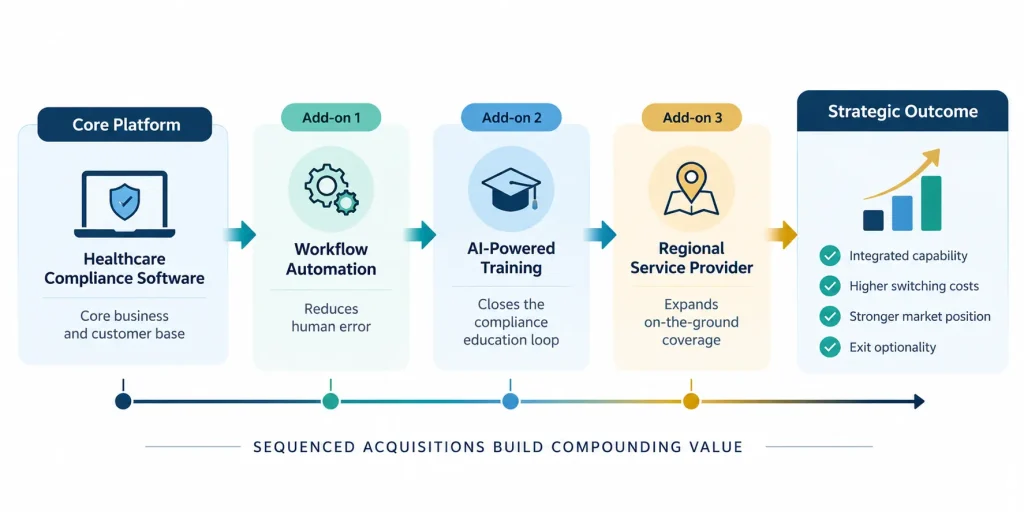
Without that patience and restraint, a reactive playbook produces a Frankenstein portfolio with functional limbs but no coherent gait. One venture-backed performance marketing company grew from $9M to $180M in 24 months while completing three acquisitions. Its CAC, LTV, and contribution margin discipline gave leadership a consistent lens for judging each deal.
Three Disciplines of Compounding Add-Ons
- Capability roadmapping: rate core functions by strategic fragility and target add-ons that reinforce thin spots. Fragile onboarding rules out new verticals, and brittle reporting rules out cross-border complexity.
- Strategic pacing: start with capability multipliers such as workflow automation or unified data structures. These small investments build the absorptive capacity that makes later integrations easier.
- Interface discipline: attach the value stream, not the whole organism. An analytics firm might keep a research boutique’s brand and culture while standardizing its data formats, forming a federated system like a coral reef.
Every add-on also needs a stated purpose, repeated until it becomes identity, and a CFO willing to resist the tyranny of quarterly optics.
The Ethics of Company Expansion: Coherence, Trust, and Truth
Growth starts to feel like drift when employees can no longer say what the company does best and customers hesitate over what they can count on. That is an ethical inflection point, because the company is outgrowing its coherence.
Coherence, Trust, and the CFO’s Burden
Coherence is the ability of the whole to make sense of its parts, and without it the platform becomes a portfolio. Trust erodes when leaders fail to explain why this target and why now, and fear fills the vacuum.
Capital is an ethical language, so the CFO carries a particular burden. Declining a seductive off-strategy target is strategic fidelity, and divesting an add-on that no longer fits is moral clarity. Leaders should share the integration burden with empathy instead of pushing it onto the smaller team. Temporal humility means refusing to mortgage future strategic plasticity for present optical growth.
Roles for the CFO, CEO, and Board
Sustainable business expansion means trading the roll-up metaphor for grafting, where new capability joins a living organism without damaging its vascular system. Each leadership role then shifts its posture in a specific way:
- CFO: A systems thinker who maps capability gaps and models integration bandwidth.
- CEO: A strategic choreographer who aligns each move with an evolving thesis.
- Board: A steward of identity, insisting on clarity of arc alongside growth.
Three Key Takeaways
- Build every market expansion strategy on systems resonance, not category match. If a target cannot help solve, scale, or simplify a core node, it is a distraction at any price.
- Ask whether the organization can absorb each step of company expansion, not only afford it. Pace integration in quarters, insulate interfaces, and run integration as a narrated product with a clear owner.
- Sequence add-ons as strategic architecture so each move clears the way for the next. Coherence, trust, and strategic truth are what let business expansion compound instead of drift.
Disclaimer: This article is intended for informational purposes only and does not constitute legal, tax, or accounting advice. You should consult your own tax advisor or counsel for advice tailored to your specific situation.
Hindol Datta is a four-time CFO and senior finance executive with over 25 years of leadership experience across cybersecurity, SaaS, gaming, logistics, digital marketing, medical devices, consumer products, and nonprofit organizations. He has led more than $120M in fundraising and over $150M in M&A transactions while building the financial and operational systems that let complex businesses scale with confidence. He is the author of seven books in the Systems CFO Series and holds active CPA, CMA, and CIA credentials.
AI-assisted insights, supplemented by 25 years of finance leadership experience.