
Executive Summary
The strength of the CFO and auditor relationship shapes how smoothly an audit unfolds and how much confidence a board places in the finance function. Candor from the first kickoff meeting reduces risk rather than creating it, and CFOs who own the audit timeline, rather than reacting to it, turn a compliance exercise into a strategic one. Clear issue tracking, mutual respect for the external auditor’s independence, and a willingness to engage analytically rather than defensively all contribute to a calmer, faster process. Across sectors as varied as cybersecurity, SaaS, gaming, logistics, and nonprofit organizations, the pattern holds steady. Audits succeed when CFOs build trust deliberately, share timelines rather than impose them, and treat findings as inputs for improvement. What boards ultimately read into an audit outcome is whether management shows discipline, transparency, and control.
Why Candor Sets the Tone
Having served as a CFO across cybersecurity, SaaS, gaming, logistics, digital marketing, medical devices, and nonprofit organizations, I have found that every successful audit begins the same way, with honesty about risks and open issues from the very first conversation. Whether the matter is an unreconciled accrual or a revenue recognition question, early disclosure allows the external auditor to plan fieldwork accurately instead of discovering surprises later. Growth introduces complexity, and auditors understand that. What they value most is a finance leader willing to name the gaps before being asked.
Own the Calendar, Then Make Room for Conversation
One of the most common sources of tension in an audit process is timing. Boards expect certainty, and auditors manage finite capacity across many engagements. The CFOs I have seen navigate this best start preparation months ahead of fiscal year end and build internal timelines with real buffers rather than optimistic assumptions.
Beyond scheduling, the strongest relationships are built through regular conversation, not just deliverables. Meeting with audit leads to walk through key estimates, asking for early readouts, and raising questions before they harden into issues all keep the process moving. During a finance transformation that reduced monthly burn from eight hundred thousand dollars to two hundred thousand dollars, that kind of proactive communication with external stakeholders proved just as important as the underlying numbers.
Track Issues With Discipline
Issues will surface in any audit, and how the finance team logs and resolves them says as much about its maturity as the resolution itself.
- Maintain a shared issue log visible to both the finance team and the auditors
- Assign clear owners and document resolution steps as they happen
- Flag timeline risks in real time rather than waiting for status meetings
In one organization, I led the finance function through a capital raise exceeding one hundred twenty million dollars, and this kind of visible, daily tracking did not just accelerate the audit. It made the entire process calmer for everyone involved.
Respect Independence, but Engage as a Peer
External auditors issue opinions, not mandates. The CFOs who add the most value know when to ask for reasoning rather than accept a finding at face value. I saw this firsthand during a period overseeing acquisitions exceeding one hundred million dollars in the gaming sector. Presenting well-documented alternative interpretations, backed by technical guidance, consistently led to stronger conclusions rather than weaker compromises. Auditors respond to thoughtful pushback with respect, not resistance, because it signals a management team that understands its own numbers.
What the Audit Really Tells the Board
Boards rarely ask only whether the audit passed. They want to know whether management responded quickly, followed process, and documented judgment along the way. Leading a forty-eight million dollar capital raise at a mission-driven education institution reinforced how closely investor confidence tracks with the discipline shown during financial reporting and audit season. A well-run audit communicates far more than a clean opinion. It communicates leadership.
Conclusion
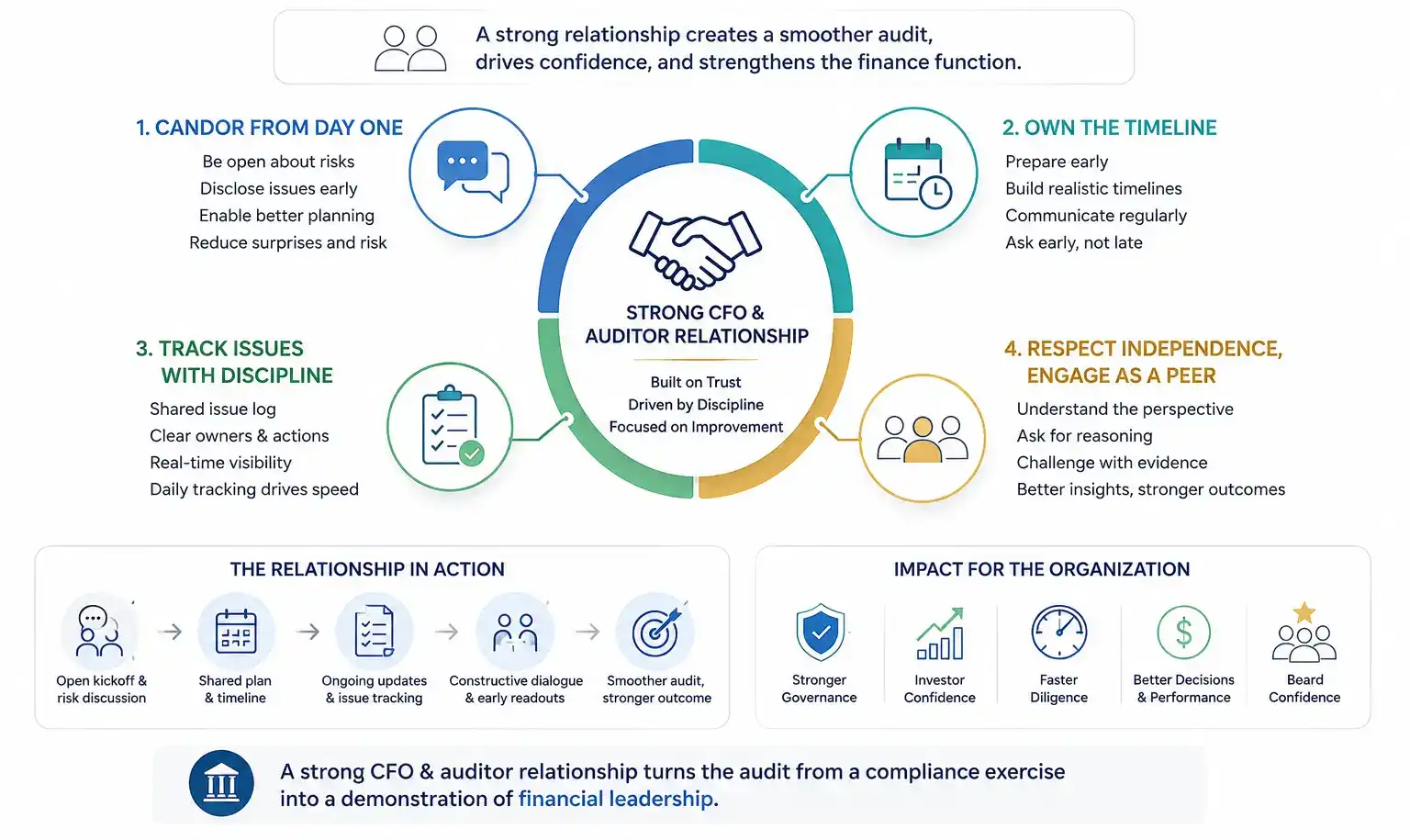
A strong CFO and auditor relationship is not an accident of good chemistry. It is the deliberate result of candor, shared ownership of the timeline, and disciplined issue tracking. Two parties with different but complementary responsibilities build this trust through mutual respect. The pattern remains consistent across cybersecurity, SaaS, logistics, gaming, and nonprofit organizations alike. Audits move faster and boards gain more confidence when CFOs treat the external auditor as a stakeholder rather than an obstacle. CFOs who invest in this relationship early transform the audit into a demonstration of financial leadership. They sustain it through open communication and thoughtful engagement. The findings that emerge are not failures to be managed defensively. They are inputs for continuous improvement. In the end, what a CFO is truly managing during an audit is not the auditor at all. It is the trust of the board, the investors, and the organization as a whole.
Disclaimer: This blog is intended for informational purposes only and does not constitute legal, tax, or accounting advice. You should consult your own tax advisor or counsel for advice tailored to your specific situation.
Hindol Datta is a seasoned finance executive with over 25 years of leadership experience across SaaS, cybersecurity, logistics, and digital marketing industries. He has served as CFO and VP of Finance in both public and private companies, leading $120M+ in fundraising and $150M+ in M&A transactions while driving predictive analytics and ERP transformations. Known for blending strategic foresight with operational discipline, he builds high-performing global finance organizations that enable scalable growth and data-driven decision-making.
AI-assisted insights, supplemented by 25 years of finance leadership experience.