
Executive Summary
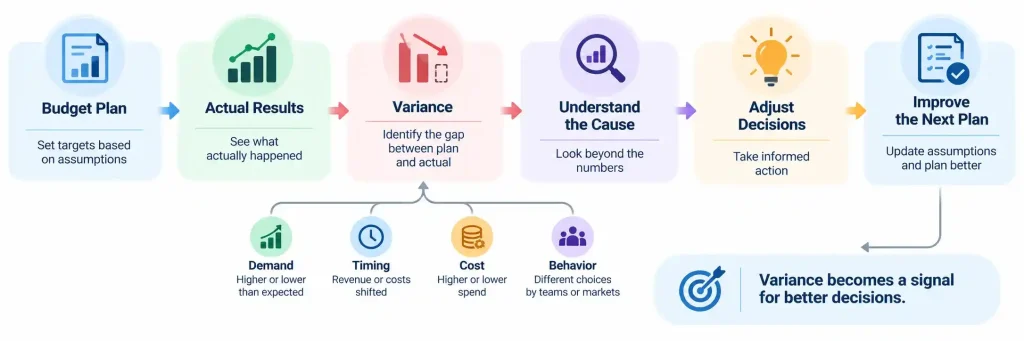
Many companies treat budget variance analysis as a monthly chore that ends with an apology and a promise to catch up. Yet the gap between plan and actual reveals how well a company understands its own assumptions. Every variance carries a message about demand, timing, cost, or behavior, and most organizations explain variances away instead of listening to them.
The sections ahead reframe variance analysis in budgeting as a strategic tool in five steps. They cover how variance exposes strategic drift and how to design systems that learn from deviation. They also address the emotional culture around misses and the role of variance in board dialogue. The final section covers rituals that make variance thinking a daily habit. Together they show the CFO as an interpreter of change, not an auditor of error.
What Budget Variance Analysis Reveals About Strategy
Every company runs on two strategies at once. The stated one lives in decks and town halls, while the lived one shows up in hiring choices, pricing approvals, and spending patterns. The monthly variance report exposes the gap between them better than any other document.
Spotting Strategic Drift
Consider a budget that plans modest sales hiring based on last quarter’s close rate. Three months later, hiring runs 40% over plan, mostly in sales operations and enablement, while pipeline falls short. The surface question is how to explain the overspend. The deeper question is whether the company has drifted toward a support-heavy model because it has lost confidence in sales effectiveness.
Strategic drift rarely begins with a single decision. It builds through small deviations that leaders rationalize each month but never resolve. Underspend deserves the same scrutiny as overspend in every review. An R&D budget that comes in $2M under plan might signal efficiency. It might also hide delayed innovation that costs far more in lost market opportunity later.
Effective variance analysis in budgeting separates two kinds of variance:
Technical Versus Behavioral Variance
| Dimension | Technical Variance | Behavioral Variance |
| Source | Timing shifts or model errors | Different choices by people or markets |
| Examples | Revenue recognized a month early, payroll moved by a holiday | Hiring slowed by doubt, a launch delayed, a new channel scaled |
| What it reveals | Mechanics of the model | Real priorities and beliefs inside the company |
| Best response | Correct the model or timing | Investigate the decision and revisit strategy |
Behavioral variance is the richest source of strategic intelligence. It shows where teams made different bets or where the market moved differently than expected. When finance reads variance as energy moving in unexpected directions, the budget becomes a hypothesis and the variance becomes the experiment talking back.
A professional services firm with five business units shows the value of this lens. Engagement-level profitability and utilization analytics, built from scratch, revealed where the business created margin and where it leaked. Those patterns explained variances that broad budget categories had hidden.
Designing Systems for Variance Analysis in Budgeting
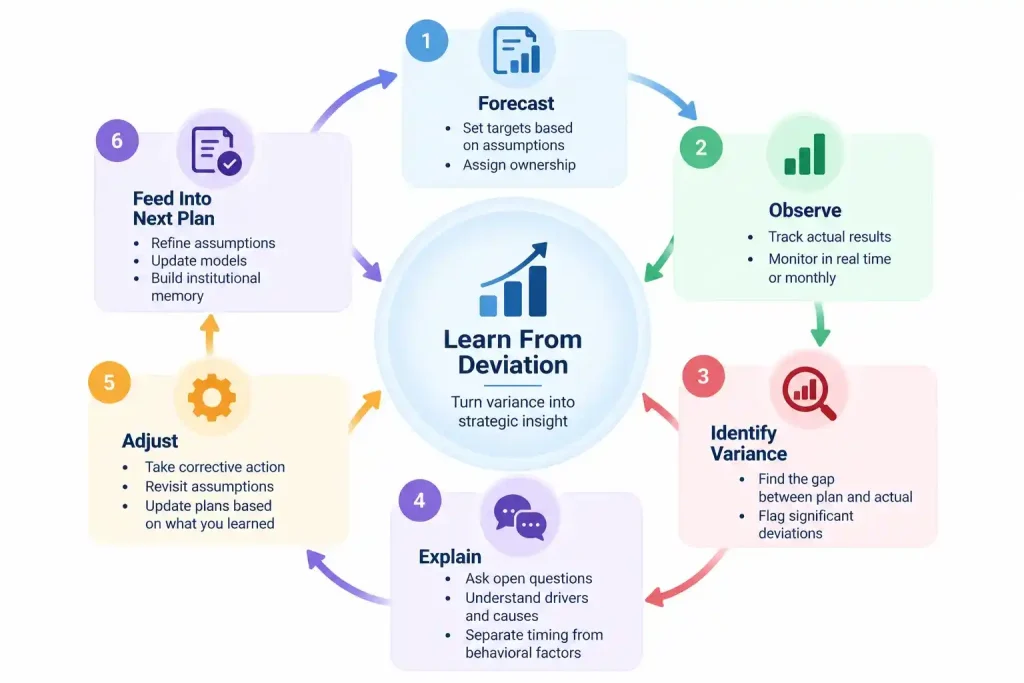
Most companies track variance the way a weather app tracks a cold front: they record it but do not expect to influence it. Companies that endure treat variance as useful feedback. They design a loop that runs from forecast to observation, deviation, explanation, and adjustment.
Variance Architecture
The loop works only if the budget has intellectual integrity. Each line should trace to a premise, such as unit cost, sales ramp, or retention. Someone who believes in that premise should own it. Without that ownership, variance becomes a difference between two fictions.
Several practices turn budget variance analysis into a learning system:
- Monthly variance conversations that start with open questions about surprises instead of red cells
- Assumption tagging that links each projection to a written premise, such as churn staying below 3.5% after a feature launch
- Confidence ranges that reflect how volatile each line is, so a 12% CAC miss reads differently against a 5% or 25% band
- Feedback into planning so that next year’s assumptions reflect what this year’s variances taught
Over time, this architecture builds institutional memory across teams. When the next forecast takes shape, someone recalls that a past ramp proved too optimistic or that enterprise onboarding took longer than expected. Imagine a company that builds its first serious variance loop during a growth year. The first months bring a variance story every month, but forecasts stabilize, hiring aligns with revenue timing, and spending shifts toward higher-yield cohorts.
A cybersecurity SaaS company with roughly $30M in ARR shows what disciplined variance loops can achieve. A driver-based forecasting engine, capacity model, and steady reporting cadence kept actuals within plus or minus five percent of forecast for 8 consecutive quarters. That consistency reflected a process that learned from each cycle.
The Emotional Culture Around Variance
A room changes when a large variance appears. Defenses rise, and the unspoken message is that someone failed. How a company responds in that moment determines whether anyone will forecast boldly again.
From Blame to Curiosity
In immature cultures, variance quickly becomes a weapon. Teams learn to sandbag, hedge, and underpromise, so accuracy turns into self-protection. In mature cultures, leaders meet variance with interpretive courage, stating what they expected, what happened, and what they learned.
Picture a CFO presenting customer acquisition costs 48% above plan. Instead of defending the number, the CFO explains a shift in lead mix and longer payback curves. The CFO also shows how an algorithm change hurt a key channel. The board leaves informed instead of angry, and trust grows.
Simple, repeatable habits help leaders sustain this tone. After each close, functional leaders can write a short note about what surprised them, which builds a shared library of insight. Accountability still matters when variance reflects poor judgment. The goal is to examine the decision without humiliating the person, so that honest accountability remains possible.
Using Budget Variance Analysis in Board Dialogue
Boards often treat variance as a test score: pass or fail. That framing wastes much of what variance can teach. At its best, variance maps how quickly and intelligently the company adapts.
Redefining Success
A strong CFO narrates adjustment instead of offering excuses. For example, the plan may have modeled $2.3M in pipeline conversion from channel partners, while actuals came in at $1.5M. That gap prompted a review of partner incentives and a shift toward direct outreach, where returns proved stronger.
A clean plan-versus-actual report is not always a sign of excellence. It may reflect overly cautious planning or too little experimentation. A quarter with meaningful variances, paired with clear causal explanation, can signal a company in close conversation with its own complexity.
A useful board format groups variances into three categories:
A Three-Part Variance Review for Boards
| Variance Type | What It Shows | Board Conversation |
| Anticipated and adjusted for | Foresight | Confirms that leading indicators worked |
| Missed and now being corrected | Adaptability | Reviews the corrective plan and timing |
| Not yet fully understood | Active inquiry | Invites the board to help interpret the signal |
The third category often proves most valuable, because it shows management pursuing understanding instead of bluffing certainty. Boards that hear variance framed this way begin to ask better questions, such as what a rise in CAC reveals about channel saturation. Shared definitions also strengthen this dialogue, as a Euronext Paris-listed gaming company with subsidiaries in five countries shows. A firmwide rollout of Oracle Financials and MicroStrategy created a single definition of revenue, which made variances comparable across borders.
Embedding Variance Thinking Into Daily Rhythm
A practice becomes a posture when people expect it instead of needing it explained. Embedding variance thinking means bringing it out of finance and into everyday decisions. The goal is a steady rhythm of reflection.
Rituals and Language
Monthly reviews form the core cadence, but lighter habits keep the practice alive between them. Teams can hold a short variance debrief in weekly staff meetings or log unexpected shifts in a shared document. A short post-close memo from each function can capture one surprise, one decision it prompted, and one open question.
Shared language matters as much as cadence for these rituals. Phrases borrowed from experimentation help teams discuss variance without shame. A team might note that reality diverged from an assumption and that the underlying pattern may have changed. A single line from a leader, stating that the review is about signal and not blame, can change the tone of a meeting.
When variance thinking becomes habit, the budget stops acting as a constraint and becomes a lens. Teams notice inflection points sooner, such as a channel scaling faster than expected or a customer behavior shifting before lagging indicators show it. Budget variance analysis, practiced this way, gives the company early detection instead of hindsight.
Three Key Takeaways
- Budget variance analysis reveals strategic drift when finance separates technical variance from behavioral variance and traces each gap to its cause.
- Variance analysis in budgeting works best as a designed loop with owned assumptions, confidence ranges, and feedback into the next plan.
- A culture of curiosity, a structured board narrative, and regular rituals turn variance from a monthly apology into a strategic tool.
Disclaimer: This article is intended for informational purposes only and does not constitute legal, tax, or accounting advice. You should consult your own tax advisor or counsel for advice tailored to your specific situation.
Hindol Datta is a four-time CFO and senior finance executive with over 25 years of leadership experience across cybersecurity, SaaS, gaming, logistics, digital marketing, medical devices, consumer products, and nonprofit organizations. He has led more than $120M in fundraising and over $150M in M&A transactions while building the financial and operational systems that let complex businesses scale with confidence. He is the author of seven books in the Systems CFO Series and holds active CPA, CMA, and CIA credentials.
AI-assisted insights, supplemented by 25 years of finance leadership experience.



