
Executive Summary
A branding framework is not a marketing artifact that finance tolerates during a downturn. It is the connective structure that determines whether cost reduction sharpens a company’s identity or quietly dismantles it. When budgets tighten, the instinct is often to treat every line item as interchangeable. A well-built branding framework forces a different question. What does this spend actually protect, and what would its absence signal to the market?
This article outlines how finance leaders can build a branding framework into the cost reduction process. Three levers determine whether financial discipline reinforces brand identity or erodes it: vendor decisions, subtraction strategy, and internal communication. Cost cuts do not need to be softer. It is sharper cuts. A framework guides them, treating brand equity as a balance sheet asset, not a marketing expense.
What a Branding Framework Protects During Cost Reduction
A brand is not the logo or the tagline. It is the accumulated trust a company has earned through every touchpoint. This spans a product unboxing, an earnings call, and the tone of an internal memo. None of these appear as discrete line items in a general ledger. Yet they represent some of the most valuable assets a company holds. A branding framework exists to make that value visible before a cost committee starts cutting.
Consider a high-growth cybersecurity and identity access management company generating roughly $30M in annual recurring revenue. The forecasting discipline that kept the business predictable also protected something less obvious: the board-grade reporting and controls environment that later carried the company through acquisition diligence. Holding actuals within five percent of forecast for eight consecutive quarters was a financial achievement, but it also sent a brand signal, telling investors, employees, and eventually an acquirer that they could trust the organization to say what it meant. A branding framework treats that kind of consistency as an asset worth defending, not a byproduct of good bookkeeping.
Turning Financial Discipline into a Branding Framework
Vendor Rationalization as a Brand Signal
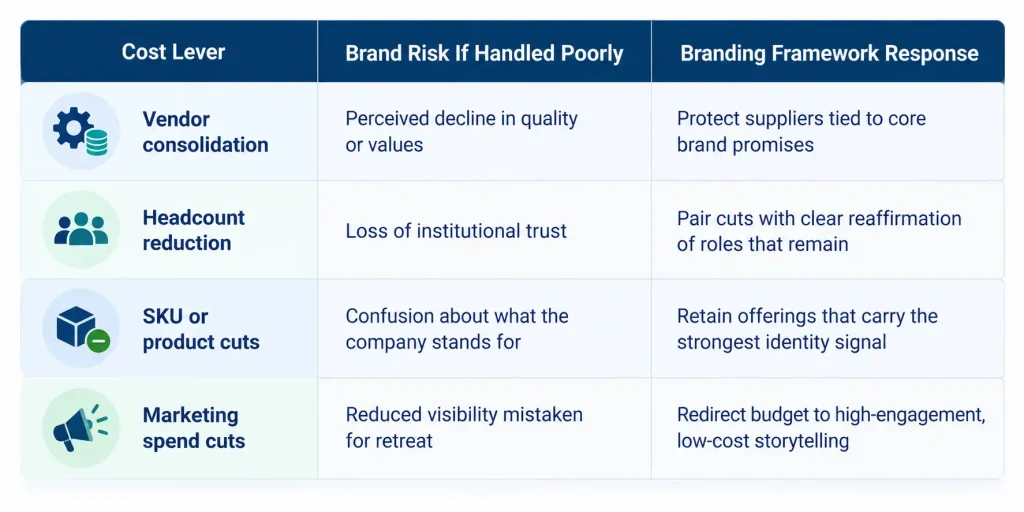
Vendor consolidation and spend rationalization often look like pure cost mechanics, but inside a branding framework they become declarations of value. A company that pays a premium for suppliers aligned with its stated principles, while cutting costlier convenience elsewhere, is telling the market something coherent about identity.
A $127M global consumer products company, operating direct-to-consumer, Amazon, and wholesale channels with a supply chain spanning China and Vietnam, demonstrates the same principle. Doubling inventory turns from three times to seven times, through demand planning and SKU rationalization, released trapped working capital and delivered four consecutive clean external audits. The rationalization targeted specific costs rather than cutting indiscriminately; it protected the SKUs and fulfillment standards that customers associated with reliability, while eliminating the excess that added cost without adding trust.
Strategic Subtraction Inside the Branding Framework
People frequently mistake subtraction for retreat, but within a disciplined branding framework it functions as clarification. A company that tries to be everything to everyone dilutes the very signal it is trying to send. The most effective cost reductions do not spread pain evenly across every initiative; they ask which functions most reflect the brand’s differentiation and protect those, even when the near-term revenue case is thin.
A venture-backed digital marketing organization that scaled from $9M to $180M in revenue within twenty-four months, while building its finance function from a single hire to a team of twelve, illustrates the same principle from the opposite direction: the metrics discipline built around customer acquisition cost, lifetime value, and contribution margin made clear which programs earned continued investment and which did not, long before a downturn ever forced the question. A branding framework built during growth becomes the same framework that guides subtraction during contraction.
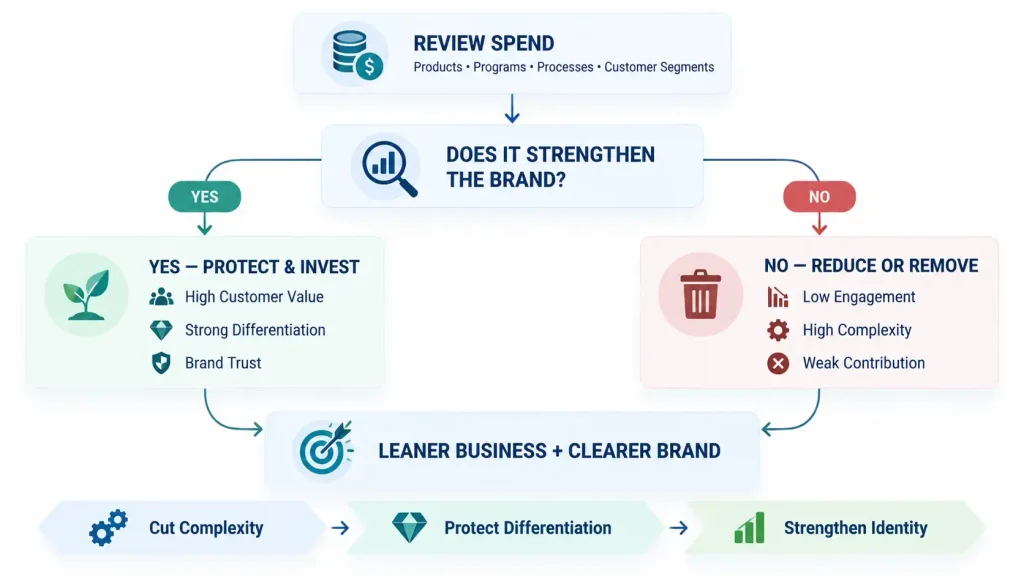
Common signs that a branding framework needs subtraction rather than addition include:
- Product lines or service tiers that consume disproportionate engineering or delivery effort relative to revenue contribution
- Marketing programs with declining engagement despite stable or rising spend
- Customer segments that require significant customization but generate limited brand advocacy
- Internal processes duplicated across regions or business units without a clear rationale
Communicating Cost Change Without Breaking the Branding Framework
The cost reduction itself rarely damages morale as much as the silence that follows it. A branding framework extends into how financial change is communicated, because employees, investors, and customers now read tone and intent as closely as they read numbers.
A mission-driven education and research institution that raised $37M in equity and venture debt required more than a capital structure; it required an investor narrative and board relationship that made the funding story legible under variable philanthropic and earned-revenue conditions. Naming what remains protected, rather than only what is being cut, turns a cost narrative from one of scarcity into one of stewardship. The same principle applied at a Euronext Paris-listed gaming and digital entertainment company operating across five countries, where consolidating financial reporting under a single Oracle Financials and MicroStrategy implementation gave every subsidiary, and every stakeholder reading the consolidated statements, one consistent definition of performance rather than five competing ones.
Effective communication inside a branding framework tends to follow the same pattern:
- Lead with context and purpose before presenting the specific cuts
- Name explicitly what is being preserved, not only what is being removed
- Invite questions about what was not cut, since that reveals priorities as clearly as the cuts themselves
- Tie the decision back to the company’s stated identity rather than treating it as an isolated financial event
Three Key Takeaways
- A branding framework treats brand equity as a measurable asset that cost decisions can either protect or erode, which means every reduction should be evaluated for its signal value, not only its dollar value.
- Subtraction, when guided by a clear branding framework, functions as clarification rather than retreat, and the discipline built during growth years, such as customer acquisition cost and contribution margin analysis, becomes the same tool that guides intelligent cuts during contraction.
- How a cost decision is communicated matters as much as the decision itself, and naming what remains protected within the branding framework turns a difficult announcement into a demonstration of stewardship rather than a signal of retreat.
Disclaimer: This article is intended for informational purposes only and does not constitute legal, tax, or accounting advice. You should consult your own tax advisor or counsel for advice tailored to your specific situation.
Hindol Datta is a four-time CFO and senior finance executive with over 25 years of leadership experience across cybersecurity, SaaS, gaming, logistics, digital marketing, medical devices, consumer products, and nonprofit organizations. He has led more than $120M in fundraising and over $150M in M&A transactions while building the financial and operational systems that let complex businesses scale with confidence. He is the author of seven books in the Systems CFO Series and holds active CPA, CMA, and CIA credentials.
AI-assisted insights, supplemented by 25 years of finance leadership experience.