
Executive Summary
Behavioral scoring gives credit management a sharper lens than bureau scores and balance sheets can offer alone. It reads how customers act on the way to paying, not only whether they paid. Payment cadence, dispute timing, and response to reminders form a signature that often flags B2B credit risk before any aging report does.
This article covers how behavioral data is captured, how it reshapes credit decisions, and how it fits inside collection workflows. It then turns to ethical boundaries and to what the practice asks of finance leadership. The goal is a credit function that sets terms with more precision and more fairness at once.
Why Credit Management Needs More Than Payment History
Credit has always been a wager on conduct, extended because a company believes the customer will honor the relationship. For decades, that belief rested on bureau reports, financial ratios, and fixed thresholds buried inside the ERP.
The spreadsheet records who paid, but it says nothing about why. Some late payers carry little danger, while some punctual payers hide real fragility.
Behavioral scoring closes this gap by watching the slope instead of the cliff. It tracks signals such as these:
- Payment cadence and tolerance for delay
- Timing, frequency, and tone of disputes
- Speed of response to reminders and nudges
- Frequency of early or partial payments
- Communication patterns during stressed periods
A client that always pays five days late, with steady rhythm and open communication, often carries less risk than one that pays on time and then goes silent. Behavior tells the real story, provided the finance team knows how to read it. This approach does not abandon rigor, because it treats trust as a continuum to manage, not a binary to enforce.
How Behavioral Data Becomes a Credit Signal
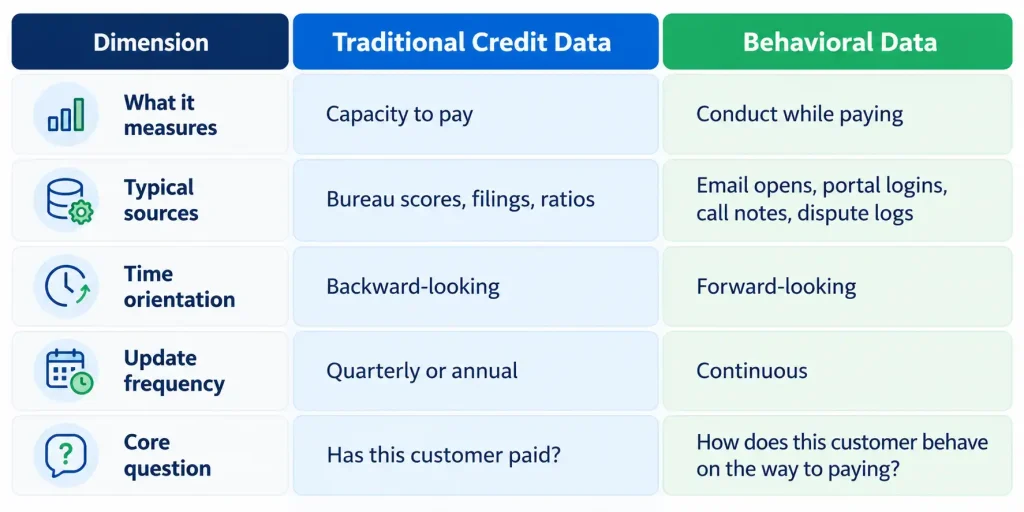
Accounts receivable is the most conversational ledger in finance, a living record of promises made, delayed, and renewed. Traditional credit data measures capacity, meaning whether a customer can pay. Behavioral data measures conduct, meaning how the customer treats its obligations along the way.
Reading the Customer Timeline
Capturing this signal means viewing each relationship as a timeline, not a single transaction. The first clue is whether the customer acknowledged the invoice or let it vanish into an AP queue. Later clues include clarifying questions, approval time, and whether a delay arrives with a phone call or with silence.
Across hundreds of customers, these gestures become the raw material of behavioral scoring. Machine learning models can cluster profiles such as chronic delayers who always pay, silent defaulters, and noisy but dependable negotiators. Risk does not disappear, but it finally becomes legible.
The Data Architecture Behind Behavioral Scoring
Most ERP and AR modules track payment status, not interaction. Behavioral scoring needs richer telemetry, gathered in one place where analysts can use it.
Traditional Credit Data Versus Behavioral Data
At a cybersecurity and identity access management company operating across 5 country entities, a unified NetSuite implementation compressed the monthly close from 18 days to 10. That gain came from one shared data structure, and behavioral models depend on the same discipline.
Behavioral scoring is attentiveness, not surveillance, and its purpose is to deepen relationships with trustworthy customers.
How Behavioral Scoring Changes Credit Decisions
Traditional credit policy runs on rigid conditionals and fixed thresholds. If revenue falls below one line and leverage rises above another, the answer is denial. These rules rarely fail from being wrong; they fail from being inflexible.
Behavioral scoring brings a probabilistic mindset to the credit desk. The question moves from whether a client has defaulted before to how likely default is over the next six months, measured against peers. A customer with weak financials but clean behavior may now rank below one with a strong balance sheet and erratic engagement.
From Gatekeeper Rules to a Layered Decision Model
Strong behavioral scoring programs never let the score replace judgment. The score becomes one layer that reorders the review queue:
- Customers with declining behavioral trends surface for earlier engagement
- Accounts with strong behavior but weak financials earn a second look before any credit hold
- Collections effort follows engagement probability, not aging alone
The Layered Credit Decision Flow
| Layer | Input | Decision Role |
| 1. Financial capacity | Bureau scores, filings, ratios | Sets the baseline credit limit |
| 2. Behavioral signal | Cadence, disputes, engagement | Adjusts priority and terms |
| 3. Human judgment | Analyst review and customer context | Confirms, overrides, or escalates |
| 4. Feedback loop | Outcomes and recorded overrides | Retrains thresholds and the model |
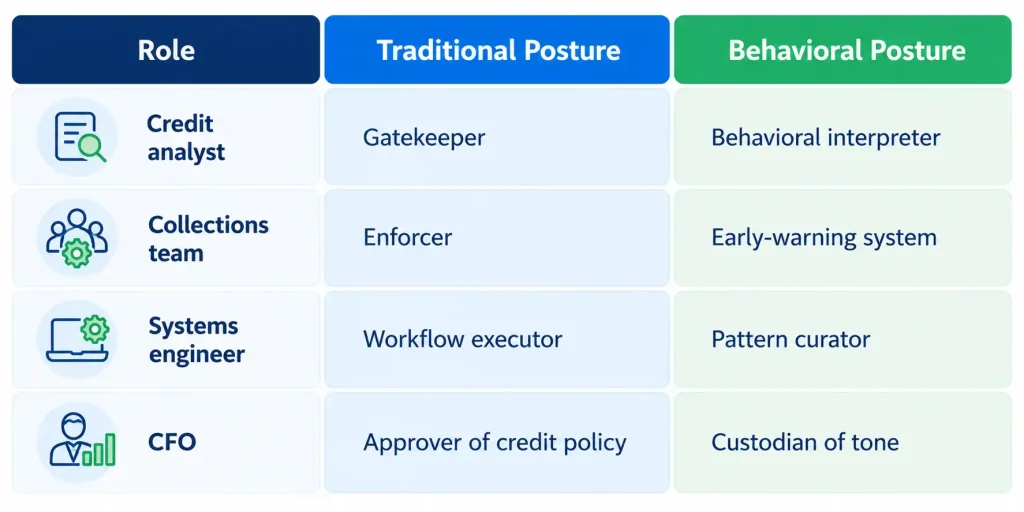
The CFO designs these protocols, deciding how to set thresholds, when to retrain models, and how to explain each decision to the board, the auditors, and the customer. Some outcomes will raise fairness questions, such as denying credit to a financially strong but unresponsive customer. The finance leader must defend the appropriateness of the score as well as its accuracy.
Embedding Behavioral Scoring in Collection Workflows
Fitting behavioral logic inside an ERP is harder than seeing it. Credit operations run on a transactional rhythm of invoice, due date, reminder, and escalation. Integrating behavioral scoring means changing how that architecture responds, not bolting a model on top.
Visibility, Interpretability, and Action
Three requirements decide whether the score earns its place in daily work:
- Visibility: the score sits next to aging buckets, DSO metrics, and the customer dashboard.
- Interpretability: a figure such as “Behavioral Risk Score: 63” needs its lineage, showing which pattern triggered the change.
- Differentiated workflows: the score routes effort by context, not by category.
Behavioral Score Workflow Triggers
| Behavioral Profile | Workflow Response |
| High risk | Route to senior collections staff earlier in the cycle |
| Declining but not yet delinquent | Proactive outreach or a preemptive adjustment of terms |
| Low risk with a temporary delay | Auto-approve a short extension |
| Stable and engaged | Standard cadence with a lighter touch |
A venture-backed digital marketing company that scaled revenue from $9M to $180M in 24 months offers a useful parallel. Its CAC, LTV, and contribution margin discipline held because the analytics lived inside daily operations. Behavioral scoring works the same way, or it does not work at all.
Adoption Is a Cultural Problem
Operational success depends less on model quality than on team confidence. Analysts who see the score as a black box will ignore it. Collections staff who feel threatened by new workflows will route around them.
Co-creation is the most durable answer to that resistance. Analysts should help build the model, collections managers should help define thresholds, and leadership should track cash flow and dispute volume. The collections script then moves away from blunt overdue notices toward a respectful question about what has changed in the customer’s payment pattern.
Ethics and Boundaries in Behavioral Credit Scoring
The line between attentiveness and intrusion is thin. Portal logins and sentiment trackers can compress months of intuition into one percentile. The larger danger is not error but indifference to the human reality behind each signal.
Behavioral scoring models can absorb bias without anyone noticing. They may penalize silence from less digitized geographies, misread assertive founders, or infer bad intent from a delay born of crisis. Four design principles guard against these failures:
- Transparency: every score should be explainable, with traceable inputs and visible assumptions.
- Feedback: customers and analysts need a path to challenge assessments, with governance over overrides.
- Grace: scores should decay over time, so one stressful quarter does not become a permanent penalty.
- Honesty about power: every decision should pass a simple test of whether the team would explain it face to face.
A model that never forgets becomes a model of punishment, one that remembers everything and understands nothing. The ledger is not a courtroom, and those choices belong to finance leaders, not to code.
Leading Credit Management in a Behavioral World
A behavioral model also signals how the company believes people should be understood, and that culture outlasts any cash it conserves.
How Behavioral Scoring Reshapes Finance Roles
At a $127M global consumer products company selling through DTC, Amazon, and wholesale channels, inventory turns rose from 3x to 7x once working capital signals drove early decisions. Receivables respond to the same discipline, since every day of delayed payment sits inside the cash conversion cycle.
Behavioral scoring, at its best, does not replace judgment but invites the finance team to use it well. Every score and every outreach leaves a memory, and those memories accumulate into reputation, the longest ledger any business keeps.
Three Key Takeaways
- Behavioral scoring measures how customers act on the way to paying, which makes it a forward-looking complement to bureau scores in B2B credit management.
- The score works best as one layer in the decision process, surfacing risk early while human judgment keeps authority over final credit decisions.
- Transparency, feedback, and score decay keep behavioral models fair, and no team should act on a signal it would hesitate to explain to the customer.
Disclaimer: This article is intended for informational purposes only and does not constitute legal, tax, or accounting advice. You should consult your own tax advisor or counsel for advice tailored to your specific situation.
Hindol Datta is a four-time CFO and senior finance executive with over 25 years of leadership experience across cybersecurity, SaaS, gaming, logistics, digital marketing, medical devices, consumer products, and nonprofit organizations. He has led more than $120M in fundraising and over $150M in M&A transactions while building the financial and operational systems that let complex businesses scale with confidence. He is the author of seven books in the Systems CFO Series and holds active CPA, CMA, and CIA credentials.
AI-assisted insights, supplemented by 25 years of finance leadership experience.



