
Executive Summary
Banking fraud detection systems set out to catch a narrow category of behavior. This includes falsified invoices, layered wire transfers, and account takeover. Across finance leadership roles spanning cybersecurity, consumer products, and mission-driven institutions, one pattern recurs. The same detection architecture is tuned for anomaly recognition. It now reads a far wider signal set than the fraud it originally targeted. Banks do not merely listen to what a borrower says. They watch accounts payable stretch, receivables age, and borrowing base headroom erode. Often, this happens weeks before leadership notices the pattern in its own numbers.
This article examines the gap between what a company’s financials say and what its bank already knows. It covers the metrics credit officers monitor alongside their banking fraud detection infrastructure. It also covers the blind spot that keeps executives from seeing their own deterioration. And it covers the discipline required to think like the institution on the other side of the table.
Understanding the Language of Financial Signals
Financial institutions do not just listen to what a company says; they watch what it signals. A confident management presentation carries weight, but the accounts payable aging report in front of a credit officer carries more. Fraud detection in banking relies on pattern recognition rather than narrative. That same probabilistic instinct helps banks detect deterioration early. Often, a leadership team has not yet decoded what happened in its own business.
This mismatch does not stem from mistrust. It stems from discipline. Credit officers, much like the fraud detection models sitting behind them, learn to read patterns that businesses routinely overlook. Day sales outstanding might creep from 52 days to 57. Vendor terms might stretch from net-30 to net-45 before accounts payable has voiced any concern internally. Liquidity does not vanish overnight. It decays quietly until the decay finally demands attention.
In one high-growth cybersecurity and identity access management engagement, the finance team held actuals within 5% of forecast. This consistency ran for 8 consecutive quarters straight. That consistency was built on watching the same working capital signals the lender was watching. The narrative a company tells and the picture its numbers present can quietly diverge. Credit risk blooms precisely inside that divergence.
The Metrics Banking Fraud Detection Systems Watch Most Closely
Every bank carries a different credit culture, but most share a common toolkit. That toolkit overlaps heavily with the analytics built for banking fraud detection. Both disciplines exist to recognize anomalies before they become losses.
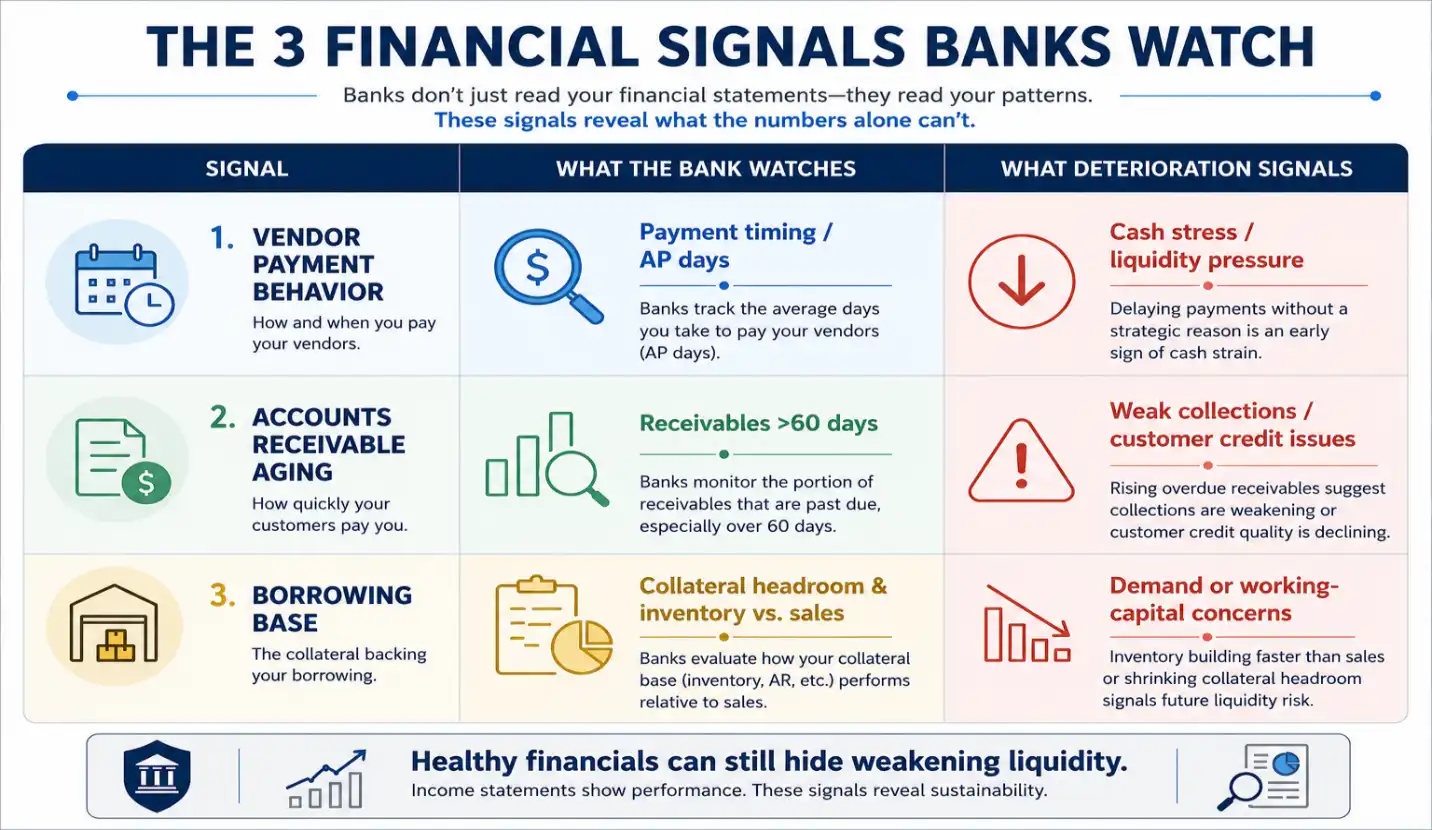
Vendor payment behavior
Delaying vendor payments without a strategic reason, such as a genuine shift in procurement policy, signals cash stress. This holds even when the income statement looks healthy. A well-packaged EBITDA figure cannot mask operational cash tightness. It only defers the question of where the liquidity is actually going.
Accounts receivable aging
When receivables beyond 60 days creep upward, banks assume either customer credit discipline is slipping or collections execution is weakening. In one engagement, a leadership team celebrated a record bookings quarter, yet AR aging revealed that new customers carried extended payment cycles that would pressure liquidity three months later. The bank had already seen the pattern before the company ran its own forecast.
Borrowing base reports
Banks track collateral headroom in context, and if inventory builds disproportionately to sales, they question demand planning. At a $127M global consumer products company, more than doubling inventory turns from 3x to 7x did more for the banking relationship than any quarterly narrative, because the lender could see the working capital metabolism improving in the reports filed every month.
The Cognitive Blind Spot in Financial Storytelling
Part of the challenge is cognitive bias. Executives who built their companies from scratch rely on pattern recognition drawn from operating experience, an intuition that serves strategy well but falters when it comes to detecting early financial erosion, largely because most leaders were never trained to see it. Banks, conditioned by decades of credit loss history and the forensic instincts that power fraud detection in banking, tend to spot deterioration sooner. A founder may describe a vendor delay as a negotiation tactic; a banker sees a red flag. Closing that gap starts with asking what the bank would conclude from a given trend before the bank has to react to it.
Learning to Think Like a Credit Officer
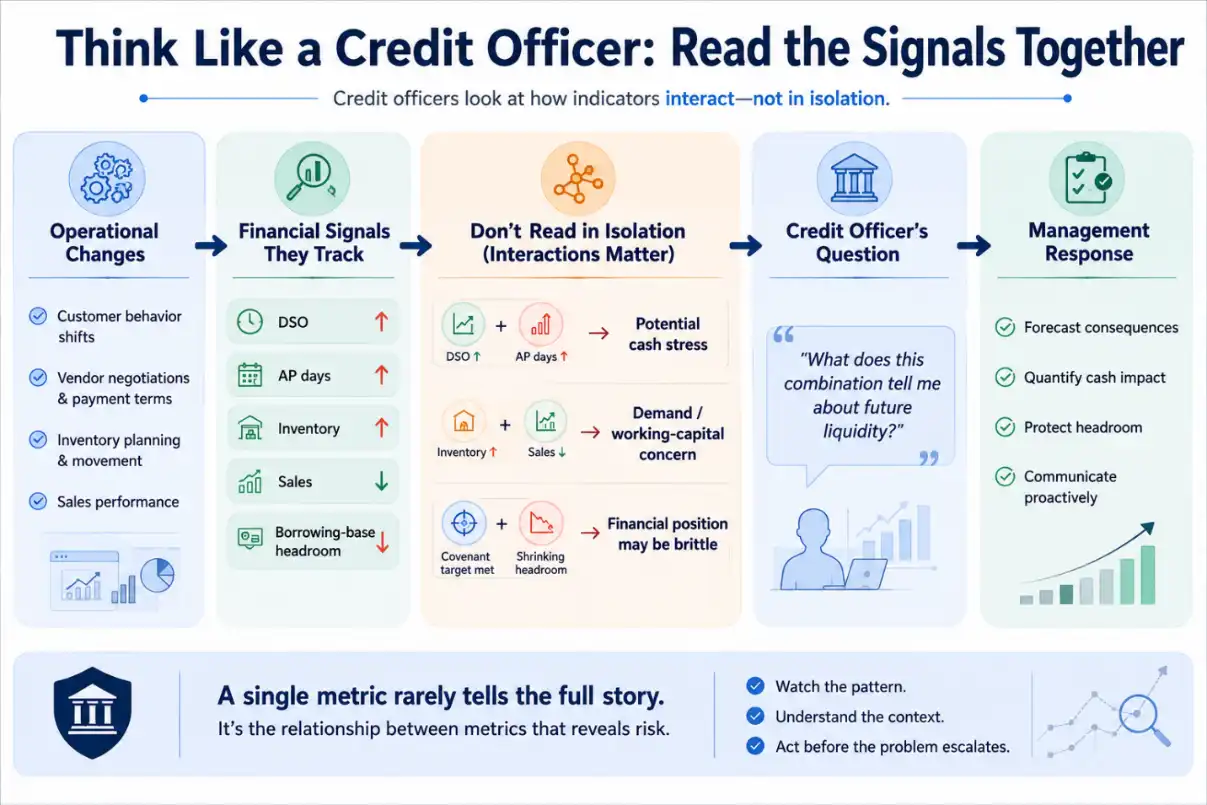
Credit officers follow mental models rooted in systems thinking, examining variables in interaction rather than isolation. A rise in DSO may not concern them if vendor payments simultaneously decline, since that combination can signal a manageable liquidity balance. But if DSO rises while AP days also rise, the inference shifts toward cash stress, and these compound indicators shape risk assessment more than any single number ever could. A late vendor payment is not merely a procurement issue; it is a liquidity signal. A sales slowdown is not merely a revenue problem; it is a working capital risk multiplier.
With one leadership team whose covenant projections kept hitting target yet felt brittle, the forecast process was rebuilt around a consequence-aware approach, testing every input against its downstream impact on cash, headroom, and signal integrity. The team began forecasting reactions, not just results.
Decoding Silence: What the Bank Is Not Telling You
One of the most misunderstood aspects of the bank relationship is silence. When a lender sees deteriorating signals, rising DSO, a constrained borrowing base, slower vendor payments, it may say nothing at first, instead recalibrating a company’s credit profile internally so it moves from stable outlook to watchlist status without a single call announcing the shift. Once that status changes, the burden of proof shifts with it.
Silence is not neutrality; it is preparation, the same quiet documentation that underpins fraud detection in banking when an account is watched rather than flagged outright. The bank begins assembling justification for future action, tightening terms and limiting revolver draws, and by the time concern is voiced out loud, the company is already late. At a mission-driven education institution where a $37M capital raise was structured, proactive transparency with lenders and the board preserved flexibility that no after-the-fact explanation could have recovered.
Translating Operational Behavior into a Fraud Detection Signal
Financials are not outputs; they are signals. Every operational behavior, how orders are fulfilled, how vendors are paid, how receivables are managed, creates a pattern that credit officers watch evolve in real time, often with more rigor than the company applies to itself. The most frequent blind spot is cultural rather than technical: finance is treated as a compliance function rather than a signaling function. One practical discipline worth building is reverse-engineering the company’s own borrowing base report each month and asking what a credit committee would infer from the changes.
Building an Internal Credit Muscle
The next evolution in credibility comes from embedding credit awareness into everyday operating rhythm, an internal credit muscle. When vendor payments slow, finance should quantify the optics rather than simply alert treasury. A 12-day average delay may preserve cash in the short term, but it signals liquidity fragility just as clearly to a lender as a pattern break would to any banking fraud detection system.
At a venture-backed digital marketing organization that scaled revenue from $9M to $180M over 24 months, the customer acquisition cost and contribution margin discipline built into daily reporting extended naturally into how AP and AR mismatches were monitored as signal divergences worth escalating on their own.
Communicating With Strategic Parsimony
If there is a single virtue worth every CFO’s attention, it is strategic parsimony: saying less while signaling more. Banks do not need every detail; they need clarity, and communication becomes effective when it reduces uncertainty rather than adding volume. The strongest lender conversations tend to share three layers: what changed, why it changed, and what is being done about it. Banks rarely mind volatility. They mind silence or deflection.
Aligning Systems Thinking with Financial Stewardship
Businesses are adaptive systems with delays, feedback loops, and cascading dependencies, and credit officers assess risk partly by observing how well a company understands its own interdependencies. A capable finance leader must understand latency patterns as well as leverage ratios, seeing how delays in delivery create timing mismatches downstream in receivables.
In one capital raise for a firm entering an aggressive growth phase, targeting a revolving facility with flexible draw mechanics, the bank raised concerns about projected DSO increases. Rather than argue the projections, the team presented a working capital simulation model showing how those increases would trigger automated changes in AP terms. The bank saw the coherence of the system and approved the facility with the proposed headroom buffers intact.
Turning Risk Awareness into a Strategic Advantage
Lenders do not expect perfection; they expect awareness. What separates companies that thrive in tight credit markets from those that falter often comes down to who manages the interpretive gap better, the difference between what a company’s data says and what its bank sees. Owning that gap creates leverage: it becomes possible to negotiate waivers before they are needed and adjust covenants before they are breached. That shift, from reporting to interpreting, is among the more valuable evolutions a finance function can make.
Three Key Takeaways
- The metrics a bank studies, vendor payment terms, AR aging, and borrowing base headroom, decay quietly long before they surface in a quarterly narrative, so reading them the way a credit officer does closes the gap between a company’s story and its numbers.
- Silence from a lender is not reassurance; it is internal recalibration, and proactive transparency, sharing an updated model before being asked, preserves flexibility that reactive explanation cannot recover once trust has shifted.
- Finance functions that turn credit relationships into strategic advantage stop treating finance as a compliance function and start treating it as a signaling function, translating every operational decision into the language their lender already uses to evaluate them.
Disclaimer: This article is intended for informational purposes only and does not constitute legal, tax, or accounting advice. You should consult your own tax advisor or counsel for advice tailored to your specific situation. Hindol Datta is a four-time CFO and senior finance executive with over 25 years of leadership experience across cybersecurity, SaaS, gaming, logistics, digital marketing, medical devices, consumer products, and nonprofit organizations. He has led more than $120M in fundraising and over $150M in M&A transactions while building the financial and operational systems that let complex businesses scale with confidence. He is the author of seven books in the Systems CFO Series and holds active CPA, CMA, and CIA credentials.
AI-assisted insights, supplemented by 25 years of finance leadership experience.