
Executive Summary
Convertible instruments have always asked accounting to hold two identities at once. A note is debt today and equity tomorrow. On a specific reporting date, it forces a company to declare what it believes that instrument truly is. ASU 2020-06 changed the terms of that declaration. Finance leaders navigating fundraising, board reporting, and dilution planning can no longer treat this standard as optional. This ASU 2020-06 summary walks through what the standard changed and why. It also covers what the change demands of a CFO. That CFO must translate the accounting into a story the board and the cap table can both live with.
Experience with convertible instruments spans several capital structures. It ranges from early-stage notes converting into a priced round to public-company diluted earnings per share calculations under SEC scrutiny. The mechanics of ASU 2020-06 are not difficult to memorize. Structuring instruments, forecasting dilution, and communicating the consequences to a board require real judgment. That is where the actual work of the CFO begins.
The Duality Convertibles Bring to the Balance Sheet
There is a quiet usefulness in convertible instruments that both founders and investors have come to depend on. They allow a company to raise capital without forcing an immediate valuation conversation. In exchange for a lower coupon, the investor gets a claim on future upside. In the early years of a company, the business is still proving itself. Every dollar of capital needs to move fast. That ambiguity is a feature rather than a flaw.
Accounting does not share the market’s comfort with ambiguity. Sooner or later, companies must classify, measure, and report every convertible instrument. That classification carries weight well beyond the financial statements. It shapes how investors read the balance sheet and how the board interprets net income. It also shapes how a cap table absorbs the eventual conversion. ASU 2020-06 did not remove that tension entirely. It did change how much of it lands on the accounting function versus the strategy function.
An ASU 2020-06 Summary: From Bifurcation to a Single Unit of Account
The Old Bifurcation Model Under ASC 470-20
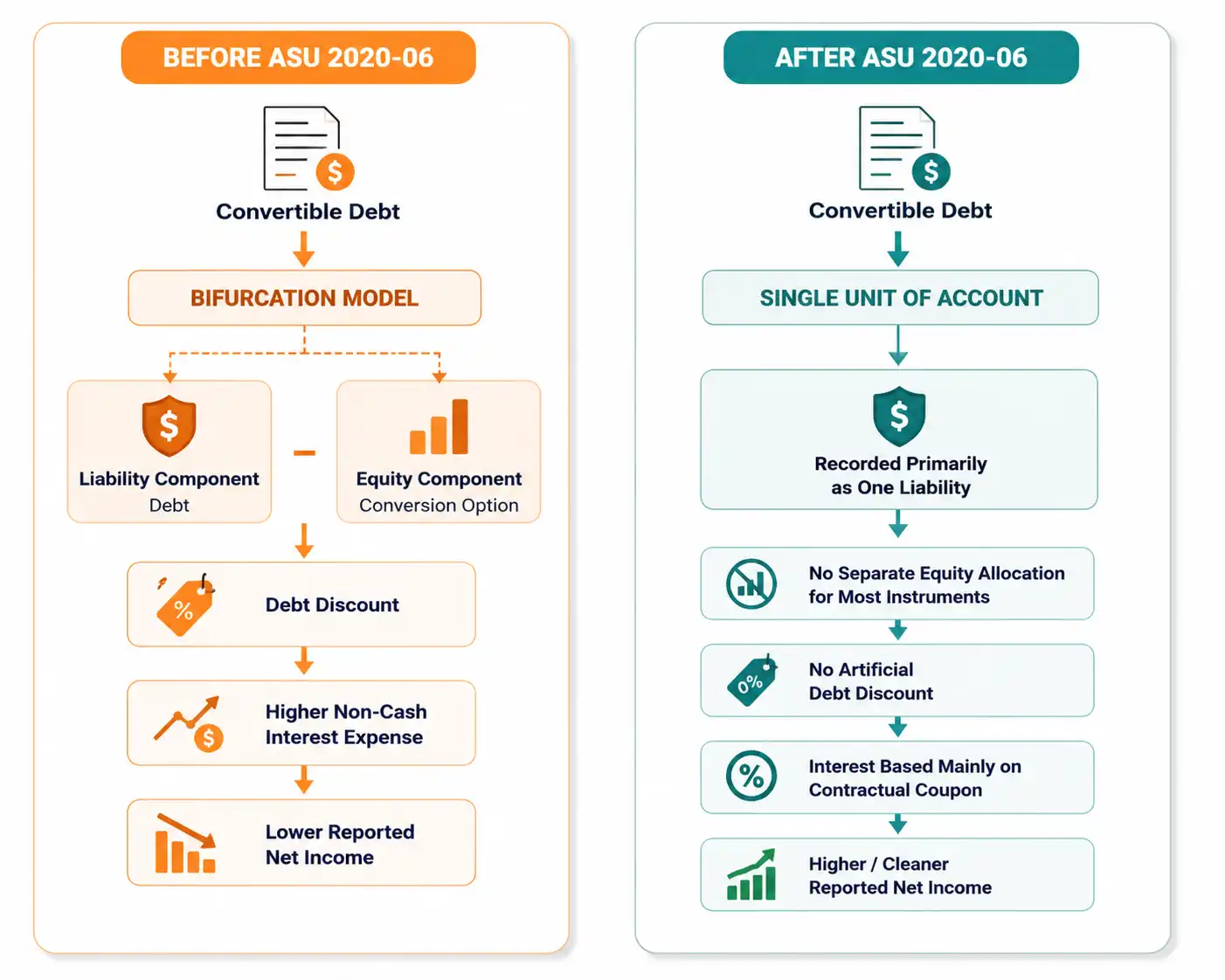
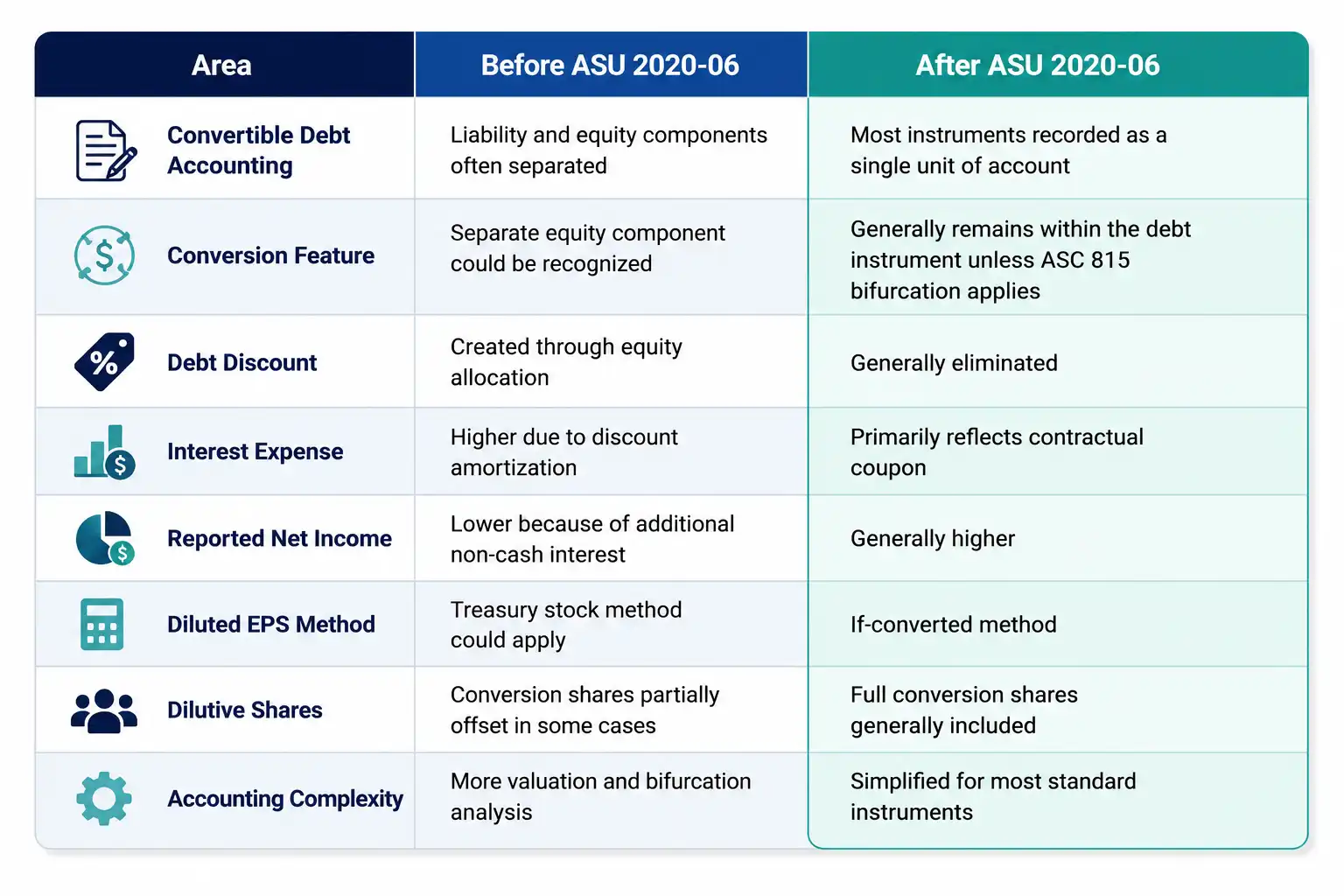
Before ASU 2020-06, ASC 470-20 governed convertible debt with a cash conversion feature and required companies to bifurcate the instrument. Issuers recorded one portion as a liability. They carried the other portion, representing the value of the conversion option, in equity. That equity allocation created a debt discount, amortized as interest expense over the life of the instrument. As a result, reported interest costs rose and net income fell relative to the stated coupon.
The logic was defensible. A convertible bond is a loan with an embedded call option on the company’s own stock. The investor accepts a lower coupon for the chance to participate in equity growth. Standard setters judged that non-cash fair value worthy of separate recognition. Convertible issuance grew across technology and biotech companies raising capital in volatile markets. The bifurcation modeling became a burden of its own. Finance teams had to build, document, and defend volatility assumptions, discount rate selection, and valuation scenarios to auditors. Anyone outside finance often struggled to interpret the resulting statements without adjustment.
What ASU 2020-06 Changed
ASU 2020-06 removed the separation requirement for most convertible instruments. Under the new guidance, companies generally treat a convertible debt instrument as a single unit of account and record it wholly as a liability, unless the conversion feature meets the criteria for bifurcation under ASC 815 or the issuer sold the instrument at a substantial premium. Convertible preferred stock receives similar treatment, recorded as a single equity instrument rather than split into components.
That change eliminated the artificial discount and the non-cash interest expense that used to depress reported earnings. Interest expense now reflects the contractual coupon rate, and net income is generally higher than under the old model, which improves the optics of the income statement for companies preparing an IPO, an acquisition, or a refinancing where lenders read the trailing financials closely.
How ASU 2020-06 Reshapes Reported Earnings and Dilution
The Shift from Treasury Stock to If-Converted Method
ASU 2020-06 also eliminated the treasury stock method for diluted earnings per share and replaced it with the if-converted method. Under the old approach, an assumed buyback funded with the conversion proceeds partially offset potential shares from conversion, softening reported dilution. Under the if-converted method, the full number of shares issuable on conversion enters the diluted share count with no offset.
For a growth company carrying substantial convertible debt, this can pull diluted EPS down noticeably, and boards accustomed to the softer treasury stock number sometimes ask pointed questions the first time the if-converted figure appears. A CFO who has not walked the board through this change in advance is having that conversation after the number has already alarmed someone, which is a far harder position than explaining it ahead of time.
Reduced Income Statement Volatility
There is a genuine benefit tucked inside the simplification. Because most conversion features no longer require bifurcation, the remeasurement of embedded derivatives that used to generate mark-to-market gains and losses each period has largely disappeared for standard instruments, and reported earnings become steadier from quarter to quarter. I have built forecasting engines that held actuals within a narrow band of plan for eight consecutive quarters at a cybersecurity and identity access management company, and predictability of that kind depends on removing this sort of non-operating noise from the income statement wherever the accounting allows it.
The Cap Table Consequence: Where Accounting Meets the Boardroom
Simplified accounting does not simplify the boardroom conversation. A convertible note or a SAFE often begins its life as a liability and ends it as equity, and the moment of conversion, usually triggered by a qualifying financing event, is a genuine turning point rather than a bookkeeping formality. Capital that was once borrowed has now joined the ranks of ownership, and that transition has to be reflected cleanly across the extinguishment of the liability, the issuance of new shares, and the remeasurement of any surviving warrants or embedded features.
The harder part is rarely the journal entry. It is the dilution that lands on the cap table and the founder and employee ownership pools once every outstanding convertible converts at once. In one venture-backed environment where I led the finance function through three funding rounds and $36.5M of capital raised, the accounting for each round was clean on its own, but the cumulative dilution across the notes and later rounds still required careful, proactive modeling so founders and early employees were not surprised on the day of a priced round. I have also sat in the CFO seat of a mission-driven institution that raised $37M across equity and venture debt, owning the investor narrative and the audit committee relationship directly, and the lesson from both settings is the same. When a company models the economic terms of a convertible instrument without fully modeling the ownership consequences, the resulting surprise at conversion strains the investor relationships the capital was meant to strengthen.
Embedded Derivatives: Where Complexity Still Lives Under ASU 2020-06
ASU 2020-06 simplifies most convertible instruments, but it does not eliminate complexity across the board. Instruments carrying embedded derivatives, such as conversion features tied to non-standard indices, down-round protection, or other contingent adjustments, may still require bifurcation under ASC 815. Once a feature is judged to meet the definition of a derivative, the company owes fair value measurement at every reporting date, which brings back the recurring valuation work, the volatility, and the disclosure burden ASU 2020-06 was designed to reduce.
This is where finance has to sit next to legal rather than downstream of it. Trigger events, protective provisions, and adjustment mechanisms all live in contract language, and boilerplate terms are no longer a safe default. A down-round protection clause that resets the conversion price if a lower-priced round occurs before maturity can, on its own, create a variable conversion feature that an auditor determines is a derivative, and the resulting liability will move with every reporting period the instrument is outstanding. What was written into a term sheet as investor protection can become a recurring distortion on the issuer’s income statement, and the only way to see that coming is to read the contract with the accounting consequence already in mind.
Preparing for ASU 2020-06 Compliance: A Practitioner’s Checklist
Finance leaders working through adoption should move through a short set of concrete steps rather than treating ASU 2020-06 as a one-time memo:
- Inventory every outstanding convertible instrument and confirm whether it qualifies for single-unit-of-account treatment or still requires bifurcation under ASC 815.
- Rebuild diluted EPS under the if-converted method and compare it against the prior treasury stock figure so the board sees the delta before it hits a filed statement.
- Model dilution across the full capitalization table, including every SAFE, note, and warrant, rather than evaluating each instrument alone.
- Review contract language for down-round protection or index-linked features that could trigger derivative accounting.
- Coordinate legal and finance review at the term sheet stage, before an instrument is issued, so the accounting consequence is known rather than discovered.
- Build the board narrative for the change in reported earnings and EPS ahead of the reporting cycle in which it first appears.
Three Key Takeaways
- ASU 2020-06 replaced a fragmented bifurcation model with a simpler single-unit-of-account approach for most convertible debt and preferred stock, which raises reported net income by removing the non-cash discount amortization that used to accompany these instruments.
- The move from the treasury stock method to the if-converted method for diluted EPS can meaningfully lower reported earnings per share for companies carrying convertible debt, and that shift deserves board-level explanation well before it shows up in a financial statement.
- Simplification at the accounting level does not simplify the cap table or the boardroom, and instruments carrying embedded derivatives such as down-round protection can still trigger the volatility and disclosure burden that ASU 2020-06 was meant to reduce, which means structuring and legal review remain as important as the accounting entry itself.
Disclaimer: This article is intended for informational purposes only and does not constitute legal, tax, or accounting advice. You should consult your own tax advisor or counsel for advice tailored to your specific situation.
Hindol Datta is a four-time CFO and senior finance executive with over 25 years of leadership experience across cybersecurity, SaaS, gaming, logistics, digital marketing, medical devices, consumer products, and nonprofit organizations. He has led more than $120M in fundraising and over $150M in M&A transactions while building the financial and operational systems that let complex businesses scale with confidence. He is the author of seven books in the Systems CFO Series and holds active CPA, CMA, and CIA credentials.
AI-assisted insights, supplemented by 25 years of finance leadership experience.