
Executive Summary
Every audit closes with the same quiet tension in its final weeks. The balance sheet stops moving, but the business in front of it does not. ASC 855 subsequent events exist because financial reporting has to reconcile those two realities. The standard draws a line between conditions that already existed at year-end and conditions that arose only after it. Getting that line right is one of the more consequential judgment calls a finance leader makes each cycle. A type 1 subsequent event forces an adjustment. A type 2 event calls only for disclosure.
This article walks through that distinction from inside the reporting cycle. A class action landed days before management signed a 10-K. A covenant was brewing before it broke. An acquisition closed after the books had already turned. The article also lays out the governance mechanics and the review protocols. It closes with the questions worth asking before an auditor asks them first.
What ASC 855 Subsequent Events Actually Require
ASC 855 governs the window between the balance sheet date and the point at which financial statements are issued. For private entities, that endpoint is the date the statements are available to be issued. Within that window, management carries an active obligation, not a passive one. It must identify anything that could change how the numbers should be read. This holds true on both sides of the exercise, whether assembling the disclosure or probing someone else’s. The pattern holds regardless of seat. Companies that treat the subsequent events window as an extension of the reporting cycle avoid the late, painful surprises.
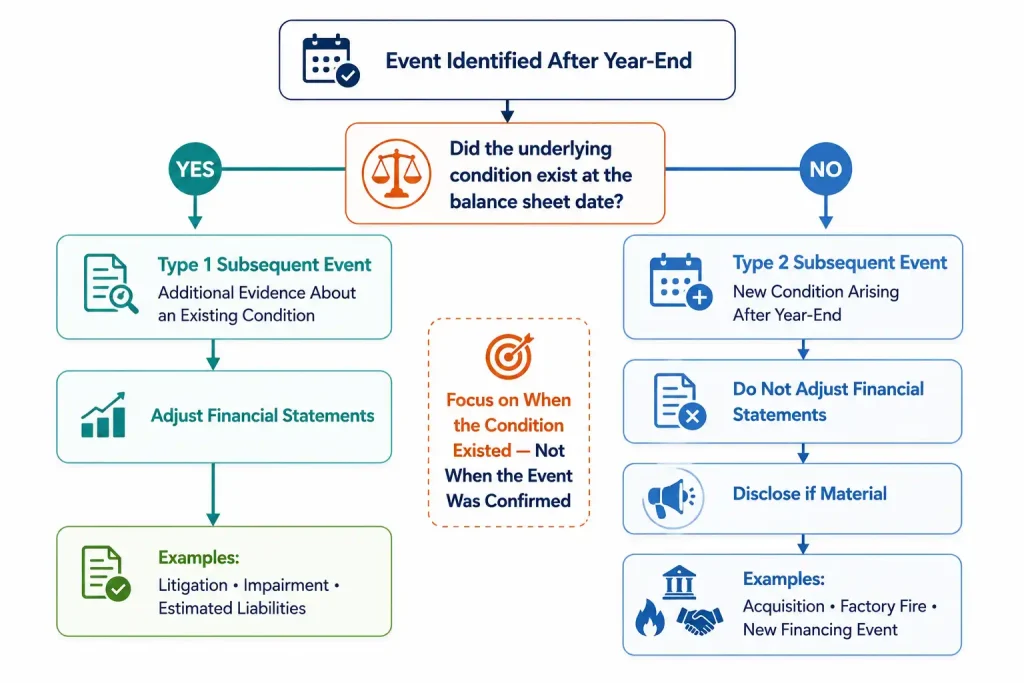
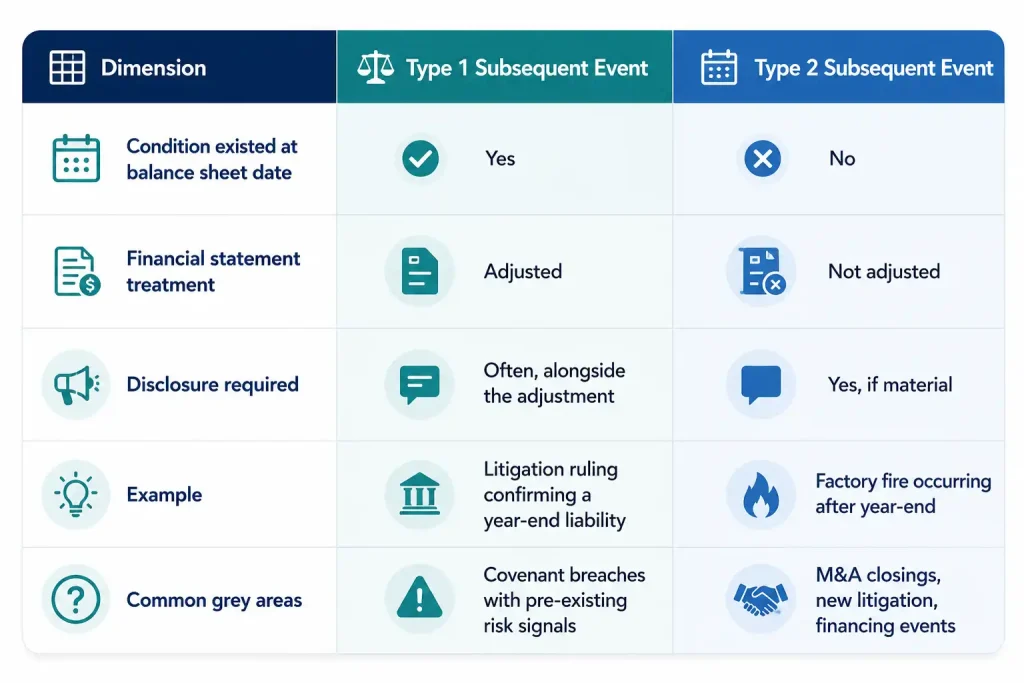
The standard sorts everything that happens in that window into two buckets. A type 1 subsequent event provides additional evidence about a condition that already existed at the balance sheet date. It must be reflected through an adjustment to the financial statements themselves. A type 2 event relates to a condition that arose only after year-end. It may need disclosure if material, but it never changes the reported balances. The distinction sounds tidy in the literature. In practice, it rarely is.
When a Type 1 Subsequent Event Forces an Adjustment
Consider a manufacturing company carrying a pending legal case as of December 31. A ruling on January 20 affirming a liability already probable and estimable at year-end does not create a new condition. It confirms one that was already sitting on the books, waiting to be measured. That is a type 1 subsequent event, and ASC 450’s recognition criteria pull it straight into the financial statements. Deferred tax positions, impairment conclusions, and previously estimated liabilities all sit in this same category whenever new evidence simply sharpens the measurement of something that was already true at the reporting date.
Type 2 Events and the Discipline of Disclosure
Now take the same company through a factory fire on January 5. Nothing about that fire existed as a condition at year-end, so it cannot retroactively change the balances that were already closed. It is a type 2 event, non-adjusting by definition, though the loss may still warrant prominent disclosure and, depending on materiality, a place in the MD&A narrative. The discipline required here is different from the discipline required for a type 1 event. Instead of remeasuring an account, the finance team has to write a footnote precise enough that a reader who never sees the underlying documentation still understands what happened, what it might cost, and how it changes the forward view of the business.
The Grey Zone: M&A, Litigation, and Covenant Breaches
The world rarely presents itself in the clean chronological stages the standard implies. Deals, disputes, and covenant tests build gradually, and the type 1 versus type 2 split only becomes obvious in hindsight.
Acquisitions That Close After Year-End
In a cybersecurity and identity access management business, an ASC 606 revenue framework and board-grade reporting carried the company through acquisition diligence, and the exercise showed how much weight the subsequent events footnote ends up bearing in that moment. A term sheet signed December 20, a close on January 10, and financial statements issued March 1 is a familiar sequence for growth-stage companies. Under ASC 805, the December financial statements do not reflect the acquisition; it is a type 2 event because the business combination itself occurred after year-end. What the footnotes must carry is the full shape of the deal, the nature of the consideration, the expected impact, and the key financial metrics that let an investor or lender see the business as it actually stands, not as the balance sheet cutoff happens to freeze it.
Covenant Breaches and the Current Debt Question
Covenant breaches sit closer to the edge. In a global consumer products business with a full banking and lender relationship set alongside a growth financing package, the lesson that surfaced repeatedly was this: if management already knew, before year-end, that a covenant was likely to be violated, the breach itself is often only the formal expression of a condition that existed earlier. Auditors will frequently argue that debt should be classified as current at year-end in that circumstance, which is not a footnote question at all. It reaches into working capital presentation, liquidity ratios, and potentially into cross-default clauses across the rest of the capital structure, so the classification decision has consequences well beyond the balance sheet line it touches directly.
Litigation That Straddles the Balance Sheet Date
Litigation follows a similar logic. A customer dispute simmering in December, with formal proceedings filed in mid-January, requires the finance team to ask whether the conditions giving rise to the claim already existed at year-end and whether the outcome was reasonably estimable at that point. If both are true, ASC 450 pulls it into an accrual and the statements must be adjusted. If the claim instead grows out of a post-year-end contract termination or a genuinely new dispute, it stays a non-adjusting event, disclosed but not booked. The legal documentation, the communications timeline, and the internal risk assessment become the evidence that determines which side of the line the matter falls on.
Building a Subsequent Event Review Process That Holds Up
None of this classification works well as a once-a-year exercise squeezed into audit fieldwork. On the finance and audit committee side of a mission-driven institution, the lesson was clear: a formal subsequent event review, involving legal, finance, and operations leadership meeting in the weeks after year-end, is not bureaucratic overhead. It is the mechanism that catches the covenant risk, the litigation development, or the transaction pipeline item before it becomes a late, embarrassing addendum to statements that have already gone out the door.
A workable review protocol tends to include the following elements:
- A post-year-end checklist covering legal matters, financing activity, and material contracts, reviewed jointly by finance and legal.
- Contemporaneous documentation of every subsequent event discussion, rather than reconstruction during audit fieldwork.
- Review of board and committee minutes through the issuance date, not just through year-end.
- A management representation letter process that forces explicit sign-off on the completeness of the subsequent events search.
- For public companies, coordination with investor relations and legal on whether an event triggers a Form 8-K or an amendment to an existing filing.
Public companies carry an added layer here. More than $100M in cross-border M&A execution and an S-1 process run with underwriters and Big Four auditors made clear how much a subsequent event disclosure can shape market perception in the days after a filing. Private companies face a quieter version of the same pressure, since lenders and investors still expect the footnotes to explain, in plain terms, what changed and why it matters.
Three Key Takeaways
- The classification of a subsequent event turns entirely on whether the underlying condition existed at the balance sheet date, and that historical question, not the calendar date of the triggering event, should drive every type 1 versus type 2 determination.
- Covenant breaches and litigation deserve particular scrutiny because the formal trigger date often arrives well after the underlying condition was already known internally, which means a rigorous, contemporaneous review process matters more than a mechanical read of the standard.
- A subsequent event review conducted as a genuine cross-functional exercise, spanning finance, legal, and operations, catches material developments early enough to disclose them with precision rather than to explain them defensively after the fact.
Disclaimer: This article is intended for informational purposes only and does not constitute legal, tax, or accounting advice. You should consult your own tax advisor or counsel for advice tailored to your specific situation.
Hindol Datta is a four-time CFO and senior finance executive with over 25 years of leadership experience across cybersecurity, SaaS, gaming, logistics, digital marketing, medical devices, consumer products, and nonprofit organizations. He has led more than $120M in fundraising and over $150M in M&A transactions while building the financial and operational systems that let complex businesses scale with confidence. He is the author of seven books in the Systems CFO Series and holds active CPA, CMA, and CIA credentials.
AI-assisted insights, supplemented by 25 years of finance leadership experience.