Executive Summary
ASC 810 consolidation asks a question many finance teams answer too late in a company’s growth curve. The answer does not hinge on the size of an equity stake. It hinges on power over an entity’s decisions. That power determines who must fold its assets, liabilities, and results into the parent’s financial statements. GAAP builds consolidation around power, benefits, and obligations. Companies scaling across borders, forming joint ventures, or relying on special purpose vehicles face this question often. It poses a real judgment call. Finance organizations face it more than once in a given year.
This article walks through the two consolidation models that govern ASC 810. It covers the criteria that define a variable interest entity and the primary beneficiary test that decides which party consolidates. It also covers the strategic consequences that follow once consolidation kicks in. A multi-entity scenario drawn from practice illustrates how the analysis plays out when ownership and control point in different directions. A closing checklist gives finance leaders a structured way to apply the standard across their own legal entity maps.
Consolidation Under ASC 810 Begins with a Question of Power, Not Percentage
The framing behind ASC 810 emerged from a period of off-balance sheet abuse. Companies used these structures to keep liabilities and losses out of view. These structures were tucked inside entities technically separate but economically inseparable from the parent. Regulators responded by shifting the consolidation test away from a narrow ownership percentage. The new inquiry asks who directs an entity’s activities and who bears the economic consequences of those decisions.
For CFOs operating multi-entity structures, that shift changes how they evaluate legal entity maps. Ownership is still relevant, but it is no longer the entire test. ASC 810 asks who holds the decision rights that matter. It also asks who absorbs the losses or captures the returns those decisions produce. A company can hold a minority stake, or no equity position at all, and GAAP still requires it to consolidate an entity if it is the one steering the ship.
Two Models Govern ASC 810 Consolidation, Voting Interest and Variable Interests
GAAP provides two paths for determining whether an entity should be consolidated, and the path a company falls into depends on how its governance and funding are structured.
The Voting Interest Model
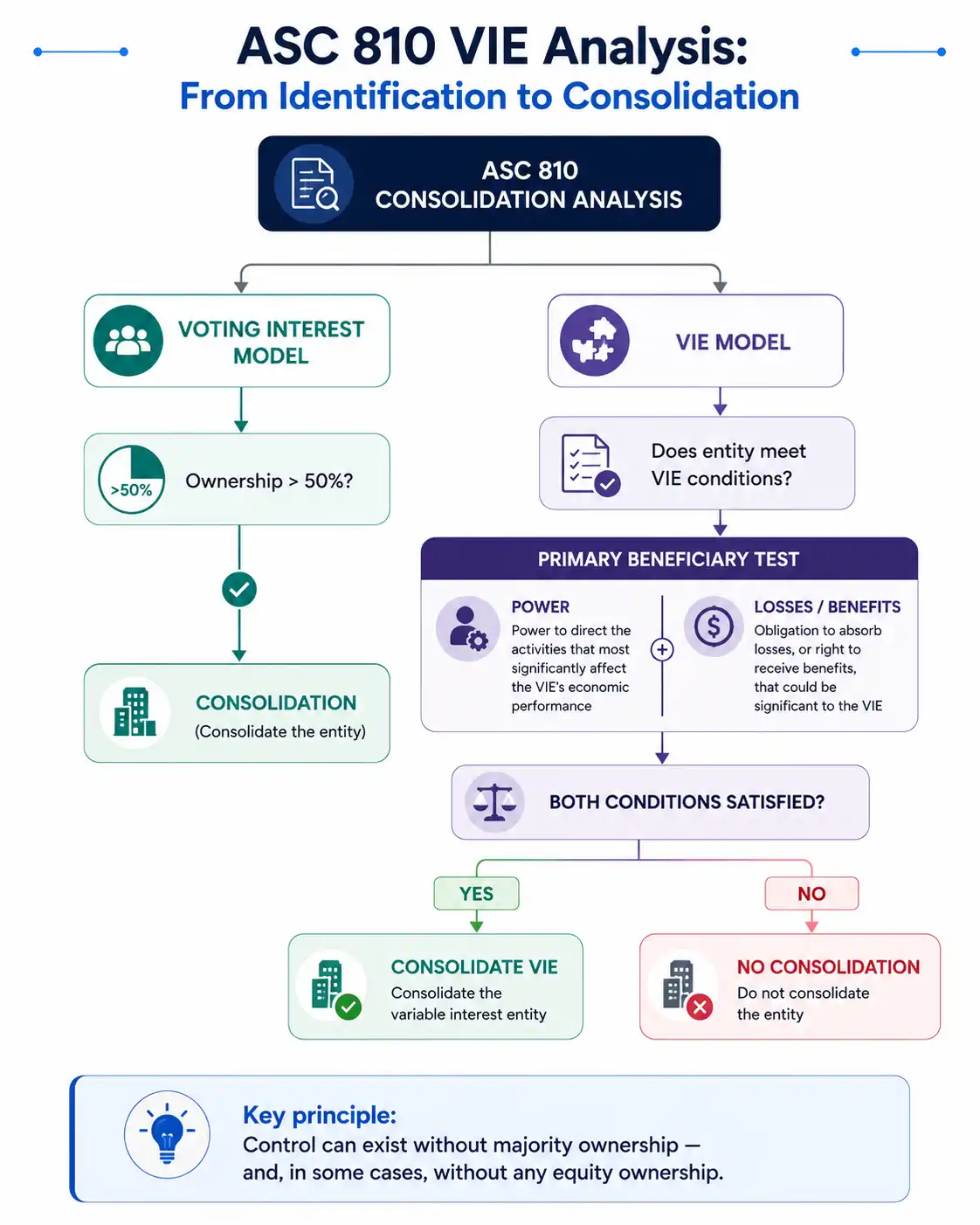
This is the model most finance professionals learn first, and it remains the more common case in practice. When a reporting entity owns more than fifty percent of another entity’s voting stock, and no unusual governance arrangements complicate the picture, consolidation follows in a fairly mechanical way. The logic is intuitive, ownership drives control, and control drives consolidation.
The Variable Interest Entity Model
The second path is where ASC 810 consolidation gets genuinely difficult, and where most restatements and late-stage audit findings originate. Even when a company owns less than fifty percent of an entity, or holds no equity interest whatsoever, it may still be required to consolidate that entity if it is the primary beneficiary of its economic outcomes and holds the power to direct the activities that most affect its performance. This is the variable interest entity, or VIE, model, and it forces a second look at relationships that were once filed away as equity method or cost method investments, because contractual arrangements, guarantees, or operational influence can quietly convert what looked like a passive investment into a consolidation obligation.
A high-growth cybersecurity and identity access management company with multi-entity operations across the United States, Canada, Mexico, India, and Nepal illustrates the point well, since a structure that looks clean on paper across five jurisdictions can still create a VIE relationship if funding flows and decision rights are not mapped with equal care.
Recognizing When an Entity Qualifies as a Variable Interest Entity
Under ASC 810, an entity is generally treated as a VIE when any of the following conditions hold true.
It lacks sufficient equity at risk to finance its own activities without additional subordinated support from another party.
The holders of its equity lack decision-making rights, or lack the ability to absorb losses and receive returns in proportion to what they have invested.
The entity’s structure relies on contractual arrangements to pass risks and rewards through to another party rather than to its nominal owners.
These conditions show up more often than most finance teams expect, clustering around a familiar set of structures.
- Joint ventures with asymmetric governance rights
- Franchise arrangements carrying guaranteed returns to the franchisor
- Entities funded through debt guaranteed by a sponsor
- Offshore structures where legal ownership sits in one jurisdiction while operational control is ceded through contract to another
Fast-growing technology companies frequently separate intellectual property ownership, international operations, or customer contracting functions into distinct legal entities for tax, regulatory, or strategic reasons, and in each case the economic substance of the arrangement, not the legal form on the incorporation documents, is what ASC 810 cares about.
The Primary Beneficiary Test Decides Who Must Consolidate
Once an entity is identified as a VIE, the next question is whether the reporting company is its primary beneficiary, and that determination rests on two conditions that must both be satisfied.
- The company holds the power to direct the activities that most significantly affect the VIE’s economic performance.
- The company has the obligation to absorb losses, or the right to receive benefits, that could be significant to the VIE.
This is rarely a clean-cut analysis. A company might hold a minority stake in a research and development joint venture, yet if it controls the development milestones, funds the operations, and captures the downstream commercialization rights, it is likely the primary beneficiary regardless of what the cap table says. Once that threshold is crossed, full consolidation follows, even at an ownership stake as low as ten percent, bringing in all of the VIE’s assets, liabilities, revenues, and expenses, along with the required noncontrolling interest disclosures.
Why ASC 810 Consolidation Carries Strategic Weight for Finance Leaders
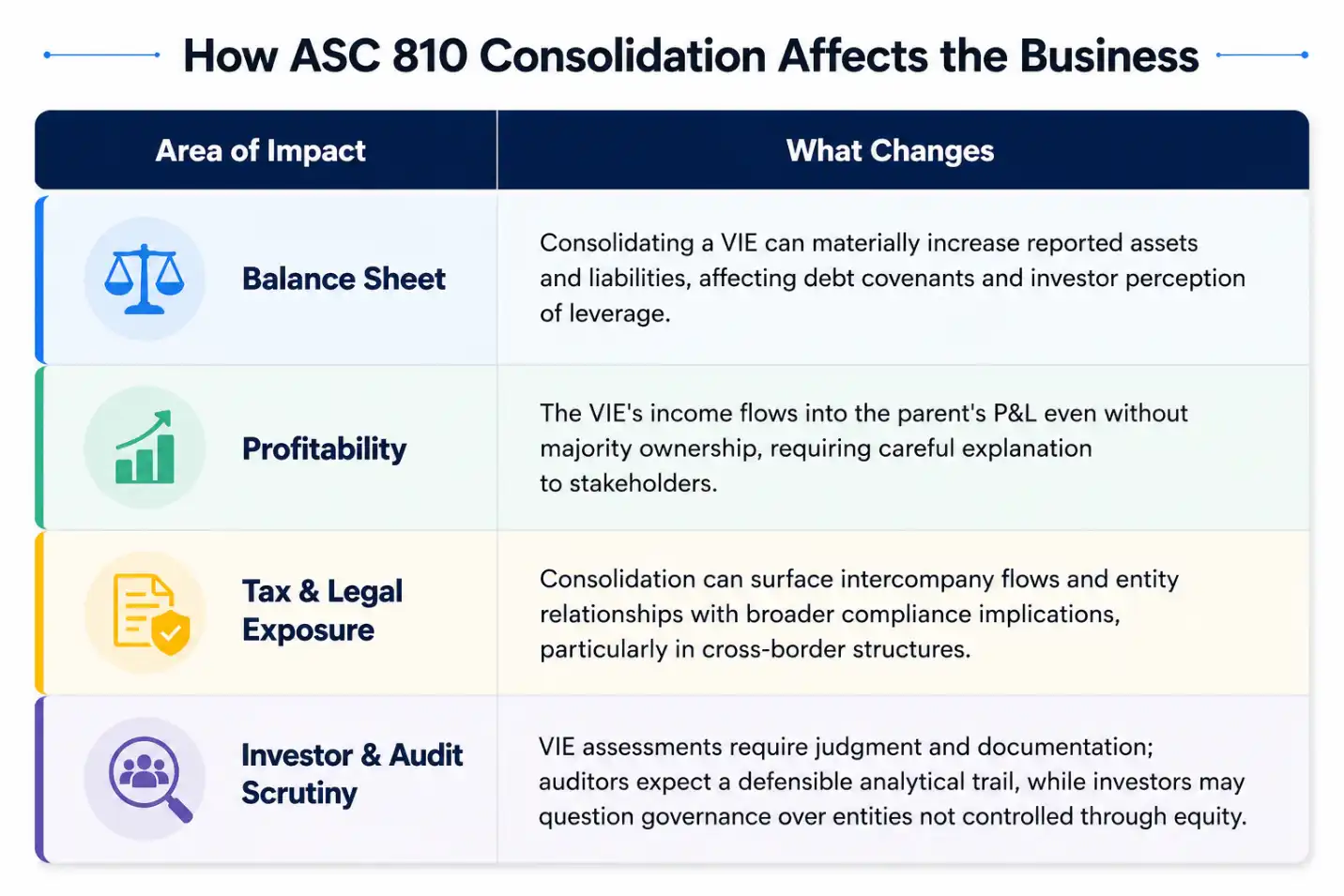
The implications of a consolidation determination extend well past the technical accounting memo and into how the business is perceived by lenders, investors, and its own board.
A Multi-Entity Consolidation Scenario From Practice
A useful illustration comes from a Series C fintech structure built across three jurisdictions, with a United States parent, a European license-holding subsidiary, and an Asian development center funded through contractual agreement rather than equity. On paper, local partners owned the Asian entity outright. In substance, the United States parent funded all of its operations, held exclusive intellectual property licensing rights, and directed the research and development timeline.
Analysis under ASC 810 concluded that the Asian entity was a VIE, and full consolidation followed. The effect was material, with total assets increasing by thirty percent and the EBITDA margin profile shifting once capitalized development costs entered the picture, changing the course of investor discussions and requiring a full re-audit of the prior year.
A comparable dynamic surfaced in a Euronext Paris-listed gaming and digital entertainment company spanning the United States, France, the United Kingdom, Singapore, and South Korea, where cross-border M&A and a firmwide systems rollout were what finally produced one defensible definition of revenue and consolidation scope under both IFRS and US GAAP.
Common Pushback on ASC 810 Consolidation, and Why It Misses the Point
A frequent objection from finance leaders runs along the lines of not owning the entity, so why consolidate it. The answer sits at the center of the standard, which is substance over form. GAAP is not asking who holds the shares. It is asking who holds the steering wheel, and who reaps the benefits or absorbs the risk of wherever that wheel points the business.
A second misconception treats VIE analysis as a large multinational problem alone, which is not accurate. Any company using special purpose vehicles, revenue-sharing agreements, licensing arrangements, or shared-service models has a reason to evaluate its relationships against the VIE framework, regardless of company size.
A Practical Checklist for Finance Leaders Applying ASC 810
- Map every legal entity in the global structure, including minority holdings, special purpose vehicles, and contractually dependent service providers.
- Evaluate control against ownership by asking who makes the key decisions, who funds the losses, and who captures the upside.
- Build a VIE assessment memo on an annual cadence, documenting rationale, data, and judgment for auditors and investors.
- Model the financial impact of each consolidation scenario before it lands on the desk unannounced.
- Review intercompany agreements against the accounting conclusions reached, since legal form has to reflect economic substance.
Three Key Takeaways
- ASC 810 consolidation is decided by power, benefit, and obligation rather than by the size of an ownership stake, which means every finance team with joint ventures, SPVs, or contractually funded affiliates needs a repeatable process for testing control rather than a one-time assumption based on the cap table.
- The variable interest entity model can require full consolidation at ownership levels as low as ten percent, so the financial statement impact of a VIE determination, from balance sheet inflation to shifts in EBITDA margin, deserves modeling well before an audit forces the question.
- A documented, annually refreshed VIE assessment memo is what turns a judgment call into a defensible position, giving auditors a trail to follow and giving the board a governance story that holds up when investors start asking who really controls the entities in the structure.
Disclaimer. This article is intended for informational purposes only and does not constitute legal, tax, or accounting advice. You should consult your own tax advisor or counsel for advice tailored to your specific situation.
Hindol Datta is a four-time CFO and senior finance executive with over 25 years of leadership experience across cybersecurity, SaaS, gaming, logistics, digital marketing, medical devices, consumer products, and nonprofit organizations. He has led more than $120M in fundraising and over $150M in M&A transactions while building the financial and operational systems that let complex businesses scale with confidence. He is the author of seven books in the Systems CFO Series and holds active CPA, CMA, and CIA credentials.
AI-assisted insights, supplemented by 25 years of finance leadership experience.