
Executive Summary
Every early-stage company forecast revenue as though the best case were the only case. Then reality sets in. Customers cancel, dispute, renegotiate, and return. ASC 606 variable consideration is the accounting discipline built for that gap between the invoice and the truth. Across two and a half decades in the CFO chair, I have come to see it differently. It is less a technical footnote. It is more a test of whether finance truly understands the business it reports on.
This piece walks through what qualifies as variable consideration. It covers how to estimate variable consideration without guessing. From there, it explains how the constraint under ASC 606 functions in practice. Finally, it looks at where the systems and controls underneath the policy tend to break. If you lead finance through a raise, an audit, or a board meeting, this is your ground. Someone will ask why revenue moved.
What Counts as Variable Consideration Under ASC 606
Under ASC 606, variable consideration covers any contract component that could change the price a customer ultimately pays. The list is longer than most finance teams initially assume. It includes:
- Refunds or rights of return
- Performance bonuses or penalties
- Volume discounts or tiered pricing
- Usage-based fees or royalties
- Early payment incentives or rebates
- Price concessions made at management’s discretion
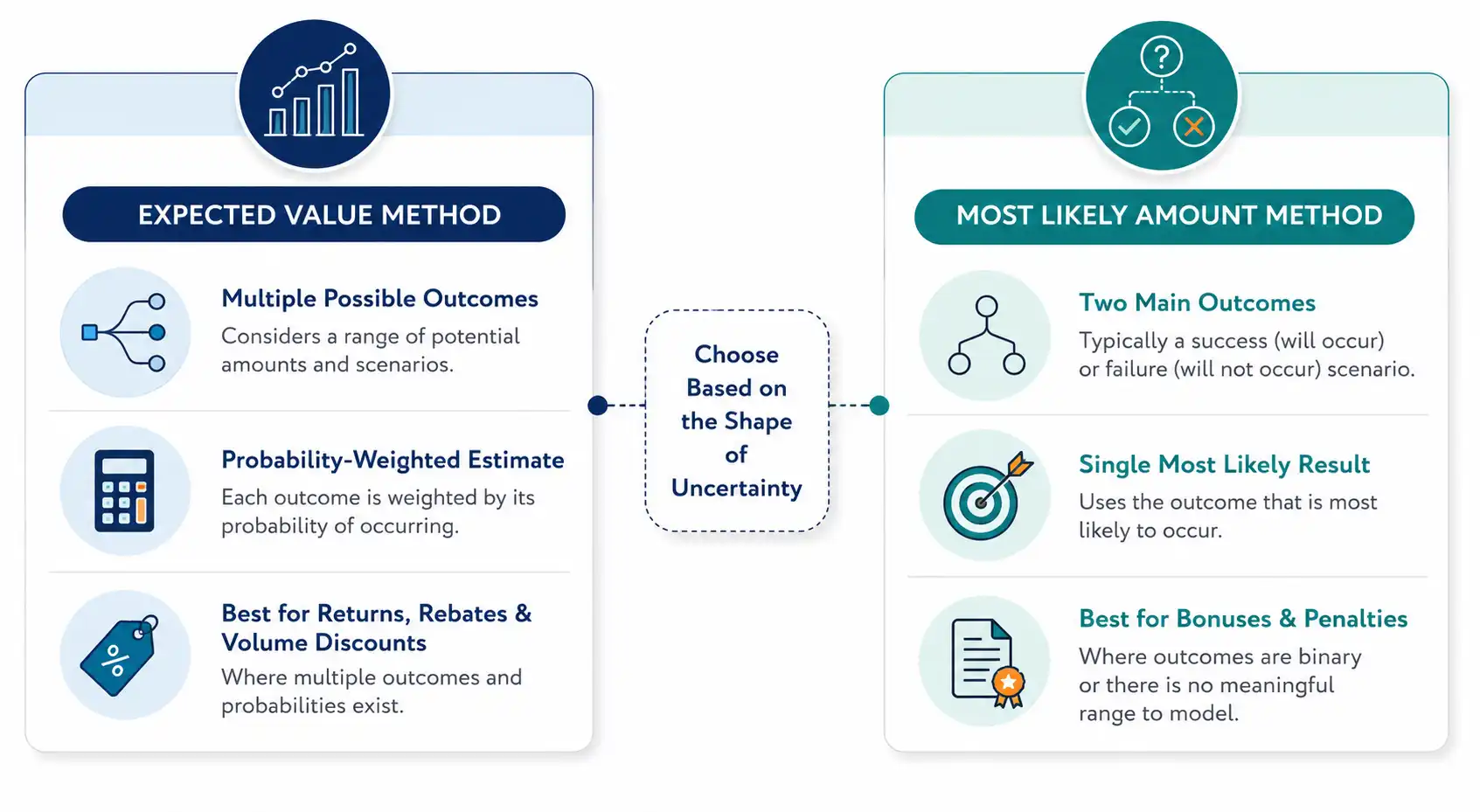
What determines whether an item belongs in this category is not its label. It comes down to a single question: does the finance team know the final transaction price at contract inception? If it is not, the finance team must estimate the consideration it expects to receive. That means choosing between the expected value method and the most likely amount method. Which one depends on the shape of the uncertainty. Expected value suits situations with a range of possible outcomes and reasonably known probabilities. That’s the kind of modeling I built for scenario planning at an AI governance platform. It was still finding its footing before a Series A. Most likely amount works better for binary outcomes, where a bonus either triggers or it does not. There, no meaningful middle ground exists to model.
Estimating Is Not Guessing
CFOs who treat estimation as an art rather than a discipline eventually pay for it. They end up explaining a restatement to a board that no longer trusts the model. Finance builds a defensible estimate from observable inputs. Think historical return rates, win rates on contract terms, amendment patterns, payment history, and customer-specific behavior. These are things finance can actually point to when an auditor asks where a number came from.
I once worked with a consumer products company doing north of $127M in revenue across direct-to-commerce, marketplace, and wholesale channels. A liberal return policy had produced a return rate finance could have measured but had not built into revenue recognition. Refunds were only deducted when processed, not estimated at the point of sale. A defensible estimate is built from observable inputs. Think historical return rates, win rates on contract terms, amendment patterns, payment history, and customer-specific behavior. That liability surfaced in due diligence conversations. The lesson underneath it has stayed with me since: once a pattern becomes predictable, accounting has to catch up to it at contract inception, not at the point of cash movement.
How the ASC 606 Constraint Actually Works
Estimating variable consideration is only half the exercise. ASC 606 also requires a constraint, meaning a company may recognize only the portion of variable consideration that is probable not to reverse. Probable, under the relevant U.S. GAAP standard, is typically read as a likelihood somewhere between seventy-five and eighty percent, and that threshold is not a suggestion.
At a mission-driven education and research institution where I served as CFO, funding scenarios shifted constantly across philanthropic commitments and earned revenue, and multi-year modeling under variable conditions became a permanent fixture of how we planned rather than an occasional exercise. That experience is where the constraint stopped being theoretical for me. If you are uncertain whether a rebate threshold will be met, or whether a refund clause might be triggered, the honest move is to defer revenue until the uncertainty resolves or until better data arrives. Growth-stage CFOs feel pressure to accelerate recognition, and the constraint is precisely what keeps optimism from becoming overstatement.
I have also reviewed a case where a software company recognized $500K in success fees tied to customer adoption criteria that were subjective at best. Adoption never firmed up the way the model assumed; the auditors reclassified the amount as deferred revenue, the board asked pointed questions, and investor conversations slowed while the story was rebuilt. Optimistic assumptions carry a real cost, and it usually shows up later than anyone would like.
Breakage, Returns, and Refund Liabilities Nobody Budgets For
Breakage is the quieter cousin of variable consideration, referring to revenue tied to services a customer is entitled to but never actually uses, prepaid credits and gift cards being the classic examples. ASC 606 allows proportionate recognition of breakage when a company can reasonably estimate the portion that will go unredeemed, but that estimate has to rest on real redemption history, not optimism. I have seen early-stage companies attempt to recognize breakage on unused professional services hours without any historical pattern to support it, and those recognitions simply do not hold up.
Refund liabilities carry their own mechanics. ASC 606 requires booking both a liability for expected returns and a corresponding asset reflecting the company’s right to recover the product. In the consumer products business I mentioned earlier, this was not an abstract accounting nuance; it moved the balance sheet, and it changed how the board read margin quality once returns were properly reflected instead of buried in a footnote.
Why Your Systems Have to Believe in Variable Consideration Too
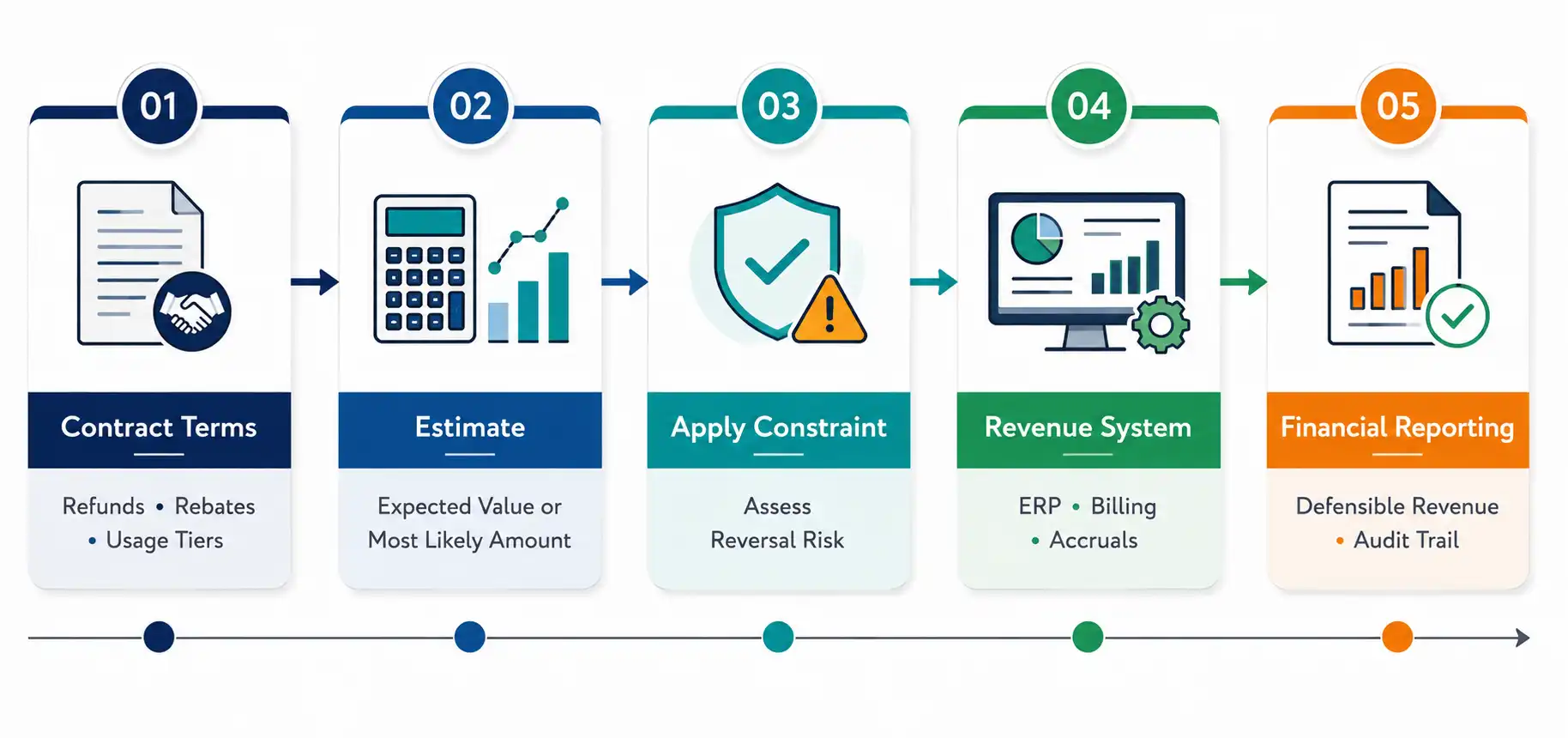
A policy is only as good as the system enforcing it. If an ERP or revenue platform cannot track rebates, tiered pricing, or refund rights, accruals quietly drift out of alignment with reality, and if a deal desk can grant concessions without visibility into finance, misstatements compound faster than anyone notices.
Earlier in my career, working in FP&A on rail and transportation operations at a logistics company, I saw firsthand how fixed infrastructure costs and variable throughput interact to shape margin, and that grounding carried forward years later when I led finance for a high-growth cybersecurity and identity access management company running close to $30M in annual recurring revenue across five countries. There, a client’s usage-based fees scaled down after a shipment threshold was crossed, but the billing system had no tier logic built into it, so revenue kept booking at list price until audit forced a manual credit waterfall. It pushed close out by weeks, added audit fees, and put a strategic funding conversation at real risk. Building the ASC 606 revenue recognition framework and driver-based forecasting engine from scratch at that company, and holding actuals within five percent of forecast for eight consecutive quarters afterward, taught me that if variability drives your pricing, your systems have to drive your accounting, not the other way around.
Internal Controls and the Discipline Variable Revenue Demands
Estimation invites judgment, and judgment invites risk. This is why ASC 606 expects companies to apply consistent methodologies, document assumptions, and reassess them on a regular basis instead of once a year out of habit. At the board level, this means disclosing the estimation models behind high-variability items. At the controller level, it means memos, schedules, and an audit trail someone outside the company could follow without a translator.
During my time as CFO of a Euronext Paris-listed gaming and digital entertainment company operating across five countries, I held a recurring rhythm of reviewing variable consideration categories, updating models against real data, and adjusting estimates prospectively rather than retroactively. Auditors noticed the discipline, and so did the board, and that pattern has repeated itself in nearly every environment where the finance function earned real credibility rather than borrowed it.
Where Startups Get ASC 606 Variable Consideration Wrong
Four patterns show up again and again across the companies I have advised:
- Ignoring variable consideration entirely and booking revenue at list price, as though the contract terms did not exist
- Estimating aggressively without applying the constraint, effectively front-loading optimism into the top line
- Failing to reassess assumptions as new data arrives, treating an estimate as a one-time decision rather than a living one
- Treating documentation as an afterthought, which turns a defensible judgment call into an indefensible one the moment an auditor asks for support
Variable consideration is not an edge case tucked into the footnotes. It is the norm for most contracts I have seen across cybersecurity, consumer products, logistics, and education, and ignoring it does more damage to credibility than almost any other line item on the income statement.
Embrace the Estimate, Defend the Logic, Protect the Business
ASC 606 does not forbid estimates, and it does not demand conservatism for its own sake. What it demands is consistency, a model that holds together under scrutiny and produces the same answer regardless of who is asking the question. Finance teams that build that discipline tend to close faster, disclose with more precision, and earn a kind of investor trust that no amount of top-line growth can substitute for on its own.
The goal was never to maximize this quarter’s revenue. It was to reflect what actually happened, in a way that is predictable, defensible, and backed by systems built to carry the weight of the judgment behind it. Revenue is a signal before it is a number, and the CFOs who understand that difference are the ones whose numbers survive contact with an auditor.
Three Key Takeaways
- Treat every contract term that could change the transaction price, refunds, rebates, usage tiers, performance bonuses, as variable consideration from day one, and choose between the expected value and most likely amount methods based on the actual shape of the uncertainty rather than convenience.
- Apply the ASC 606 constraint honestly by recognizing only the portion of variable consideration that is probable not to reverse, and treat that seventy-five to eighty percent threshold as a discipline rather than an obstacle to growth-stage reporting.
- Build the ERP, billing, and controls infrastructure to match the pricing model you actually sell, because a driver-based forecasting engine and a documented estimation methodology are what let an auditor, a board, and a future acquirer trust the revenue line without a month of explanation.
Disclaimer: This article is intended for informational purposes only and does not constitute legal, tax, or accounting advice. You should consult your own tax advisor or counsel for advice tailored to your specific situation.
Hindol Datta is a four-time CFO and senior finance executive with over 25 years of leadership experience across cybersecurity, SaaS, gaming, logistics, digital marketing, medical devices, consumer products, and nonprofit organizations. He has led more than $120M in fundraising and over $150M in M&A transactions while building the financial and operational systems that let complex businesses scale with confidence. He is the author of seven books in the Systems CFO Series and holds active CPA, CMA, and CIA credentials.
AI-assisted insights, supplemented by 25 years of finance leadership experience.