
Executive Summary
Revenue recognition timing is rarely the technical afterthought many finance functions treat it as. Under ASC 606, once a contract qualifies for recognition over time, the harder question begins. Does the pattern of value delivery track the calendar, or does it track discrete deliverables and milestones? The ASC 606 milestone method and the percentage of completion method ASC 606 permits are not interchangeable defaults. Each reflects a different theory of how a customer receives value. Choosing the wrong one distorts the story a company tells investors, lenders, and its own board.
This article walks through the substance test that governs the choice, and the operational discipline that milestone revenue recognition demands. It also covers the systems failures that most often turn a sound accounting judgment into an audit finding. It draws on patterns that recur across cybersecurity, professional services, education, and consumer products finance functions. The same underlying question, whether performance is uniform or uneven, keeps resurfacing in different industry clothing.
Time-Based Recognition: When Uniform Performance Sets the Pattern
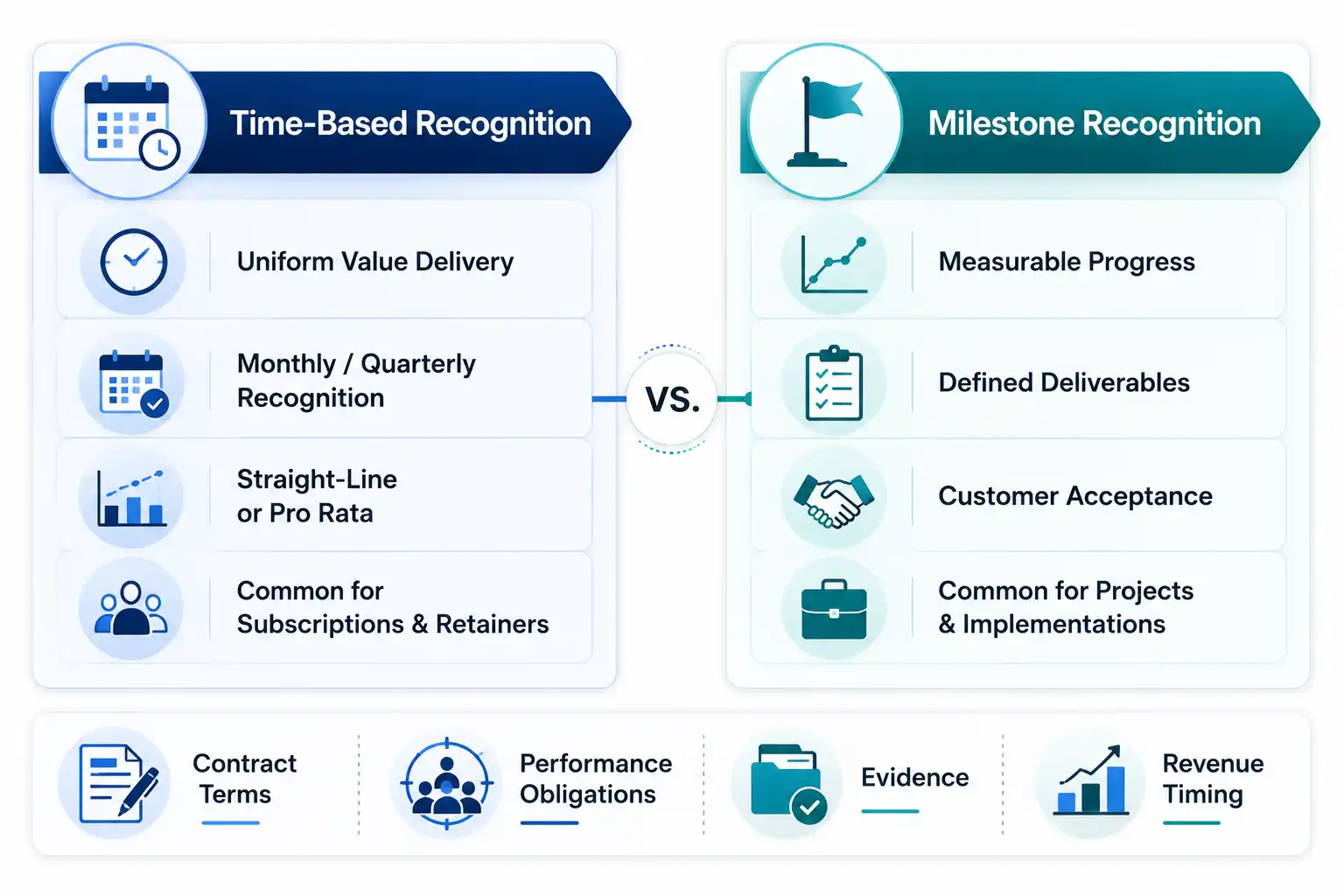
Time-based revenue recognition assumes that a customer receives roughly equal value in every period of a contract term. A subscription license, a maintenance agreement, or a service retainer typically fits this pattern. Straight-line recognition, whether monthly, quarterly, or pro rata by days, follows naturally. The method also supports partial-period recognition for contracts that start or end mid-cycle.
The condition that makes time-based recognition appropriate is uniformity. If customers receive materially different benefits at different stages of the contract, the straight-line pattern starts to misrepresent the economics. The same is true if the cost to serve varies significantly across the term. Consider a high-growth cybersecurity and identity access management company operating near $30M in annual recurring revenue. Building the ASC 606 framework there meant testing that uniformity assumption line by line. It meant not assuming it held simply because the company sold the product as a subscription.
The ASC 606 Milestone Method: Output-Based Recognition in Practice
Output-based revenue recognition shifts the question. Instead of asking how long a contract has run, it asks how much of the deliverable the team has completed. This is the domain of the ASC 606 milestone method. It is common wherever engagements have discrete, observable stages: professional services, construction, research and development, and multi-phase implementations.
Output measures can track units delivered, data processed, modules completed, or customer-defined checkpoints. Consider a professional services firm operating across five business units. Engagement-level profitability analytics were built from the ground up. They made clear that recognizing revenue upon completion of each defined phase matched the contract language. It also matched the client’s own expectation of progress. That kind of milestone revenue recognition introduces real complexity. They made clear that recognizing revenue upon completion of each defined phase matched the contract language. It also matched the client’s own expectation of progress.
What Qualifies as a Reliable Output Measure
- A defined deliverable with an unambiguous completion criterion, such as system go-live or a signed customer acceptance
- A unit of work that can be counted and verified independently of the finance team, such as scans processed or records migrated
- A checkpoint the customer itself defined in the contract, giving the measure enforceability beyond internal judgment
Percentage of Completion Method ASC 606: Applying the Substance Test
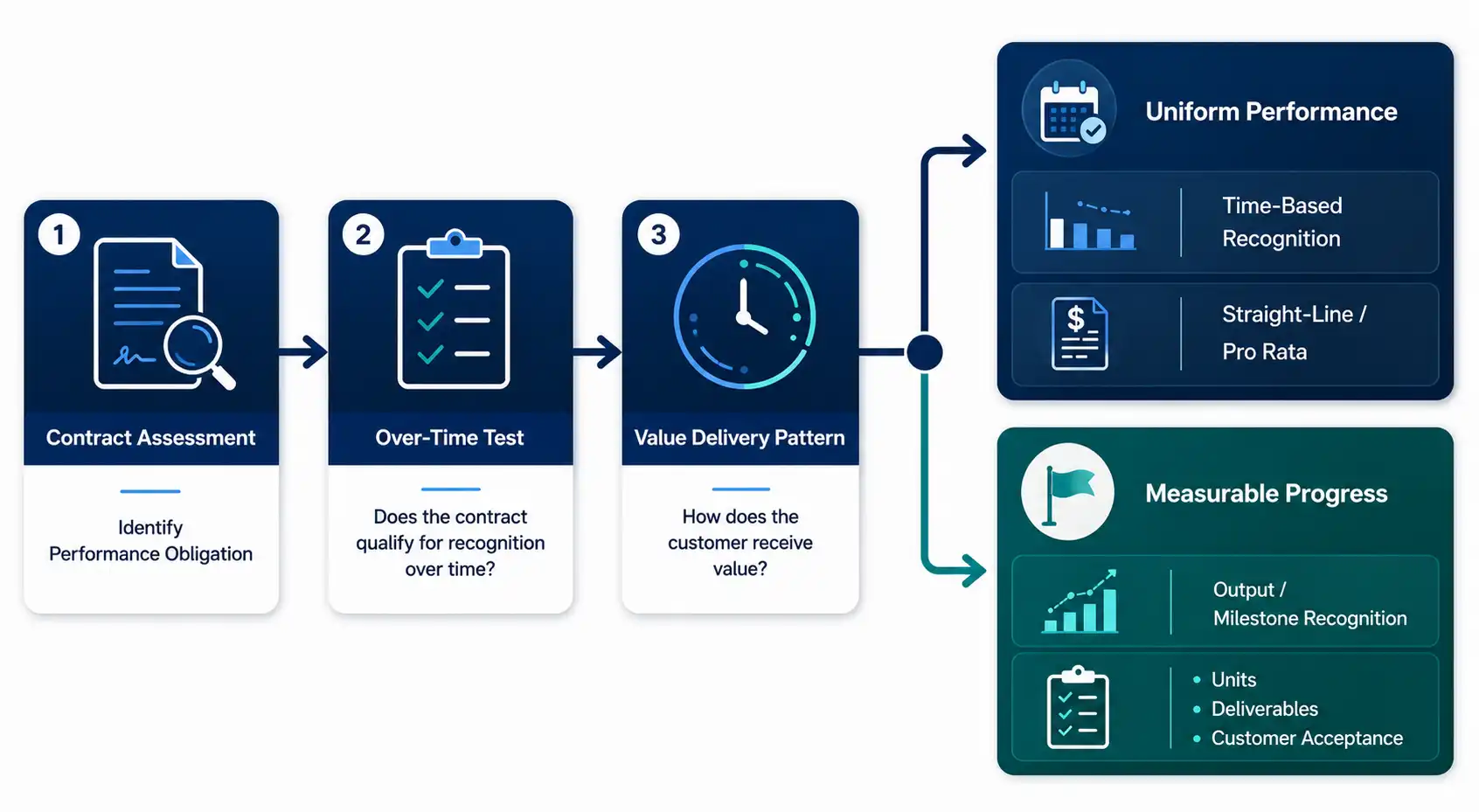
Before choosing between time and output patterns, a contract must clear the threshold for over-time recognition. ASC 606 allows revenue recognition over time when at least one of three conditions is met.
- The customer simultaneously receives and consumes the benefit as the work is performed, as with routine services
- The performance creates or enhances an asset that the customer controls as it is being built, as with construction on customer-owned property
- The asset created has no alternative use to the seller, and there is an enforceable right to payment for performance completed to date, as with custom software
Once a contract clears that test, the harder judgment begins. A company that layers services, training, or integration on top of a software product must determine whether those elements form distinct performance obligations or bundle into one, and then ask which measure, time or output, actually reflects how the company satisfies performance. In a medical device manufacturer’s operations controllership, standard costing and bill of materials management demanded exactly this kind of line-by-line judgment, applied to inventory rather than revenue but built on the same discipline of matching a measurement basis to the underlying economics. Data analytics services billed against scans processed offer a clean illustration: a twelve-month contract with uneven monthly volume delivers more value to the customer in high-volume months, and output-based recognition captures that unevenness far better than a straight line ever could.
The Risk of Defaulting to Time-Based Recognition
Auditors have grown less tolerant of companies that default to straight-line recognition without documented analysis. A common failure pattern involves front-loaded services, where the customer receives most of the value in the first two months of a longer contract, and straight-line recognition smooths over that reality in a way that overstates revenue in later periods and understates it early on.
That mismatch is not a cosmetic issue. It distorts margin trends, confuses forecasting, and can quietly erode credibility with lenders or acquirers who are reading the numbers as a proxy for how the business actually operates. Correcting course after the fact is expensive: it typically requires not only revised journal entries but new controls, updated documentation, and a harder conversation with the audit committee than the right pattern would have required at the outset.
Contract Language, Hybrid Models, and the Board Conversation
Language that looks routine on first read often buries the right pattern. A contract that appears time-based can carry milestone-based acceptance criteria in an appendix, triggering billing only once the customer satisfies those milestones, with no obligation to pay before completion. That single clause can reclassify a contract from time-based to output-based and move millions of dollars in quarterly revenue, which is precisely why revenue recognition judgment cannot live in finance alone. Sales language and accounting assumptions have to be reconciled before the ink dries, not after the audit begins.
Many contracts blend both patterns. A subscription may run straight-line while implementation services attached to the same contract recognize by milestone, which means multiple performance obligations each carrying their own pattern and their own standalone selling price calculation. Within a Series D enterprise resource planning rollout, tagging revenue patterns at the order line level, so that every item in a contract carried metadata indicating time-based or output-based treatment, let that dual pattern flow cleanly through billing, recognition, and reporting without manual reconciliation at month end. Building that kind of system took real effort, but it prevented audit findings and gave forecasting a level of precision the business had not had before.
Boards rarely need the technical nuance of ASC 606 explained to them, but they do need to trust that reported revenue reflects true delivery. In a mission-driven education institution’s board and audit committee reporting, the pattern that worked was a simple narrative, stated plainly and repeated consistently: revenue is recognized over time because the service is uniform, or by milestone because it reflects customer-specific progress, backed by a written policy memo rather than an improvised explanation in the meeting itself.
Revisiting the Pattern as the Business Scales
A recognition pattern that fits a company at Series A can break by Series C, as products evolve and premium tiers with defined onboarding phases change what the customer is actually buying. The discipline that holds up is a quarterly review: does the current method still match how value is delivered, have new contract types entered the mix, and does customer success or legal have visibility into obligations that finance has not yet seen. Waiting for an audit to force the correction is the expensive way to learn this lesson.
Three Key Takeaways
- The choice between the ASC 606 milestone method and time-based recognition should follow directly from how uniformly the customer receives value, not from which method is administratively easier to run in the current system stack.
- Contract language, particularly appendices and acceptance criteria, frequently contains the clause that determines whether a contract is genuinely time-based or output-based, which makes joint review by finance and legal a control rather than a courtesy.
- The businesses that avoid audit findings are the ones that embed recognition patterns into systems and order-level metadata rather than reconstructing the logic manually each quarter in a spreadsheet.
Disclaimer: This article is intended for informational purposes only and does not constitute legal, tax, or accounting advice. You should consult your own tax advisor or counsel for advice tailored to your specific situation.
Hindol Datta is a four-time CFO and senior finance executive with over 25 years of leadership experience across cybersecurity, SaaS, gaming, logistics, digital marketing, medical devices, consumer products, and nonprofit organizations. He has led more than $120M in fundraising and over $150M in M&A transactions while building the financial and operational systems that let complex businesses scale with confidence. He is the author of seven books in the Systems CFO Series and holds active CPA, CMA, and CIA credentials.
AI-assisted insights, supplemented by 25 years of finance leadership experience.